Description
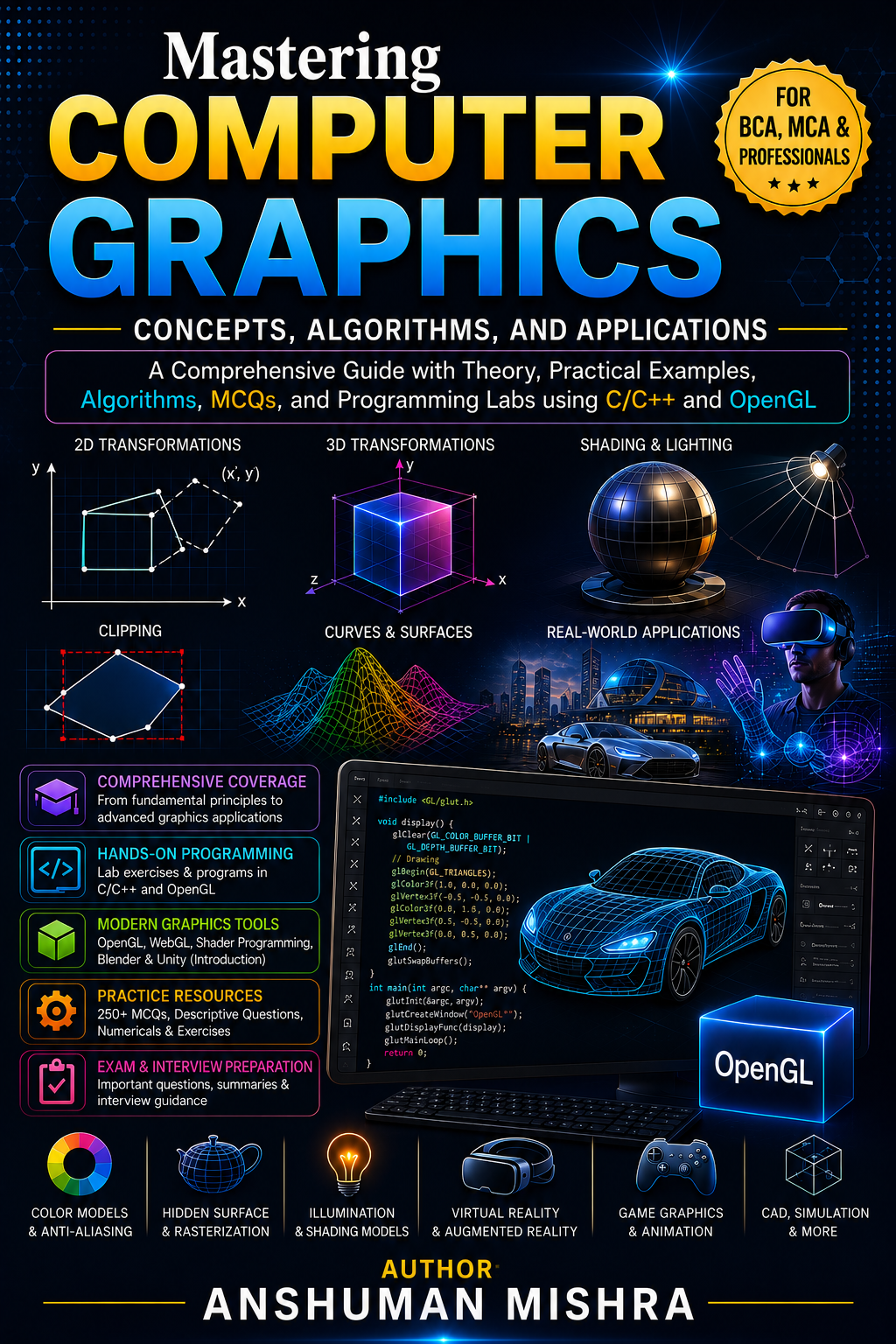
Mastering Computer Graphics: Concepts, Algorithms, and Applications for BCA, MCA & Professionals
A Comprehensive Guide with Theory, Practical Examples, Algorithms, MCQs, and Programming Labs using C/C++ and OpenGL
About the Book
Mastering Computer Graphics: Concepts, Algorithms, and Applications for BCA, MCA & Professionals is a comprehensive textbook and practical reference designed for students, educators, developers, and professionals who want to develop a strong understanding of computer graphics.
Computer Graphics is one of the most visually engaging areas of computer science. It combines mathematics, algorithms, programming, geometry, visualization, design, and creativity to transform numerical information into meaningful visual experiences.
From simple points and lines to sophisticated 3D environments, animations, games, simulations, virtual reality systems, and computer-aided design, computer graphics has become an essential technology across modern industries.
This book takes readers on a structured journey from the fundamentals of graphics systems to advanced concepts such as 3D transformations, projections, illumination, shading, hidden surface removal, rasterization, animation, ray tracing, VR, AR, game graphics, and CAD.
The book is designed to bridge the gap between theoretical learning and practical implementation. Readers are introduced to important algorithms through clear explanations, mathematical formulations, examples, programming exercises, and laboratory activities.
Why Learn Computer Graphics?
Computer graphics is not limited to creating attractive images.
It provides the foundation for technologies used in:
- Video games
- Animation and visual effects
- Computer-aided design
- Engineering visualization
- Medical visualization
- Virtual reality
- Augmented reality
- Simulation
- Scientific visualization
- Geographic information systems
- User interfaces
- Computer vision
- Digital entertainment
- Education and training
Understanding computer graphics also develops important computational skills such as algorithmic thinking, coordinate geometry, matrix operations, transformations, recursion, optimization, and problem solving.
What Makes This Book Different?
This book follows a practical learning philosophy:
Concept → Mathematics → Algorithm → Implementation → Experiment → Application
Instead of treating graphics algorithms as isolated theoretical topics, the book explains how they work, why they are needed, and where they are applied.
Readers can learn the underlying mathematics and then implement concepts through programming exercises and graphics laboratories.
The book combines:
- Theory
- Mathematical foundations
- Algorithms
- Pseudocode
- Programming concepts
- Practical examples
- OpenGL programming
- WebGL introduction
- Laboratory exercises
- MCQs
- Descriptive questions
- Numerical problems
- Case studies
- Project ideas
Unit I — Introduction to Computer Graphics
The first unit establishes the foundation of computer graphics.
Readers learn what computer graphics is, how graphics systems work, and why graphics has become an important area of computing.
Topics include:
- Definition and scope of computer graphics
- Applications of computer graphics
- Interactive and non-interactive graphics
- Graphics hardware
- Graphics software
- Display technologies
- Raster-scan systems
- Random-scan systems
- Color and display techniques
The chapter also introduces the relationship between graphics software and hardware, helping learners understand how visual information is generated and displayed by computer systems.
Unit II — Output Primitives and Attributes
Every complex graphical scene is constructed from basic graphical primitives.
This unit introduces the fundamental building blocks of graphics, including:
- Pixels
- Points
- Lines
- Circles
- Ellipses
- Polygons
- Frame buffers
- Primitive attributes
Special attention is given to important line-drawing algorithms.
DDA Algorithm
The Digital Differential Analyzer (DDA) algorithm is explained step by step, including its mathematical foundation and implementation.
Bresenham’s Algorithm
The book also provides a detailed study of Bresenham’s line-drawing algorithm, demonstrating how efficient integer-based calculations can be used to generate lines on raster displays.
Readers also explore:
- Line color
- Line thickness
- Line styles
- Pixel intensity
- Polygon representation
Practical Lab
Students can implement DDA and Bresenham’s algorithms and compare their behavior.
Unit III — 2D Geometric Transformations
Transformation is one of the most important concepts in computer graphics.
This unit explains how graphical objects can be moved, rotated, resized, reflected, and distorted.
Major transformations include:
- Translation
- Rotation
- Scaling
- Reflection
- Shearing
The book introduces matrix representation and homogeneous coordinates, which provide a systematic mathematical framework for transformations.
Readers also learn:
- Composite transformations
- Transformation order
- Transformation about arbitrary points
- Coordinate-system manipulation
Practical Lab
Students can apply different transformations to basic geometric shapes and observe how their positions and orientations change.
Unit IV — 2D Viewing and Clipping
A graphics system may contain objects that are outside the visible portion of a scene.
Clipping determines which portions of graphical objects should actually be displayed.
This unit introduces the graphics viewing pipeline and explains:
- Window and viewport concepts
- Window-to-viewport mapping
- Point clipping
- Line clipping
- Polygon clipping
Important algorithms covered include:
Cohen-Sutherland Algorithm
A widely studied line-clipping technique based on region codes.
Liang-Barsky Algorithm
A more mathematical parametric approach to line clipping.
Sutherland-Hodgman Algorithm
An important polygon-clipping method.
Practical Lab
Students can implement window-to-viewport mapping and line-clipping algorithms.
Unit V — 3D Geometric Transformations
Modern graphics applications rely heavily on three-dimensional representations.
This unit introduces:
- 3D object representation
- 3D coordinate systems
- Translation
- Rotation
- Scaling
- Matrix-based transformations
- Parallel projection
- Perspective projection
- 3D viewing transformations
The book explains how three-dimensional objects are mathematically transformed before being projected onto a two-dimensional display.
Understanding these concepts provides an essential foundation for:
- Game development
- 3D modeling
- Animation
- Simulation
- VR
- CAD
Practical Lab
Students can experiment with 3D transformations using OpenGL.
Unit VI — Curves and Fractals
Not every graphical object can be represented effectively using straight lines and polygons.
This unit introduces mathematical techniques for generating smooth curves and complex recursive patterns.
Topics include:
- Curve generation
- Bezier curves
- B-Spline curves
- Fractal geometry
- Recursive graphics
Important fractal examples include:
- Koch Curve
- Sierpinski Triangle
- Dragon Curve
These topics demonstrate the connection between mathematics, recursion, algorithms, and visual design.
Practical Lab
Students can create Bezier curves and generate fractal patterns through recursive algorithms.
Unit VII — Illumination and Shading Models
Realistic graphics require more than geometric modeling.
Objects must interact visually with light.
This unit explains the fundamentals of illumination and shading.
Topics include:
- Light sources
- Material properties
- Ambient lighting
- Diffuse reflection
- Specular reflection
- Phong illumination
- Gouraud shading
- Flat shading
- Smooth shading
Readers learn how lighting calculations affect the appearance of surfaces and how shading techniques contribute to visual realism.
Practical Lab
Students can experiment with lighting and Phong shading using OpenGL.
Unit VIII — Hidden Surface Removal and Rasterization
When multiple objects exist within a 3D scene, the graphics system must determine which surfaces are visible.
This unit introduces techniques for solving the hidden-surface problem.
Topics include:
- Back-face removal
- Z-buffer algorithm
- Painter’s algorithm
- Scan-line techniques
- BSP trees
- Rasterization
The book explains how geometric descriptions are ultimately converted into pixels and how graphics systems determine which pixels should appear on the screen.
Practical Lab
Students can visualize Z-buffer operations and basic rasterization techniques.
Unit IX — Color Models and Anti-Aliasing
Color is fundamental to visual communication.
This unit introduces major color representation systems, including:
- RGB
- CMY
- HSV
Readers learn how different color models represent and manipulate colors and how conversions can be performed between them.
The unit also covers:
- Anti-aliasing
- Edge smoothing
- Gamma correction
- Dithering
- Sampling-related visual artifacts
Practical Lab
Students can implement color-model conversions and experiment with edge-smoothing techniques.
Unit X — Animation and Graphics Programming
Animation brings static graphical objects to life.
This unit introduces the fundamental principles behind computer animation.
Topics include:
- Keyframes
- Inbetweening
- 2D animation
- 3D animation
- Frame-buffer animation
- Real-time graphics
- OpenGL programming
- WebGL fundamentals
The chapter provides a bridge between traditional graphics concepts and modern interactive graphics programming.
Practical Lab
Students can create simple animations using OpenGL and explore the basics of WebGL-based graphics.
Unit XI — Advanced Topics and Applications
The final unit connects computer graphics concepts with modern technologies and industry applications.
Topics include:
Virtual Reality
Understanding how graphics contributes to immersive virtual environments.
Augmented Reality
Exploring the role of graphics in overlaying digital information onto real-world environments.
Computer Vision
An introduction to the relationship between graphics, images, and visual computing.
Game Graphics
Understanding the graphical foundations behind interactive games and simulations.
Ray Tracing
An introduction to a powerful technique for producing realistic lighting and reflections.
Computer-Aided Design
Exploring graphics applications in engineering, architecture, manufacturing, and visualization.
This unit helps readers understand how foundational graphics algorithms connect with modern industries.
Practical Programming and Laboratory Learning
One of the major strengths of this book is its emphasis on practical implementation.
The book provides opportunities to work with:
- C/C++
- OpenGL
- WebGL
- Graphics libraries
- Basic shader concepts
- Image-processing concepts
- Interactive graphics
Laboratory exercises can include:
- Drawing lines using DDA
- Drawing lines using Bresenham’s algorithm
- Generating circles and ellipses
- Applying 2D transformations
- Implementing clipping algorithms
- Creating 3D transformations
- Drawing Bezier curves
- Generating fractals
- Implementing illumination models
- Exploring Z-buffering
- Performing color-model conversions
- Creating basic animations
These activities help students move from theory to implementation.
Mathematical Foundation
Computer graphics is strongly connected to mathematics.
Throughout the book, readers encounter concepts involving:
- Coordinate geometry
- Vectors
- Matrices
- Trigonometry
- Transformations
- Recursion
- Projection
- Interpolation
- Geometry
This mathematical foundation helps learners understand why graphics algorithms work rather than simply memorizing them.
For example, matrix operations provide the foundation for geometric transformations, while vector mathematics is essential for lighting, projections, and 3D graphics.
Exam and Interview Preparation
The book is also designed to support academic and professional preparation.
Practice material includes:
- Multiple-choice questions
- Short-answer questions
- Descriptive questions
- Numerical problems
- Algorithm-based questions
- Programming exercises
- Viva questions
- Interview-oriented questions
The inclusion of these resources makes the book useful for university examinations, laboratory assessments, technical interviews, and competitive preparation.
Who Should Read This Book?
BCA Students
The book provides a structured introduction to computer graphics suitable for undergraduate computer science students.
MCA Students
Advanced topics, mathematical foundations, algorithms, and programming laboratories make the book suitable for postgraduate learners.
B.Tech CSE/IT Students
Engineering students can use the book as a conceptual and practical reference for computer graphics courses.
Graphics Developers
Developers working with visualization, games, animation, simulation, or interactive graphics can strengthen their fundamentals.
Game Development Enthusiasts
The sections on transformations, 3D graphics, shading, rasterization, animation, and real-time graphics provide a foundation for understanding game graphics.
Educators
Faculty members can use the structured units, practical exercises, MCQs, and project ideas for classroom teaching and laboratory sessions.
Self-Learners
Readers with a basic programming background can use the progressive structure to study computer graphics independently.
Key Features
1. Comprehensive Coverage
The book covers computer graphics from fundamental concepts to advanced applications.
2. Algorithm-Oriented Learning
Important graphics algorithms are explained systematically with their underlying logic.
3. Practical Programming
C/C++ and OpenGL provide a programming-oriented approach to learning.
4. Laboratory Exercises
Every major section includes practical opportunities for experimentation.
5. Modern Graphics Concepts
The book introduces OpenGL, WebGL, VR, AR, ray tracing, game graphics, and CAD applications.
6. Mathematical Understanding
Graphics concepts are connected with matrices, vectors, transformations, geometry, and other mathematical foundations.
7. Examination Support
MCQs, descriptive questions, numerical problems, and viva-oriented material support academic preparation.
8. Project-Based Learning
Students can apply concepts through graphics programming projects and real-world applications.
Learning Outcomes
After completing this book, readers will be able to:
- Explain fundamental computer graphics concepts.
- Understand graphics hardware and display systems.
- Implement basic graphics primitives.
- Apply DDA and Bresenham line-drawing algorithms.
- Implement circle and ellipse generation algorithms.
- Perform 2D and 3D geometric transformations.
- Understand homogeneous coordinates and transformation matrices.
- Implement clipping algorithms.
- Work with projections and viewing transformations.
- Generate Bezier and B-Spline curves.
- Create recursive fractal patterns.
- Understand illumination and shading techniques.
- Apply hidden-surface removal methods.
- Understand rasterization processes.
- Work with RGB, CMY, and HSV color models.
- Apply basic anti-aliasing techniques.
- Develop simple graphics animations.
- Explore OpenGL and WebGL programming.
- Understand the foundations of VR, AR, gaming, CAD, and ray tracing.
- Develop graphics-based academic and portfolio projects.
Real-World Applications
The concepts presented in this book have applications across numerous industries.
Gaming
3D transformations, lighting, shading, animation, rasterization, and real-time rendering form the foundation of modern games.
Animation and Visual Effects
Curves, transformations, lighting, rendering, and animation techniques are essential for digital animation and visual effects.
Engineering and CAD
Computer graphics enables engineers and designers to visualize and manipulate complex technical models.
Virtual and Augmented Reality
3D graphics, projection, transformations, and real-time rendering are fundamental to immersive technologies.
Scientific Visualization
Graphics allows researchers to represent complex numerical and scientific information visually.
Medical Visualization
Three-dimensional visualization can help represent anatomical and medical information.
Simulation
Graphics is used to create visual environments for training, engineering, education, and research.
Project-Based Learning
The book provides a strong foundation for developing practical graphics projects.
Possible projects include:
- 2D Drawing Application
- Interactive Transformation Tool
- Line and Circle Drawing Simulator
- Clipping Algorithm Visualizer
- 3D Object Viewer
- Fractal Generator
- Basic Animation System
- Simple 2D Game
- 3D Scene Visualization
- Interactive OpenGL Application
- Color Model Visualization Tool
- Basic CAD Interface
- Ray-Tracing Demonstration
Such projects can help students develop academic submissions as well as portfolio material.
Tools and Technologies
The book introduces and discusses several tools and technologies, including:
- C
- C++
- OpenGL
- WebGL
- Graphics programming concepts
- BGI-based graphics concepts
- Blender fundamentals
- Unity fundamentals
- Python-based image-processing concepts
The emphasis remains on understanding the underlying graphics principles so that readers can transfer their knowledge across different tools and platforms.
Pedagogical Structure
Each major topic is organized to make learning systematic and progressive.
Readers can expect:
Learning Objectives → Concept Explanation → Mathematical Foundation → Algorithm → Example → Practical Implementation → Exercise → Review
This structure helps students develop both conceptual clarity and implementation skills.
Benefits of Studying This Book
Strong Academic Foundation
The book provides comprehensive coverage of topics commonly included in BCA, MCA, and computer science curricula.
Algorithmic Thinking
Students learn how graphical problems can be converted into computational algorithms.
Programming Skills
Hands-on graphics programming improves practical understanding of C/C++ and OpenGL concepts.
Mathematical Confidence
Transformations, projections, vectors, matrices, and geometric concepts strengthen mathematical problem-solving abilities.
Industry Awareness
Exposure to gaming, VR, AR, CAD, animation, ray tracing, and visualization helps readers understand industry applications.
Portfolio Development
Practical projects provide opportunities to demonstrate graphics programming and problem-solving skills.
Interview Preparation
Understanding fundamental algorithms and graphics concepts can help students prepare for technical interviews and viva examinations.
A Complete Learning Journey
The book follows a carefully designed progression:
Graphics Fundamentals
↓
Primitives and Algorithms
↓
2D Transformations
↓
Viewing and Clipping
↓
3D Graphics
↓
Curves and Fractals
↓
Lighting and Shading
↓
Rasterization
↓
Color and Anti-Aliasing
↓
Animation
↓
Modern Graphics Applications
This progression enables beginners to gradually move toward more advanced graphics concepts.
Conclusion
Mastering Computer Graphics: Concepts, Algorithms, and Applications for BCA, MCA & Professionals is designed as a complete learning resource for understanding both the theory and practical implementation of computer graphics.
The book brings together mathematics, algorithms, programming, visualization, and creativity.
From drawing a simple line using the DDA algorithm to understanding 3D transformations, lighting, rasterization, animation, and modern technologies such as VR and AR, readers progressively develop the knowledge required to understand how computer-generated visual environments are created.
Its combination of theoretical explanations, mathematical concepts, algorithms, programming laboratories, OpenGL examples, MCQs, exercises, and real-world applications makes it suitable for academic study as well as independent learning.
Whether you are preparing for a BCA or MCA examination, studying computer graphics as part of a B.Tech CSE/IT program, preparing for technical interviews, developing a graphics project, or exploring careers in gaming, animation, visualization, simulation, or immersive technologies, this book provides a strong foundation.
Computer graphics is ultimately where mathematics meets computation and creativity.
This book invites readers to explore that intersection, understand the algorithms behind visual experiences, and develop the practical skills needed to transform ideas into graphics.
Master the concepts. Understand the algorithms. Write the programs. Create the visuals.

Reviews
There are no reviews yet.