Description
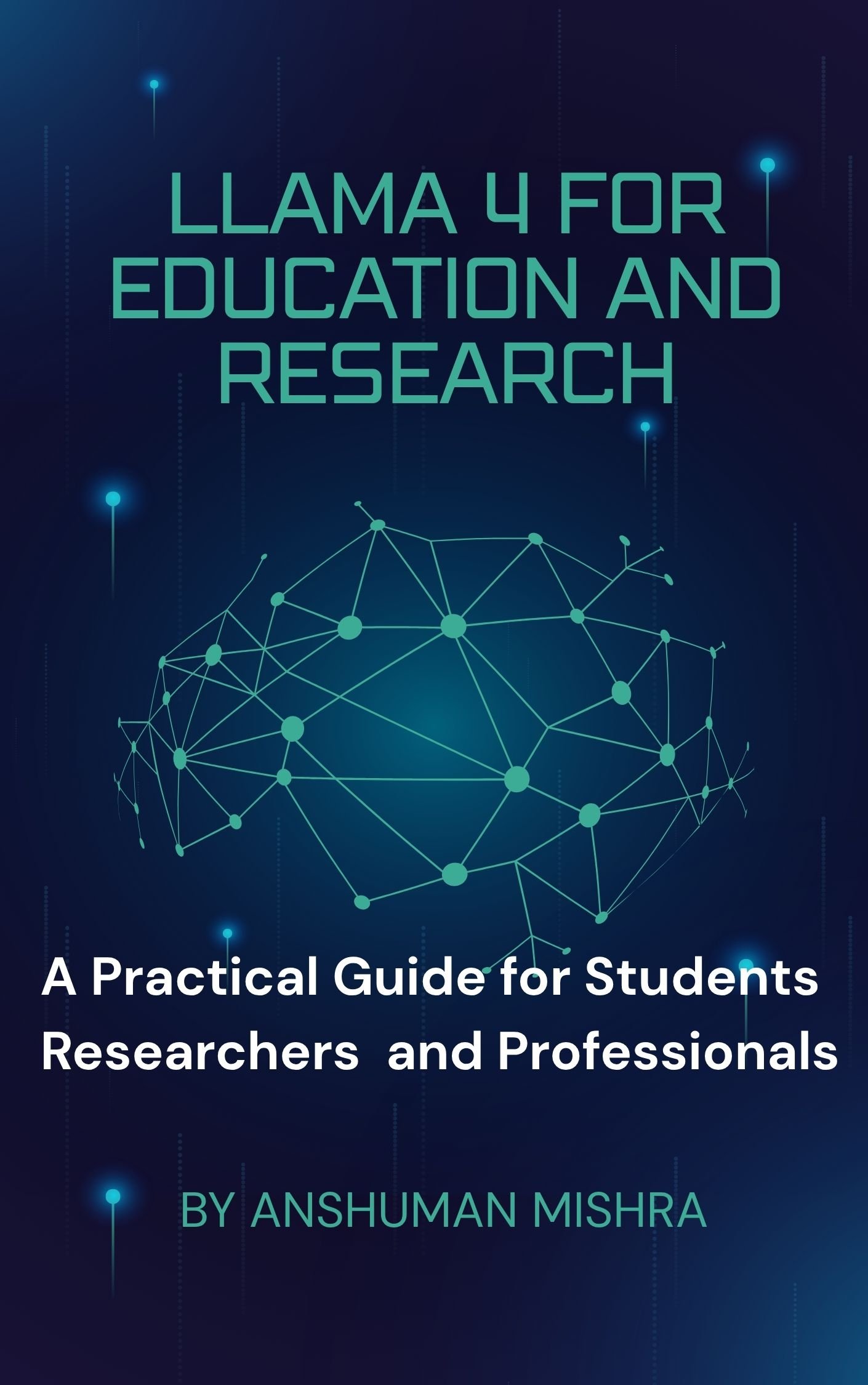
Llama 4 for Education and Research
A Practical Guide for Students, Researchers, and Professionals
Understanding Multimodal AI Tools, Working Models, and Real-World Applications
Artificial intelligence is rapidly transforming the way people learn, conduct research, create knowledge, and perform professional tasks. Modern AI systems are increasingly capable of working with different forms of information, including text, images, audio, and other data. These capabilities are driving the growth of multimodal AI, opening new possibilities across education, research, business, software development, and professional productivity.
Llama 4 for Education and Research is designed as a practical and accessible guide for readers who want to understand modern AI systems and explore how they can be used effectively in academic and professional environments.
The book combines AI fundamentals, Llama 4 concepts, practical workflows, educational applications, research support, multimodal learning, AI projects, productivity strategies, and responsible AI practices in one structured resource.
Rather than focusing only on technical theory, the book explains how AI systems can become practical tools for learning, research, teaching, knowledge management, and professional development.
What You Will Learn
This book provides a structured learning path covering:
- Fundamentals of modern artificial intelligence
- Generative AI and multimodal AI
- The Llama 4 family and its major concepts
- Open-weight AI models
- How large language models work
- Training and inference
- AI input processing and output generation
- Multimodal information processing
- AI model evaluation and optimization
- Setting up AI tools and working environments
- Cloud-based AI workflows
- Prompt design and output evaluation
- AI-assisted study and exam preparation
- Research and literature-review workflows
- AI-assisted academic writing
- AI-supported teaching and lesson planning
- Multimodal learning applications
- AI APIs and development platforms
- Workflow automation
- Practical AI projects
- Professional AI applications
- AI productivity systems
- Ethical and responsible AI usage
- Preparing for an AI-driven future
Complete Chapter-Wise Coverage
Chapter 1: Introduction to Modern AI Systems
The book begins with the evolution of artificial intelligence and introduces generative AI and multimodal systems. Readers develop a foundation in important AI terminology and explore why modern AI technologies matter in education, research, and knowledge creation.
Chapter 2: Understanding the Llama 4 Family
This chapter introduces the Llama 4 family and discusses important concepts such as model architecture, open-weight models, multimodal capabilities, responsible use, AI safety, and the educational importance of accessible AI technologies.
The chapter helps readers understand where Llama 4 fits within the broader evolution of modern AI systems.
Chapter 3: Working Model of AI Systems
Understanding what happens behind an AI tool is essential for using it effectively. This chapter explains how AI models learn from data, how neural networks and large language models work, the difference between training and inference, input processing, output generation, multimodal processing, model evaluation, and optimization.
Chapter 4: Setting Up AI Tools
This chapter provides practical guidance for preparing an AI workspace. Readers explore hardware and software considerations, AI platforms, cloud environments, configuration, data preparation, output testing, and troubleshooting common issues.
Chapter 5: Using AI for Learning and Study Support
Students can use AI as a learning assistant when it is applied thoughtfully. This chapter explores AI-assisted study planning, note preparation, concept explanations, practice questions, exam preparation, personalized learning, skill development, and productivity techniques.
The focus is on using AI to support understanding and independent learning, rather than simply producing answers.
Chapter 6: AI Tools for Research Work
Researchers can benefit from AI-assisted workflows for organizing information and exploring ideas. This chapter covers literature review support, research idea generation, data interpretation assistance, academic writing, research-paper structure, citation and reference support, collaboration, and responsible AI use.
Chapter 7: AI in Teaching and Education
Educators can use AI to support lesson planning, educational content creation, assessment, feedback, and interactive learning. This chapter explores practical applications while emphasizing the continued importance of teacher judgment and academic quality.
Chapter 8: Multimodal Learning Applications
Modern AI systems can work with multiple types of information. This chapter explores text processing, image understanding, audio and speech interaction, video analysis, visual learning, creative learning, and multimodal knowledge systems.
These concepts demonstrate how AI can expand traditional approaches to learning and information management.
Chapter 9: Practical Tools Related to the Llama Ecosystem
Readers are introduced to practical categories of tools and platforms that can complement Llama-based workflows. Topics include AI chat interfaces, development platforms, APIs, automation tools, data processing, knowledge management, research productivity, and educational content tools.
Chapter 10: Step-by-Step Working Model of AI Tools
This chapter transforms concepts into practical workflows. Readers learn how to create an AI workspace, run models, design prompts, evaluate outputs, improve results iteratively, automate repetitive activities, and build simple AI-based projects.
Chapter 11: Professional Applications
AI is becoming relevant across many professional fields. This chapter explores applications in software development, data analysis, content creation, business intelligence, scientific research, education technology, digital communication, and career development.
Chapter 12: Responsible and Ethical AI Usage
Powerful AI systems require responsible use. This chapter discusses AI ethics, responsible data usage, transparency, academic integrity, misuse prevention, risk awareness, safe practices, and building trust in AI-assisted systems.
Chapter 13: Building Practical AI Projects
Readers move from theory to project development through examples such as an AI study assistant, research helper, educational chatbot, content generator, knowledge organizer, and data analyzer.
The chapter also explains a structured process for developing, testing, evaluating, and improving AI projects.
Chapter 14: AI Productivity Systems
AI can become a practical productivity partner when integrated into daily workflows. This chapter covers time management, task automation, digital knowledge systems, workflow optimization, collaboration, professional skill development, continuous learning, and long-term productivity strategies.
Chapter 15: Preparing for the AI-Driven Future
The final chapter focuses on the skills and mindset needed for an AI-driven world. Topics include AI literacy, future-ready skills, AI-assisted innovation, lifelong learning, knowledge expansion, responsible AI communities, future research opportunities, and practical guidance for students and professionals.
Key Features of the Book
Practical and Beginner-Friendly
The book explains complex AI concepts in clear and accessible language, making it suitable for readers who are beginning their AI journey.
Education-Focused
Students and educators receive dedicated guidance on study support, lesson planning, educational content, assessment, personalized learning, and classroom applications.
Research-Oriented
Researchers can explore practical AI workflows for literature review, idea development, organization, academic writing, analysis, and collaboration.
Multimodal AI Coverage
The book introduces the concepts behind AI systems capable of processing multiple forms of information, helping readers understand the possibilities of multimodal learning and interaction.
Hands-On AI Workflows
Readers are encouraged to move beyond theoretical knowledge and explore practical workflows, prompts, projects, evaluation methods, and productivity applications.
Professional Applications
The book demonstrates how AI concepts can be applied across software development, data analysis, content creation, business, scientific research, and education technology.
Responsible AI Emphasis
Ethics, privacy, academic integrity, transparency, safety, and responsible data use are treated as essential parts of AI literacy.
Future-Ready Learning
The book encourages continuous learning and adaptation as AI technologies and professional requirements continue to evolve.
Who Should Read This Book?
This book is ideal for:
- College and university students
- BCA and MCA students
- B.Tech and M.Tech students
- Computer Science learners
- Researchers and PhD scholars
- Research assistants
- Faculty members and educators
- Teachers and trainers
- Academic professionals
- Software developers
- Technology professionals
- AI enthusiasts
- Digital professionals
- Knowledge workers
- Entrepreneurs exploring AI
- Professionals developing AI literacy
Perfect For
Students:
Use AI-supported workflows for study planning, concept understanding, practice, revision, and skill development.
Researchers:
Explore AI-assisted approaches to literature organization, research ideation, writing support, and knowledge management.
Educators:
Discover practical ways to integrate AI into lesson planning, educational content, assessment, and interactive learning.
Professionals:
Understand how modern AI systems can improve productivity, analysis, communication, and professional workflows.
AI Beginners:
Build foundational knowledge before progressing toward practical AI applications and projects.
From AI Fundamentals to Practical Applications
Artificial intelligence is no longer limited to specialized laboratories or large technology organizations. AI tools are increasingly becoming part of everyday education, research, communication, software development, and professional work.
However, using AI effectively requires more than simply knowing how to enter a prompt. Users need to understand what AI systems can do, how their outputs should be evaluated, how to design useful workflows, and how to use the technology responsibly.
Llama 4 for Education and Research provides a structured pathway for developing that understanding.
The book brings together the fundamentals of AI, multimodal systems, Llama 4 concepts, practical workflows, educational applications, research use cases, project development, productivity strategies, and responsible AI practices.
Whether you are a student exploring AI for the first time, a researcher looking for new productivity approaches, an educator planning AI-supported learning activities, or a professional preparing for the changing workplace, this book provides a practical foundation for exploring modern AI technologies.
About the Author
Anshuman Mishra is an experienced educator, author, and technology professional with a strong background in computer science, programming, artificial intelligence, and digital technologies.
He holds an M.Tech in Computer Science from BIT Mesra and has extensive experience in teaching and guiding learners in technical and emerging technology domains.
As an author, Anshuman Mishra has developed books covering programming, artificial intelligence, emerging technologies, education, and practical applications of digital tools.
His approach focuses on clarity, structured learning, practical implementation, and accessibility, enabling readers with different levels of technical knowledge to understand complex concepts.
With a strong interest in artificial intelligence and its applications in education and professional development, he aims to help learners understand modern technologies and use them responsibly for learning, research, productivity, and innovation.
Llama 4 for Education and Research reflects this practical educational vision by connecting modern AI concepts with real-world academic and professional applications.
Reviews
There are no reviews yet.