Description
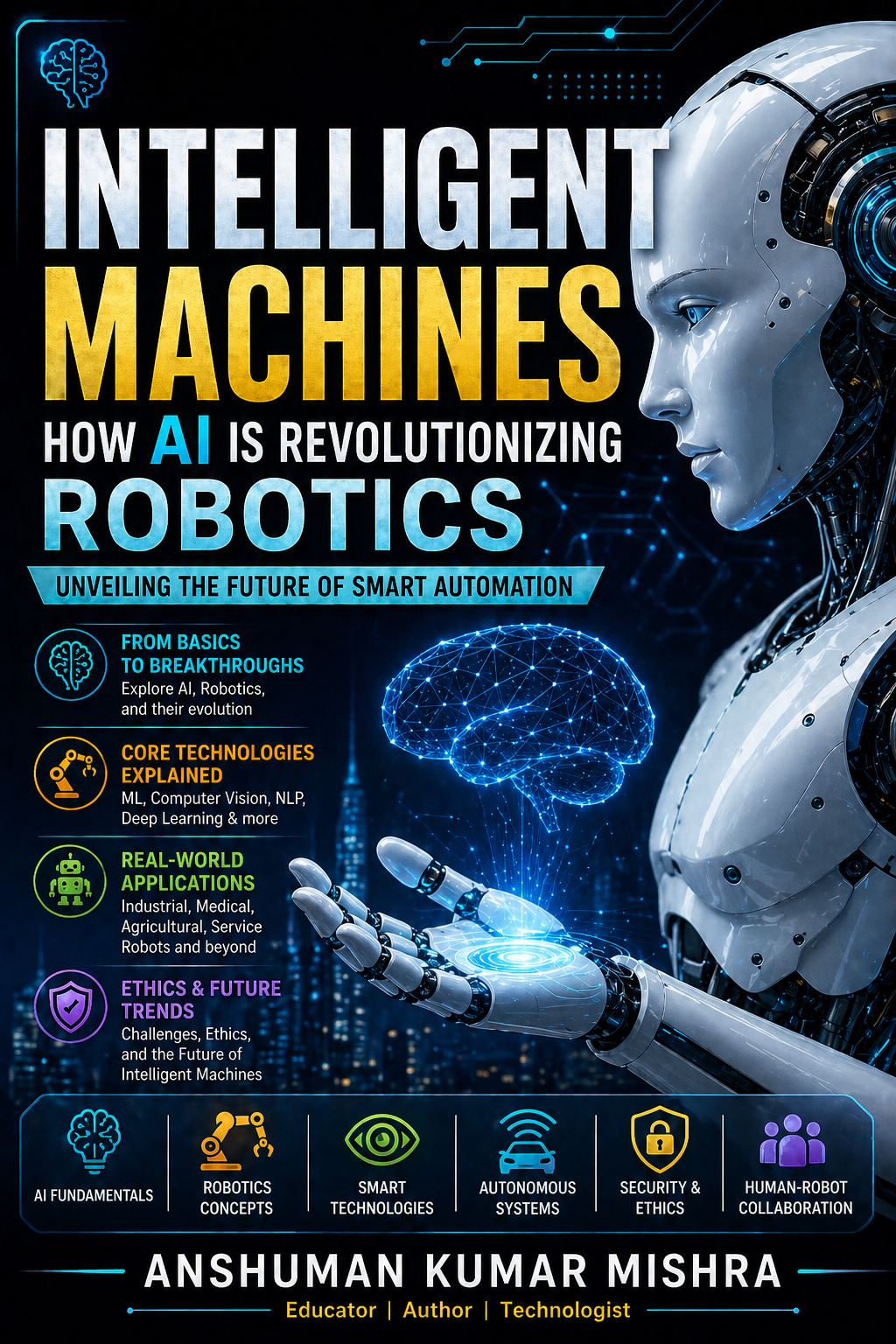
Intelligent Machines: How AI is Revolutionizing Robotics
Unveiling the Future of Smart Automation
Artificial Intelligence is transforming robotics from machines that simply follow programmed instructions into intelligent systems capable of perception, learning, decision-making, communication, and adaptation.
Intelligent Machines: How AI is Revolutionizing Robotics provides a structured exploration of this exciting intersection between AI and robotics. Designed for students, engineers, technology enthusiasts, researchers, and aspiring AI and robotics professionals, the book takes readers from fundamental concepts to advanced applications, emerging technologies, ethical questions, and the future of intelligent machines.
From Basic Concepts to Intelligent Machines
The book begins by establishing a strong foundation in Artificial Intelligence and Robotics.
Readers are introduced to:
- The meaning and evolution of Artificial Intelligence
- Historical development of AI
- Narrow AI, General AI, and Superintelligent AI concepts
- AI versus traditional automation
- The fundamentals of robotics
- Different types of robots
- Sensors and actuators
- Control systems
- Human-Robot Interaction (HRI)
This foundation makes the book accessible to readers who may be new to AI or robotics while also providing a useful reference for learners with technical backgrounds.
Understanding the AI-Robotics Connection
The next stage explores how AI gives robots the ability to interpret their surroundings and respond intelligently.
Readers discover how AI can help robots:
See → Understand → Learn → Decide → Act
A practical case study of an AI-powered autonomous vacuum cleaner demonstrates how intelligent technologies can be combined to create useful autonomous systems.
Core Technologies Behind Intelligent Robots
The book then examines the technologies that make modern AI-powered robotics possible.
Machine Learning
Readers learn about:
- Supervised learning
- Unsupervised learning
- Reinforcement learning
- Data-driven robot training
- Learning through practical examples
A pick-and-place learning example demonstrates how robots can improve their performance using data and learning techniques.
Computer Vision
Robots need to understand their environment, and computer vision provides an important part of that capability.
The book explores:
- Image processing
- Object recognition
- Visual SLAM
- Facial recognition
- Gesture control
These concepts help explain how robots can identify objects, navigate environments, and interact with humans.
Natural Language Processing
Modern intelligent robots can increasingly interact with people through natural language.
This section explores:
- Speech and language understanding
- Voice assistants
- Chatbots integrated into robotic systems
- Human-robot communication
A customer-service robotics case study demonstrates how NLP can contribute to interactive robotic experiences.
Neural Networks and Deep Learning
The book introduces neural-network concepts relevant to robotics, including:
- Convolutional Neural Networks (CNNs)
- Recurrent Neural Networks (RNNs)
- Deep learning for robotic perception
- Robotics applications of neural networks
Readers gain an understanding of how deep learning can support complex perception and decision-making tasks.
Reinforcement Learning and Decision Making
Robots operating autonomously need to make decisions in changing environments.
The book introduces:
- Trial-and-error learning
- Markov Decision Processes
- Autonomous navigation
- Planning and decision-making
These concepts provide insight into how intelligent machines can learn appropriate actions through interaction with their environment.
Real-World Applications of AI in Robotics
The book moves beyond theory to explore how intelligent machines are transforming industries.
Industrial Robotics
Readers explore the role of AI in:
- Smart factories
- Automated manufacturing
- Predictive maintenance
- Quality control
- Intelligent production systems
A manufacturing case study provides additional context for understanding AI-powered industrial automation.
Service Robotics
AI-powered robots are increasingly being explored in service environments such as:
- Healthcare
- Surgical assistance
- Domestic environments
- Companion applications
- Food services
- Hospitality
The book examines how intelligent robots can assist people in different real-world environments.
Autonomous Vehicles and Drones
Autonomous systems represent one of the most visible applications of AI-driven robotics.
Topics include:
- Self-driving vehicles
- Autonomous navigation
- Delivery drones
- Aerial robotics
- Ethical and legal considerations
The discussion also highlights the importance of responsible development when autonomous systems operate around people and public infrastructure.
Humanoid and Social Robots
The book explores the fascinating field of humanoid and social robotics, including:
- Emotional recognition
- Human-robot interaction
- Simulated empathy
- Social communication
- Robotic ethics
A case study involving Sophia the Robot provides a practical reference point for understanding humanoid and social robotics.
Agricultural and Environmental Robotics
Intelligent machines are also creating new possibilities in agriculture and environmental management.
The book explores:
- Precision farming
- Automated agricultural systems
- Climate monitoring
- Forest management
- Environmental robotics
- Robotics for sustainability
These applications demonstrate how AI and robotics can contribute to more efficient and data-driven approaches to resource management.
Challenges of AI-Based Robotics
Building intelligent machines involves significant technical challenges.
The book discusses:
- Hardware limitations
- Energy efficiency
- Computing requirements
- AI and robotics integration
- IoT connectivity
- Edge computing
Understanding these limitations is essential for anyone interested in developing practical robotic systems.
Ethics and Social Impact
Technology does not exist independently of society. As robots become increasingly capable, important ethical and social questions emerge.
The book examines:
- Potential job displacement
- Economic impact of automation
- Human control over intelligent machines
- Robot rights as a philosophical question
- Data privacy
- Responsible AI and robotics
These discussions encourage readers to consider not only what intelligent machines can do, but also how they should be designed and used responsibly.
The Future of Intelligent Machines
The final chapter looks toward emerging possibilities in AI and robotics, including:
- Collaborative Robots (Cobots)
- Swarm Intelligence
- Human-Robot Symbiosis
- Advanced autonomous systems
- Future human-machine collaboration
These technologies could reshape workplaces, healthcare, transportation, agriculture, manufacturing, and everyday life.
Key Features of the Book
✔ Beginner-friendly introduction to AI and robotics
✔ Structured progression from fundamentals to advanced concepts
✔ Covers Machine Learning, Deep Learning, Computer Vision, NLP, and Reinforcement Learning
✔ Explores industrial, healthcare, agricultural, environmental, and service robotics
✔ Discusses autonomous vehicles and drones
✔ Introduces humanoid and social robots
✔ Includes practical case studies and real-world applications
✔ Examines ethical, legal, and social implications
✔ Explores emerging technologies such as Cobots and Swarm Intelligence
✔ Useful for academic learning, projects, research, and career preparation
Who Should Read This Book?
This book is especially useful for:
- Computer Science students
- Artificial Intelligence students
- Robotics students
- Engineering students
- AI/ML learners
- Robotics enthusiasts
- Researchers and academic learners
- Technology professionals
- Students preparing for technical interviews
- Aspiring AI and robotics engineers
- Anyone interested in the future of intelligent automation
Career and Learning Benefits
The knowledge presented in this book can help readers build a foundation for exploring careers and further studies in areas such as:
- AI and Machine Learning
- Robotics Engineering
- Automation
- Computer Vision
- Autonomous Systems
- Industrial Robotics
- AI Research
- Smart Manufacturing
- Robotics Software Development
- Intelligent Automation
A Journey Toward the Future
Intelligent Machines: How AI is Revolutionizing Robotics goes beyond explaining machines and algorithms. It explores a fundamental transformation in technology: the movement from automated machines to intelligent machines.
As AI continues to evolve, the relationship between humans and robots will become increasingly important. Understanding the technologies, applications, limitations, and ethical questions surrounding intelligent machines is therefore essential for the next generation of technology professionals.
Learn how machines perceive. Understand how they learn. Discover how they decide. Explore how intelligent robots are reshaping the future.
Reviews
There are no reviews yet.