Description
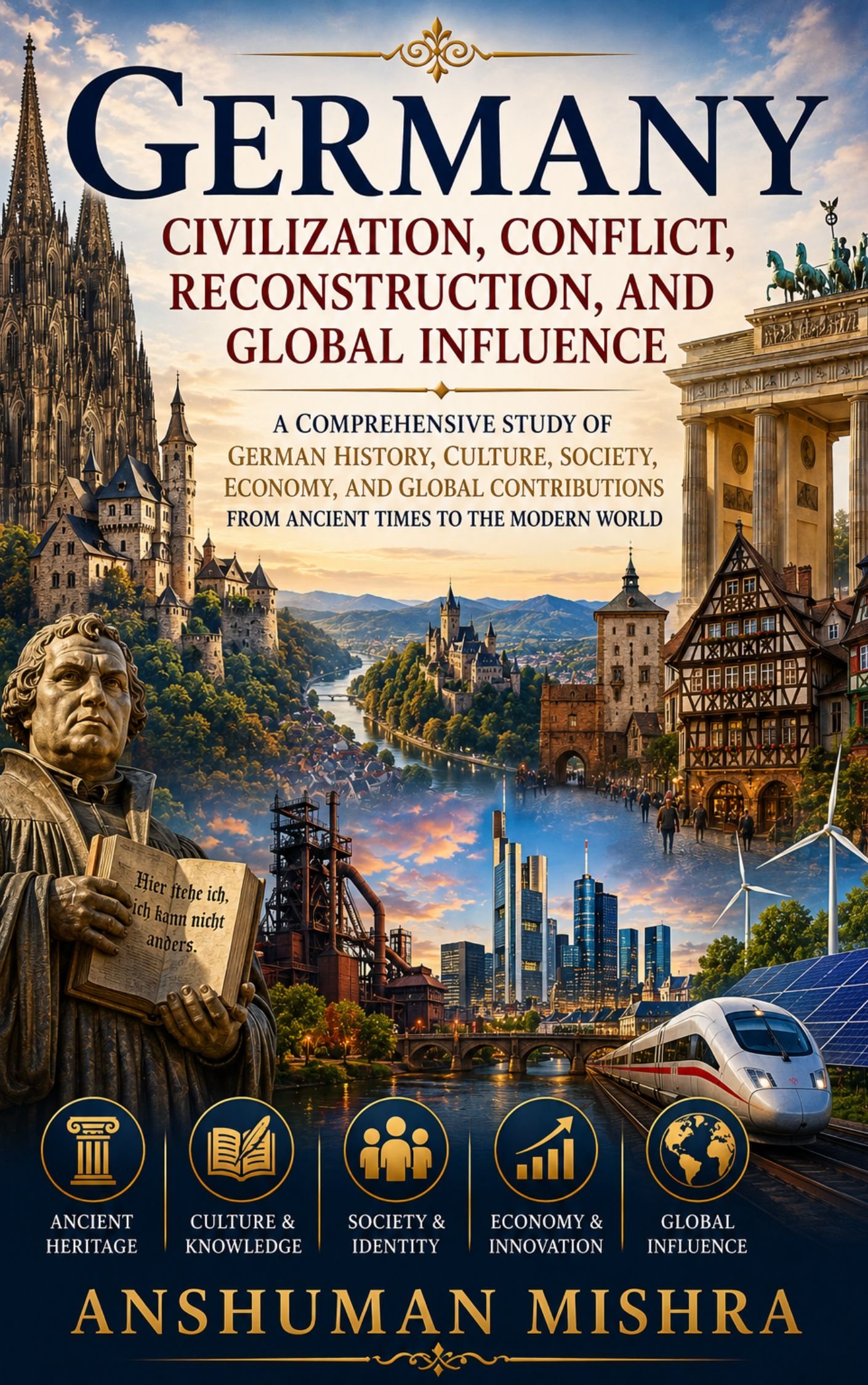
Germany: Civilization, Conflict, Reconstruction, and Global Influence
A Comprehensive Study of German History, Culture, Society, Economy, and Global Contributions from Ancient Times to the Modern World
Explore the remarkable evolution of one of Europe’s most influential civilizations through Germany: Civilization, Conflict, Reconstruction, and Global Influence. This comprehensive and academically grounded book presents Germany’s history as a continuous civilizational journey, demonstrating how geography, culture, education, science, philosophy, governance, industry, and social institutions have shaped the nation across thousands of years.
Rather than focusing only on political events or military conflicts, this book adopts a long-view historical perspective that explains how Germany evolved through cultural exchange, intellectual development, technological innovation, economic transformation, and institutional resilience.
Beginning with Germany’s geography, rivers, forests, mountains, and natural resources, readers discover how the country’s strategic location at the heart of Europe influenced migration, trade, settlement patterns, and cultural interaction. The book then examines prehistoric communities, Celtic and Germanic tribes, and the lasting influence of Roman civilization on German lands through trade, law, military frontiers, and cultural exchange.
The medieval era explores the formation of the Holy Roman Empire, feudal institutions, monastic scholarship, medieval cities, guilds, universities, architecture, and the foundations of German political and cultural identity. Readers gain insight into how religion, education, commerce, and regional diversity shaped German civilization for centuries.
A major section examines the Protestant Reformation and the intellectual movements that transformed Europe. The book explains the influence of Martin Luther, religious reform, educational development, and the emergence of new ideas that reshaped governance, society, and cultural life.
The narrative continues through the Enlightenment, Germany’s extraordinary contributions to philosophy, literature, music, science, and higher education, followed by industrialization, engineering excellence, technological innovation, and national unification. These developments positioned Germany as one of the world’s leading industrial and scientific powers.
The book also provides a balanced examination of Germany’s experiences with conflict, division, reconstruction, and reunification. Rather than emphasizing ideology or political controversy, it focuses on institutional learning, democratic development, economic recovery, reconciliation, and the rebuilding of a stable and prosperous society.
Modern Germany is presented as a global leader in manufacturing, engineering, research, renewable energy, environmental sustainability, vocational education, innovation, and international cooperation. Readers also explore contemporary issues including digital transformation, demographic change, migration, social inclusion, and Germany’s leadership within Europe and the wider international community.
Inside This Book You’ll Discover
- Germany’s geography and environmental foundations
- Prehistoric settlements, Celtic cultures, and Germanic tribes
- Roman influence and Germanic civilization
- The Holy Roman Empire and medieval institutions
- The Protestant Reformation and religious transformation
- Enlightenment philosophy, literature, music, and education
- Industrialization, engineering, and technological progress
- German unification and modern nation-building
- Conflict, reconstruction, reconciliation, and reunification
- German language, culture, traditions, and social values
- Scientific achievements, research institutions, and innovation
- Manufacturing excellence, exports, and the modern economy
- Germany’s leadership in renewable energy and sustainability
- European cooperation, diplomacy, and global responsibility
- Twenty-first century opportunities, challenges, and future development
Written in a clear, balanced, and academically accessible style, this book is ideal for university students, competitive examination aspirants, educators, researchers, historians, and readers interested in European civilization, German history, political institutions, cultural studies, economics, science, engineering, and international relations.
Whether you are studying Germany’s historical development, exploring European civilization, researching industrialization and innovation, or seeking to understand one of the world’s leading knowledge-based economies, this book provides a comprehensive, objective, and engaging guide.
Discover how Germany’s enduring traditions, educational excellence, scientific achievements, industrial strength, democratic institutions, and commitment to sustainability continue to shape Europe and contribute to global civilization.
Reviews
There are no reviews yet.