Description
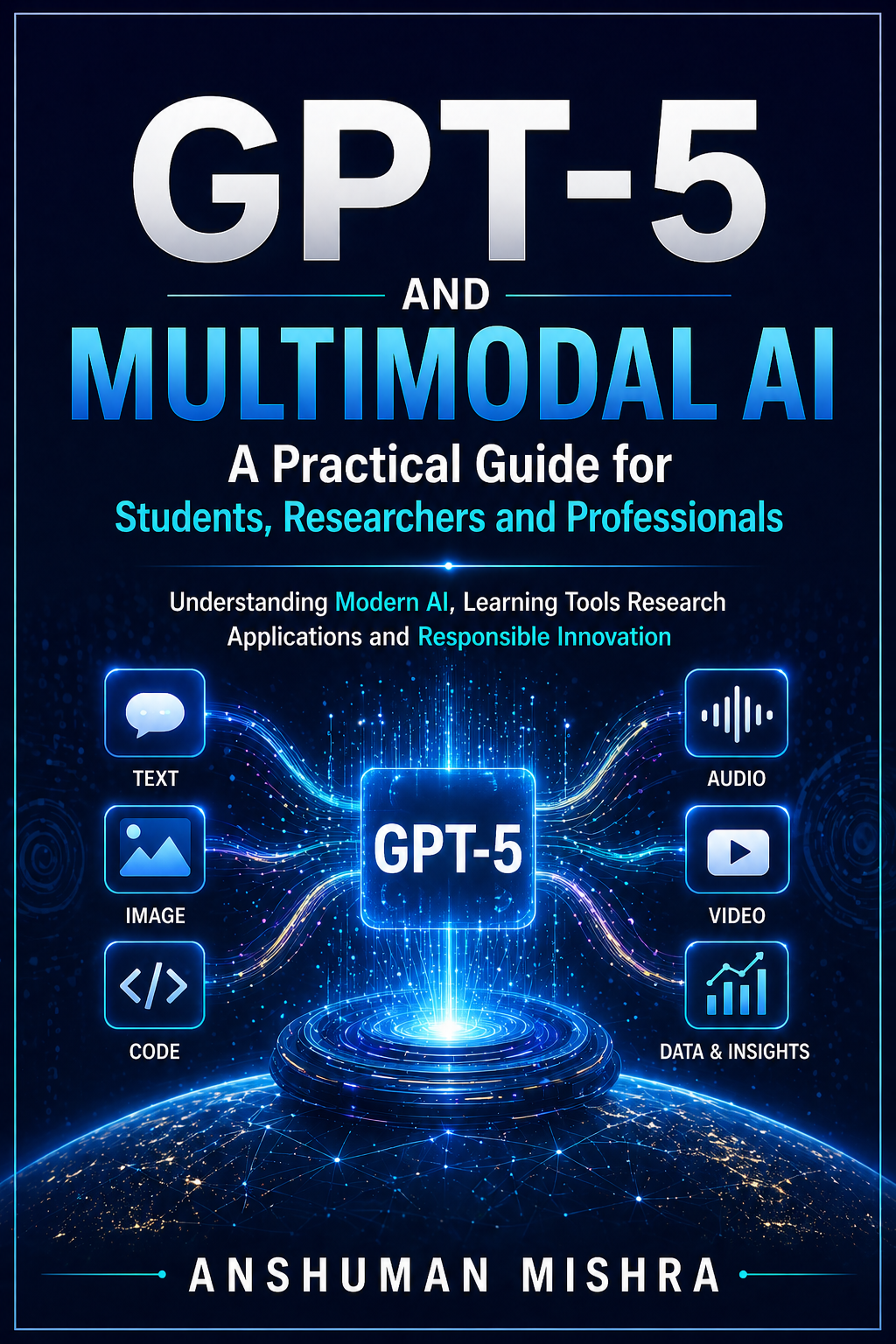
GPT-5 and Multimodal AI
A Practical Guide for Students, Researchers, and Professionals
Understanding Modern AI, Learning Tools, Research Applications, and Responsible Innovation
Artificial Intelligence has moved far beyond traditional rule-based computer programs. Modern AI systems can process natural language, analyze images, work with code, interpret structured information, assist with research, and support complex professional workflows.
GPT-5 and Multimodal AI: A Practical Guide for Students, Researchers, and Professionals provides a structured and practical introduction to this rapidly evolving field. The book is designed to help readers understand modern AI concepts while also learning how AI tools can be applied responsibly in education, academic research, professional environments, and lifelong learning.
Rather than focusing exclusively on technical theory, this book combines AI fundamentals, modern model concepts, multimodal intelligence, practical applications, learning strategies, research workflows, productivity techniques, and responsible AI principles.
Understanding the Evolution of Modern AI
The book begins by exploring the historical development of Artificial Intelligence.
Readers are introduced to the progression from:
Rule-Based Systems → Machine Learning → Neural Networks → Large Language Models → Multimodal AI
This historical perspective helps readers understand how modern intelligent systems evolved and why current AI technologies are significantly more capable than many earlier approaches.
The book also explains the growing role of AI in:
- Education
- Scientific research
- Business
- Software development
- Communication
- Data analysis
- Creative work
- Professional productivity
Understanding GPT-5 and Modern AI Systems
The book introduces GPT-5 within the broader context of modern AI and Large Language Models.
Readers explore concepts such as:
- What modern language models are
- How AI systems process information
- Context and knowledge processing
- Reasoning and problem-solving
- AI assistants
- Multimodal interaction
- Differences between earlier and modern AI systems
The objective is to help readers develop conceptual clarity rather than simply learning how to operate one particular AI tool.
Because AI models and product capabilities evolve rapidly, the book encourages readers to verify current technical specifications and features through authoritative documentation.
Foundations of Modern AI Architecture
Understanding the basic architecture behind AI systems can make AI usage much more meaningful.
The book introduces:
- Neural networks
- Transformer architecture
- Attention mechanisms
- Large Language Models
- Model training
- Training data
- Model optimization
- Mixture-of-Experts concepts
These topics are explained in accessible language while maintaining sufficient technical depth for students and professionals who want to develop a stronger foundation.
What Is Multimodal AI?
One of the most important developments in modern Artificial Intelligence is multimodal intelligence.
Traditional AI systems often focused on one type of information. Modern multimodal systems can work across different information formats.
The book explores AI capabilities involving:
- Text
- Images
- Audio
- Speech
- Video
- Code
- Structured data
Readers learn how information from different modalities can be combined to support more sophisticated AI workflows.
Multimodal AI in Education
Multimodal AI has significant potential in education.
For example, students can potentially use AI systems to:
- Explain complex concepts
- Analyze diagrams and images
- Generate practice questions
- Summarize learning materials
- Support language learning
- Explore difficult topics interactively
- Create personalized study resources
The book emphasizes that AI should function as a learning support tool, while students remain responsible for understanding concepts and developing independent reasoning skills.
AI Tools for Students
Students increasingly encounter AI tools during their academic journey.
This book presents practical educational applications including:
- Study planning
- Concept explanation
- Homework support
- Practice exercises
- Exam preparation
- Note creation
- Revision assistance
- Language learning
- Skill development
The book also explains how students can evaluate AI-generated information instead of accepting every response without verification.
AI in Teaching and Learning
Educators can also benefit from responsible AI adoption.
The book explores how AI can support:
- Lesson planning
- Teaching material development
- Interactive learning
- Practice question generation
- Assessment support
- Feedback preparation
- Adaptive learning
- Student engagement
The emphasis remains on human-AI collaboration. AI tools can reduce repetitive workload, but educators continue to provide the expertise, mentorship, context, and human connection essential to effective education.
AI for Researchers
Research environments generate and process enormous amounts of information.
AI tools can assist researchers with selected parts of the research workflow.
The book explores:
- Literature review assistance
- Academic article summarization
- Research idea generation
- Information organization
- Data analysis assistance
- Research workflow management
- Scientific discovery support
- Collaboration with AI tools
The book also emphasizes the importance of verifying sources, maintaining originality, protecting research data, and following institutional research policies.
Research Integrity and Responsible AI
AI can accelerate research, but responsible usage is essential.
Researchers should understand that AI-generated information may contain:
- Errors
- Unsupported claims
- Incorrect references
- Misinterpretations
- Incomplete information
The book therefore encourages researchers to use AI as an assistant rather than an unquestioned authority.
Human verification, source checking, methodological rigor, and academic integrity remain essential.
AI for Professionals
Modern professionals can integrate AI into many aspects of their work.
The book explores professional applications including:
Software Development
AI-assisted coding, debugging, documentation, problem solving, and software design.
Data Analytics
Pattern identification, data interpretation, analytical assistance, and reporting.
Marketing and Communication
Content planning, idea development, communication support, and audience-oriented workflows.
Project Management
Planning assistance, documentation, task organization, and project communication.
Decision Support
Structured information analysis and scenario exploration, while keeping final decisions under appropriate human responsibility.
Understanding the Working Model of AI
The book explains the basic workflow through which users interact with AI systems.
Readers explore:
User Input → AI Processing → Pattern Recognition → Response Generation → Human Evaluation → Refinement
This model helps readers understand why the quality of the input, context, instructions, and evaluation process can significantly affect the usefulness of an AI response.
Using AI Tools Step by Step
A major practical component of the book is learning how to interact effectively with AI systems.
Readers learn about:
- Accessing AI platforms
- Creating clear prompts
- Providing useful context
- Specifying desired output formats
- Refining responses
- Using multimodal inputs
- Evaluating generated content
- Integrating AI into everyday workflows
The goal is to develop AI literacy and practical AI interaction skills that can be transferred across different tools.
Prompt Engineering and AI Interaction
Effective AI usage depends heavily on communication.
The book introduces principles for creating better instructions, including:
- Clear objectives
- Context
- Role definition
- Constraints
- Output format
- Examples
- Step-by-step requirements
- Quality evaluation
These techniques can improve interactions with many different generative AI systems.
AI in Professional and Creative Industries
The book also explores broader professional applications.
AI can support workflows in areas such as:
- Software engineering
- Data science
- Healthcare support
- Creative industries
- Education technology
- Knowledge management
- Global collaboration
The book presents these applications from an educational perspective while emphasizing that high-stakes professional decisions require appropriate human expertise and oversight.
Risk Awareness and Responsible AI
Understanding AI capabilities is only one part of AI literacy. Understanding its limitations is equally important.
The book discusses:
- AI hallucinations
- Inaccurate outputs
- Bias
- Data privacy
- Security
- Human oversight
- Ethical decision-making
- Over-dependence on AI
- Critical evaluation
Readers are encouraged to develop the habit of verify, evaluate, and then use rather than blindly trusting AI-generated information.
Building Critical Thinking with AI
One of the most important messages of the book is that AI should not weaken human thinking.
Instead, AI can be used to encourage:
- Questioning
- Comparison
- Analysis
- Evaluation
- Creativity
- Problem solving
- Independent judgment
Students and professionals who develop these skills can use AI more effectively while maintaining intellectual independence.
The Future of Multimodal AI
The final chapters explore the future direction of AI technologies.
Potential areas of development include:
- More capable multimodal systems
- Personalized AI assistants
- AI-supported scientific research
- Human-AI collaboration
- Intelligent workplace systems
- Personalized learning environments
- Lifelong AI-supported education
The book encourages readers to view AI as an evolving field that requires continuous learning.
Preparing for the AI Era
AI literacy is increasingly becoming an important component of modern education and professional development.
The book encourages readers to develop:
- Foundational AI knowledge
- Critical thinking
- Prompting skills
- Digital literacy
- Ethical awareness
- Data privacy awareness
- AI evaluation skills
- Human-AI collaboration skills
- Continuous learning habits
The ability to use AI effectively will increasingly depend not only on technical knowledge but also on judgment, creativity, communication, and responsible decision-making.
Who Should Read This Book?
This book is suitable for:
- Students interested in modern AI
- Teachers and educators exploring AI-assisted learning
- Researchers using AI in academic workflows
- Professionals seeking productivity improvements
- Developers interested in AI-assisted programming
- Data analysts exploring AI-supported analysis
- Content creators exploring multimodal AI
- Entrepreneurs interested in AI applications
- AI beginners seeking a structured introduction
- Technology enthusiasts interested in the future of AI
Key Features
Modern AI Foundation:
Introduces the evolution and fundamentals of contemporary AI.
GPT-5 Focus:
Provides an educational framework for understanding GPT-5 and modern AI systems.
Multimodal AI:
Explores text, image, audio, video, code, and structured information.
AI for Students:
Covers study planning, concept explanation, practice, revision, and skill development.
AI for Researchers:
Introduces literature review assistance, research workflows, summarization, and data analysis support.
AI for Professionals:
Explores software development, data analytics, marketing, project management, and productivity.
Practical AI Usage:
Provides step-by-step guidance for interacting with modern AI tools.
Responsible AI:
Emphasizes privacy, ethics, human oversight, verification, and critical thinking.
Future-Oriented Learning:
Explores emerging trends and the skills needed for the evolving AI era.
Why Choose This Book?
GPT-5 and Multimodal AI: A Practical Guide for Students, Researchers, and Professionals is designed as more than an introduction to a particular AI model. It provides a broader understanding of how modern AI systems are transforming the way people learn, research, create, communicate, and work.
The book connects technical concepts with practical applications, making it useful for readers with different levels of AI knowledge.
Its central philosophy is simple:
Learn AI → Understand AI → Use AI → Evaluate AI → Use AI Responsibly
By developing both technical awareness and critical thinking, readers can make AI a productive partner in education, research, professional development, and lifelong learning.
Educational Disclaimer
AI systems, model capabilities, features, pricing, interfaces, and availability can change rapidly. Readers should consult current official documentation when making decisions based on specific AI products or technical specifications.
AI-generated information can contain errors, omissions, outdated information, or unsupported claims. Important information should therefore be independently verified.
AI should not be treated as a replacement for qualified professionals in high-stakes areas such as healthcare, law, finance, safety, or academic decision-making.
This book is intended for educational, research, professional-development, and general informational purposes.
About the Author
Anshuman Mishra
Anshuman Mishra is an academician, educator, and author specializing in Computer Science, Artificial Intelligence, emerging technologies, and technology-enabled education. He holds an M.Tech in Computer Science from BIT Mesra and has extensive teaching experience in computer science and information technology.
His academic and writing interests focus on making complex technological concepts accessible to students, educators, researchers, and professionals. Through his educational books and learning resources, he aims to bridge the gap between theoretical knowledge and practical technology applications.
His work covers areas including Artificial Intelligence, Generative AI, Prompt Engineering, Agentic AI, Programming, Computer Science, Emerging Technologies, and digital learning.
Through this book, he seeks to help readers develop the knowledge, practical awareness, and responsible mindset required to participate effectively in the rapidly evolving AI-driven world.
Reviews
There are no reviews yet.