Description
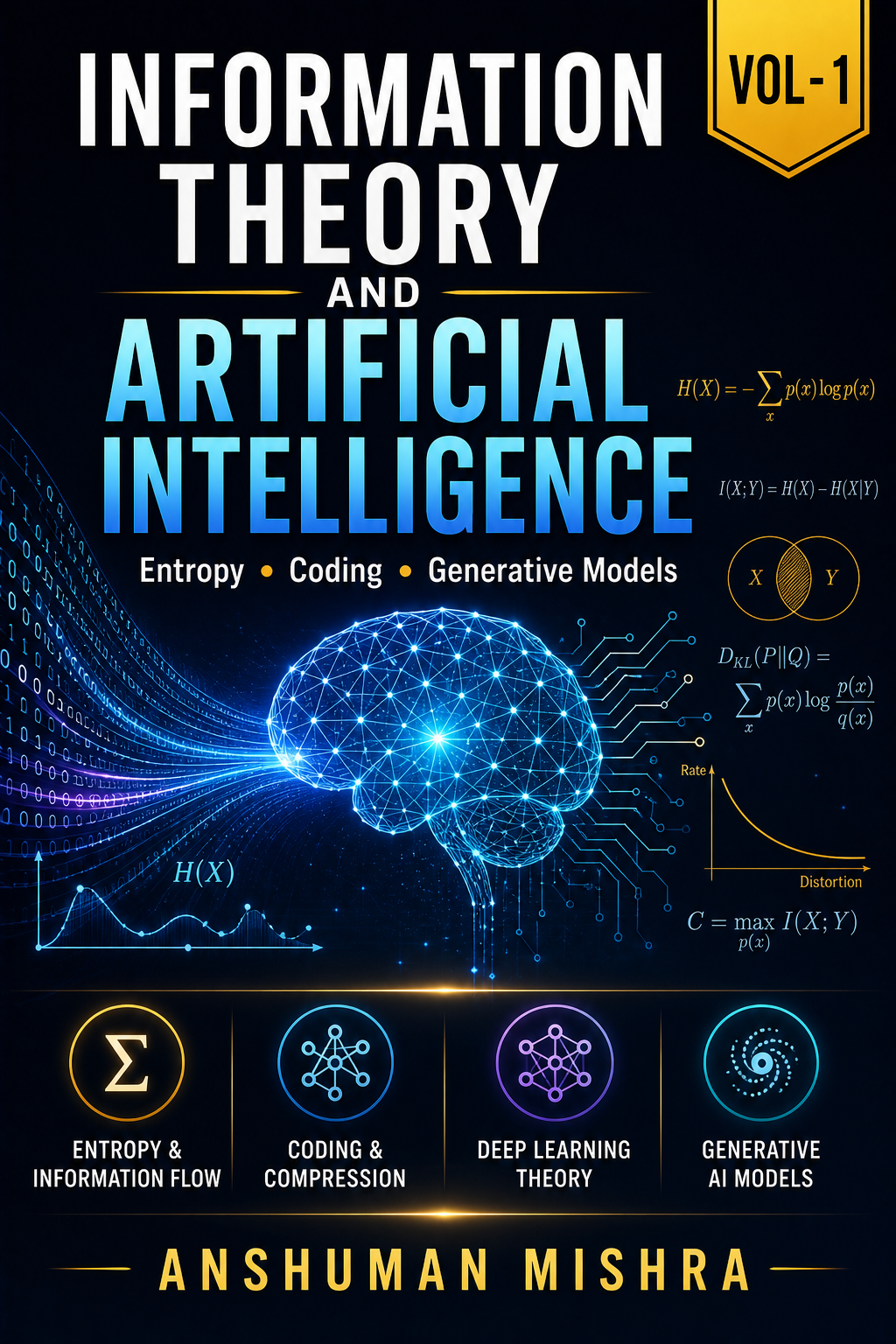
Information Theory and Artificial Intelligence
Entropy, Coding, Regularization, and Generative Models (Vol. 1)
Artificial Intelligence has transformed modern computing by enabling machines to learn, reason, communicate, and generate knowledge from vast amounts of data. Behind every intelligent learning algorithm lies a fundamental mathematical discipline that quantifies uncertainty, information, compression, and communication—Information Theory.
Information Theory and Artificial Intelligence: Entropy, Coding, Regularization, and Generative Models (Vol. 1) presents a modern, application-oriented approach to understanding how information-theoretic principles power today’s Artificial Intelligence, Machine Learning, Deep Learning, Data Science, Computer Vision, Natural Language Processing, Reinforcement Learning, and Generative AI systems.
Beginning with Shannon’s revolutionary theory of information, the book introduces entropy, probability, coding theory, communication systems, and data compression before progressing toward advanced AI topics such as information bottleneck methods, entropy-based optimization, neural compression, coding theory, adversarial robustness, and variational autoencoders.
Every chapter combines mathematical foundations with practical AI applications, enabling readers to understand how uncertainty, information flow, compression, and probabilistic learning influence the design of intelligent systems.
Whether you are a university student, researcher, AI engineer, data scientist, software developer, or educator, this book provides a comprehensive roadmap connecting Information Theory with modern Artificial Intelligence.
What You’ll Learn
✔ Foundations of Information Theory
✔ Shannon Information Theory
✔ Entropy and Information Measures
✔ Shannon Entropy
✔ Joint Entropy
✔ Conditional Entropy
✔ Cross Entropy
✔ Kullback–Leibler (KL) Divergence
✔ Mutual Information
✔ Differential Entropy
✔ Probability and Uncertainty
✔ Source Coding
✔ Data Compression
✔ Huffman Coding
✔ Arithmetic Coding
✔ Lempel–Ziv Compression (LZ77/LZ78)
✔ Rate-Distortion Theory
✔ Neural Data Compression
✔ Autoencoder-Based Compression
✔ Channel Capacity
✔ Noisy Channel Coding
✔ Communication Systems
✔ Distributed Artificial Intelligence
✔ Federated Learning
✔ Multi-Agent AI Communication
✔ Information-Theoretic Learning
✔ Minimum Description Length (MDL)
✔ Information Bottleneck Theory
✔ Representation Learning
✔ Neural Representation Compression
✔ Cross-Entropy Loss
✔ Maximum Entropy Models
✔ Entropy Regularization
✔ Reinforcement Learning
✔ L1 and L2 Regularization
✔ Bayesian Learning
✔ Dropout Techniques
✔ PAC-Bayes Theory
✔ Neural Networks
✔ Information Propagation
✔ Representation Complexity
✔ Coding Theory
✔ Error Correcting Codes
✔ Hamming Codes
✔ BCH Codes
✔ Reed–Solomon Codes
✔ Neural Decoders
✔ End-to-End Communication Systems
✔ Deep Learning Communication
✔ Adversarial Robustness
✔ Variational Autoencoders (VAE)
✔ Evidence Lower Bound (ELBO)
✔ β-VAE
✔ InfoVAE
✔ Probabilistic Deep Learning
Table of Contents
Part I – Foundations of Information Theory
Chapter 1
Introduction to Information Theory
Chapter 2
Entropy and Measures of Information
Chapter 3
Source Coding and Data Compression
Chapter 4
Channel Capacity and Communication Limits
Part II – Information Theory in Machine Learning
Chapter 5
Information-Theoretic Learning
Chapter 6
Entropy-Based Loss Functions
Chapter 7
Regularization Techniques Through the Information Lens
Chapter 8
Information Theory in Deep Neural Networks
Part III – Coding Theory and AI Systems
Chapter 9
Fundamentals of Error-Correcting Codes
Chapter 10
Neural Approaches to Coding
Chapter 11
Robustness, Adversarial Noise, and Coding Theory
Part IV – Variational Inference and Probabilistic Deep Learning
Chapter 12
Variational Autoencoders (VAEs)
Who Should Read This Book?
This book is ideal for:
- B.Tech Students
- BCA Students
- MCA Students
- B.Sc. Computer Science Students
- M.Tech Students
- Artificial Intelligence Students
- Machine Learning Students
- Deep Learning Researchers
- Data Science Students
- Computer Science Researchers
- AI Engineers
- Software Engineers
- Data Scientists
- University Faculty
- Research Scholars
- Information Theory Enthusiasts
- Communication Engineers
- Competitive Examination Aspirants
Key Features
✅ Comprehensive introduction to Information Theory for AI
✅ Step-by-step mathematical explanations
✅ Modern applications in Machine Learning and Deep Learning
✅ Coding theory integrated with Artificial Intelligence
✅ Entropy-based optimization techniques
✅ Neural communication systems and AI robustness
✅ Variational Autoencoders and Generative AI
✅ Federated Learning and Distributed AI concepts
✅ Research-oriented and industry-relevant content
✅ University syllabus aligned
✅ Suitable for self-study, projects, research, and professional development
Why This Book?
Traditional Information Theory books primarily focus on communication systems, while many Artificial Intelligence books introduce machine learning algorithms without explaining the underlying mathematical principles governing information, uncertainty, and compression.
This book bridges that gap by presenting Information Theory as the mathematical foundation of modern Artificial Intelligence. Readers gain a unified understanding of entropy, coding, probabilistic learning, regularization, representation learning, and generative models while exploring their applications in neural networks, deep learning, reinforcement learning, and intelligent communication systems.
Whether you are preparing for university examinations, pursuing AI research, or building intelligent applications, this book provides the theoretical depth and practical insights required to master one of the most important mathematical foundations of Artificial Intelligence.
Book Details
Title: Information Theory and Artificial Intelligence
Subtitle: Entropy, Coding, Regularization, and Generative Models
Volume: Vol. 1
Author: Anshuman Mishra
Publisher: Anshuman Mishra
Publication Year: 2025
Language: English
Category: Artificial Intelligence, Information Theory, Machine Learning, Deep Learning, Data Science, Computer Science



Reviews
There are no reviews yet.