Description
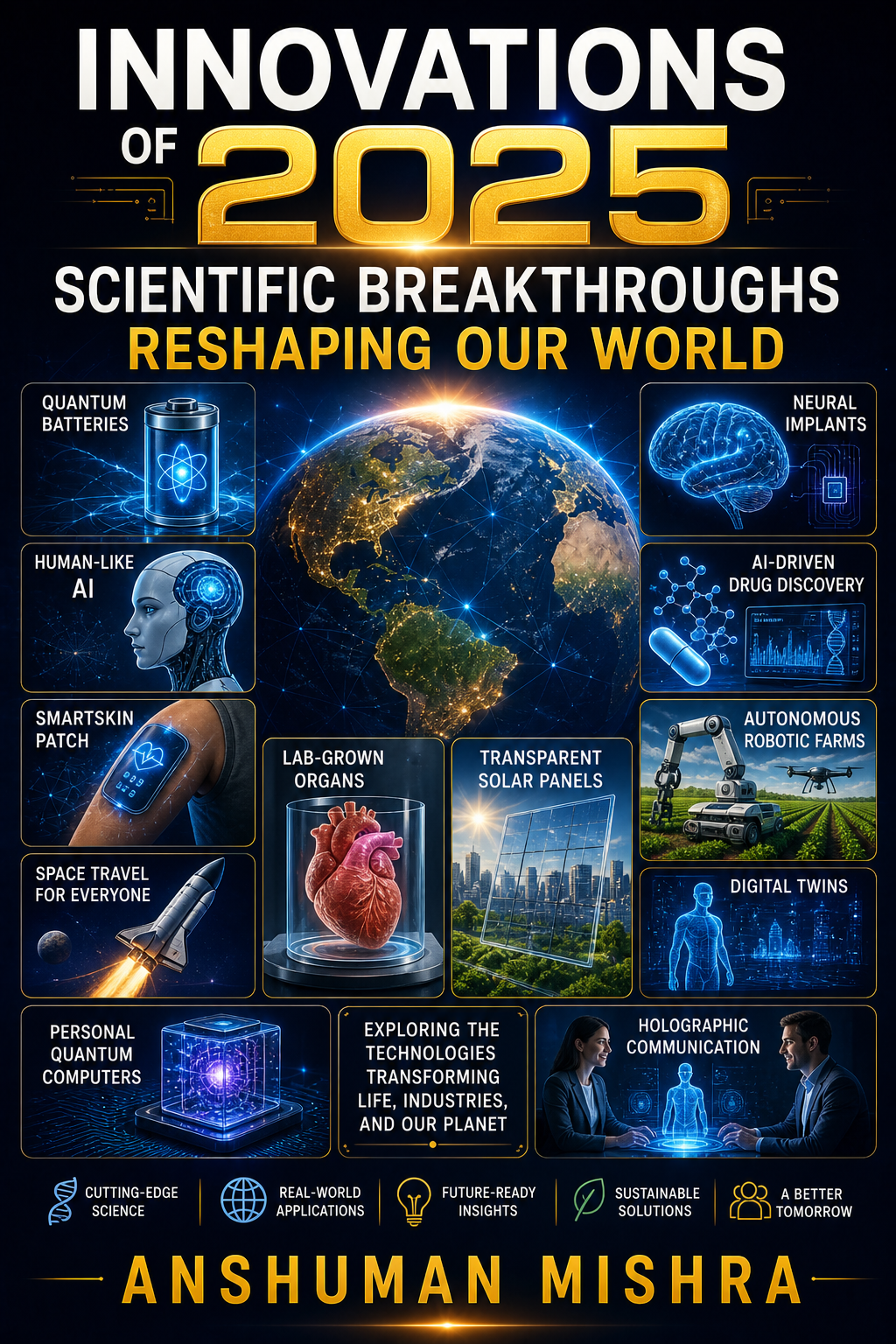
Innovations of 2025: Scientific Breakthroughs Reshaping Our World
Scientific Discovery • Emerging Technology • Artificial Intelligence • Quantum Computing • Healthcare • Sustainability • Future Innovation
The twenty-first century is witnessing an extraordinary acceleration of scientific and technological development. Advances in computing, artificial intelligence, materials science, biotechnology, energy, and interdisciplinary research are transforming the way humanity understands problems and develops solutions.
Innovations of 2025: Scientific Breakthroughs Reshaping Our World explores the major areas of scientific and technological innovation associated with the 2025 era and examines their potential influence on society, industries, education, healthcare, business, and the global environment.
The book presents 2025 as an important reference point in the continuing evolution of modern science—not as a single moment when the future suddenly arrives, but as a period in which many long-term research efforts, emerging technologies, and interdisciplinary discoveries increasingly move toward practical applications.
THE ERA OF TRANSFORMATIONAL TECHNOLOGIES
Several technological developments are converging at the same time.
Artificial intelligence is becoming increasingly capable of supporting research, automation, content generation, scientific analysis, and decision-making.
Quantum computing is progressing from theoretical research toward increasingly sophisticated experimental systems.
Materials science is producing new materials with properties that can support advanced electronics, energy systems, medicine, transportation, and manufacturing.
Biotechnology is expanding the possibilities for understanding biological systems and developing new approaches to healthcare.
Clean-energy research is responding to the need for more efficient and sustainable methods of producing, storing, and using energy.
The convergence of these fields creates opportunities for innovations that cannot be understood through a single discipline alone.
WHY 2025 MATTERS
The year 2025 represents an important milestone in the broader timeline of technological development because many research programmes and technological trends have been progressing for decades.
Several forces contribute to this transformation.
Increased Computational Power
Modern computing provides scientists and engineers with unprecedented capabilities for simulation, modelling, optimization, and data analysis.
Artificial intelligence and high-performance computing are increasingly becoming research tools across scientific disciplines.
Advances in Materials Science
New materials can enable more efficient electronics, energy storage, sensors, medical devices, and industrial technologies.
Materials innovation therefore serves as an important foundation for many emerging technologies.
Interdisciplinary Collaboration
Some of the most important modern discoveries occur at the intersection of different fields.
Computer science interacts with biology.
Physics interacts with information science.
Engineering interacts with materials science.
AI interacts with medicine, education, climate research, and many other disciplines.
This interdisciplinary environment is accelerating the development of new ideas and applications.
Investment in Research and Development
Public institutions, universities, private companies, startups, and research organizations continue to invest in emerging technologies.
Research funding can accelerate experimentation, commercialization, infrastructure development, and talent creation.
ARTIFICIAL INTELLIGENCE AND THE NEW SCIENTIFIC LANDSCAPE
Artificial intelligence is one of the most significant technological forces associated with the modern innovation ecosystem.
AI can assist researchers with:
- Data analysis
- Pattern recognition
- Scientific literature analysis
- Simulation
- Prediction
- Optimization
- Image analysis
- Drug discovery
- Engineering design
The growing use of AI in science also raises important questions about reproducibility, reliability, transparency, human oversight, and responsible innovation.
The book therefore considers technological opportunity alongside the need for careful evaluation.
QUANTUM COMPUTING AND NEXT-GENERATION COMPUTATION
Quantum computing represents a fundamentally different approach to computation.
Instead of relying exclusively on classical bits, quantum systems use quantum states to process information.
The book introduces the broader significance of:
- Qubits
- Superposition
- Entanglement
- Quantum algorithms
- Quantum simulation
- Quantum communication
- Quantum information science
Rather than presenting quantum computing as a replacement for conventional computers, the book examines where quantum approaches may offer potential advantages and where significant technical challenges remain.
MATERIALS SCIENCE AND ADVANCED ENGINEERING
Scientific progress depends heavily on the materials available to engineers.
Emerging materials can influence:
- Electronics
- Energy storage
- Solar technologies
- Sensors
- Robotics
- Aerospace
- Medical devices
- Manufacturing
The development of materials with improved strength, conductivity, flexibility, durability, or other specialized properties can create entirely new technological possibilities.
HEALTHCARE AND BIOMEDICAL INNOVATION
Scientific innovation is also transforming healthcare.
Advances in computation, biotechnology, medical imaging, genomics, diagnostics, and data analysis are creating new possibilities for disease detection and treatment.
AI-assisted medical analysis, personalized medicine, computational biology, and advanced diagnostic systems demonstrate how technology and healthcare are increasingly interconnected.
The book explores these developments while emphasizing the importance of scientific validation, patient safety, privacy, and responsible application.
CLIMATE, ENERGY, AND SUSTAINABILITY
Some of the most important technological challenges are connected to the environment.
Innovation is increasingly focused on:
- Renewable energy
- Energy storage
- Smart grids
- Carbon reduction
- Sustainable materials
- Climate modelling
- Resource efficiency
- Environmental monitoring
Scientific breakthroughs in these areas could contribute to addressing global environmental challenges.
However, technological solutions alone cannot solve every environmental problem. Policy, economics, infrastructure, public participation, and responsible consumption also remain important.
THE ROLE OF COMPUTING IN SCIENTIFIC DISCOVERY
Computational science has become an essential part of modern research.
Scientists increasingly use computational methods to:
- Simulate complex systems
- Analyse enormous datasets
- Model physical processes
- Predict molecular behaviour
- Study climate patterns
- Discover potential materials
- Optimize engineering systems
The growing integration of AI with scientific computing may further accelerate the process of hypothesis generation, experimentation, and analysis.
INTERDISCIPLINARY INNOVATION
One of the major themes of Innovations of 2025 is that future breakthroughs increasingly emerge at the boundaries between disciplines.
Examples include:
AI + Biology → Computational Biology
Quantum Computing + AI → Quantum Machine Learning
Materials Science + Energy → Advanced Energy Storage
Robotics + AI → Autonomous Systems
Biotechnology + Computing → Precision Medicine
Climate Science + AI → Advanced Environmental Modelling
These combinations illustrate why future scientists and professionals need interdisciplinary knowledge.
SOCIETAL TRANSFORMATION
Scientific innovation does not remain inside laboratories.
It influences:
- Education
- Employment
- Communication
- Transportation
- Healthcare
- Manufacturing
- Business
- Entertainment
- Public services
- Everyday life
As technologies become more accessible, society must adapt to changing workflows, skills, economic models, and expectations.
The book encourages readers to consider not only what technology can do, but also how society should use it responsibly.
THE ECONOMICS OF INNOVATION
Scientific breakthroughs can create new industries and business models.
Emerging technologies can generate opportunities for:
- Startups
- Research organizations
- Technology companies
- Entrepreneurs
- Engineers
- Scientists
- Educators
- Consultants
- Digital professionals
Understanding technological trends can therefore help individuals and organizations anticipate changes in markets and develop appropriate strategies.
ETHICAL QUESTIONS AND RESPONSIBLE INNOVATION
Technological progress also creates difficult questions.
Who should control powerful technologies?
How should sensitive data be protected?
How can AI systems be evaluated for reliability?
What happens when automation changes employment?
How should emerging technologies be regulated?
How can innovation remain accessible and beneficial to society?
The book encourages readers to examine scientific progress through both technical and ethical perspectives.
WHY STUDY THIS BOOK?
Studying Innovations of 2025: Scientific Breakthroughs Reshaping Our World can provide several important benefits.
1. Understanding Emerging Trends
Readers gain a broad perspective on important technologies and scientific developments shaping the modern world.
2. Better Decision-Making
Knowledge of technological trends can help students, professionals, entrepreneurs, and organizations make more informed decisions about learning, careers, research, and innovation.
3. Identifying New Opportunities
Emerging technologies create opportunities across technology, healthcare, education, business, engineering, and research.
Understanding these trends can help readers recognize potential areas for future development.
4. Developing Interdisciplinary Knowledge
The book connects multiple scientific disciplines and demonstrates how discoveries in one field can influence another.
5. Encouraging Scientific Curiosity
By exploring emerging technologies and scientific questions, the book encourages readers to remain curious and continue learning.
6. Understanding Global Challenges
Many innovations are directly connected to challenges such as climate change, healthcare access, energy security, resource management, and sustainable development.
7. Developing Critical Thinking
Technological claims should not automatically be accepted as facts.
Readers are encouraged to distinguish between:
Scientific evidence → Emerging research → Technological possibility → Speculation
This distinction is essential for responsible understanding of future technologies.
8. Career Development
Professionals and students who understand emerging technologies can better identify the skills likely to become valuable in rapidly changing industries.
WHO SHOULD READ THIS BOOK?
Students
Students of computer science, physics, engineering, biotechnology, medicine, environmental science, and related disciplines can use the book to develop broader awareness of emerging technologies.
Researchers
Researchers can explore interdisciplinary connections and identify areas for further investigation.
Educators
Teachers and academic institutions can use the material as an introductory resource for discussions about science, technology, and future innovation.
Entrepreneurs
Entrepreneurs can identify emerging technological areas that may create new products, services, and business opportunities.
Technology Professionals
Professionals can use the book to understand broader technological trends beyond their immediate specialization.
Science and Technology Enthusiasts
Readers interested in the future of humanity, scientific discovery, and technological progress can explore the major innovation themes shaping the modern era.
PREPARING FOR THE FUTURE
The future is not created by technology alone.
It is shaped by the interaction between:
Science + Technology + Human Creativity + Ethics + Policy + Society
Understanding this relationship is essential for navigating an increasingly technology-driven world.
The innovations associated with 2025 are therefore best understood as part of a much larger process of scientific development.
Some technologies will mature rapidly.
Some will encounter technical or economic barriers.
Some will evolve into entirely different forms.
And some ideas that appear promising today may not achieve widespread adoption.
This uncertainty is itself an important part of scientific progress.
A WINDOW INTO THE FUTURE
Innovations of 2025: Scientific Breakthroughs Reshaping Our World offers readers a broad view of the technologies and scientific developments influencing the modern era.
Its central message is simple:
Innovation is not a single invention. It is a continuous process of discovery, experimentation, adaptation, and learning.
By studying emerging technologies, readers can better understand where science is moving, what opportunities may emerge, and what challenges society must prepare to address.
The future will be shaped not only by the technologies we create, but by the choices we make about how those technologies are developed and used.
Innovations of 2025 invites readers to explore that future with curiosity, scientific awareness, and critical thinking.


Reviews
There are no reviews yet.