Description
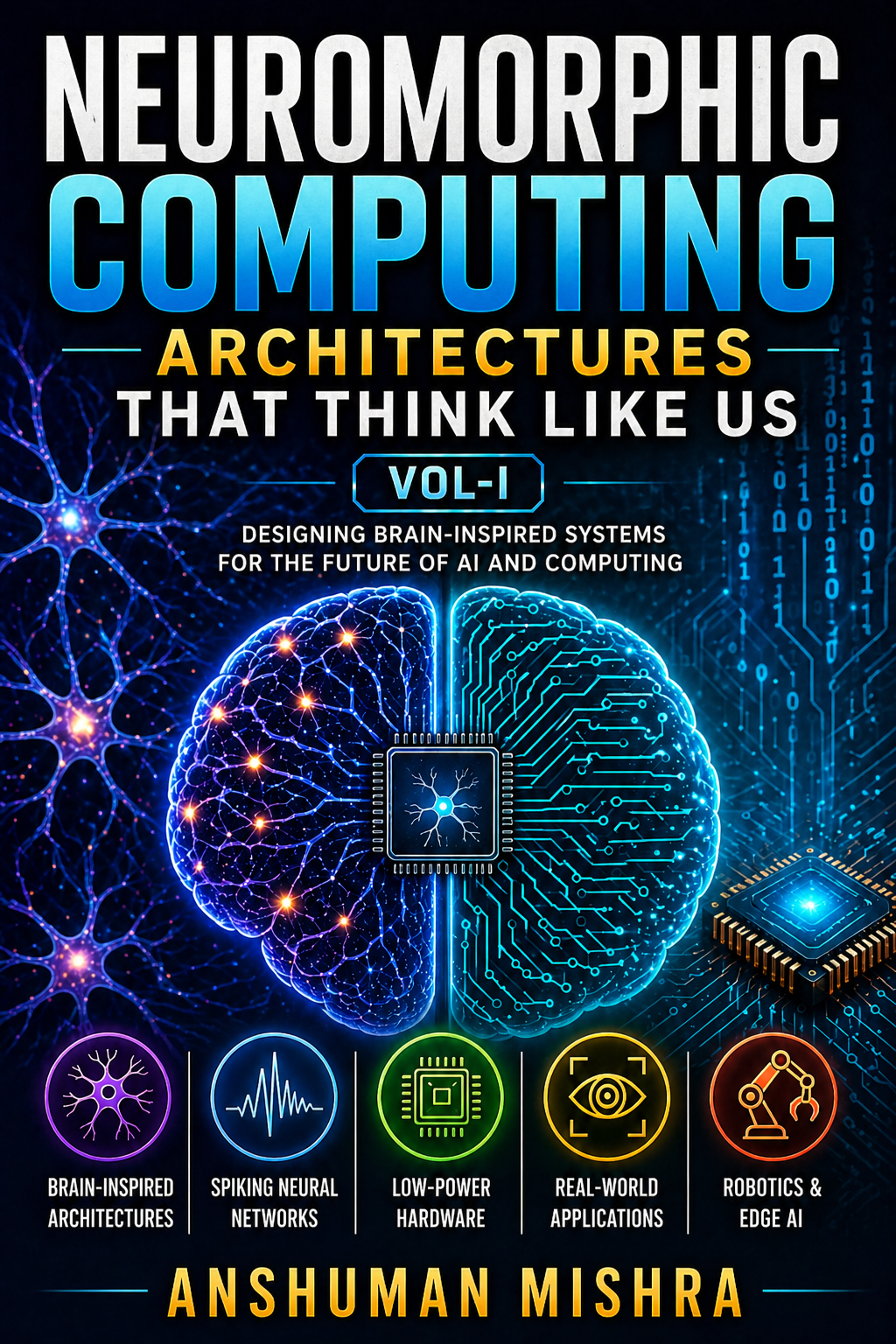
Neuromorphic Computing: Architectures That Think Like Us (VOL-I)
Designing Brain-Inspired Systems for the Future of AI and Computing
Artificial Intelligence is entering an era where traditional computing architectures face increasing challenges in terms of energy consumption, computational efficiency, latency, and scalability. As AI models become larger and more complex, researchers are increasingly looking toward one of nature’s most remarkable information-processing systems—the human brain.
Neuromorphic Computing: Architectures That Think Like Us (VOL-I) explores this exciting field of brain-inspired computing and explains how biological principles can influence the design of next-generation computing architectures.
The book provides a structured introduction to neuromorphic computing, biological neural systems, spiking neural networks, brain-inspired learning, event-driven processing, specialized hardware, and emerging neuromorphic technologies.
Rather than treating neuromorphic computing only as a theoretical concept, the book connects biological inspiration with computer architecture, artificial intelligence, machine learning, hardware design, and energy-efficient computation.
🧠 Understanding Brain-Inspired Computing
The human brain processes enormous amounts of information while operating with remarkably low energy consumption compared with many conventional computing systems.
This observation has inspired researchers to ask an important question:
Can computers be designed to process information more like biological brains?
Neuromorphic computing attempts to answer this question by developing systems inspired by:
- Neurons
- Synapses
- Neural connectivity
- Spike-based communication
- Plasticity
- Event-driven computation
- Parallel information processing
- Distributed learning
This book introduces these concepts progressively, helping readers understand why neuromorphic architectures represent an important direction for future AI systems.
What This Book Covers
Part I – Foundations of Neuromorphic Computing
The first part establishes the conceptual and biological foundation of neuromorphic computing.
Chapter 1 – Introduction to Neuromorphic Computing
The opening chapter introduces the fundamental idea of designing computing systems inspired by the brain.
Readers explore:
- The brain as an inspiration for computing
- Historical development of brain-inspired architectures
- Evolution of neuromorphic computing
- Traditional computing vs. neuromorphic computing
- Advantages of brain-inspired architectures
- Energy-efficient AI
- Event-driven computation
- Potential applications
- Future impact of neuromorphic systems
The chapter helps readers understand why conventional computing architectures may need new approaches as AI continues to scale.
Chapter 2 – Biological Foundations
To understand neuromorphic computing, it is important to understand the biological systems that inspire it.
This chapter introduces:
- Structure of the human brain
- Functions of neurons
- Synaptic connections
- Neural communication
- Brain plasticity
- Learning mechanisms
- Spike-based communication
- Biological information processing
The discussion creates a bridge between neuroscience and computer engineering, showing how biological mechanisms can inspire computational models.
Chapter 3 – Neuromorphic Principles and Models
The book then moves from biological concepts to computational models.
Major topics include:
Spiking Neural Networks (SNNs)
Readers are introduced to neural models that communicate information through discrete spikes or events rather than relying solely on conventional continuous numerical activations.
Hebbian Learning
The book explores the foundational idea behind Hebbian learning and its significance in brain-inspired learning systems.
STDP
Spike-Timing-Dependent Plasticity (STDP) is discussed as an important learning mechanism for adapting synaptic connections according to spike timing.
Event-Driven Processing
Unlike conventional systems that may continuously process information, neuromorphic systems can respond primarily when meaningful events occur.
Energy Efficiency
The chapter explains why event-driven and brain-inspired processing can potentially reduce computational and energy requirements in suitable applications.
Part II – Hardware Architectures and Technologies
The second part focuses on the hardware foundations that make neuromorphic computing possible.
Chapter 4 – Neuromorphic Hardware Overview
This chapter examines how neuromorphic hardware differs from traditional computing architectures.
Topics include:
- Digital neuromorphic systems
- Analog neuromorphic systems
- Hybrid architectures
- Von Neumann architecture
- Brain-inspired architectures
- Parallel processing
- Event-driven computation
- Real-time processing
- Low-power design
- Energy-efficient AI hardware
The discussion highlights the architectural challenges involved in moving from conventional processor-based computing toward systems inspired by biological information processing.
Chapter 5 – Leading Neuromorphic Chips
The book introduces several important neuromorphic computing platforms and research systems.
Readers explore:
IBM TrueNorth
An influential neuromorphic architecture designed around large-scale spiking neural computation and energy-efficient processing.
Intel Loihi
A neuromorphic research platform designed to explore event-based neural computation and learning.
BrainScaleS
A neuromorphic computing platform emphasizing accelerated neural simulation and hardware-based neural processing.
SpiNNaker
A many-core architecture designed for large-scale real-time neural network simulation.
The chapter provides a comparative perspective on their architectures, capabilities, design philosophies, and potential applications.
Chapter 6 – Emerging Technologies in Neuromorphic Hardware
The final chapter of this volume explores emerging technologies that could influence the future development of neuromorphic systems.
Topics include:
- Memristors
- Resistive RAM
- Synaptic hardware
- Phase-change materials
- Emerging memory technologies
- 3D neuromorphic chips
- Hardware integration
- Fabrication challenges
- Scalability
- Energy-efficient architectures
These technologies are particularly important because future neuromorphic systems may require computing and memory technologies that more closely resemble the distributed and highly parallel nature of biological neural systems.
Key Features of the Book
1. Brain-Inspired Approach
The book explains computing concepts through biological inspiration, helping readers understand the motivation behind neuromorphic architectures.
2. AI + Computer Architecture
It connects artificial intelligence with processor architecture, neural computation, hardware design, and emerging computing technologies.
3. Spiking Neural Networks
Readers gain an introduction to SNNs, spike-based communication, STDP, and event-driven processing.
4. Hardware-Focused Coverage
The book explores important neuromorphic hardware platforms and emerging technologies.
5. Energy-Efficient Computing
Special attention is given to low-power and event-driven computation, which are important considerations for future AI systems.
6. Suitable for Academic and Research Learning
The structured organization makes the book useful for students, educators, researchers, and technology professionals exploring advanced computing concepts.
Who Should Read This Book?
This book is particularly useful for:
- BCA students
- B.Tech / BE students
- MCA students
- M.Tech students
- Computer Science students
- Artificial Intelligence students
- Machine Learning students
- Data Science students
- Electronics and VLSI students
- Robotics students
- AI researchers
- Computer architecture researchers
- Neuromorphic computing researchers
- Embedded systems professionals
- AI/ML professionals
- Technology enthusiasts
- University faculty members
What You Will Learn
After reading this volume, you will be able to:
✔ Understand the fundamental concepts of neuromorphic computing
✔ Explain the relationship between neuroscience and computing
✔ Understand neurons and synapses as computational concepts
✔ Explain spike-based communication
✔ Understand Spiking Neural Networks
✔ Learn the foundations of Hebbian learning and STDP
✔ Understand event-driven computation
✔ Explain the motivation for energy-efficient AI hardware
✔ Compare traditional and neuromorphic architectures
✔ Understand digital and analog neuromorphic implementations
✔ Explore major neuromorphic computing platforms
✔ Understand the role of TrueNorth, Loihi, BrainScaleS, and SpiNNaker
✔ Explore memristors and emerging memory technologies
✔ Understand challenges associated with neuromorphic hardware scaling
✔ Develop a foundation for advanced neuromorphic AI research
Why Neuromorphic Computing Matters
The future of AI will not depend only on creating increasingly powerful algorithms. It will also depend on developing efficient computing architectures capable of executing intelligent algorithms with manageable energy and hardware requirements.
Neuromorphic computing offers a different perspective.
Instead of simply making conventional computers faster, it explores how computing systems can be redesigned around principles inspired by biological intelligence.
This makes neuromorphic computing particularly relevant to areas such as:
- Edge AI
- Robotics
- Autonomous systems
- Smart sensors
- IoT
- Real-time AI
- Wearable computing
- Intelligent vision
- Low-power machine learning
- Brain-inspired artificial intelligence
Learning Journey
The book follows a carefully structured progression:
Biological Brain → Neurons & Synapses → Spikes → SNNs → Learning → Neuromorphic Principles → Hardware Architectures → Neuromorphic Chips → Emerging Technologies
This progression helps readers move from basic concepts to advanced technological perspectives without losing the connection between biology, algorithms, and hardware.
Book Details
Book Title: Neuromorphic Computing: Architectures That Think Like Us
Subtitle: Designing Brain-Inspired Systems for the Future of AI and Computing
Volume: VOL-I
Subject: Neuromorphic Computing, Artificial Intelligence, Spiking Neural Networks, Brain-Inspired Computing, Computer Architecture
Level: Undergraduate, Postgraduate, Professional and Research
Format: Academic / Technical Reference Book

Reviews
There are no reviews yet.