Description
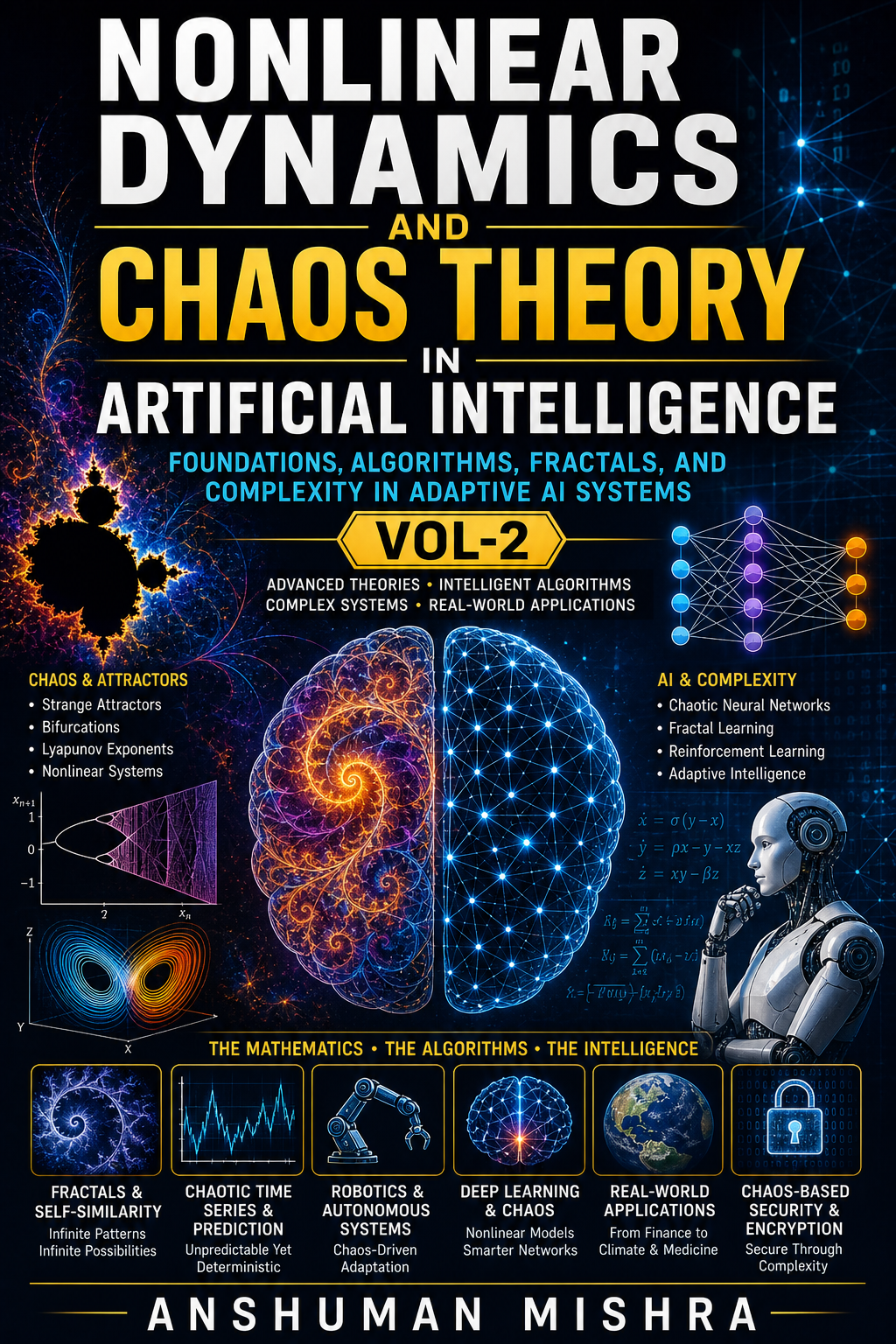
Nonlinear Dynamics and Chaos Theory in Artificial Intelligence
Advanced Adaptive Learning, Autonomous Systems, and Computational Intelligence (Vol. 2)
Artificial Intelligence is rapidly evolving toward systems that continuously adapt, self-organize, learn from complex environments, and make intelligent decisions under uncertainty. Such intelligent behavior often arises from nonlinear dynamics, chaos theory, fractal mathematics, and complex adaptive systems, making these mathematical disciplines increasingly important in modern AI research.
Nonlinear Dynamics and Chaos Theory in Artificial Intelligence: Advanced Adaptive Learning, Autonomous Systems, and Computational Intelligence (Vol. 2) extends the concepts introduced in Volume 1 by exploring advanced applications of nonlinear mathematics in Machine Learning, Deep Learning, Reinforcement Learning, Robotics, Autonomous Systems, Cognitive Computing, and Brain-Inspired Artificial Intelligence.
The book presents a comprehensive study of chaotic feature generation, nonlinear optimization, fractal prediction models, swarm robotics, adaptive control systems, chaotic reinforcement learning, cognitive AI, computational simulation, Python implementations, scientific computing, and future AI research directions.
Readers will learn how chaos-based algorithms improve optimization, robustness, prediction accuracy, adaptive behavior, and intelligent decision-making in complex environments. Practical implementation using Python, NumPy, SciPy, SymPy, PyTorch, TensorFlow, and visualization libraries makes this volume suitable for both academic research and industrial AI applications.
Whether you are a graduate student, AI researcher, robotics engineer, data scientist, computational mathematician, or software developer, this book provides an advanced mathematical framework for designing the next generation of intelligent adaptive systems.
What You’ll Learn
✔ Chaos in Machine Learning
✔ Chaos in Deep Learning
✔ Chaotic Feature Engineering
✔ Chaotic Regularization
✔ Learning Rate Scheduling
✔ Chaotic Dropout
✔ Ensemble Learning
✔ Fractal Prediction Models
✔ Chaotic Time-Series Forecasting
✔ Weather Prediction
✔ Financial Forecasting
✔ Stock Market Prediction
✔ Environmental Modeling
✔ Biomedical Signal Analysis
✔ Gaussian Processes
✔ Chaos Robotics
✔ Chaotic Robot Control
✔ Adaptive Robot Navigation
✔ Swarm Robotics
✔ Autonomous Systems
✔ Nonlinear Control Systems
✔ Cognitive Artificial Intelligence
✔ Brain-Inspired Computing
✔ Neural Oscillations
✔ Emergent Intelligence
✔ Cognitive Architectures
✔ Reinforcement Learning
✔ Chaotic Exploration
✔ Policy Gradient Methods
✔ Q-Learning
✔ Adaptive Reinforcement Learning
✔ Numerical Differentiation
✔ Chaos Detection Algorithms
✔ Delay Embedding
✔ Takens’ Theorem
✔ Lyapunov Exponent Estimation
✔ Bifurcation Analysis
✔ Python Programming
✔ NumPy
✔ SciPy
✔ SymPy
✔ Matplotlib
✔ PyTorch
✔ TensorFlow
✔ Chaotic Neural Networks
✔ Computational Intelligence
✔ Chaotic Cryptography
✔ Climate Modeling
✔ Fractal Image Compression
✔ Medical Artificial Intelligence
✔ Explainable AI (XAI)
✔ Quantum Computing
✔ Artificial General Intelligence (AGI)
✔ Bio-Inspired Intelligence
Table of Contents
Part IV – Chaos in Machine Learning and Deep Learning
Chapter 11
Chaos in Machine Learning and Deep Learning
Chapter 12
Fractal and Chaotic Models in Prediction
Part V – Chaos in Autonomous and Intelligent Systems
Chapter 13
Chaos Robotics
Chapter 14
Chaos in Cognitive and Brain-Inspired Artificial Intelligence
Chapter 15
Chaos in Reinforcement Learning
Part VI – Tools, Techniques and Implementation
Chapter 16
Mathematical and Computational Tools
Chapter 17
Python Simulations and Frameworks
Part VII – Applications, Case Studies and Research Directions
Chapter 18
Real-World Application Case Studies
Chapter 19
Current Research Trends in Nonlinear Artificial Intelligence
Chapter 20
Future Directions and Open Problems
Who Should Read This Book?
This book is ideal for:
- M.Tech Students
- PhD Scholars
- Artificial Intelligence Researchers
- Machine Learning Engineers
- Deep Learning Researchers
- Reinforcement Learning Engineers
- Robotics Engineers
- Autonomous Systems Developers
- Data Scientists
- Computational Mathematicians
- Applied Mathematics Students
- Scientific Computing Researchers
- Software Engineers
- University Faculty
- Research Scientists
- Control Systems Engineers
- Brain-Inspired AI Researchers
- Quantum Computing Researchers
- AI Professionals
- Competitive Examination Aspirants
Key Features
✅ Advanced applications of Nonlinear Dynamics in Artificial Intelligence
✅ Chaos Theory integrated with Machine Learning and Deep Learning
✅ Fractal Mathematics for prediction and forecasting
✅ Reinforcement Learning with chaos-based optimization
✅ Brain-inspired Artificial Intelligence and Cognitive Computing
✅ Robotics and Autonomous Systems applications
✅ Python implementations using NumPy, SciPy, SymPy, PyTorch, and TensorFlow
✅ Real-world case studies in healthcare, finance, climate science, and cybersecurity
✅ Explainable AI and emerging research topics
✅ Research-oriented content aligned with modern AI developments
✅ Suitable for graduate studies, research, and industrial innovation
Why This Book?
Modern Artificial Intelligence systems increasingly operate in dynamic, nonlinear, and uncertain environments where conventional mathematical models often fail to capture complex adaptive behavior. This book presents Nonlinear Dynamics, Chaos Theory, Fractal Mathematics, Reinforcement Learning, Robotics, and Adaptive Artificial Intelligence within a unified mathematical and computational framework.
Readers gain practical and theoretical knowledge of chaos-driven optimization, adaptive neural learning, nonlinear prediction models, autonomous decision-making, and intelligent control systems. The inclusion of Python-based simulations and modern AI frameworks enables readers to translate advanced mathematical concepts into real-world AI applications.
Whether you are conducting academic research, developing intelligent autonomous systems, or exploring the future of Artificial Intelligence, this volume provides a comprehensive foundation for nonlinear computational intelligence.
Book Details
Title: Nonlinear Dynamics and Chaos Theory in Artificial Intelligence
Subtitle: Advanced Adaptive Learning, Autonomous Systems, and Computational Intelligence
Volume: Vol. 2
Author: Anshuman Mishra
Publisher: Anshuman Mishra
Publication Year: 2025
Language: English
Category: Artificial Intelligence, Nonlinear Dynamics, Chaos Theory, Machine Learning, Computational Intelligence, Applied Mathematics

Reviews
There are no reviews yet.