Description
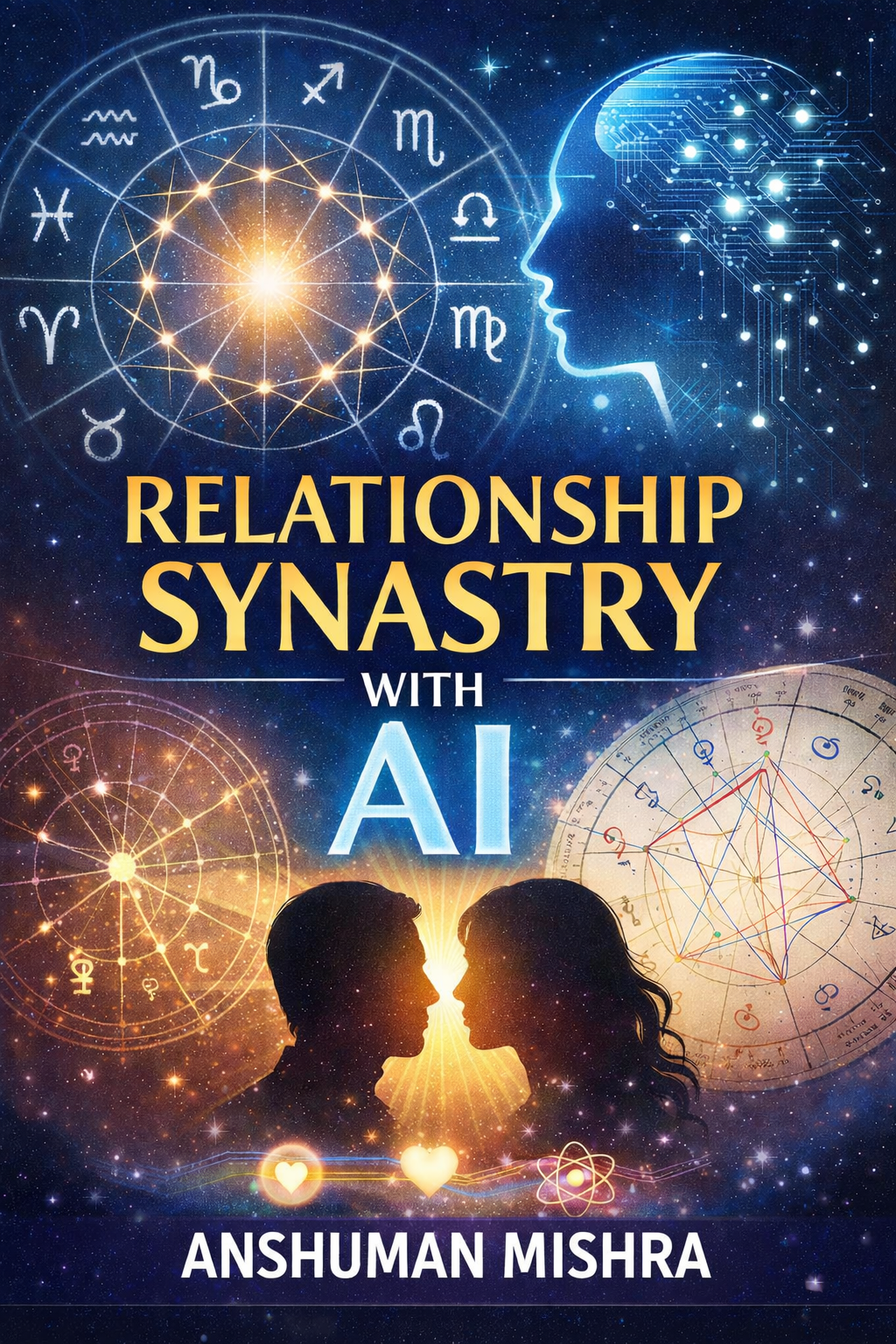
Relationship Synastry with AI
Educational Prompts for Chart Connections and Compatibility Analysis
Author: Anshuman Mishra
Relationships are complex, dynamic, and influenced by countless personal, cultural, social, and psychological factors. Across history, different traditions have developed symbolic frameworks for reflecting upon interpersonal connections. Synastry, the comparison of two natal charts, is one such traditional astrological framework.
Relationship Synastry with AI: Educational Prompts for Chart Connections and Compatibility Analysis presents a modern, structured, and educational exploration of synastry by bringing together traditional astrological concepts and contemporary artificial intelligence tools.
This book does not present astrology as a scientifically established method for predicting relationships, compatibility, personality, or future outcomes. Instead, it approaches synastry as a symbolic, historical, cultural, and interpretative subject and introduces AI as a tool for organizing information, developing structured prompts, comparing symbolic patterns, and supporting educational exploration.
Explore the Foundations of Relationship Synastry
The book begins by introducing the fundamental concepts of relationship synastry.
Readers learn how two natal charts are traditionally compared and how planetary relationships are interpreted within a symbolic framework.
The introductory chapters explore:
- The meaning and purpose of synastry
- Historical development of relationship astrology
- Cultural interpretations of compatibility
- Symbolic planetary interactions
- Synastry versus composite charts
- Limitations of astrological interpretation
This foundation allows beginners to approach the subject systematically rather than relying on isolated interpretations.
Understand Natal Charts Before Studying Synastry
A clear understanding of natal charts is essential for studying chart comparisons.
The book therefore introduces the fundamental components of a natal chart, including:
- Planets
- Zodiac signs
- Houses
- Aspects
- Chart structure
- Symbolic personality themes
- Data accuracy considerations
Readers gain the conceptual foundation required to understand how two charts may be examined together.
Explore Planetary Connections
A major section of the book focuses on traditional interpretations of planetary interactions in synastry.
Topics include:
Sun and Moon Connections
The Sun and Moon are explored as symbolic representations associated with identity, awareness, emotional experience, and personal rhythms.
Venus and Mars Symbolism
The book examines traditional symbolic associations of Venus and Mars with values, attraction, expression, preferences, and interpersonal dynamics.
Mercury and Communication
Mercury-related symbolism is explored in the context of communication, thought processes, information exchange, and conversational patterns.
Outer Planets
The book also introduces the broader and generational symbolism associated with the outer planets and explains why they should be interpreted within an appropriate contextual framework.
Importantly, these concepts are presented as symbolic interpretations rather than factual measurements of relationship quality.
Understand Houses in Synastry
Another important feature of the book is its exploration of house overlays.
Readers learn how astrologers traditionally examine situations in which one person’s planets are placed within another person’s houses.
The book discusses themes associated with:
- First House — identity and self-expression
- Fourth House — emotional and domestic themes
- Seventh House — partnership symbolism
- Tenth House — public life and social interaction
- Multiple house influences
Rather than treating one placement as decisive, the book encourages readers to consider multiple factors and broader context.
Learn About Synastry Aspects
The book provides an educational introduction to major and minor aspects used in chart comparison.
Readers explore:
- Conjunctions
- Trines
- Squares
- Oppositions
- Minor aspects
- Orb considerations
The emphasis is on understanding how these relationships are traditionally interpreted and how different indicators can be considered together.
Artificial Intelligence and Astrology
One of the most distinctive features of Relationship Synastry with AI is its introduction to artificial intelligence within an astrological learning environment.
The book explains how AI can assist with:
- Organizing chart information
- Structuring analytical questions
- Comparing multiple factors
- Identifying patterns in provided information
- Generating educational summaries
- Creating structured learning exercises
However, AI is not presented as an authority.
The book repeatedly emphasizes the importance of human judgment, critical thinking, source verification, and awareness of AI limitations.
Learn to Create Better AI Prompts
The practical heart of the book is its focus on educational prompt design.
Readers learn how to construct prompts that are:
- Clear
- Specific
- Neutral
- Structured
- Context-aware
- Less susceptible to unnecessary bias
The book introduces beginner, intermediate, and advanced approaches to prompt construction.
Readers can learn how to break complex chart-comparison questions into smaller analytical components rather than asking AI for a simplistic overall conclusion.
A Structured AI-Assisted Synastry Workflow
The book provides an organized framework for educational AI-assisted analysis.
A typical workflow involves:
Step 1: Preparing relevant chart information
Step 2: Defining the analytical objective
Step 3: Comparing relevant chart components
Step 4: Designing a neutral AI prompt
Step 5: Reviewing the generated output
Step 6: Identifying inconsistencies or unsupported assumptions
Step 7: Comparing multiple interpretations
Step 8: Documenting observations
Step 9: Applying independent judgment
This approach helps readers use AI as a learning assistant rather than an automated decision-maker.
Ethics, Privacy, and Consent
Relationship-related information can be personal and sensitive. The book therefore places considerable emphasis on responsible use.
Important topics include:
- Privacy
- Consent
- Responsible communication
- Cultural sensitivity
- Avoiding deterministic conclusions
- Avoiding emotional dependency
- Maintaining educational integrity
- Responsible use of AI-generated information
Readers are encouraged not to use symbolic interpretations as a substitute for direct communication, professional advice, or informed personal judgment.
Common Misconceptions About Synastry
The book addresses several common misunderstandings surrounding relationship astrology.
It examines concepts such as:
- The myth of perfect compatibility
- Over-reliance on a single aspect
- Misinterpretation of challenging aspects
- Confusing correlation with causation
- Ignoring real-world context
- Treating AI-generated content as fact
This critical approach encourages readers to understand the difference between symbolic interpretation and evidence-based conclusions.
Educational Case Studies and Practical Exercises
To make the learning process more practical, the book includes hypothetical examples and structured exercises.
Readers can explore:
- Hypothetical chart comparisons
- Step-by-step analysis
- Comparative scenarios
- Pattern identification
- Neutral interpretation
- Prompt-writing exercises
- Reflection activities
- Self-evaluation methods
These examples are intended for educational purposes only and are not presented as predictions or relationship advice.
Critical Thinking and Scientific Perspective
A particularly important component of this book is its balanced treatment of astrology.
The book acknowledges that astrology does not have established scientific validation as a predictive system. It therefore encourages readers to examine astrological concepts through multiple perspectives, including:
- Historical interpretation
- Cultural context
- Symbolic analysis
- Psychology
- Cognitive bias
- Critical thinking
- Evidence and uncertainty
This helps readers explore the subject with intellectual curiosity without confusing symbolic frameworks with scientifically established conclusions.
Who Should Read This Book?
Relationship Synastry with AI is suitable for:
- Astrology beginners
- Students of traditional astrology
- Readers interested in synastry
- AI and technology enthusiasts
- Prompt-engineering learners
- Researchers exploring interdisciplinary subjects
- Educators
- Students interested in cultural traditions
- Readers interested in symbolic systems
- Lifelong learners
It is particularly useful for readers who want to explore how traditional interpretative systems can be studied using modern information and AI-assisted learning techniques.
What Makes This Book Different?
The book combines three important elements:
Traditional Knowledge
It introduces foundational concepts of natal charts, planets, signs, houses, and aspects.
Artificial Intelligence
It explains structured prompting, data organization, AI-assisted analysis, and output evaluation.
Critical Thinking
It emphasizes uncertainty, ethical responsibility, independent judgment, privacy, and the limitations of symbolic interpretation.
This combination creates a modern educational framework rather than a traditional prediction-oriented astrology guide.
Key Topics Covered
Relationship Synastry • Synastry Astrology • Natal Charts • Compatibility Symbolism • Planetary Interactions • Sun and Moon Synastry • Venus and Mars • Mercury and Communication • Zodiac Signs • Astrological Houses • House Overlays • Synastry Aspects • Conjunctions • Trines • Squares • Oppositions • AI in Astrology • AI Prompts • Prompt Engineering • AI-Assisted Analysis • Astrology Education • Ethical Astrology • Critical Thinking • Cognitive Bias • Astrology and Technology • Educational Case Studies
An Educational Approach to Astrology and AI
Relationship Synastry with AI: Educational Prompts for Chart Connections and Compatibility Analysis invites readers to explore the fascinating intersection of traditional symbolic systems and modern technology.
Its purpose is not to tell readers whether a relationship will succeed or fail, nor to provide guaranteed compatibility conclusions.
Instead, it teaches readers how to understand concepts, organize information, construct better prompts, compare symbolic patterns, evaluate AI-generated responses, and maintain independent judgment.
By combining traditional astrological concepts with modern AI-assisted learning techniques, this book offers a thoughtful resource for anyone interested in exploring synastry from an educational and analytical perspective.
About the Author
Anshuman Mishra is an academic professional and author with a background in computer science, higher education, analytical thinking, and educational content development.
His approach to writing emphasizes structured learning, clarity, responsible technology use, and practical understanding. In Relationship Synastry with AI, he applies these principles to an interdisciplinary subject, connecting traditional symbolic concepts with modern AI-assisted analytical methods.
The result is a learning-oriented book designed to encourage curiosity, structured exploration, ethical awareness, and critical thinking.

Reviews
There are no reviews yet.