Description
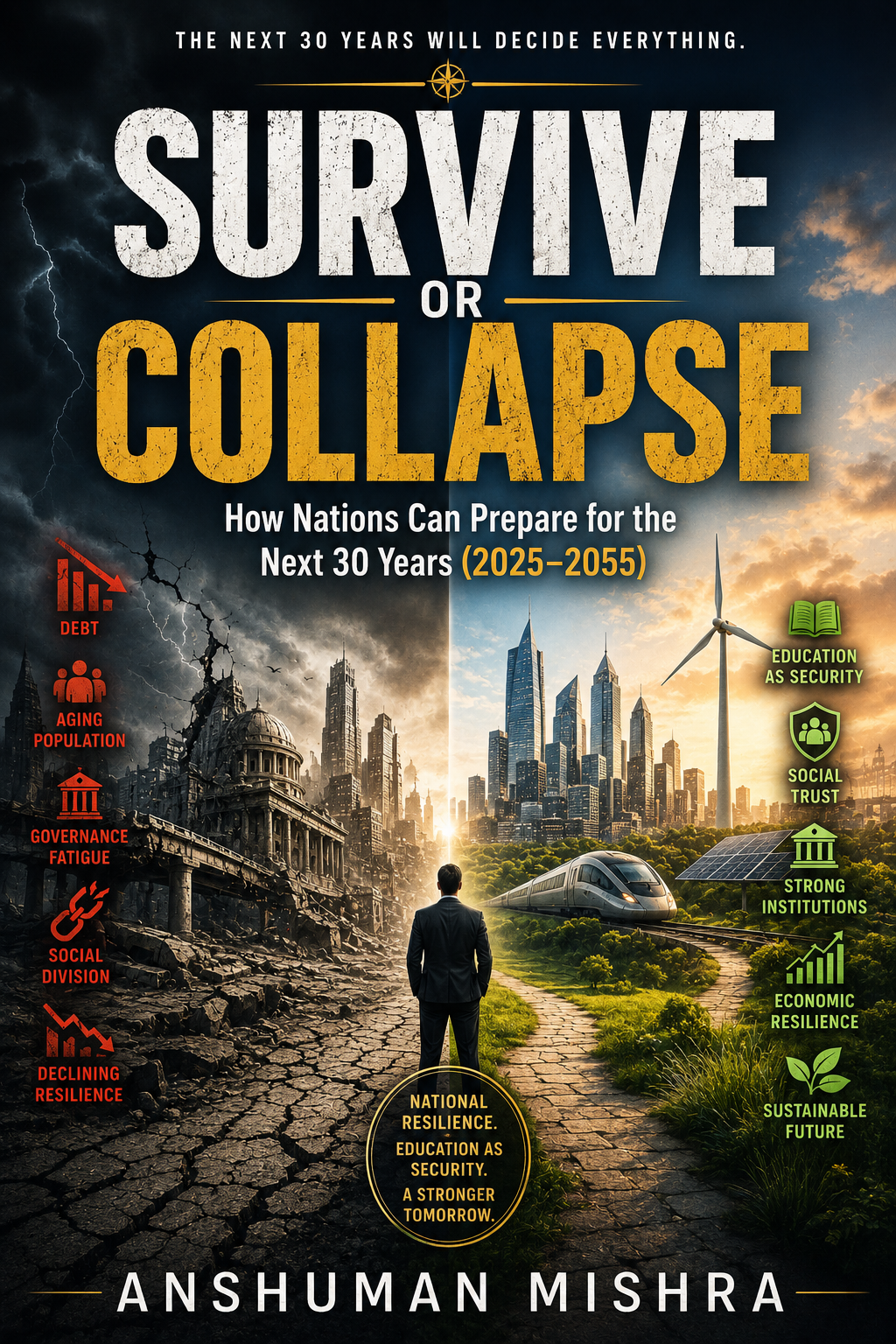
Survive or Collapse: How Nations Can Prepare for the Next 30 Years (2025–2055)
National Resilience, Education as Security, and Long-Term Governance in an Age of Permanent Uncertainty
The twenty-first century is entering an era defined by overlapping and persistent challenges. Climate change, demographic transitions, technological disruption, geopolitical competition, economic volatility, artificial intelligence, cybersecurity, institutional pressure, and social polarization are reshaping the foundations of governance across the world. Rather than occurring as isolated crises, these forces increasingly interact, creating a future in which uncertainty itself becomes a defining characteristic of national life.
Survive or Collapse: How Nations Can Prepare for the Next 30 Years (2025–2055) offers a comprehensive and policy-oriented examination of how countries can strengthen their capacity to adapt, endure, and prosper in this evolving environment. Grounded in public policy, economics, governance studies, international relations, and institutional analysis, this book presents a practical framework for understanding the long-term drivers of national resilience.
Instead of focusing solely on military strength or economic output, the book argues that durable national success depends on the quality of institutions, effective governance, educational systems, social trust, economic adaptability, technological preparedness, and strategic planning. These interconnected factors determine how societies respond to disruption, recover from crises, and sustain long-term development.
The book begins by examining why traditional governance models are increasingly challenged by continuous global uncertainty. Readers explore how rapid technological change, geopolitical shifts, demographic trends, and environmental pressures require governments to move beyond reactive crisis management toward proactive resilience planning.
A central theme throughout the book is the concept of national resilience—the ability of a country to absorb shocks, adapt to changing circumstances, maintain institutional legitimacy, and continue functioning effectively during periods of sustained stress. The discussion extends beyond emergency response to include resilient economic systems, public administration, education, infrastructure, healthcare, and civic institutions.
Education is presented as one of the most important long-term investments a nation can make. The book explains how critical thinking, lifelong learning, scientific literacy, workforce adaptability, and civic education contribute not only to economic growth but also to democratic stability, innovation, and social cohesion. Rather than treating education solely as preparation for employment, it is examined as a strategic pillar of national preparedness.
Institutional quality receives particular attention as the book analyzes governance effectiveness, policy continuity, bureaucratic capacity, transparency, accountability, rule of law, and public trust. Readers gain insight into why strong institutions often outperform individual leadership in sustaining development across generations and why long-term policy consistency is essential for addressing structural challenges.
Additional chapters explore demographic change, aging populations, migration, labor markets, economic resilience, technological transformation, artificial intelligence, climate adaptation, cybersecurity, urban development, social cohesion, conflict prevention, strategic autonomy, crisis leadership, and international cooperation. Throughout the analysis, the book emphasizes evidence-based policymaking and long-term strategic thinking over short-term political cycles.
Historical examples and comparative case studies illustrate how societies have responded to major disruptions, highlighting lessons that may inform future governance without claiming certainty about future outcomes. Rather than predicting inevitable decline or guaranteed success, the book encourages thoughtful preparation, institutional learning, and adaptive policymaking.
Inside This Book You’ll Discover
- National resilience as a framework for long-term governance
- The impact of permanent uncertainty on public policy
- Education as a strategic national asset
- Social trust, civic cohesion, and institutional legitimacy
- Governance quality and rule of law
- Long-term policy planning beyond election cycles
- Demographic transitions and workforce transformation
- Economic resilience and sustainable development
- Artificial intelligence, digital governance, and cybersecurity
- Climate adaptation and environmental resilience
- Infrastructure, public health, and crisis preparedness
- Political stability, conflict prevention, and social inclusion
- Strategic autonomy and international cooperation
- Comparative lessons from resilient societies
- Practical approaches to strengthening institutions and national preparedness
Written in a balanced, analytical, and accessible style, this book is intended for policymakers, civil servants, researchers, educators, university students, public administration professionals, international relations scholars, strategic planners, think tanks, and readers interested in the future of governance and national development.
Whether you are studying public policy, preparing for civil services, conducting research, advising institutions, or seeking a deeper understanding of the structural forces shaping nations over the coming decades, Survive or Collapse provides a rigorous framework for evaluating resilience, governance, and long-term national strategy.
As governments and societies navigate an increasingly uncertain world, this book encourages readers to think beyond immediate crises and consider how education, institutions, social trust, technological readiness, and strategic foresight can contribute to stronger, more adaptable, and more resilient nations.


Reviews
There are no reviews yet.