Description
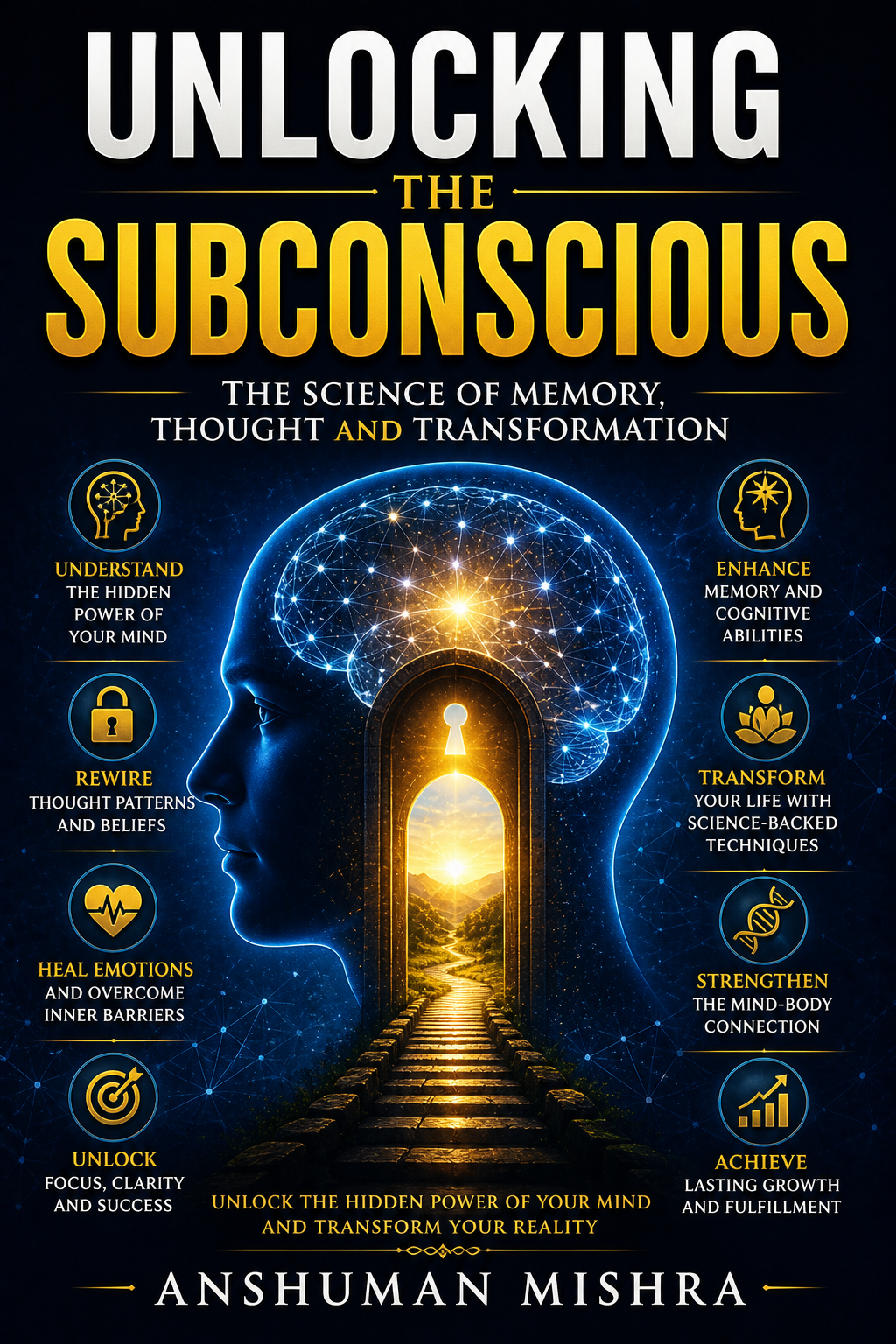
Unlocking the Subconscious: The Science of Memory, Thought and Transformation
Understanding Memory, Thought, Emotion, Habits, and the Hidden Processes of the Mind
The human mind is extraordinarily complex.
Much of what we think, remember, feel, and do is influenced not only by deliberate conscious thought but also by processes operating outside immediate awareness.
Unlocking the Subconscious: The Science of Memory, Thought and Transformation explores these less-visible dimensions of mental life through the perspectives of neuroscience, psychology, cognitive science, memory research, emotional processing, habit formation, and behavioral change.
The book examines how memories influence present thinking, how habits develop, how emotions affect decision-making, how attention and learning interact with memory, and how people can become more aware of automatic patterns in everyday life.
Rather than presenting the subconscious as a mysterious or magical force, the book approaches it as a subject for thoughtful scientific and psychological exploration.
What Is the Subconscious?
Human cognition involves many processes that do not always enter conscious awareness.
Examples include:
- Automatic habits
- Implicit memories
- Learned associations
- Emotional responses
- Pattern recognition
- Automatic attention
- Skill-based behavior
- Rapid decision processes
Understanding these processes can help explain why people sometimes act, react, remember, or make decisions without consciously analyzing every step.
This book explores these mechanisms and their relationship with conscious thought.
PART I — Understanding the Subconscious Mind
Chapter 1 — The Subconscious Mind: The Gateway to Transformation
The book begins with an introduction to subconscious processes and their role in human cognition.
It explores:
- Conscious and non-conscious mental processes
- The relationship between awareness and automatic behavior
- Perception and interpretation
- Identity and self-concept
- Learned patterns
- The interaction between conscious and subconscious processing
The chapter establishes an important foundation for understanding how mental processes outside immediate awareness can influence everyday behavior.
Chapter 2 — Memory and the Subconscious
Memory is not a single system.
Different forms of memory contribute to learning, recognition, habits, emotional responses, and everyday behavior.
This chapter examines:
- Memory formation
- Memory storage
- Memory retrieval
- Implicit memory
- Explicit memory
- Emotional influences on memory
- Information filtering
- Recall and recognition
Readers gain a clearer understanding of why some experiences remain highly accessible while others become difficult to consciously recall.
Chapter 3 — Thought Programming and Belief Formation
Repeated experiences can influence expectations, beliefs, habits, and patterns of thought.
This chapter explores:
- Repeated thinking
- Learned beliefs
- Past experiences
- Cognitive patterns
- Self-suggestion
- Thought conditioning
- Expectations
- Belief formation
The discussion encourages readers to examine how recurring thoughts and learned assumptions can influence perception and behavior.
The book also distinguishes between the popular idea of “programming the subconscious” and the more evidence-based psychological concepts of learning, conditioning, habit formation, cognitive restructuring, and behavioral reinforcement.
Chapter 4 — Emotional Intelligence and the Subconscious Mind
Emotions and cognition are closely connected.
This chapter examines how previous experiences and learned associations can influence emotional responses and decision-making.
Topics include:
- Emotional memory
- Automatic emotional reactions
- Emotional triggers
- Decision-making
- Emotional awareness
- Emotional regulation
- Cognitive reframing
- Behavioral change
Readers are encouraged to develop greater awareness of their emotional responses and the circumstances that influence them.
Chapter 5 — The Hidden Power of the Subconscious in Daily Life
Many everyday behaviors become increasingly automatic through repetition.
This chapter explores the relationship between subconscious processes and:
- Habits
- Routines
- Attention
- Decision-making
- Intuition
- Pattern recognition
- Productivity
- Focus
The discussion of intuition is particularly important. Intuition is presented not as a supernatural ability but as a possible result of rapid pattern recognition, prior learning, experience, and information processing.
PART II — Changing Thought and Behavioral Patterns
Chapter 6 — Techniques to Rewire and Reprogram the Subconscious
People can develop greater awareness of their habits and thought patterns, and certain practices may support behavioral and cognitive change.
This chapter explores:
- Meditation
- Attention training
- Affirmations
- Visualization
- Mental rehearsal
- Habit formation
- Cognitive reframing
- Hypnotherapy as a psychological intervention
The book presents these techniques as tools for reflection, learning, and behavioral change rather than as guaranteed methods for controlling the mind.
The emphasis is on consistent practice, realistic expectations, and evidence-informed personal development.
Chapter 7 — Overcoming Subconscious Barriers to Success
Fear, uncertainty, negative expectations, and learned habits can sometimes interfere with personal goals.
This chapter examines:
- Fear and avoidance
- Self-doubt
- Limiting beliefs
- Negative thinking patterns
- Failure and learning
- Motivation
- Goal-directed behavior
- Growth-oriented thinking
Readers are encouraged to identify unhelpful patterns and replace them with more constructive ways of interpreting setbacks and pursuing goals.
Chapter 8 — Dreams, Creativity, and the Subconscious Mind
Dreams have fascinated humanity for centuries.
This chapter explores dreams from psychological, cognitive, and creative perspectives.
It examines:
- Dream experiences
- Memory consolidation
- Emotional processing
- Problem solving
- Creativity
- Imagination
- Associative thinking
- Artistic inspiration
Rather than assuming that every dream contains a hidden message, the book explores the scientifically and psychologically interesting ways in which dreaming may relate to memory, emotion, and creative cognition.
PART III — Emotional Well-Being and Mind–Body Connections
Chapter 9 — Emotional Wounds, Memory, and Recovery
Difficult experiences can influence memory, emotions, attention, beliefs, and behavior.
This chapter examines:
- Emotional memories
- Stress responses
- Learned associations
- Coping
- Cognitive reframing
- Forgiveness
- Letting go
- Positive behavioral change
The discussion emphasizes that serious psychological distress and trauma can require appropriate professional support. Personal reflection techniques should complement—not replace—qualified mental-health care when it is needed.
Chapter 10 — The Subconscious Mind and Physical Health
The mind and body continuously interact.
Stress, beliefs, expectations, sleep, emotions, and behavior can influence aspects of physical well-being.
This chapter explores:
- Stress and the body
- Mind–body interactions
- Psychophysiological responses
- Expectations and health
- Placebo effects
- Recovery and well-being
- Healthy behavioral habits
The book takes a balanced approach, recognizing the genuine relationship between psychological and physiological processes without suggesting that thoughts alone can cure physical illness.
PART IV — Future Frontiers
Chapter 11 — Future Frontiers in Subconscious Mind Research
The final chapter moves toward emerging research.
Topics include:
- Neuroscience of non-conscious processing
- Automatic decision-making
- Memory research
- Artificial intelligence
- Human cognition and machine learning
- Brain–machine interfaces
- Memory enhancement research
- Future directions in consciousness studies
The chapter considers how advances in neuroscience and technology may provide new ways to investigate the relationship between memory, cognition, awareness, and computation.
Conclusion — Awakening the Full Power of Your Mind
The concluding section brings together the central ideas of the book.
Readers are encouraged to reflect on:
- How automatic patterns influence everyday behavior
- How memory shapes present experience
- How habits develop
- How emotional responses can be understood
- How attention can be trained
- How learning can modify behavior
- How self-awareness can support positive change
The ultimate goal is not to “control” every unconscious process.
Instead, it is to develop a better understanding of the mind and create greater awareness, intentionality, and flexibility in everyday life.
Major Themes of the Book
🧠 The Subconscious Mind
Understand mental processes that operate outside immediate conscious awareness.
🧩 Memory
Explore implicit and explicit memory, encoding, retrieval, emotional influences, and learning.
💭 Thought Patterns
Examine how repeated experiences and cognitive patterns can influence beliefs and behavior.
❤️ Emotion
Understand the relationship between emotional memory, decision-making, and behavioral responses.
🔄 Habits
Discover how repeated actions can become automatic and how habits can be modified through deliberate practice.
🎯 Focus and Attention
Explore cognitive processes involved in concentration, learning, and productivity.
🌙 Dreams
Examine connections between dreaming, memory, emotion, imagination, and creativity.
🎨 Creativity
Understand how memory, association, attention, and unconscious processing may contribute to creative thinking.
🧘 Meditation and Awareness
Explore meditation and attention practices as approaches to increasing awareness and improving self-regulation.
🔬 Neuroscience
Connect popular ideas about the subconscious with modern research into memory, cognition, emotion, and non-conscious processing.
Understanding Memory
Memory is one of the central themes of this book.
Readers are introduced to different aspects of memory and their relationship with behavior.
The book explores how:
Experience → Encoding → Storage → Retrieval → Learning
can influence future responses.
It also considers why memory is not a perfect recording of the past.
Memory can be influenced by:
- Emotion
- Attention
- Context
- Prior knowledge
- Repetition
- Expectations
- Later experiences
This makes memory both powerful and complex.
Thought, Beliefs, and Behavior
The book examines how thoughts and beliefs can influence behavior without presenting the mind as a simple programmable machine.
Human behavior develops through interactions among:
Biology + Learning + Environment + Memory + Emotion + Social Experience + Cognition
Understanding this interaction provides a more realistic framework for personal development.
Emotional Intelligence
Emotional intelligence requires more than simply identifying emotions.
It involves developing awareness of:
- What we feel
- Why we may feel it
- How we respond
- What situations trigger particular reactions
- How our responses affect others
- How we can regulate behavior appropriately
The book connects these ideas with subconscious and automatic processes.
Habits and Automatic Behavior
Habits are among the clearest examples of mental processes becoming increasingly automatic.
Through repetition and learning, behaviors can require less conscious effort.
The book explores how readers can become more aware of:
- Habit triggers
- Repeated routines
- Environmental cues
- Automatic responses
- Reward patterns
- Behavioral reinforcement
This provides a practical framework for thinking about habit development and change.
The Role of Intuition
Intuition is often described as a mysterious “sixth sense.”
This book approaches intuition from a cognitive perspective.
In many situations, intuitive judgments may reflect rapid processing based on:
- Previous experience
- Learned patterns
- Familiarity
- Context
- Memory
- Recognition
This perspective allows readers to appreciate intuition while also recognizing that intuitive judgments can sometimes be inaccurate or influenced by bias.
Practical Approaches Explored
The book introduces several practices that readers can explore for self-reflection and behavioral development:
- Meditation
- Mindfulness
- Visualization
- Mental rehearsal
- Affirmations
- Cognitive reframing
- Attention training
- Habit tracking
- Reflective journaling
- Goal setting
These techniques are presented as practical tools rather than guaranteed formulas for transformation.
Who Should Read This Book?
Unlocking the Subconscious is suitable for:
- Psychology students
- Neuroscience enthusiasts
- Cognitive science students
- Personal development readers
- Teachers and educators
- Researchers
- AI and cognitive science enthusiasts
- Students interested in memory and learning
- Professionals interested in productivity
- Readers interested in consciousness
- Readers exploring habits and behavioral change
- General readers interested in the science of the mind
Academic and Research Applications
The book can provide useful background for study and research in areas such as:
- Cognitive psychology
- Memory science
- Neuroscience
- Consciousness studies
- Behavioral psychology
- Cognitive science
- Emotional intelligence
- Learning science
- Habit formation
- Decision-making
- Human–AI interaction
- Brain–machine interfaces
- Computational cognition
It can be useful as supplementary reading for seminars, classroom discussions, projects, presentations, and interdisciplinary research.
Key Learning Outcomes
After reading this book, readers should be able to:
- Explain the distinction between conscious and non-conscious mental processes.
- Understand major mechanisms involved in memory.
- Distinguish implicit and explicit memory.
- Explain how emotions can influence memory and decision-making.
- Understand how habits and learned associations develop.
- Identify recurring cognitive and behavioral patterns.
- Understand the role of attention and pattern recognition.
- Explore the relationship between dreams, memory, and creativity.
- Evaluate popular claims about subconscious “reprogramming” critically.
- Understand meditation, visualization, and related practices in a realistic context.
- Explore the mind–body relationship without confusing psychological influence with medical treatment.
- Examine emerging research into AI, neuroscience, and brain–machine interfaces.
Science Meets Personal Transformation
One of the defining features of Unlocking the Subconscious is its attempt to connect scientific ideas with everyday life.
The book does not treat the subconscious as an unlimited source of hidden power.
Instead, it explores how greater understanding of:
Memory
Attention
Emotion
Learning
Habits
Cognition
Behavior
can help people make more informed choices about personal development.
The emphasis is on understanding the mind rather than promising instant transformation.
Why This Book Matters
The subconscious is often surrounded by exaggerated claims and popular myths.
A scientifically informed approach can help separate useful psychological concepts from unsupported ideas.
Understanding non-conscious mental processes can help us ask better questions:
Why do we form certain habits?
Why do some memories remain powerful?
How do emotions influence our decisions?
Why do familiar patterns feel comfortable?
How does learning change behavior?
How can attention and awareness influence our choices?
These questions are relevant not only to psychology but also to education, leadership, creativity, productivity, health, technology, and artificial intelligence.
The Future of the Mind
The book concludes by looking beyond current knowledge.
Advances in neuroscience, AI, cognitive computing, and brain–machine interfaces may provide new opportunities to investigate memory and cognition.
Future research may deepen our understanding of:
- Human memory
- Non-conscious processing
- Decision-making
- Learning
- Cognitive enhancement
- Brain–machine interaction
- Artificial cognition
These developments may transform how we understand the relationship between brain, mind, memory, and technology.
Final Reflection
Unlocking the Subconscious: The Science of Memory, Thought and Transformation is ultimately an invitation to understand the mind with greater curiosity and scientific awareness.
The subconscious is not a mysterious machine hidden somewhere inside the brain.
It represents a broad collection of processes—automatic, learned, emotional, cognitive, and behavioral—that interact continuously with conscious experience.
By understanding these processes, we can become more aware of how memory shapes us, habits guide us, emotions influence us, and learning changes us.
The goal is not to control every hidden process.
The goal is to become more conscious of the processes that influence our lives.
Understand your memory.
Observe your thought patterns.
Recognize your habits.
Develop emotional awareness.
Learn continuously.
And use knowledge of the mind to make more intentional choices.
Reviews
There are no reviews yet.