Description
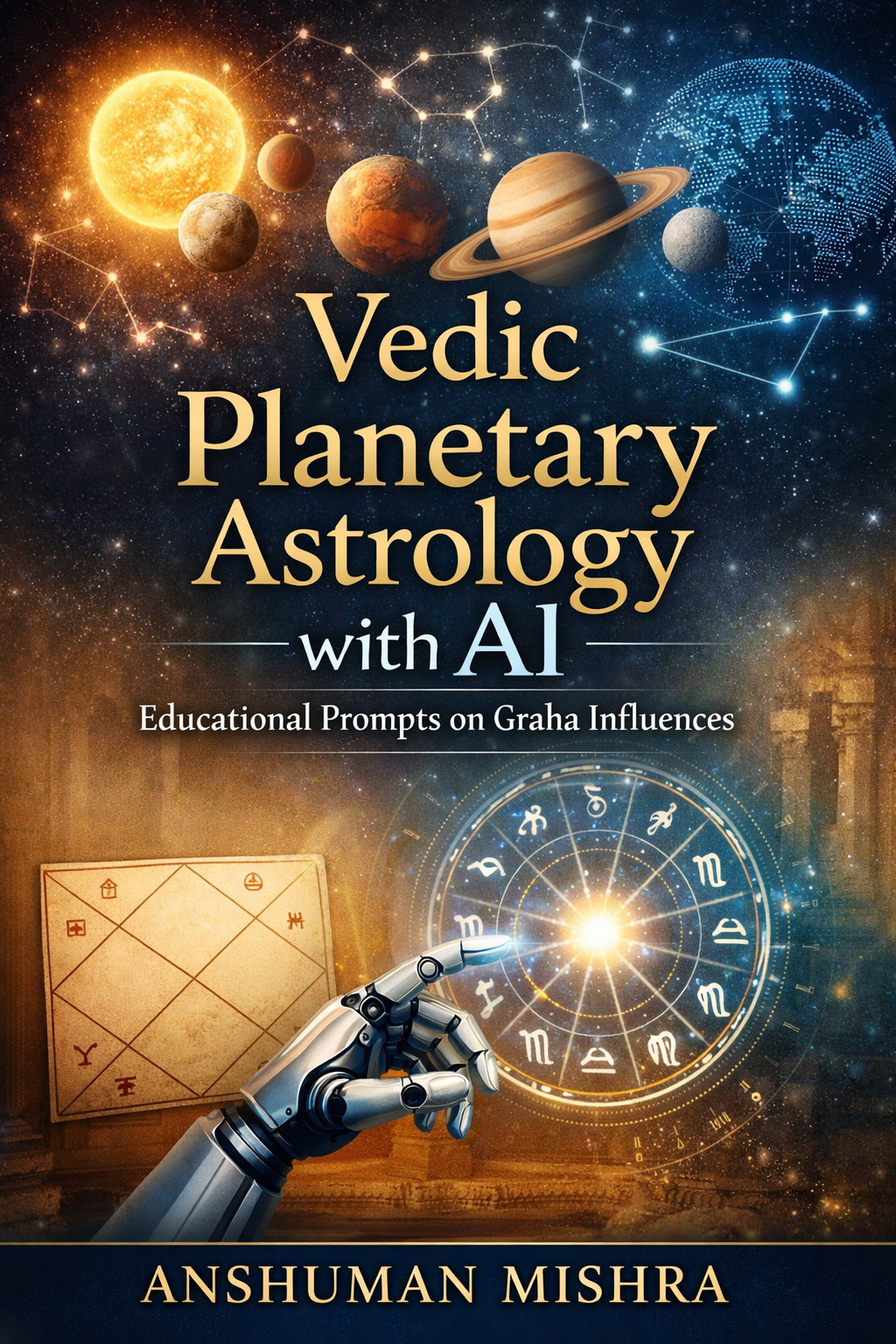
Vedic Planetary Astrology with AI: Educational Prompts on Graha Influences is a carefully structured educational guide for readers who want to understand the foundational concepts of Vedic astrology through a modern, organized, and responsible learning framework.
The book introduces traditional concepts such as Grahas, Rashi, Nakshatras, Bhavas, Lagna, Drishti, planetary relationships, and Dashas, while also demonstrating how artificial intelligence can be used as a learning assistant for organizing information, creating study prompts, comparing concepts, and supporting structured analysis.
The approach throughout the book is educational and analytical. Astrology is presented as a traditional symbolic and interpretative system rather than an empirically established scientific method or a source of guaranteed predictions.
What You Will Learn
The book covers:
- Foundations of Vedic astrology
- Meaning and scope of Graha-based astrology
- Astronomy and astrology
- Rashi and zodiac systems
- Twelve zodiac signs
- Elements and modalities
- Lunar and solar calculations
- Nakshatra system
- Nine Grahas
- Surya and Chandra
- Mangal, Budh, Guru, Shukra, and Shani
- Rahu and Ketu
- Bhava or house system
- Twelve houses
- House lords
- Lagna or Ascendant
- Birth-chart structure
- Planetary placements
- Planetary strength and weakness
- Drishti or planetary aspects
- Planetary relationships
- Vimshottari Dasha
- Antardasha
- AI-assisted astrology learning
- AI prompts for Graha analysis
- Chart observation exercises
- Case-study frameworks
- Reflection journals
- Ethical use of astrology
- Scientific perspective and limitations
Understanding Vedic Planetary Astrology
The book begins with an introduction to Vedic astrology and its traditional conceptual framework.
Readers are introduced to the idea of Grahas and the role they play within traditional astrological interpretation.
Rather than beginning with complex chart-reading techniques, the book builds understanding progressively—from basic concepts to more advanced analytical structures.
This makes the book suitable for beginners as well as learners who already have some familiarity with astrology.
Astronomy and Astrology
One of the important educational features of this book is its clear distinction between astronomy and astrology.
Astronomy is an empirical scientific discipline concerned with the observation, measurement, and study of celestial objects and phenomena.
Astrology, by contrast, is presented in this book as a traditional symbolic and interpretative system.
Understanding this distinction helps readers approach the subject with intellectual clarity and avoid confusing traditional astrological interpretations with scientifically established astronomical findings.
Rashi and Zodiac Systems
The book introduces the structure of the zodiac and the traditional Rashi system.
Readers explore:
- Twelve Rashis
- Symbolic characteristics
- Elements
- Modalities
- Zodiac relationships
- Time-based systems
- Lunar and solar concepts
The purpose is to provide a foundation for understanding how zodiac signs are organized within traditional Vedic astrology.
Understanding the Nine Grahas
The nine traditional Grahas form one of the central subjects of the book.
The book introduces:
Surya — Sun
Discussed in terms of its traditional symbolic associations and role within astrological interpretation.
Chandra — Moon
Explored through traditional associations with cycles, emotions, and mental symbolism.
Mangal — Mars
Introduced through traditional concepts relating to energy, action, initiative, and drive.
Budh — Mercury
Discussed in relation to communication, reasoning, learning, and analytical symbolism.
Guru — Jupiter
Explored through traditional associations with knowledge, learning, growth, and wisdom.
Shukra — Venus
Presented through symbolic themes associated with harmony, aesthetics, relationships, and refinement.
Shani — Saturn
Discussed through traditional concepts of discipline, structure, patience, and responsibility.
Rahu and Ketu
The book introduces Rahu and Ketu as important components of the traditional nine-Graha framework and explains their conceptual and symbolic roles.
Bhavas — The Twelve Houses
The house or Bhava system provides another important foundation for chart interpretation.
The book explains how the twelve houses are traditionally associated with different areas of life.
Readers learn about:
- Twelve Bhavas
- House significance
- Angular houses
- Succedent houses
- Cadent houses
- House lords
- Relationships between houses
- Analytical approaches to house interpretation
The focus is on understanding the framework rather than making deterministic conclusions.
Lagna and Birth Charts
The Lagna, or Ascendant, is an important concept in Vedic astrology.
This section introduces readers to:
- Birth-chart fundamentals
- Ascendant
- Planetary positions
- House placement
- Rashi placement
- Basic chart structure
- Chart observation methods
Readers are encouraged to approach chart interpretation systematically instead of jumping directly to conclusions.
Drishti and Planetary Relationships
The book introduces the concept of Drishti, commonly translated as planetary aspect or influence within traditional astrological frameworks.
Topics include:
- Meaning of Drishti
- Standard aspects
- Special aspects
- Planet-to-planet relationships
- Multiple planetary influences
- Combining symbolic factors
These concepts are presented as components of traditional chart-analysis methodology.
Dashas and Time-Period Systems
The book also introduces traditional planetary-period systems, particularly Vimshottari Dasha.
Readers learn about:
- Planetary periods
- Dasha sequence
- Antardasha
- Time-based interpretation
- Traditional analytical frameworks
The book emphasizes that such systems should be understood as part of the astrological tradition rather than treated as scientifically verified forecasting mechanisms.
Artificial Intelligence as a Learning Assistant
One of the most distinctive features of this book is the integration of Artificial Intelligence into astrology education.
AI can assist learners with:
- Organizing astrological concepts
- Creating study notes
- Generating educational questions
- Comparing planetary concepts
- Structuring chart observations
- Creating practice exercises
- Developing reflection prompts
- Summarizing learning material
However, the book clearly explains that AI should not be treated as an authority.
AI-generated information can contain errors, inconsistencies, or fabricated details, so readers are encouraged to verify important information using reliable sources.
AI Prompts for Graha Learning
The book provides a structured approach to designing prompts for learning about Grahas.
Readers can use prompts to explore:
- Traditional meanings
- Symbolic associations
- Planetary relationships
- House placements
- Comparative concepts
- Study questions
- Reflection exercises
The goal is to encourage better questioning and organized learning, rather than generating unquestioned conclusions.
AI Prompts for House Interpretation
AI can also be used to create structured learning exercises around the twelve Bhavas.
For example, learners can ask an AI tool to:
- Explain the traditional meaning of a particular house
- Compare two houses
- Create a study table
- Generate practice questions
- Explain relationships between houses
- Create hypothetical chart exercises
This approach transforms AI into a study companion rather than a prediction engine.
Chart Comparison and Case Studies
The book includes a practical framework for studying sample charts.
Readers are guided to:
- Identify the Lagna.
- Identify planetary placements.
- Note relevant houses.
- Observe traditional aspects.
- Record planetary relationships.
- Compare multiple symbolic factors.
- Document observations.
- Avoid jumping to absolute conclusions.
This systematic approach encourages disciplined learning.
Practical Exercises and Worksheets
To reinforce understanding, the book includes practical exercises covering:
- Rashi identification
- Graha identification
- House analysis
- Planetary placement
- Drishti observation
- Chart comparison
- AI prompt development
- Reflection exercises
- Self-evaluation
These activities allow learners to move from theoretical understanding toward practical study.
Ethical Approach to Astrology
Ethics is an important component of the book.
Readers are encouraged to avoid:
- Guaranteed predictions
- Fear-based interpretations
- Absolute claims
- Misleading statements
- Unverified information
- Unnecessary dependence on astrology
- Treating symbolic interpretations as established facts
The book promotes a responsible approach based on learning, reflection, and critical thinking.
Scientific Perspective and Limitations
A dedicated section discusses the limitations of astrology.
The book explains the difference between:
Scientific evidence and symbolic interpretation
and encourages readers to evaluate claims carefully.
It introduces concepts such as:
- Evidence-based reasoning
- Cognitive bias
- Confirmation bias
- Overgeneralization
- Interpretation errors
- Verification
- Critical thinking
This makes the book particularly useful for readers who want to explore astrology without abandoning intellectual curiosity or analytical thinking.
Responsible Use of AI
Artificial intelligence is powerful but imperfect.
The book explains that AI tools can:
- Make factual errors
- Misinterpret traditional terminology
- Generate inconsistent explanations
- Produce overconfident answers
- Reflect biases present in their training data
Therefore, learners are encouraged to verify important information and use AI as a supportive educational tool, not as a final authority.
Who Should Read This Book?
This book is ideal for:
- Beginners learning Vedic astrology
- Students of traditional knowledge systems
- Astrology enthusiasts
- AI and technology learners
- Educators and content creators
- Researchers interested in cultural studies
- Readers interested in Indian traditions
- Independent learners
- Readers interested in AI-assisted education
No advanced technical or programming knowledge is required.
Key Features
✔ Beginner-friendly introduction to Vedic astrology
✔ Rashi and zodiac fundamentals
✔ Nine Grahas explained systematically
✔ Surya, Chandra, Mangal, Budh, Guru, Shukra, Shani, Rahu and Ketu
✔ Twelve Bhavas
✔ Lagna and birth-chart fundamentals
✔ Planetary placements
✔ Drishti and planetary relationships
✔ Vimshottari Dasha
✔ Antardasha concepts
✔ AI-assisted learning techniques
✔ AI prompts for Graha study
✔ AI prompts for Bhava analysis
✔ Chart comparison exercises
✔ Case-study framework
✔ Practical worksheets
✔ Reflection journals
✔ Ethical guidelines
✔ Scientific perspective
✔ Critical-thinking framework
✔ Limitations of astrology
✔ Responsible use of AI
Why This Book Is Different
Many introductory astrology books focus primarily on interpretations or predictions.
This book takes a different approach.
It focuses on learning how to study the system.
The reader is encouraged to:
Observe → Question → Analyze → Compare → Document → Reflect → Verify
This learning cycle helps develop a more structured understanding of traditional astrological concepts.
Final Perspective
Vedic Planetary Astrology with AI: Educational Prompts on Graha Influences provides a modern framework for exploring a traditional subject.
It combines the traditional vocabulary of Grahas, Rashis, Bhavas, Lagna, Drishti, Nakshatras, and Dashas with contemporary learning methods based on AI prompts, structured exercises, documentation, and critical thinking.
The book does not present astrology as a scientifically established predictive system. Instead, it encourages readers to understand its traditional frameworks, cultural context, symbolic language, and interpretative methodology responsibly.
Whether you are beginning your journey into Vedic astrology or looking for a more structured way to organize your existing knowledge, this book provides a practical foundation for continued learning.

Reviews
There are no reviews yet.