Description
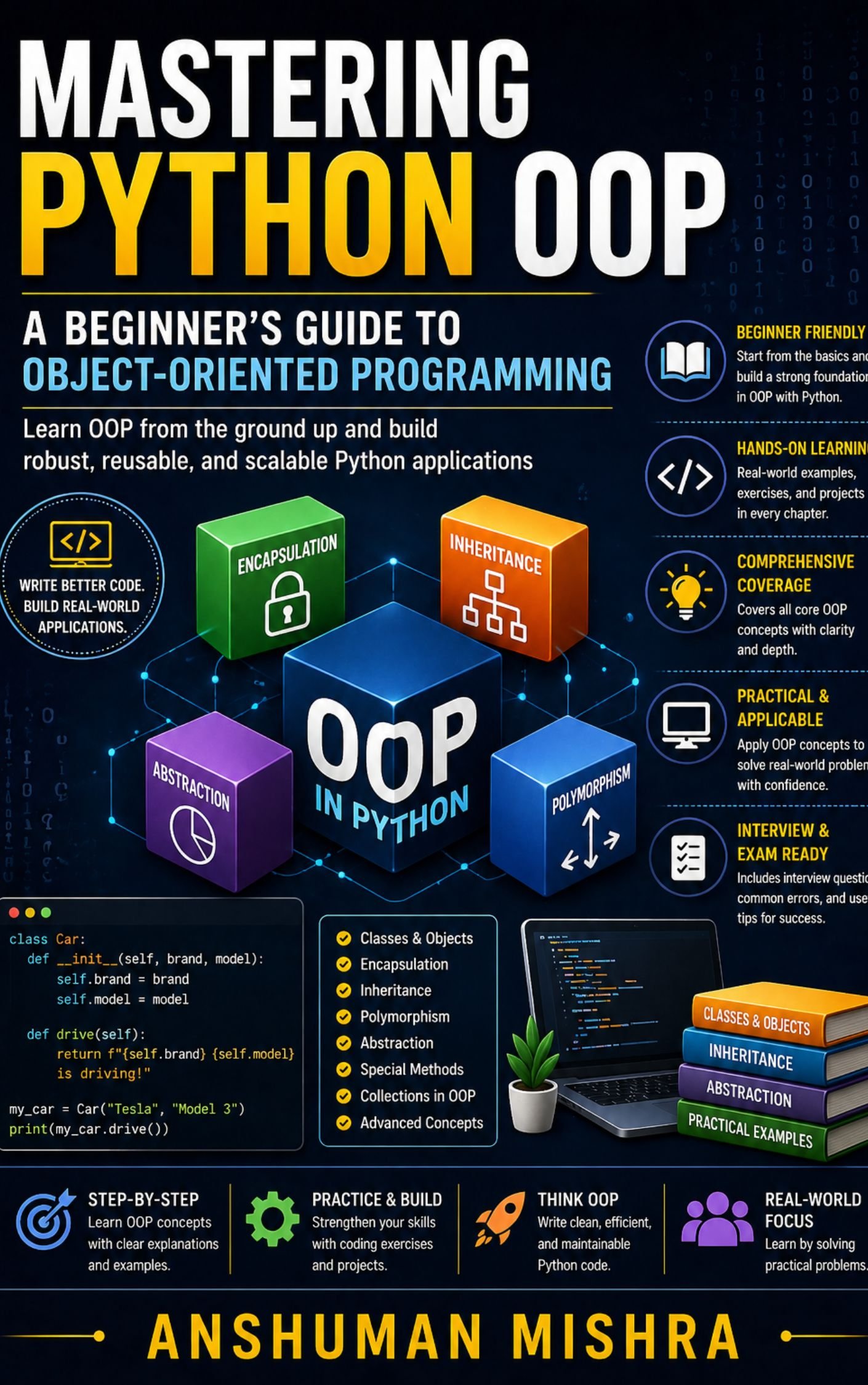
Mastering Python OOP: A Beginner’s Guide to Object-Oriented Programming
Build Strong Python Programming Skills Through Object-Oriented Thinking
Object-Oriented Programming (OOP) is one of the most important programming paradigms for developing organized, reusable, scalable, and maintainable software.
For beginners, however, concepts such as classes, objects, inheritance, polymorphism, abstraction, and special methods can initially seem difficult.
Mastering Python OOP: A Beginner’s Guide to Object-Oriented Programming is designed to make these concepts easier to understand through a structured, progressive learning approach.
The book begins with the fundamental ideas behind Object-Oriented Programming and gradually moves toward practical Python implementations and advanced OOP concepts.
Start with the Fundamentals
The book begins by answering a fundamental question:
What is Object-Oriented Programming?
Readers are introduced to the four major principles of OOP:
- Encapsulation
- Abstraction
- Inheritance
- Polymorphism
The book also explains the difference between procedural programming and object-oriented programming, helping beginners understand why OOP is useful for larger and more complex software projects.
Classes and Objects
Classes and objects form the foundation of Python OOP.
This section explains:
- What classes are
- What objects are
- How to define classes
- How to create objects
- How objects interact with methods and attributes
- The
__init__method - Class attributes
- Instance attributes
Practical examples help readers connect the concepts with real programming situations.
Encapsulation
The book then explores encapsulation, an important concept for controlling how data and functionality are organized within objects.
Readers learn about:
- Public and private attributes
- Getter and setter methods
- Data access and modification
- The
@propertydecorator - Practical applications of encapsulation
The focus is on helping learners understand how to design classes that are easier to maintain and use.
Inheritance
Inheritance allows developers to create new classes based on existing classes.
This chapter explains:
- The meaning of inheritance
- Implementing inheritance in Python
- Single inheritance
- Multiple inheritance
- Method overriding
- The
super()function - Practical applications
Through examples, readers can understand how inheritance supports code reuse and hierarchical class design.
Polymorphism
Polymorphism allows different objects to respond to similar operations in their own ways.
The book covers:
- The concept of polymorphism
- Method overriding
- Python’s approach to method overloading
- Polymorphic behavior
- Real-world programming scenarios
This helps readers understand how flexible and extensible Python applications can be designed using common interfaces and behaviors.
Abstraction
The concept of abstraction is explored through Python’s tools for creating abstract structures.
Readers learn:
- What abstraction means
- Abstract classes
- Abstract methods
- The
abcmodule - Designing classes around common interfaces
- Real-world examples
This chapter helps learners understand how unnecessary implementation details can be separated from the essential behavior of a system.
Special Methods and Operator Overloading
Python provides powerful special methods that allow objects to interact naturally with Python’s built-in operations.
The book introduces special methods such as:
__str____repr__- Other commonly used dunder methods
It also explains operator overloading, showing how custom objects can be designed to work with operators in meaningful ways.
Working with Collections in OOP
Real-world applications often require classes to manage collections of data.
This section explores how Python classes can work with:
- Lists
- Tuples
- Dictionaries
- Iterators
- Objects containing collections
Readers are also introduced to:
__iter____next__
Practical examples demonstrate how objects can behave like iterable collections.
Advanced OOP Concepts
For readers who want to go beyond the fundamentals, the book introduces several advanced topics.
These include:
- Metaclasses
- Decorators in OOP
- Design patterns
- Singleton Pattern
- Factory Pattern
These topics provide a starting point for understanding more sophisticated Python software design techniques.
Practical and Career-Oriented Learning
The book is designed not only to explain OOP concepts but also to support practical programming development.
The appendices provide additional learning resources, including:
Python OOP Interview Questions
A useful collection of questions to help learners review important concepts and prepare for technical discussions and interviews.
Common Errors and Debugging Tips
Beginners can learn about common programming mistakes and practical approaches to identifying and resolving errors.
Additional Learning Resources
The book also provides direction for continuing Python and OOP learning beyond the core chapters.
Key Features of the Book
✔ Beginner-friendly explanation of Python OOP
✔ Step-by-step progression from basic to advanced concepts
✔ Clear coverage of the four pillars of OOP
✔ Classes and objects explained with practical examples
✔ Encapsulation and property decorators
✔ Single and multiple inheritance
✔ Method overriding and super()
✔ Polymorphism and abstraction
✔ Abstract classes and the abc module
✔ Special methods and operator overloading
✔ Iterators and collections in OOP
✔ Introduction to metaclasses and decorators
✔ Design patterns such as Singleton and Factory
✔ Interview questions and debugging guidance
Who Should Read This Book?
This book is ideal for:
- Python beginners
- Computer Science students
- IT and engineering students
- Programming learners
- Undergraduate and postgraduate students
- Aspiring Python developers
- Software development beginners
- Students preparing for programming interviews
- Developers looking to strengthen Python OOP fundamentals
- Anyone who wants to learn object-oriented programming with Python
What Will You Learn?
After studying this book, readers will have a stronger understanding of how to:
- Design classes and create objects
- Organize Python programs using OOP
- Protect and manage object data
- Reuse code through inheritance
- Implement polymorphic behavior
- Create abstract structures
- Customize object behavior with special methods
- Work with collections inside classes
- Understand decorators and metaclasses
- Explore common design patterns
- Debug common Python OOP problems
- Prepare for Python-related technical interviews
Build Better Python Programs
Learning Python syntax is only the beginning. Understanding how to structure programs effectively is an important step toward becoming a stronger developer.
Mastering Python OOP: A Beginner’s Guide to Object-Oriented Programming provides a practical pathway from basic OOP concepts to more advanced Python programming techniques.
Whether you are learning Python for academic study, software development, projects, interviews, or professional growth, this book can serve as a structured reference for developing a solid foundation in Python Object-Oriented Programming.
Learn the concepts. Build the classes. Understand the objects. Master Python OOP.
Reviews
There are no reviews yet.