Description
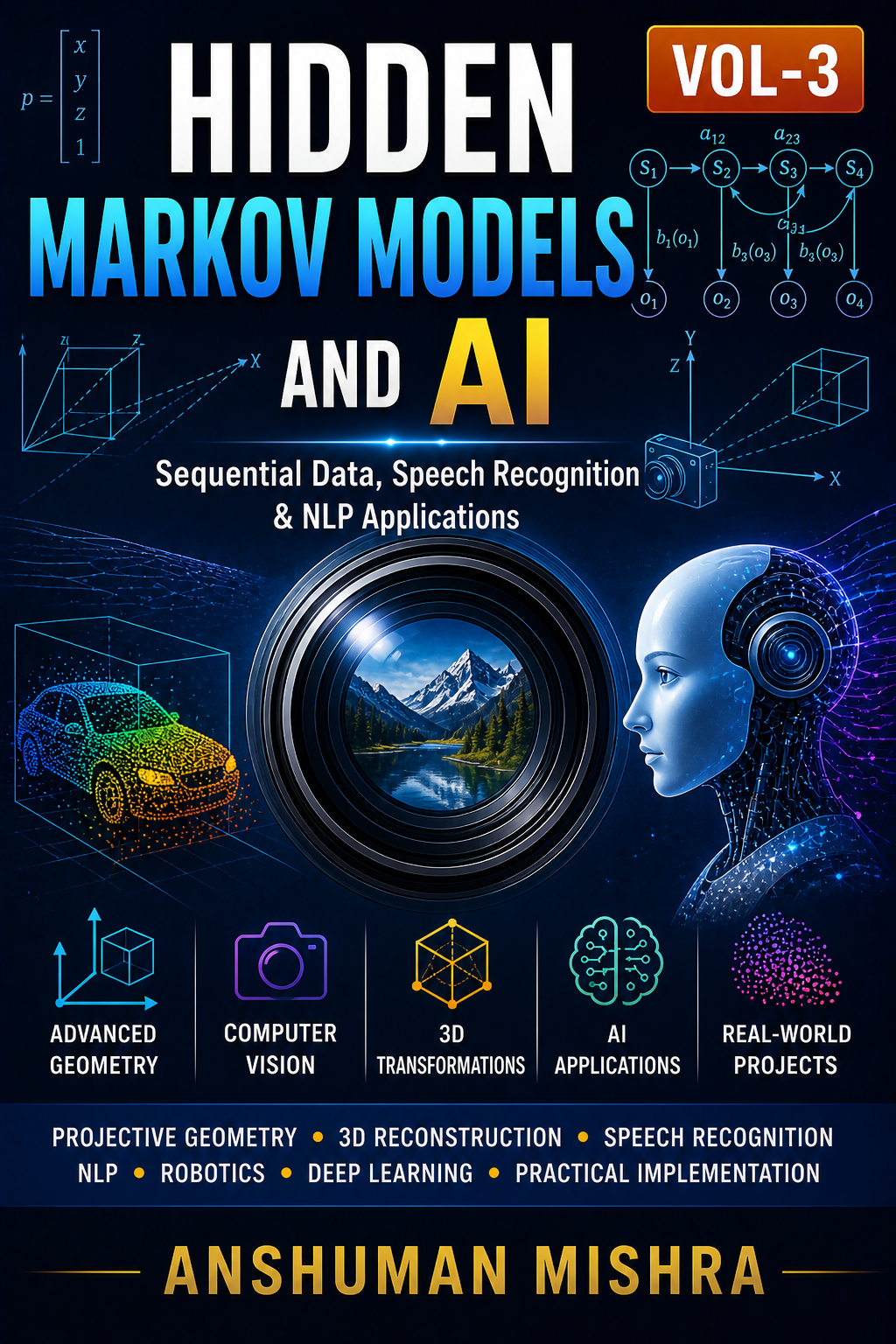
Hidden Markov Models and AI: Sequential Data, Speech Recognition & NLP Applications (Vol. 3)
Author: Anshuman Mishra
Artificial Intelligence continues to evolve toward systems capable of understanding, predicting, and acting within highly dynamic environments. While deep learning has transformed many areas of AI, probabilistic sequence models—especially Hidden Markov Models (HMMs)—remain indispensable in domains where interpretability, sequential reasoning, uncertainty modeling, and statistical efficiency are essential.
Hidden Markov Models and AI: Sequential Data, Speech Recognition & NLP Applications (Vol. 3) is the final volume of this comprehensive series and takes readers beyond theory into practical implementation, interdisciplinary applications, industrial case studies, and future research frontiers. Building upon the mathematical foundations introduced in Volume 1 and the speech recognition and natural language processing applications explored in Volume 2, this volume demonstrates how Hidden Markov Models continue to power intelligent systems across bioinformatics, finance, cybersecurity, Internet of Things (IoT), robotics, autonomous navigation, and modern AI research.
Designed for undergraduate and postgraduate students, AI researchers, software engineers, data scientists, computational biologists, robotics developers, and industry professionals, this volume combines rigorous theoretical concepts with hands-on programming, practical projects, and modern AI development frameworks.
Purpose and Vision of the Book
The goal of this volume is to help readers transition from understanding Hidden Markov Models to confidently implementing and applying them in real-world AI systems.
The book is guided by five core principles:
- Demonstrate practical implementation of HMMs.
- Explore interdisciplinary AI applications.
- Connect classical probabilistic models with modern deep learning.
- Provide industry-oriented projects and case studies.
- Inspire future research in probabilistic Artificial Intelligence.
Rather than treating HMMs as historical algorithms, this book presents them as living technologies that continue to contribute to modern intelligent systems.
Why This Book Matters
Many real-world AI problems involve uncertainty, hidden states, temporal dependencies, and sequential observations. Hidden Markov Models remain one of the most interpretable and mathematically elegant frameworks for solving these challenges.
This volume demonstrates their applications in:
- Bioinformatics
- Computational Biology
- Healthcare Analytics
- Financial Forecasting
- Algorithmic Trading
- Fraud Detection
- Cybersecurity
- Internet of Things (IoT)
- Human Activity Recognition
- Robotics
- Autonomous Navigation
- Sensor Fusion
- Intelligent Monitoring Systems
- Predictive Maintenance
- Sequential Decision-Making
Readers will also explore how HMMs integrate with deep neural networks, probabilistic programming, and next-generation AI architectures.
What This Volume Covers
Part VI – Multi-Domain Applications of Hidden Markov Models
The book begins by exploring advanced applications of HMMs across multiple scientific and engineering disciplines.
Bioinformatics and Computational Biology
Hidden Markov Models have transformed biological sequence analysis.
Topics include:
- DNA Sequence Modeling
- Protein Secondary Structure Prediction
- CpG Island Detection
- Gene Finding Algorithms
- Biological Sequence Annotation
- Genome Analysis
- Gene Prediction Case Studies
Readers learn how probabilistic sequence models support modern computational biology and precision medicine.
Finance, IoT, and Cybersecurity
Sequential probabilistic modeling plays an increasingly important role in intelligent monitoring and prediction.
Coverage includes:
- Market Regime Switching
- Financial Trend Prediction
- Economic Time-Series Modeling
- IoT Activity Recognition
- Event Prediction
- Anomaly Detection
- Cybersecurity Monitoring
- Fraud Detection Systems
These chapters demonstrate how HMMs enable intelligent decision-making under uncertainty across industrial domains.
Robotics and Autonomous Systems
Autonomous systems constantly estimate hidden states while interacting with uncertain environments.
The book explores:
- Robot Localization
- Path Prediction
- Sequential Navigation
- Sensor Fusion
- Autonomous Decision Systems
- Mobile Robotics
- Intelligent Navigation
- Practical Autonomous Vehicle Case Studies
Readers understand how probabilistic state estimation enables reliable robotic intelligence.
Part VII – Implementation, Practicals, and Case Studies
One of the distinguishing features of this volume is its strong emphasis on practical implementation.
Building Hidden Markov Models from Scratch
Readers learn how to implement complete HMM systems using Python.
Topics include:
- Environment Setup
- Markov Chain Programming
- Forward Algorithm Implementation
- Viterbi Algorithm Coding
- Baum–Welch Training
- Debugging Strategies
- Optimization Techniques
- Real Dataset Applications
Every algorithm is translated into practical code, enabling readers to build HMM systems independently.
Modern AI Libraries
The book introduces widely used software frameworks and AI libraries for Hidden Markov Models.
Coverage includes:
- hmmlearn
- PyTorch-Based HMM Models
- TensorFlow Hybrid Architectures
- HTK Speech Toolkit
- Kaldi Speech Recognition
- NLTK Integration
- spaCy Integration
- scikit-learn for Sequential Modeling
Readers gain familiarity with both academic and industrial development tools.
Hands-On Projects
Learning is reinforced through practical assignments that simulate real AI development tasks.
Projects include:
- Building a Part-of-Speech Tagger
- Developing a Speech Recognition System
- Weather Prediction Models
- DNA Sequence Segmentation
- IoT Activity Recognition
- Financial Trend Prediction
- Fraud Detection Systems
These projects help transform theoretical understanding into practical engineering skills.
Part VIII – Future of Hidden Markov Models
The concluding chapters examine the future role of HMMs in modern Artificial Intelligence.
Deep Learning vs Hidden Markov Models
Readers explore the strengths and limitations of different sequential learning paradigms.
Topics include:
- Recurrent Neural Networks
- Long Short-Term Memory Networks
- Gated Recurrent Units
- Transformer Architectures
- Hybrid Deep–HMM Systems
- Comparative Performance Analysis
- Research Trends in Sequential Learning
The book explains when HMMs remain preferable despite advances in deep learning.
Future Research Directions
The final chapter introduces emerging research areas likely to shape the next generation of intelligent systems.
Coverage includes:
- Explainable Sequential AI
- Responsible Artificial Intelligence
- Probabilistic Programming
- Neuro-Symbolic Sequence Models
- Hidden Markov Models for AGI
- Ethical AI
- Trustworthy Sequential Intelligence
- Future Research Opportunities
These discussions provide valuable inspiration for postgraduate students, PhD researchers, and AI scientists.
Key Features of the Book
✔ Advanced interdisciplinary applications
✔ Complete Python implementation guide
✔ Modern AI software libraries
✔ Real-world datasets and projects
✔ Robotics and autonomous systems
✔ Bioinformatics applications
✔ Financial AI and cybersecurity
✔ Hybrid HMM–Deep Learning architectures
✔ Explainable probabilistic AI
✔ Future research directions
Who Should Read This Book?
This book is ideal for:
- BCA Students
- MCA Students
- B.Tech Students
- M.Tech Students
- Artificial Intelligence Students
- Machine Learning Engineers
- Data Scientists
- Robotics Engineers
- Computational Biologists
- NLP Engineers
- Speech Recognition Researchers
- Cybersecurity Professionals
- IoT Developers
- Financial Analysts
- AI Researchers
- PhD Scholars
- Faculty Members
- Industry Professionals
Readers who have completed Volumes 1 and 2 will gain the greatest benefit, though those with a solid understanding of Hidden Markov Models can also use this volume independently.
Applications Covered
The concepts discussed throughout this volume have applications in:
- Artificial Intelligence
- Machine Learning
- Hidden Markov Models
- Bioinformatics
- Computational Biology
- DNA Sequence Analysis
- Protein Structure Prediction
- Gene Prediction
- Precision Medicine
- Healthcare AI
- Financial Forecasting
- Algorithmic Trading
- Fraud Detection
- Cybersecurity
- Internet of Things (IoT)
- Smart Sensors
- Human Activity Recognition
- Robotics
- Autonomous Vehicles
- Sensor Fusion
- Navigation Systems
- Predictive Analytics
- Time-Series Forecasting
- Speech Recognition
- Natural Language Processing
- Deep Learning
- Hybrid AI Systems
- Explainable AI
- Probabilistic Programming
- Artificial General Intelligence
About the Author
Anshuman Mishra is an experienced academician, educator, researcher, and author specializing in Artificial Intelligence, Machine Learning, Computer Science, Data Science, Applied Mathematics, and Emerging Technologies. Through years of teaching and research, he has developed a strong commitment to making advanced AI concepts accessible while maintaining academic depth and practical relevance.
His books emphasize the integration of mathematical theory, algorithmic understanding, practical programming, and real-world applications, helping readers develop the skills needed for both research and industry.
Conclusion
Hidden Markov Models have stood the test of time because they offer a unique combination of mathematical elegance, interpretability, and practical effectiveness. Even in the age of deep learning and large-scale neural architectures, HMMs continue to play a vital role in speech recognition, language processing, bioinformatics, robotics, finance, cybersecurity, and intelligent sequential decision-making.
Hidden Markov Models and AI: Sequential Data, Speech Recognition & NLP Applications (Vol. 3) completes this comprehensive trilogy by bringing together advanced applications, practical implementation, modern AI frameworks, and future research directions. It equips readers with the knowledge and tools required to design, implement, and innovate using probabilistic sequence models in the rapidly evolving landscape of Artificial Intelligence.
Whether your goal is academic excellence, industrial AI development, or pioneering research, this volume serves as a comprehensive guide to mastering the practical and future-facing dimensions of Hidden Markov Models.


Reviews
There are no reviews yet.