Description
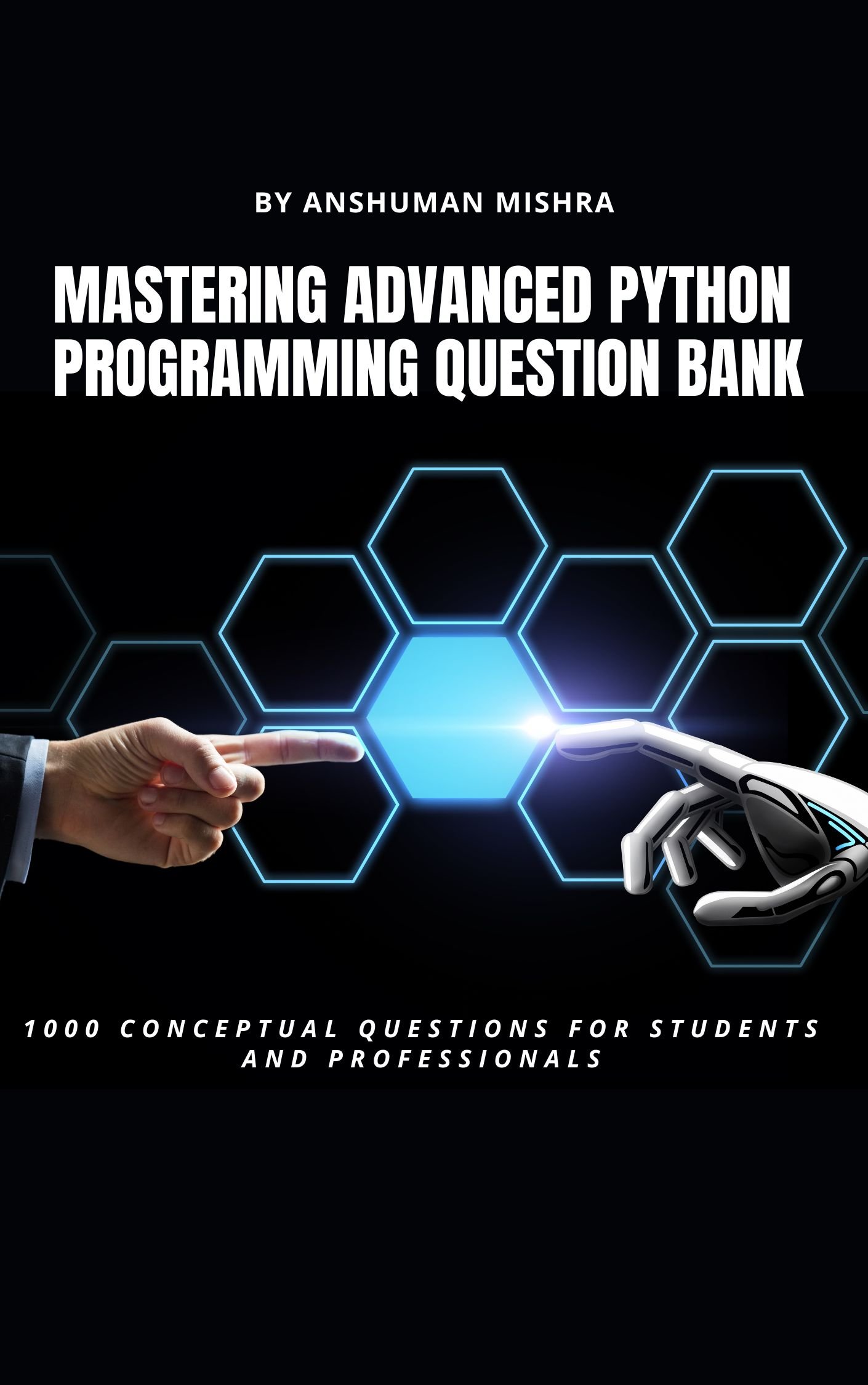
Mastering Advanced Python Programming QUESTION BANK
1000+ Conceptual Questions for Students and Professionals
- A Comprehensive Question Bank with MCQs, Short and Mid-Length Questions – For BCA, MCA, B.Tech, M.Tech & Software Interviews *
Mastering Advanced Python Programming QUESTION BANK is a comprehensive academic and professional preparation resource designed for learners who want to strengthen their advanced Python programming concepts through structured practice.
Python is one of the most widely used programming languages in software development, automation, data processing, networking, web development, and modern technology applications. However, mastering Python requires more than understanding basic syntax. Learners must develop strong conceptual knowledge of advanced data structures, iterators, generators, decorators, exception handling, concurrency, networking, databases, APIs, and other important programming concepts.
This book addresses these requirements through a carefully organized question-bank format that combines theory, conceptual understanding, programming practice, and interview preparation.
What Makes This Book Valuable?
The book contains 12 comprehensive chapters, covering important areas of advanced Python programming. Each chapter follows a consistent learning structure, making it useful for classroom teaching, examination preparation, laboratory practice, self-study, placement preparation, and technical interviews.
Every chapter includes:
- 50 MCQs
- 25 Short Answer Questions
- 15 Mid-Length Answer Questions with Answers
- 20 Programming Questions with Answers
Across the 12 chapters, the book provides a large collection of questions and programming exercises designed to improve conceptual clarity, analytical thinking, coding ability, and problem-solving skills.
Key Topics Covered
Chapter 1: Advanced Data Structures in Python
Explore advanced operations and concepts related to Python’s lists, tuples, sets, dictionaries, and collection utilities. Topics include comprehensions, hashing, namedtuple, defaultdict, deque, heapq, Counter, and OrderedDict.
Chapter 2: Iterators and Generators
Understand iterable objects, custom iterators, generator functions, generator expressions, lazy evaluation, and the yield keyword. The chapter emphasizes memory-efficient programming and Pythonic iteration techniques.
Chapter 3: Decorators and Closures
Learn about first-class functions, closures, function decorators, decorator chaining, parameterized decorators, staticmethod, and classmethod. Practical questions help learners understand how decorators are used in real applications.
Chapter 4: Lambda Functions, map, filter, and reduce
Develop a strong understanding of functional programming techniques in Python. The chapter covers lambda expressions, map(), filter(), reduce(), functional pipelines, and practical programming applications.
Chapter 5: Error Handling and Exceptions
Learn how to build reliable Python applications using exception handling. Topics include built-in exceptions, exception hierarchy, try-except-else-finally, custom exceptions, exception chaining, raising exceptions, and logging.
Chapter 6: File Handling and Context Managers
Practice reading and writing files, handling CSV and JSON data, working with text and binary files, and using the with statement. The chapter also introduces custom context managers using __enter__() and __exit__().
Chapter 7: Modules, Packages, and Virtual Environments
Understand Python’s modular programming architecture, package organization, imports, namespaces, __init__.py, __name__, __main__, pip, virtual environments, and dependency management.
Chapter 8: Multithreading and Multiprocessing
Explore concurrency and parallelism using Python’s threading and multiprocessing modules. The chapter covers the Global Interpreter Lock (GIL), synchronization, locks, queues, thread safety, and producer-consumer concepts.
Chapter 9: Networking and Sockets
Learn the fundamentals of TCP/IP and socket programming. Questions and programming exercises cover server-client architecture, socket communication, and multithreaded networking applications.
Chapter 10: Regular Expressions in Python
Develop practical skills in pattern matching and text processing using Python’s re module. Topics include match(), search(), findall(), groups, quantifiers, lookaheads, substitution, and validation.
Chapter 11: Python with Databases – SQLite and MySQL
Learn how Python applications communicate with databases. The chapter covers SQLite, MySQL connectivity, SQL queries, transactions, data retrieval, insertion, updates, and secure database programming practices.
Chapter 12: Working with APIs and Web Requests
Understand how Python communicates with web services through REST APIs and HTTP requests. Topics include GET, POST, PUT, DELETE, JSON parsing, status codes, headers, authentication, and API error handling.
Major Features
Exam-Oriented Content:
Designed to support university examinations, internal assessments, quizzes, practical examinations, and competitive preparation.
Interview Preparation:
Important advanced Python concepts such as decorators, generators, threading, multiprocessing, regex, databases, sockets, and APIs are highly relevant for technical interviews.
Programming Practice:
The book goes beyond theoretical questions by providing programming-oriented exercises that encourage learners to write, understand, debug, and improve Python code.
Progressive Learning:
Topics are organized systematically, allowing learners to move from advanced language concepts toward practical application areas.
Structured Question Bank:
The consistent chapter-wise format makes the book convenient for students, teachers, trainers, and institutions.
Python 3.x Focus:
Programming exercises and solutions are designed around modern Python 3.x programming practices.
Academic + Professional Use:
The book can serve as a curriculum companion, question bank, laboratory resource, placement preparation guide, interview preparation book, and self-learning resource.
Who Should Buy This Book?
This book is especially useful for:
- BCA Students
- MCA Students
- B.Tech CSE/IT Students
- M.Tech Students
- Computer Science and IT learners
- Python programming students
- Programming instructors and faculty members
- Training institutes and coding bootcamps
- Software development aspirants
- Python interview candidates
- Job seekers preparing for technical roles
- Freelancers and automation learners
- Self-learners interested in advanced Python
Perfect For
University Examination Preparation
Prepare systematically using MCQs, short-answer questions, descriptive questions, and programming exercises.
Technical Interviews
Revise advanced Python concepts and practice problem-oriented questions relevant to software development roles.
Classroom Teaching
Faculty members can use the question bank for assignments, quizzes, internal examinations, tutorials, and laboratory sessions.
Programming Practice
Strengthen practical Python skills by working through programming questions covering real-world concepts.
Self-Learning
Use the chapter-wise structure to identify weak areas, revise concepts, and gradually improve programming confidence.
Final Takeaway
Mastering Advanced Python Programming QUESTION BANK is designed to bridge the gap between conceptual learning and practical programming. Instead of relying only on theoretical explanations, learners can test their knowledge, analyze Python behavior, practice programming, and prepare for academic and professional challenges.
Whether you are a student preparing for examinations, a job seeker preparing for Python interviews, an educator creating assessments, or a professional strengthening your programming skills, this book provides a structured and practical way to revise and master advanced Python programming concepts.
Reviews
There are no reviews yet.