Description
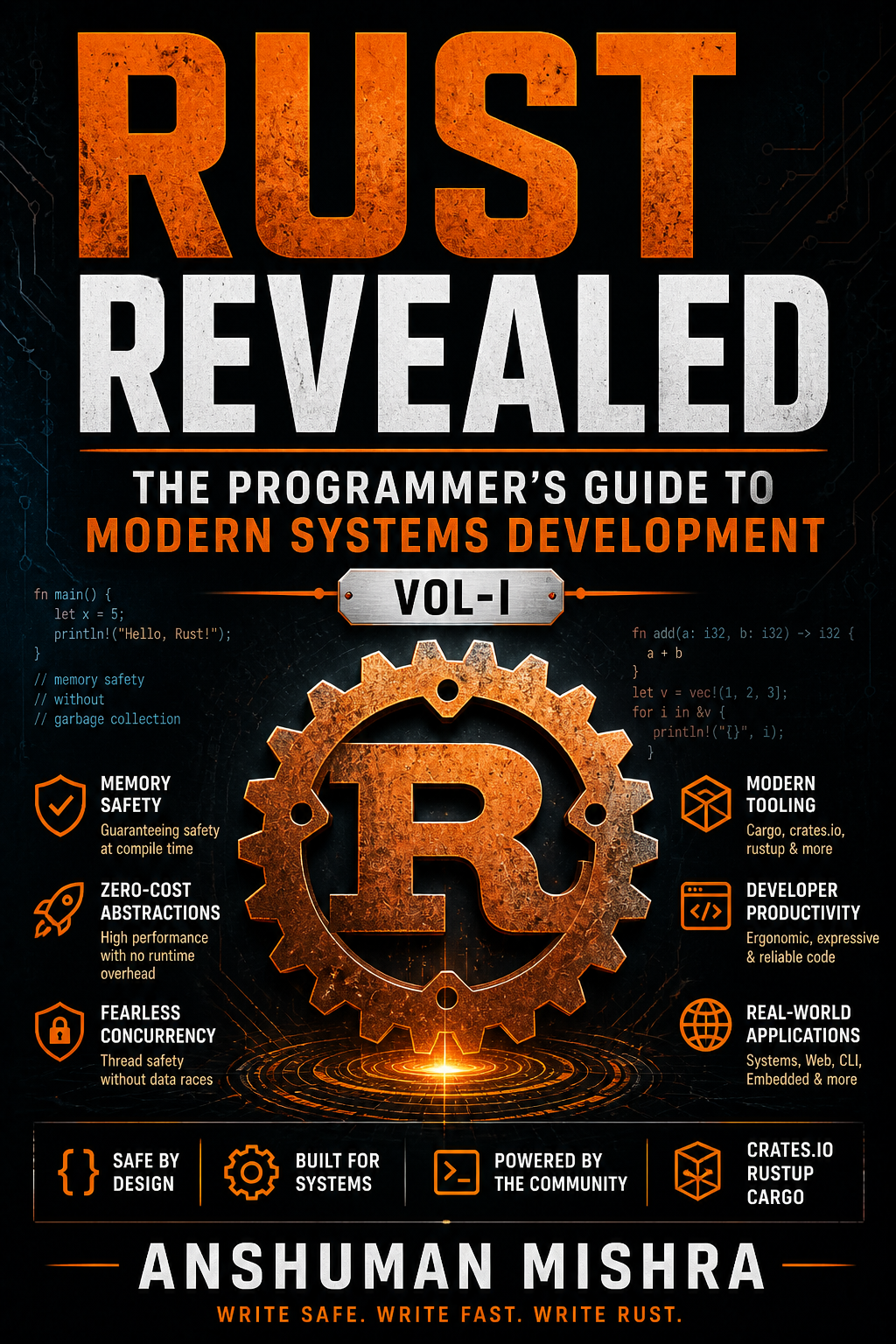
Modern software development demands programming languages that can deliver high performance, memory safety, reliability, and concurrency without sacrificing developer productivity.
Rust Revealed: The Programmer’s Guide to Modern Systems Development (VOL-I) introduces readers to Rust, a modern systems programming language designed to address many of the challenges traditionally associated with low-level software development.
Rust combines the performance and control expected from systems programming with powerful compile-time safety mechanisms. Its ownership model, borrowing rules, strong type system, and modern tooling help developers create software that is both efficient and reliable.
This volume provides a structured journey from the fundamentals of Rust to important concepts such as ownership, borrowing, lifetimes, collections, error handling, structures, enumerations, and pattern matching.
The goal is not simply to teach Rust syntax. It is to develop a Rust programming mindset that encourages safe, maintainable, efficient, and well-structured software.
Why Learn Rust?
Rust has become an important language for modern systems development because it combines several characteristics that developers traditionally had to balance carefully.
Memory Safety
Rust’s ownership and borrowing system helps prevent many classes of memory-related errors at compile time.
High Performance
Rust is designed for performance-sensitive software and provides fine-grained control over system resources.
Modern Type System
Rust’s type system helps developers express program behavior more precisely and detect many errors before execution.
Powerful Toolchain
Tools such as Cargo, rustup, rustfmt, and Clippy provide an integrated development workflow.
Modern Systems Development
Rust can be applied to areas such as:
- Systems programming
- Backend development
- Command-line applications
- Embedded systems
- Networking
- Web services
- Performance-sensitive applications
- Developer tools
What This Volume Covers
Part I – Getting Started with Rust
The book begins with the fundamental concepts required to start programming in Rust.
Chapter 1 – Introduction to Rust
The first chapter introduces Rust and explains why it was designed as a modern systems programming language.
Topics include:
- History of Rust
- Motivation behind Rust
- Design philosophy
- Key characteristics
- Rust compared with traditional systems languages
- Performance and safety
- Real-world use cases
Readers gain an understanding of what makes Rust different from languages such as C, C++, Java, and Python.
Chapter 2 – Setting Up the Rust Environment
Before writing larger programs, developers need a reliable development environment.
This chapter explains:
- Installing Rust using rustup
- Rust toolchain management
- Setting up Visual Studio Code
- Recommended extensions
- Creating a Rust project
- Compiling Rust programs
- Running the first program
- Understanding basic project structure
The chapter concludes with the classic Hello, World! program and introduces the basic Rust development workflow.
Chapter 3 – The Rust Toolchain
Rust provides a powerful ecosystem of development tools.
This chapter introduces:
Cargo
Cargo is Rust’s build system and package manager. Readers learn how to:
- Create projects
- Build applications
- Run programs
- Manage dependencies
- Create packages
- Work with project configuration
Crates and Modules
The book explains how Rust projects can be organized into reusable components using crates and modules.
rustfmt
Readers learn how automated formatting can improve code consistency.
Clippy
Clippy provides useful lints and suggestions that help developers improve Rust code.
Testing
The chapter introduces basic unit testing and demonstrates how testing can be integrated into the Rust development workflow.
Part II – Core Language Concepts
The second part develops the core programming concepts required for writing Rust applications.
Chapter 4 – Variables and Data Types
Rust’s approach to variables is an important part of its programming philosophy.
This chapter explores:
- Variables
- Immutability
- Mutability
- Shadowing
- Constants
- Primitive data types
- Integers
- Floating-point numbers
- Boolean values
- Characters
- Type inference
- Type conversion
A major emphasis is placed on immutability by default, helping readers understand how Rust encourages safer programming practices.
Chapter 5 – Control Flow and Pattern Matching
Control flow determines how programs make decisions and repeat operations.
The chapter covers:
ifexpressionselseelse ifmatchloopwhilefor- Loop control
- Pattern matching
- Advanced pattern matching concepts
Rust’s powerful pattern-matching capabilities are introduced as an important mechanism for writing expressive and safe programs.
Chapter 6 – Functions and Modules
Well-designed software requires modular and reusable code.
This chapter explains:
- Function definitions
- Parameters
- Return values
- Expressions and statements
- Function scope
- Modules
moduse- Namespaces
- Visibility
- Code organization
Readers learn how to structure Rust programs so that applications remain understandable and maintainable as they grow.
Chapter 7 – Ownership, Borrowing, and Lifetimes
One of the most distinctive aspects of Rust is its ownership model.
This chapter introduces the concepts that form the foundation of Rust’s memory-safety guarantees.
Topics include:
- Ownership
- Stack and heap concepts
- Moving values
- Borrowing
- References
- Mutable references
- Ownership rules
- Lifetime concepts
- Lifetime annotations
- Lifetime elision
Understanding these concepts is essential for becoming proficient in Rust.
The chapter helps readers understand how Rust manages memory safely without relying on a traditional garbage collector.
Part III – Memory and Data Management
The third part focuses on data structures, collections, error handling, and safe data modeling.
Chapter 8 – Collections and Compound Types
Real applications require more than primitive data types.
This chapter introduces Rust’s important compound and collection types.
Topics include:
- Tuples
- Arrays
- Vectors
- HashMaps
- HashSets
- Strings
- String slices
- UTF-8 considerations
- Collection manipulation
- Ownership with collections
Readers learn how to efficiently store and manipulate groups of values while respecting Rust’s ownership rules.
Chapter 9 – Error Handling in Rust
Reliable software must be able to handle unexpected situations.
Rust provides powerful mechanisms for representing and handling errors.
This chapter introduces:
OptionResult- Recoverable errors
- Unrecoverable errors
unwrapexpect?operator- Error propagation
- Custom error types
- Error-handling strategies
The focus is on designing programs that handle failures explicitly rather than allowing unexpected conditions to silently propagate.
Chapter 10 – Structs, Enums, and Pattern Matching
Rust provides powerful mechanisms for modeling real-world entities and states.
This chapter covers:
Structs
Readers learn how to create custom data structures and associate behavior with them.
Methods
Associated functions and methods are introduced for organizing functionality around data.
Enums
Rust enums allow developers to represent values that may belong to different possible variants.
Pattern Matching
Pattern matching is used to safely work with different enum variants and program states.
Exhaustive Matching
Readers learn why Rust’s compiler encourages developers to handle possible cases explicitly.
These features help developers build safe, expressive, and maintainable data models.
Key Features of the Book
1. Beginner-Friendly Learning Path
The book begins with basic programming concepts and gradually introduces Rust’s more advanced features.
2. Strong Focus on Ownership
Ownership, borrowing, and lifetimes receive special attention because they are central to understanding Rust.
3. Modern Development Workflow
Readers are introduced to:
- rustup
- Cargo
- crates
- rustfmt
- Clippy
- Unit testing
- VS Code
4. Practical Programming Perspective
The book focuses on concepts that can be applied to real Rust projects rather than limiting the discussion to syntax.
5. Systems Programming Foundation
The concepts introduced in this volume prepare readers for more advanced areas such as concurrency, asynchronous programming, networking, web development, embedded systems, and performance optimization.
What You Will Learn
After completing this volume, readers will be able to:
✔ Understand Rust’s philosophy and design goals
✔ Install and configure the Rust development environment
✔ Use rustup and Cargo
✔ Create and manage Rust projects
✔ Understand crates and modules
✔ Use rustfmt and Clippy
✔ Write basic unit tests
✔ Work with variables and data types
✔ Understand immutability and mutability
✔ Use control-flow structures
✔ Apply pattern matching
✔ Create functions and modules
✔ Understand namespaces and scope
✔ Explain Rust’s ownership model
✔ Work with references and borrowing
✔ Understand lifetime concepts
✔ Use vectors, arrays, tuples, and hash collections
✔ Work with strings and slices
✔ Handle errors using Result and Option
✔ Create custom error-handling logic
✔ Define structs and enums
✔ Use associated methods
✔ Apply exhaustive pattern matching
✔ Build a strong foundation for advanced Rust development
Who Should Read This Book?
This book is suitable for:
- BCA Students
- MCA Students
- B.Tech / BE Students
- M.Tech Students
- Computer Science Students
- Software Developers
- System Programmers
- Backend Developers
- Web Developers
- Embedded Systems Learners
- Programming Beginners
- C/C++ Developers
- Python Developers
- JavaScript Developers
- Software Engineering Professionals
- Programming Faculty
- Competitive Exam Aspirants
- Technology Enthusiasts
Career and Professional Applications
Learning Rust can provide a foundation for working in several technology domains, including:
Systems Programming
Developing efficient and reliable low-level software.
Backend Development
Building high-performance web services and APIs.
Embedded Development
Creating software for resource-constrained devices.
Networking
Developing efficient networking applications and infrastructure.
Developer Tools
Building command-line tools, compilers, utilities, and development infrastructure.
Performance-Critical Software
Creating applications where speed, memory usage, and reliability are important.
Learning Journey
The book follows a progressive learning path:
Rust Introduction → Environment Setup → Cargo → Syntax → Data Types → Control Flow → Functions → Modules → Ownership → Borrowing → Lifetimes → Collections → Error Handling → Structs → Enums → Pattern Matching
This approach allows readers to build their knowledge step by step while developing the conceptual foundation required for advanced Rust programming.
Why This Book Is Valuable
Rust represents an important direction in modern systems programming because it attempts to combine:
Performance + Memory Safety + Reliability + Modern Language Design
Understanding these principles is valuable even beyond Rust itself. Concepts such as immutability, explicit error handling, modular programming, ownership, and safe resource management can improve a developer’s overall programming mindset.
Rust Revealed – VOL-I therefore serves not only as an introduction to Rust syntax but also as a foundation for thinking about safe, efficient, and maintainable software systems.
Book Details
Book Title: Rust Revealed: The Programmer’s Guide to Modern Systems Development
Volume: VOL-I
Subject: Rust Programming, Systems Programming, Software Development, Memory Safety
Level: Beginner to Intermediate
Author: Anshuman Mishra
Publication Year: 2025
Format: Technical / Academic Reference Book


Reviews
There are no reviews yet.