Description
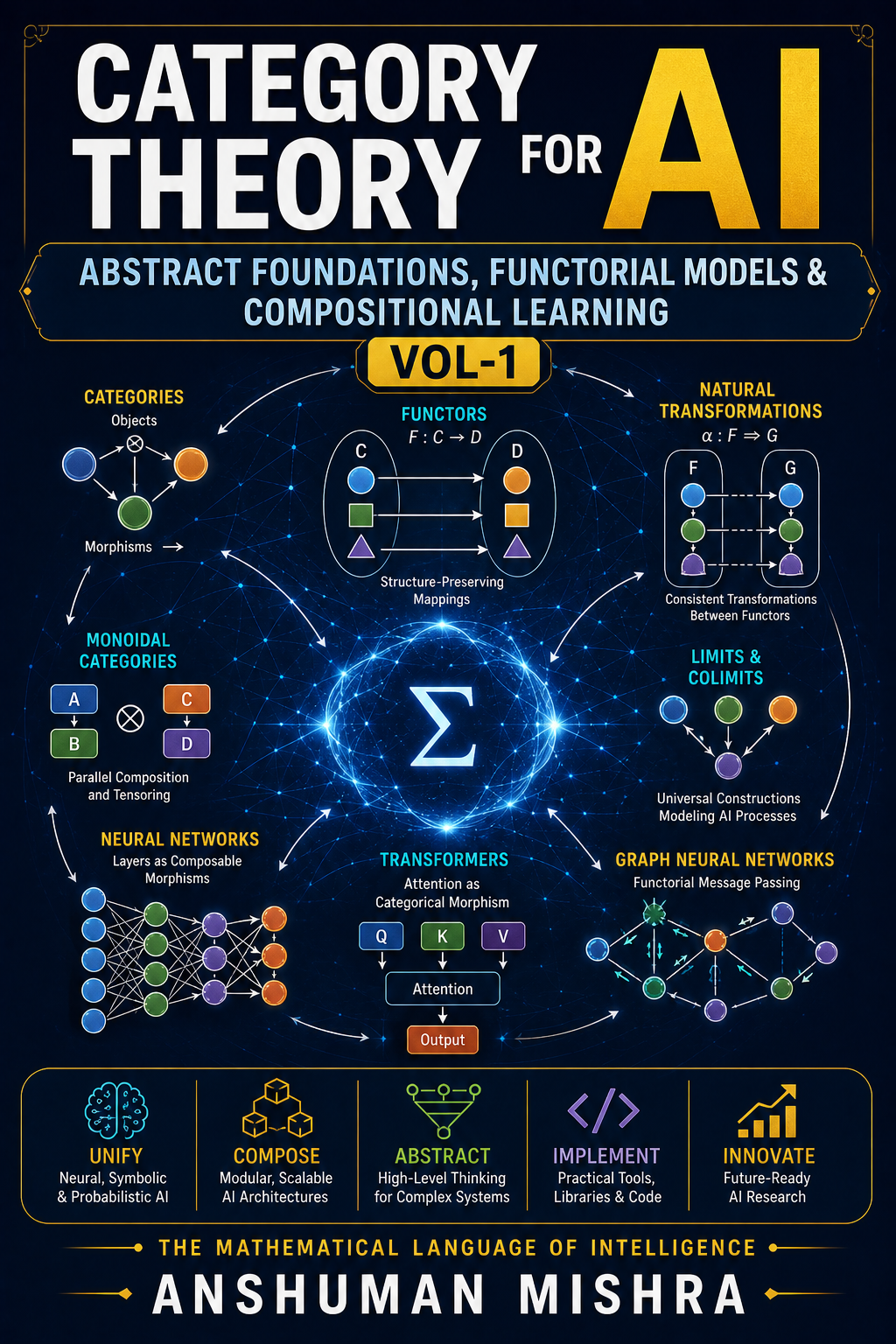
Category Theory for AI
Abstract Foundations, Functorial Models & Compositional Learning (Vol. 1)
Artificial Intelligence is entering a new era where abstraction, compositionality, and mathematical structure are becoming essential for building scalable, explainable, and trustworthy intelligent systems. While traditional AI has relied heavily on linear algebra, calculus, probability, and optimization, a growing body of research demonstrates that Category Theory provides a powerful unifying language capable of connecting symbolic reasoning, neural computation, probabilistic inference, graph learning, and modern deep learning architectures.
Category Theory for AI: Abstract Foundations, Functorial Models & Compositional Learning (Vol. 1) introduces readers to this exciting interdisciplinary field by presenting Category Theory as the mathematical foundation for next-generation Artificial Intelligence.
Beginning with the basic concepts of categories, objects, morphisms, functors, and natural transformations, the book gradually develops advanced topics such as monoidal categories, universal constructions, Yoneda Lemma, categorical machine learning, graph neural networks, probabilistic AI, and compositional deep learning. Every concept is explained with intuitive examples and connected to practical AI systems, enabling readers to understand how abstract mathematical structures can model real-world intelligent computation.
This volume is written for undergraduate and postgraduate students, researchers, educators, mathematicians, AI engineers, and software professionals who wish to explore one of the most promising mathematical frameworks shaping the future of Artificial Intelligence.
What You’ll Learn
✔ Foundations of Category Theory
✔ Categories, Objects and Morphisms
✔ Composition and Identity Morphisms
✔ Commutative Diagrams
✔ Abstract vs Concrete Categories
✔ Set, Rel, Cat, Top and Vect Categories
✔ Universal Properties
✔ Limits and Colimits
✔ Categorical Equivalence
✔ Functors
✔ Covariant and Contravariant Functors
✔ Natural Transformations
✔ Functor Categories
✔ Adjunctions
✔ Monoidal Categories
✔ Cartesian Categories
✔ Closed Categories
✔ Tensor Products
✔ Functional Programming Concepts
✔ Universal Constructions
✔ Yoneda Lemma
✔ Pullbacks and Pushouts
✔ Equalizers and Coequalizers
✔ Representable Functors
✔ Category Theory for Machine Learning
✔ Data Pipelines as Categories
✔ Dataset Transformations
✔ Neural Networks as Morphisms
✔ Layers as Functors
✔ Backpropagation through Category Theory
✔ Computation Graphs
✔ Functorial Machine Learning
✔ Transfer Learning
✔ Multi-Modal Learning
✔ Probabilistic Categories
✔ Markov Categories
✔ Bayesian Reasoning
✔ Diffusion Models
✔ Statistical Learning
✔ Monoids and Semirings
✔ Order Theory
✔ Graph Neural Networks
✔ Graph Categories
✔ Hypergraphs
✔ Equivariant Learning
✔ Tensor Categories
✔ Deep Learning Semantics
✔ Residual Networks
✔ Transformer Architectures
✔ Compositional Artificial Intelligence
Table of Contents
Part I – Category Theory Essentials for AI
Chapter 1
Introduction to Category Theory and Artificial Intelligence
Chapter 2
Foundations of Categories
Chapter 3
Functors and Natural Transformations
Chapter 4
Monoidal, Cartesian and Closed Categories
Chapter 5
Limits, Colimits and Universal Constructions
Part II – Category Theory for Machine Learning
Chapter 6
Categories of Data
Chapter 7
Neural Networks in a Categorical Framework
Chapter 8
Functorial Machine Learning
Chapter 9
Category Theory for Probabilistic Models
Chapter 10
Operational and Algebraic Structures in Artificial Intelligence
Part III – Applied Category Theory in AI Architectures
Chapter 11
Graphs, Categories and Artificial Intelligence
Chapter 12
Categories and Deep Learning Frameworks
Who Should Read This Book?
This book is ideal for:
- B.Tech Students
- BCA Students
- MCA Students
- M.Tech Students
- Computer Science Students
- Mathematics Students
- Artificial Intelligence Students
- Machine Learning Engineers
- Deep Learning Researchers
- Data Scientists
- Software Engineers
- Research Scholars
- University Faculty
- AI Architects
- Computational Mathematicians
- Functional Programming Enthusiasts
- Robotics Researchers
- Graph Neural Network Researchers
- PhD Scholars
- Competitive Examination Aspirants
Key Features
✅ First-principles introduction to Category Theory for Artificial Intelligence
✅ Bridges abstract mathematics with modern AI systems
✅ Covers Functors, Natural Transformations, and Monoidal Categories
✅ Explains Neural Networks through categorical frameworks
✅ Includes probabilistic AI and Bayesian reasoning
✅ Graph Neural Networks and Transformer architectures
✅ Universal constructions with AI applications
✅ Modern Machine Learning interpretation
✅ Research-oriented and industry-relevant content
✅ Suitable for university courses and advanced self-study
✅ Rich conceptual explanations with practical AI insights
Why This Book?
Category Theory is increasingly recognized as one of the most promising mathematical languages for describing complex Artificial Intelligence systems. Unlike traditional AI textbooks that focus on algorithms alone, this book provides a unified mathematical framework capable of expressing neural computation, probabilistic reasoning, graph learning, and compositional machine learning using elegant categorical concepts.
Readers will develop a deep understanding of how abstraction, composition, and mathematical structure contribute to building scalable, interpretable, and reusable AI architectures. Whether pursuing academic research, advanced AI development, or mathematical foundations of intelligent systems, this book offers a comprehensive guide to one of the fastest-growing areas of AI research.
Book Details
Title: Category Theory for AI
Subtitle: Abstract Foundations, Functorial Models & Compositional Learning
Volume: Vol. 1
Author: Anshuman Mishra
Publisher: Anshuman Mishra
Publication Year: 2025
Language: English
Category: Artificial Intelligence, Category Theory, Machine Learning, Mathematics, Computer Science, Deep Learning

Reviews
There are no reviews yet.