Description
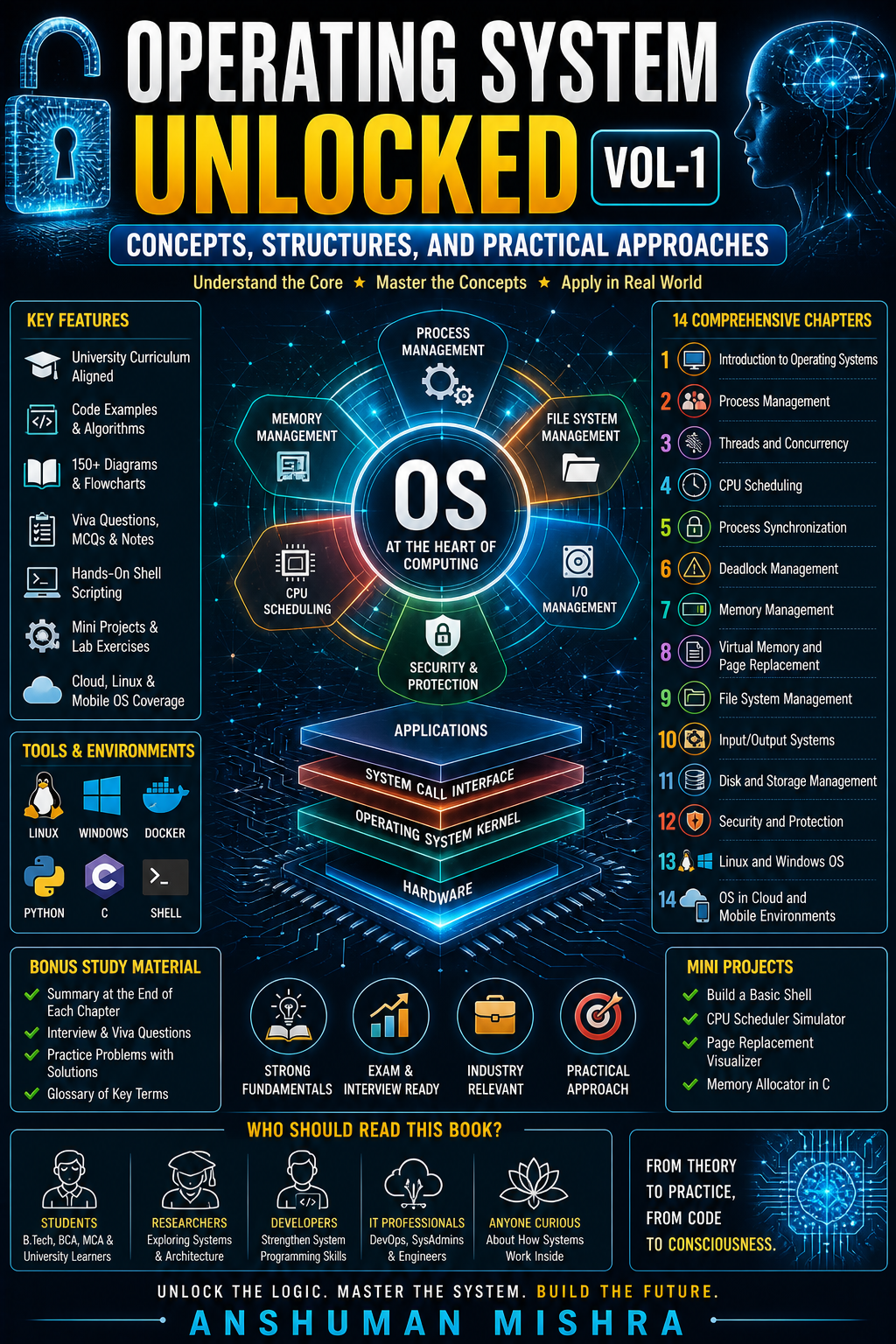
An operating system is the foundation of modern computing. Every computer, smartphone, server, cloud platform, and embedded device depends on an operating system to manage hardware resources and provide an efficient environment for applications.
Operating Systems Unlocked: Concepts, Structures, and Practical Approaches (VOL-I) provides a structured and comprehensive introduction to the fundamental principles behind operating systems.
The book is designed to move beyond memorizing definitions. It explains how operating systems work, why specific algorithms are required, and how different OS components interact with one another.
From process creation and CPU scheduling to synchronization, deadlock management, memory allocation, and virtual memory, readers develop a strong conceptual foundation that can be applied to academic examinations, programming, system design, and technical interviews.
What This Book Covers
The book covers eight major chapters that establish a strong foundation in Operating Systems.
Chapter 1: Introduction to Operating Systems
The book begins by introducing the fundamental role of an operating system.
Readers explore:
- Definition and purpose of operating systems
- Evolution of operating systems
- Batch operating systems
- Time-sharing systems
- Real-time operating systems
- Distributed operating systems
- Mobile operating systems
- Operating systems as resource managers
- Operating system services
- System calls
- User interfaces
- Monolithic architecture
- Layered architecture
- Microkernel architecture
- Modular operating systems
This chapter helps readers understand the architecture and responsibilities of an operating system.
Chapter 2: Process Management
Processes are central to operating-system execution.
This chapter explains:
- Process concepts
- Process states
- Process state transitions
- Process Control Block (PCB)
- Process scheduling
- Long-term scheduler
- Short-term scheduler
- Medium-term scheduler
- Context switching
- Process creation and termination
- Process operations
- Interprocess Communication (IPC)
The chapter establishes the foundation required to understand CPU scheduling and concurrent execution.
Chapter 3: Threads and Concurrency
Modern applications frequently execute multiple tasks concurrently.
This chapter explores:
- Processes vs. threads
- User-level threads
- Kernel-level threads
- Benefits of multithreading
- Thread libraries
- POSIX threads
- Java thread concepts
- One-to-One model
- Many-to-One model
- Many-to-Many model
- Introduction to concurrency problems
Readers gain an understanding of why multithreading is important for responsive and efficient applications.
Chapter 4: CPU Scheduling
CPU scheduling determines how processes receive processor time.
The chapter introduces important scheduling concepts and algorithms, including:
- Scheduling terminology
- Scheduling criteria
- First-Come, First-Served (FCFS)
- Shortest Job First (SJF)
- Priority Scheduling
- Round Robin
- Multilevel Queue Scheduling
- Preemptive scheduling
- Non-preemptive scheduling
- Waiting time
- Turnaround time
- Response time
- Throughput
- Scheduling performance evaluation
A particularly useful feature is the inclusion of Gantt-chart-based analysis and numerical examples, helping students understand how scheduling algorithms work step by step.
Chapter 5: Process Synchronization
When multiple processes or threads share resources, synchronization becomes essential.
This chapter covers:
- Critical Section Problem
- Peterson’s Solution
- Bakery Algorithm
- Hardware synchronization support
- Semaphores
- Mutexes
- Monitors
- Bounded Buffer Problem
- Readers-Writers Problem
- Dining Philosophers Problem
The chapter helps readers understand how operating systems prevent inconsistent results and coordinate concurrent activities.
Chapter 6: Deadlock Management
Deadlocks are among the most important resource-management problems in operating systems.
Readers learn:
- Deadlock definition
- Deadlock characterization
- Necessary conditions
- Mutual exclusion
- Hold and wait
- No preemption
- Circular wait
- Resource Allocation Graph
- Deadlock prevention
- Deadlock avoidance
- Deadlock detection
- Deadlock recovery
- Banker’s Algorithm
Special attention is given to Banker’s Algorithm and resource-allocation concepts, making this chapter valuable for both university examinations and technical interviews.
Chapter 7: Memory Management
Memory management is one of the core responsibilities of an operating system.
This chapter explains:
- Logical address space
- Physical address space
- Address translation
- Swapping
- Contiguous memory allocation
- Paging
- Page tables
- Translation Lookaside Buffer (TLB)
- Segmentation
- Internal fragmentation
- External fragmentation
- Virtual memory fundamentals
Readers learn how operating systems efficiently allocate and manage memory among multiple processes.
Chapter 8: Virtual Memory and Page Replacement
The final chapter focuses on virtual memory and the techniques used to manage page faults and limited physical memory.
Topics include:
- Demand paging
- Page-fault handling
- Page replacement
- FIFO algorithm
- LRU algorithm
- Optimal page replacement
- Clock algorithm
- Thrashing
- Working Set Model
- Memory-mapped files
- Shared memory
The chapter provides a strong foundation for understanding how modern operating systems can execute programs whose memory requirements exceed available physical memory.
Key Benefits of Studying This Book
1. Strong Conceptual Foundation
The book explains fundamental OS concepts systematically, helping readers develop a clear understanding before moving toward advanced topics.
2. Algorithm-Oriented Learning
Important operating-system algorithms are explained in a structured manner, including:
- CPU scheduling algorithms
- Synchronization algorithms
- Banker’s Algorithm
- Page replacement algorithms
3. Numerical and Problem-Solving Approach
Topics such as CPU scheduling, deadlocks, paging, and page replacement are particularly suitable for numerical practice and examination preparation.
4. Academic and Professional Relevance
The book is useful for university courses as well as technical interview preparation.
5. Easy-to-Follow Structure
Complex operating-system concepts are divided into smaller topics with logical progression.
6. Practical Understanding
Instead of focusing exclusively on theoretical definitions, the book emphasizes how operating-system mechanisms work in practical computing environments.
What You Will Learn
After studying this book, readers will be able to:
✔ Explain the purpose and functions of an operating system
✔ Understand different OS architectures
✔ Describe process states and process management
✔ Understand Process Control Blocks
✔ Explain process scheduling mechanisms
✔ Differentiate processes and threads
✔ Understand multithreading models
✔ Solve CPU scheduling problems
✔ Analyze Gantt charts
✔ Understand synchronization mechanisms
✔ Apply semaphore and mutex concepts
✔ Explain classical synchronization problems
✔ Identify deadlock conditions
✔ Understand deadlock prevention and avoidance
✔ Apply Banker’s Algorithm
✔ Understand memory allocation techniques
✔ Explain paging and segmentation
✔ Understand page tables and TLB
✔ Calculate page replacement behavior
✔ Compare FIFO, LRU, Optimal, and Clock algorithms
✔ Understand virtual memory and demand paging
✔ Analyze common operating-system performance issues
Who Should Read This Book?
This book is especially suitable for:
- BCA Students
- MCA Students
- B.Tech / BE Students
- M.Tech Students
- Computer Science Students
- Information Technology Students
- Software Engineering Students
- Computer Science Faculty
- Programming Learners
- System Programming Students
- UGC-NET Computer Science Aspirants
- GATE Computer Science Aspirants
- Technical Interview Candidates
- IT Professionals
- Computer Science Researchers
Academic Use
The book can serve as a reference for courses covering:
- Operating Systems
- System Software
- Computer Architecture
- Computer Networks
- Concurrent Programming
- System Programming
- Advanced Operating Systems
- Computer Science Fundamentals
It can also be useful for preparing conceptual and numerical questions related to CPU scheduling, synchronization, deadlocks, memory management, paging, and virtual memory.
Core Topics at a Glance
Operating Systems → Processes → Threads → CPU Scheduling → Synchronization → Deadlocks → Memory Management → Virtual Memory → Page Replacement
This progression gives readers a complete foundation for understanding the major mechanisms through which operating systems manage computing resources.
Book Details
Book Title: Operating Systems Unlocked: Concepts, Structures, and Practical Approaches
Volume: VOL-I
Subject: Operating Systems / Computer Science
Level: Undergraduate to Postgraduate
Author: Anshuman Mishra
Publication Year: 2025
Format: Academic / Technical Reference Book


Reviews
There are no reviews yet.