Description
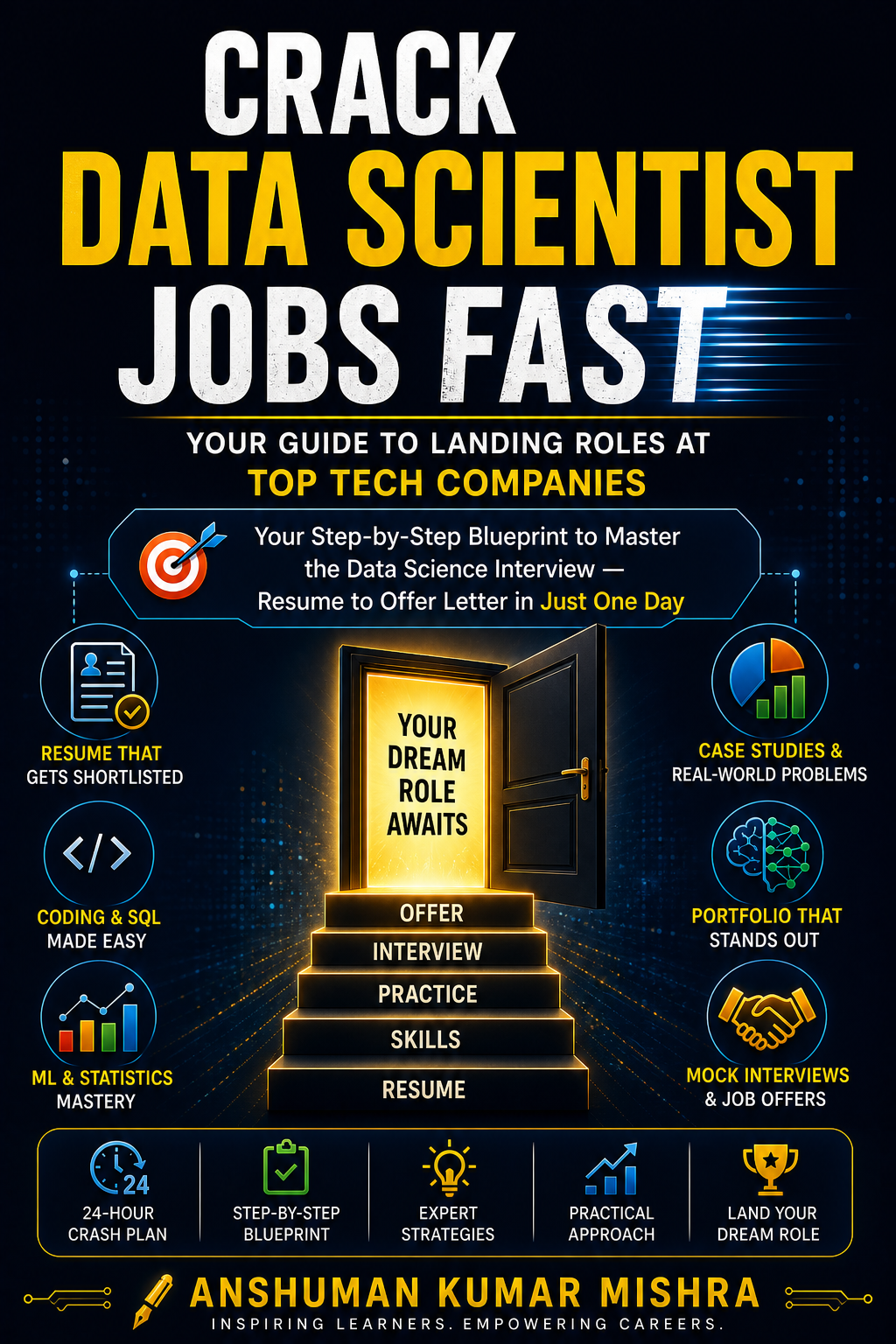
Landing a Data Scientist job requires much more than knowing machine learning algorithms. Candidates are expected to demonstrate a combination of statistics, probability, Python, SQL, machine learning, data analysis, business thinking, problem-solving, communication, and interview skills.
Crack Data Scientist Jobs Fast: Your Guide to Landing Roles at Top Tech Companies is designed as a practical roadmap for candidates who want to prepare efficiently for the modern Data Science hiring process.
The book takes the reader through the complete journey—from creating an ATS-friendly resume and optimizing LinkedIn to solving technical problems, handling SQL challenges, explaining machine learning models, approaching product case studies, presenting projects, answering behavioral questions, negotiating offers, and following up after interviews.
The central idea is simple:
Effective interview preparation is not about studying everything. It is about studying the right things in the right order.
The book therefore presents a focused 24-hour crash-preparation framework that helps candidates prioritize high-impact concepts and organize their preparation when interview time is limited.
The 24-hour approach should be viewed as an intensive preparation strategy, not as a guarantee of employment. A strong Data Science career still requires continuous learning, practical experience, and repeated interview practice.
What This Book Covers
The book covers the major stages of the Data Scientist recruitment journey:
- Resume and ATS optimization
- LinkedIn profile development
- Statistics and probability
- Python fundamentals
- Machine learning concepts
- Coding and algorithms
- SQL and data wrangling
- Feature engineering
- Model evaluation
- Data Science case studies
- Product analytics
- Portfolio development
- GitHub and Kaggle
- Data storytelling
- Behavioral interviews
- Mock interviews
- HR and culture-fit rounds
- Salary negotiation
- Interview follow-ups
- Crash preparation planning
Chapter-Wise Highlights
Chapter 1: The 24-Hour Mindset
The first chapter introduces the philosophy behind focused interview preparation.
Topics include:
- Importance of data in modern organizations
- Growth of Data Science
- Role of Data Scientists in technology companies
- Understanding modern hiring processes
- Prioritizing preparation topics
- Creating a 24-hour preparation schedule
- Avoiding low-value preparation
- Building an interview-focused mindset
The chapter helps candidates understand that preparation quality matters more than simply accumulating study hours.
Chapter 2: The Ultimate Job Seeker Profile
Before reaching the interview room, candidates must first get shortlisted.
This chapter focuses on:
- ATS-friendly resume design
- Data Science resume structure
- Highlighting technical skills
- Presenting Python, R and SQL knowledge
- Adding machine learning projects
- Certifications
- Quantifying project achievements
- LinkedIn optimization
- Creating a professional online presence
Readers learn how to present their skills clearly to recruiters and hiring teams.
Chapter 3: Core Concepts You Must Master
This chapter establishes the essential technical foundation.
It covers:
- Statistics
- Probability
- Python fundamentals
- Supervised learning
- Unsupervised learning
- Classification
- Regression
- Clustering
- Model-training fundamentals
The emphasis is on understanding concepts well enough to explain them clearly during an interview.
Chapter 4: The Art of Problem Solving
Data Science interviews may include programming and algorithmic problem solving.
Topics include:
- Data structures
- Arrays
- Strings
- Hash tables
- Searching
- Sorting
- Basic algorithms
- Problem-solving strategies
- Time complexity
- Space complexity
- Interview-style coding problems
The chapter helps candidates develop a structured approach to solving coding questions.
Chapter 5: SQL & Data Wrangling Challenges
SQL is one of the most important practical skills for Data Science roles.
This chapter covers:
- Data querying
- Filtering
- Aggregation
- Joins
- Subqueries
- Common Table Expressions
- Window functions
- Ranking
- Data transformation
- Business-oriented SQL problems
Readers learn how to approach SQL not just as a programming language but as a tool for answering business questions.
Chapter 6: Statistics & Probability Questions
Statistics is a fundamental part of Data Science interviews.
Topics include:
- Probability concepts
- Bayes’ Theorem
- Random variables
- Distributions
- Hypothesis testing
- p-values
- Confidence intervals
- Statistical significance
- A/B testing
- Recommendation-system examples
The chapter focuses on both conceptual questions and practical interpretation.
Chapter 7: Machine Learning
This chapter focuses on the machine learning knowledge candidates are commonly expected to understand.
Topics include:
- Linear Regression
- Logistic Regression
- Decision Trees
- k-Nearest Neighbors
- Support Vector Machines
- Classification
- Regression
- Feature engineering
- Model evaluation
- Cross-validation
- Overfitting
- Underfitting
- Bias-variance tradeoff
The goal is not simply to memorize algorithms but to understand when, why, and how they should be used.
Chapter 8: Data Science Case Studies
Data Scientists often need to solve open-ended business problems.
This chapter introduces frameworks for approaching questions such as:
- How would you improve a product?
- Why has conversion declined?
- How would you measure customer retention?
- How would you evaluate a recommendation system?
- Which metrics should be tracked?
- How would you design an experiment?
Readers learn to structure ambiguous problems into:
Problem → Data → Metrics → Analysis → Hypothesis → Experiment → Recommendation
Chapter 9: Portfolio That Pays
A strong portfolio can demonstrate practical ability beyond a resume.
Topics include:
- Building a professional GitHub profile
- Data Science projects
- Kaggle participation
- Project documentation
- README files
- Presenting project architecture
- Explaining methodology
- Discussing challenges and results
- Demonstrating business impact
Readers learn how to transform projects into compelling interview stories.
Chapter 10: Soft Skills That Seal the Deal
Technical skills alone may not be enough.
This chapter covers:
- Communication
- Data storytelling
- Structured explanations
- Presenting analytical results
- Handling difficult questions
- Behavioral interviews
- STAR framework
- Teamwork examples
- Leadership and ownership
The focus is on communicating technical work in a way that business and technical interviewers can understand.
Chapter 11: Mock Interviews and Real Feedback
Practice is an important part of interview preparation.
This chapter explains:
- Mock interview structure
- Technical mock interviews
- SQL mock interviews
- ML mock interviews
- Case-study practice
- Self-recorded interview analysis
- Peer feedback
- Mentor feedback
- Identifying recurring mistakes
- Improving answers
Chapter 12: Final Round — HR and Culture Fit
The final stages of recruitment often involve behavioral and HR discussions.
Topics include:
- Company values
- Culture-fit questions
- Leadership principles
- Motivation
- Career goals
- Strengths and weaknesses
- Compensation discussions
- Salary negotiation
- Relocation considerations
- Contract and employment considerations
The chapter helps candidates prepare for conversations beyond technical assessment.
Chapter 13: Top Data Science Interview Questions
This chapter provides a focused collection of high-value interview questions with:
- Suggested approaches
- Conceptual explanations
- Problem-solving strategies
- Interview tips
- Common mistakes
- Ways to structure responses
It also introduces the idea of understanding the interviewer’s perspective so candidates can answer questions more effectively.
Chapter 14: The 24-Hour Crash Plan
This is the core rapid-preparation chapter.
It provides a structured approach to organizing limited preparation time.
The plan covers areas such as:
- Resume review
- Python revision
- SQL practice
- Statistics revision
- ML fundamentals
- Case-study preparation
- Project revision
- Behavioral questions
- Mock interview
- Final revision
The objective is to maximize preparation efficiency rather than attempt to learn an entire Data Science curriculum in one day.
Chapter 15: Post-Interview Secrets
The interview does not necessarily end when the meeting ends.
This chapter discusses:
- Thank-you messages
- Professional follow-ups
- Recruiter communication
- Following up appropriately
- Handling waiting periods
- Maintaining recruiter relationships
- Preparing for additional rounds
- Learning from unsuccessful interviews
- Preparing for future opportunities
Key Features
1. Complete Interview Roadmap
The book covers the entire journey:
Resume → Shortlisting → Coding → SQL → Statistics → ML → Case Study → Portfolio → Behavioral Round → HR → Follow-up
2. 24-Hour Crash Preparation Framework
A structured approach helps candidates decide what to revise first when interview time is limited.
3. Technical + Non-Technical Preparation
The book combines:
- Technical concepts
- Coding
- SQL
- Statistics
- Machine Learning
- Case studies
- Communication
- Behavioral preparation
- HR preparation
4. Practical Interview Strategy
Candidates learn how to approach problems rather than simply memorize answers.
5. Portfolio Guidance
The book explains how to present GitHub, Kaggle, and personal projects effectively.
6. Business-Oriented Thinking
Modern Data Scientists often work on business and product problems. The book therefore emphasizes metrics, experimentation, product analytics, and structured problem solving.
Benefits of Studying This Book
1. Structured Preparation
Instead of jumping between random tutorials and interview questions, readers get a structured preparation sequence.
2. Strong Technical Foundation
The book revises the core skills required for many Data Science interviews:
Python + SQL + Statistics + Machine Learning + Problem Solving
3. Better Interview Communication
Candidates learn how to explain technical concepts clearly and logically.
4. Improved Case-Study Skills
Business-oriented case studies develop analytical thinking and structured decision making.
5. Stronger Portfolio Presentation
Readers learn how to transform projects into evidence of practical ability.
6. Better Time Management
The 24-hour crash plan helps candidates prioritize important topics when preparation time is limited.
7. Career Readiness
The book supports preparation for roles such as:
- Data Scientist
- Junior Data Scientist
- Data Analyst
- Machine Learning Analyst
- Product Data Scientist
- Business Data Analyst
- Machine Learning Engineer — entry-level preparation
Who Should Read This Book?
This book is suitable for:
- BCA Students
- MCA Students
- B.Tech / BE Students
- M.Tech Students
- Data Science Students
- Machine Learning Learners
- Fresh Graduates
- Aspiring Data Scientists
- Career Switchers
- Data Analysts
- Python Developers
- Machine Learning Engineers
- Professionals preparing for technical interviews
- Candidates targeting product and technology companies
Skills Covered
Python | SQL | Statistics | Probability | Machine Learning | Data Wrangling | Feature Engineering | Model Evaluation | Coding | Algorithms | Product Analytics | A/B Testing | Data Storytelling | GitHub | Kaggle | Resume Optimization | Behavioral Interviews | HR Interviews | Case Studies
What You Will Learn
After working through this book, you will be better prepared to:
✔ Build an ATS-friendly Data Science resume
✔ Optimize your LinkedIn profile
✔ Revise essential Python concepts
✔ Solve practical SQL problems
✔ Understand statistics and probability questions
✔ Explain major machine learning algorithms
✔ Discuss feature engineering and model evaluation
✔ Approach Data Science case studies
✔ Present your projects confidently
✔ Build a stronger GitHub portfolio
✔ Prepare for behavioral interviews
✔ Use the STAR framework
✔ Handle HR discussions professionally
✔ Practice mock interviews
✔ Create a focused 24-hour revision schedule
✔ Follow up professionally after interviews
Ideal For
Data Science Interviews | Machine Learning Interviews | SQL Interviews | Python Interviews | Technical Interviews | Product Analytics Interviews | Campus Placements | Freshers | Career Switchers | University Students | Technology Professionals
Book Information
Book Title: Crack Data Scientist Jobs Fast: Your Guide to Landing Roles at Top Tech Companies
Subtitle: Your Step-by-Step Blueprint to Master the Data Science Interview — Resume to Offer Letter in Just One Day
Subject: Data Science Career & Interview Preparation
Focus: Resume, Python, SQL, Statistics, Machine Learning, Case Studies, Portfolio, Behavioral & HR Interviews
Level: Beginner to Intermediate
Reviews
There are no reviews yet.