Description
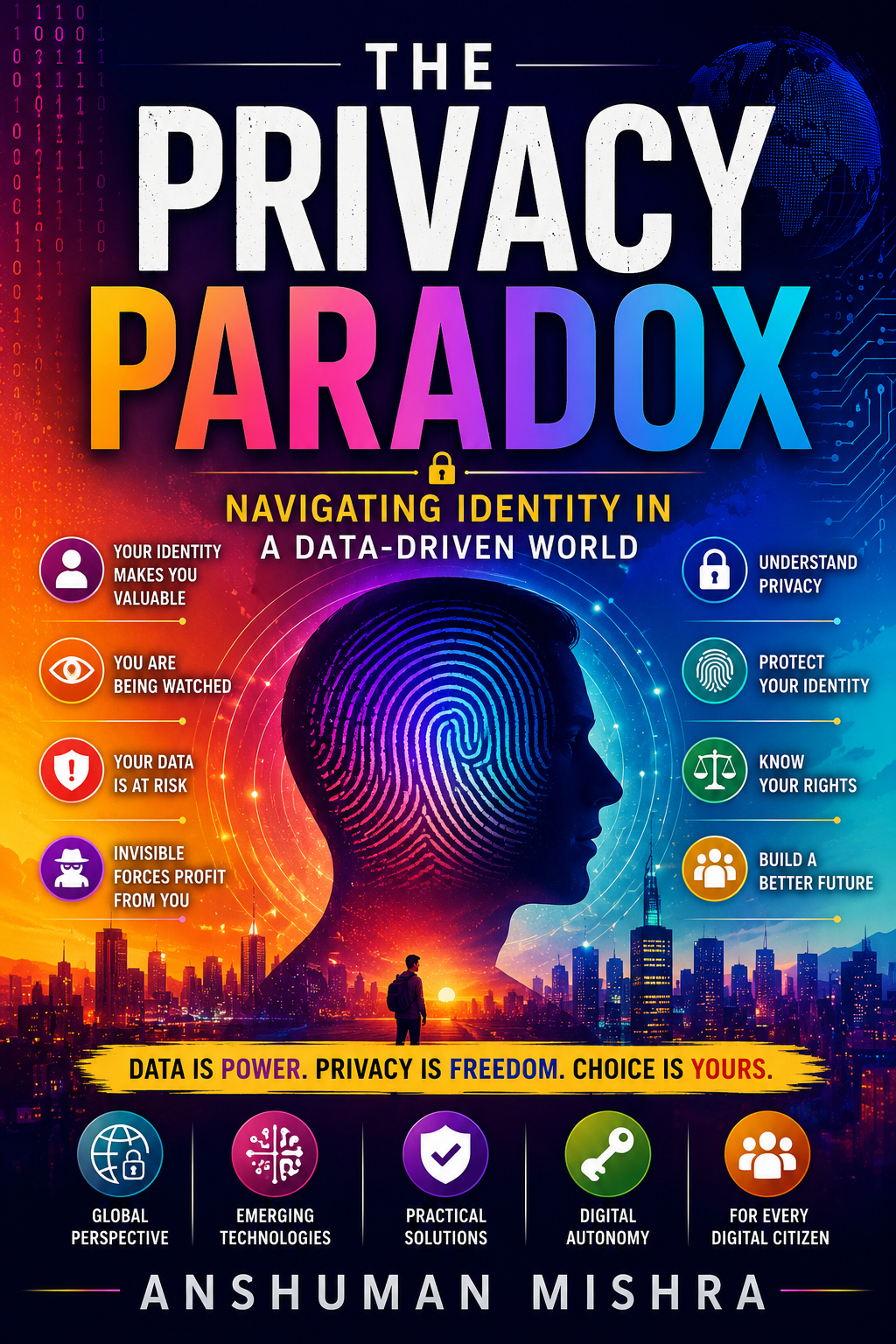
The Privacy Paradox: Navigating Identity in a Data-Driven World
About the Book
In today’s hyperconnected world, identity is no longer limited to a name, photograph, passport, or physical document. Our digital identity is continuously created and reshaped through the websites we visit, applications we use, purchases we make, locations we share, devices we carry, and interactions we have online.
Every search, click, login, transaction, photograph, location signal, and online interaction can contribute to a growing digital representation of who we are.
This transformation has created enormous opportunities for convenience, personalization, security, and innovation. At the same time, it has introduced difficult questions about privacy, surveillance, identity ownership, consent, cybersecurity, and personal autonomy.
The Privacy Paradox: Navigating Identity in a Data-Driven World explores these questions from technological, legal, social, ethical, and human perspectives.
The central idea of the book is simple but profound:
People increasingly value privacy, yet they often surrender personal information in exchange for convenience.
This contradiction is commonly described as the privacy paradox.
The book examines why this paradox exists, how digital identities are created and monetized, how surveillance systems operate, why data breaches are so damaging, how privacy laws attempt to protect individuals, and what technological and social approaches can help people regain greater control over their digital lives.
Why Privacy Matters in the Digital Age
Privacy has traditionally been associated with physical spaces, personal correspondence, confidential conversations, and private information.
Digital technologies have expanded the meaning of privacy dramatically.
Today, privacy can involve:
- Personal identity
- Financial information
- Location data
- Biometric information
- Health records
- Search history
- Social-media activity
- Online purchases
- Communication patterns
- Behavioral profiles
- Device information
- Genetic information
The combination of these seemingly separate data points can create a remarkably detailed picture of an individual.
The challenge is therefore no longer simply:
“Who has my information?”
It is also:
“What can be inferred about me from my information?”
Chapter 1 — The Rise of Digital Identity
The first chapter introduces the concept of digital identity and explains how it has evolved from traditional identification systems into complex digital profiles.
Readers explore different forms of digital identity, including:
- Social identity
- Financial identity
- Biometric identity
- Behavioral identity
- Professional identity
- Online personas
The chapter traces the movement from traditional documents such as passports and identification cards toward online accounts, digital credentials, biometric authentication, and interconnected digital profiles.
It also examines the growing economic value of identity-related data.
Chapter 2 — The Anatomy of Privacy in the Digital Age
Privacy is not a single concept.
This chapter explores several dimensions of privacy, including:
- Informational privacy
- Bodily privacy
- Territorial privacy
- Communication privacy
It examines how privacy expectations differ across cultures, societies, technologies, and legal systems.
Readers also explore modern privacy risks such as:
- Behavioral tracking
- Location monitoring
- Facial recognition
- Psychological profiling
- Emotional inference
- Data aggregation
A special section examines data brokers and the invisible ecosystem through which personal information can be collected, combined, analyzed, and reused.
Chapter 3 — Surveillance Society
Surveillance has evolved far beyond traditional security cameras.
Modern surveillance can involve:
- Smartphones
- Internet services
- Social platforms
- CCTV networks
- Biometric systems
- Facial recognition
- Connected devices
- Advertising technologies
This chapter examines both government surveillance and corporate data collection.
It discusses the growth of data-driven business models and asks an important question:
When a digital service appears free, what are users actually giving in return?
The chapter also examines why people sometimes accept surveillance because of perceived benefits such as convenience, personalization, security, or access to services.
Chapter 4 — Identity Theft, Data Breaches, and Cybercrime
As digital identity becomes increasingly important, stolen personal information becomes an attractive target for cybercriminals.
This chapter explains:
- Identity theft
- Credential theft
- Phishing
- Data breaches
- Account compromise
- Stolen personal information
- Cybercrime ecosystems
It also discusses the broader consequences of major data breaches, including financial losses, reputational damage, emotional stress, and the difficulty of restoring trust after personal information has been exposed.
The chapter emphasizes the importance of organizational security and privacy by design.
Chapter 5 — The Legal Landscape of Privacy
Privacy is increasingly recognized as an important legal and human-rights concern.
This chapter introduces major privacy frameworks and regulatory approaches, including:
- GDPR
- CCPA
- India’s Digital Personal Data Protection framework
- OECD privacy principles
- Data protection concepts
- Consent and accountability
The chapter also explores the right to be forgotten, examining the tension between personal privacy and society’s interest in information, historical records, journalism, and accountability.
Cross-border data transfers are discussed as another major challenge because digital information frequently moves between countries with different legal frameworks.
Chapter 6 — Biometric Identity Systems and Digital IDs
Biometric technologies have transformed digital authentication.
Examples include:
- Fingerprints
- Facial recognition
- Iris recognition
- Voice recognition
- Behavioral biometrics
These systems can provide convenient authentication, but biometric information presents unique privacy challenges.
Unlike a password, biometric characteristics are difficult or impossible to replace once compromised.
The chapter examines digital identity systems around the world and explores the debate between:
Centralized identity systems
and
Decentralized and self-sovereign identity models.
It also considers risks involving accessibility, exclusion, algorithmic bias, surveillance, and unequal access to digital services.
Chapter 7 — The Privacy Paradox in Daily Life
Why do people say they care about privacy while frequently sharing personal information?
This chapter explores the psychological and behavioral foundations of the privacy paradox.
Examples include:
- Accepting website cookies
- Sharing location information
- Oversharing on social media
- Using loyalty programs
- Installing smart-home devices
- Using health trackers
The chapter explains how convenience often outweighs abstract privacy concerns.
It also introduces dark patterns, consent fatigue, and other interface-design practices that can influence user decisions.
The central question becomes:
Can technology be designed so that privacy-friendly choices are also the easiest choices?
Chapter 8 — Privacy in Emerging Technologies
New technologies create new forms of privacy risk.
Artificial Intelligence
AI can analyze enormous quantities of personal information and generate predictions about behavior, preferences, and potential decisions.
Internet of Things
Smart speakers, watches, cameras, appliances, and other connected devices continuously generate information about their environments and users.
AR and VR
Immersive technologies can collect highly sensitive information such as movement, gaze, gestures, and interaction patterns.
Genomic Data
Genetic information is especially sensitive because it can reveal information about individuals and potentially their biological relatives.
This chapter examines how emerging technologies require privacy considerations to be integrated from the beginning rather than added after deployment.
Chapter 9 — Reclaiming Digital Autonomy
Privacy protection is not solely the responsibility of governments and technology companies.
Individuals can also improve their digital resilience.
This chapter discusses general privacy and security practices such as:
- Strong and unique passwords
- Multi-factor authentication
- Reviewing app permissions
- Secure browsing
- Limiting unnecessary data sharing
- Keeping software updated
- Reviewing account privacy settings
- Reducing unnecessary digital exposure
It also introduces privacy-oriented technologies and concepts such as encrypted communication, privacy-focused browsing, decentralized systems, and responsible security testing.
The goal is not to eliminate technology from everyday life, but to encourage more informed and deliberate participation in the digital world.
Chapter 10 — The Future of Identity and Privacy
The final chapter looks toward the future.
Emerging technologies may provide new approaches to protecting personal information, including:
- Zero-knowledge proofs
- Homomorphic encryption
- Privacy-preserving machine learning
- Decentralized identity
- Secure computation
- Privacy-enhancing technologies
The chapter also examines digital identities in virtual environments and asks:
Who owns your digital self?
As virtual avatars, synthetic identities, AI-generated representations, and immersive environments become increasingly sophisticated, questions surrounding identity ownership and digital autonomy will become even more important.
The Hidden Economy of Personal Data
One of the book’s central themes is the economic value of personal information.
Modern digital businesses can use data to:
- Personalize services
- Improve recommendations
- Target advertising
- Detect fraud
- Understand consumer behavior
- Optimize products
- Predict future actions
This creates a complicated relationship between users and digital platforms.
Users receive convenience and services.
Companies receive valuable information.
The book examines whether this exchange is genuinely voluntary when users have limited understanding of how their data is collected and processed.
Surveillance and Convenience
The book also explores a difficult social contradiction.
People may object to surveillance in principle while accepting it when it provides:
- Faster services
- Better recommendations
- Safer transportation
- Easier authentication
- Personalized experiences
- Security benefits
This creates a central tension:
How much privacy are people willing to exchange for convenience?
And perhaps more importantly:
Who gets to decide where that boundary lies?
Identity Theft and the Human Cost of Data Breaches
Data breaches are not merely technical incidents.
When personal information is exposed, individuals can experience:
- Financial disruption
- Account compromise
- Loss of trust
- Reputational damage
- Anxiety
- Long-term security concerns
The book therefore treats cybersecurity and privacy as human issues rather than purely technical problems.
Privacy, AI, and Algorithmic Profiling
Artificial intelligence introduces a new dimension to privacy.
Traditional data collection asks:
“What information do we have about you?”
AI can move toward a more powerful question:
“What can we predict about you?”
Machine learning systems can identify patterns across large datasets and generate inferences that individuals may never have explicitly provided.
This raises important questions about:
- Transparency
- Explainability
- Consent
- Algorithmic fairness
- Profiling
- Automated decision-making
- Data minimization
Privacy as Digital Autonomy
The book ultimately presents privacy as more than secrecy.
Privacy can support:
- Personal autonomy
- Freedom of thought
- Freedom of expression
- Dignity
- Security
- Individual choice
- Human independence
A society where every action is permanently recorded and analyzed could fundamentally change how people behave.
Therefore, privacy is also connected to the freedom to explore, experiment, communicate, and develop one’s identity without constant observation.
Key Features of the Book
Comprehensive Coverage
The book combines technology, cybersecurity, law, economics, ethics, psychology, and social science.
Digital Identity Focus
Readers gain a detailed understanding of how digital identities are created, analyzed, stored, and protected.
Privacy and Surveillance
Government and corporate surveillance are examined from multiple perspectives.
Legal Perspective
Major privacy principles and regulatory frameworks are introduced in an accessible manner.
Emerging Technology
AI, IoT, AR, VR, digital twins, biometrics, and genomic data are discussed in the context of privacy.
Practical Awareness
Readers gain practical knowledge for improving their digital privacy and security habits.
Ethical Perspective
The book encourages critical thinking about the balance between innovation, security, convenience, and individual rights.
Who Should Read This Book?
This book is suitable for:
- BCA students
- B.Tech students
- MCA students
- M.Tech students
- Computer Science students
- Cybersecurity students
- Data Science students
- AI and Machine Learning learners
- Information Technology professionals
- Cybersecurity professionals
- Researchers
- Educators
- Policymakers
- Digital-rights researchers
- General readers interested in technology and privacy
Benefits of Studying This Book
1. Understanding Digital Identity
Readers learn how traditional identity has evolved into complex digital profiles.
2. Developing Privacy Awareness
The book helps readers recognize common privacy risks in everyday technology.
3. Understanding Surveillance
Readers gain insight into both government and corporate surveillance systems.
4. Improving Digital Resilience
The book introduces practical principles for protecting personal accounts and information.
5. Understanding Privacy Law
Readers receive an accessible introduction to major privacy frameworks and concepts.
6. Exploring Emerging Technologies
The book connects privacy with AI, IoT, biometrics, AR, VR, genomics, and decentralized identity.
7. Developing Ethical Thinking
Readers are encouraged to consider the social consequences of data-driven technologies.
Learning Outcomes
After studying this book, readers will be able to:
- Define and explain digital identity.
- Identify different categories of personal data.
- Understand modern privacy risks.
- Explain the concept of surveillance capitalism.
- Understand the basic mechanisms behind identity theft and data breaches.
- Recognize common privacy vulnerabilities.
- Understand major data protection principles.
- Analyze the advantages and risks of biometric identification.
- Explain the privacy paradox.
- Understand how AI contributes to profiling and prediction.
- Identify privacy challenges associated with IoT and immersive technologies.
- Understand the importance of privacy-preserving technologies.
- Develop stronger digital privacy awareness.
- Analyze ethical questions surrounding digital identity.
- Think critically about the relationship between convenience and autonomy.
The Central Message
The central message of The Privacy Paradox is that privacy should not be viewed as an obstacle to technological progress.
Instead, privacy can be understood as a fundamental design requirement for a trustworthy digital society.
Technology should not force individuals to choose between:
Convenience OR Privacy
The long-term goal should be:
Convenience AND Privacy
Achieving this requires cooperation among:
Citizens + Technology Companies + Governments + Designers + Researchers + Educators
Conclusion
The Privacy Paradox: Navigating Identity in a Data-Driven World is ultimately a book about much more than personal information.
It is about identity, autonomy, dignity, security, freedom, and the future of human participation in a digital society.
As artificial intelligence becomes more powerful, connected devices become more common, biometric identification expands, and digital identities become increasingly important, the question of privacy will become impossible to ignore.
The challenge is not to reject technology.
The challenge is to build technology that respects the people who use it.
The future of digital identity should therefore be shaped by principles of:
Transparency
Security
Consent
Fairness
Accountability
User Control
Privacy by Design
The ultimate question is not simply:
“How much data can technology collect?”
It is:
“How can society use technology without losing control over the identities, freedoms, and dignity of the people it is designed to serve?”
That is the privacy paradox—and understanding it is one of the essential challenges of the digital age.





Reviews
There are no reviews yet.