Description
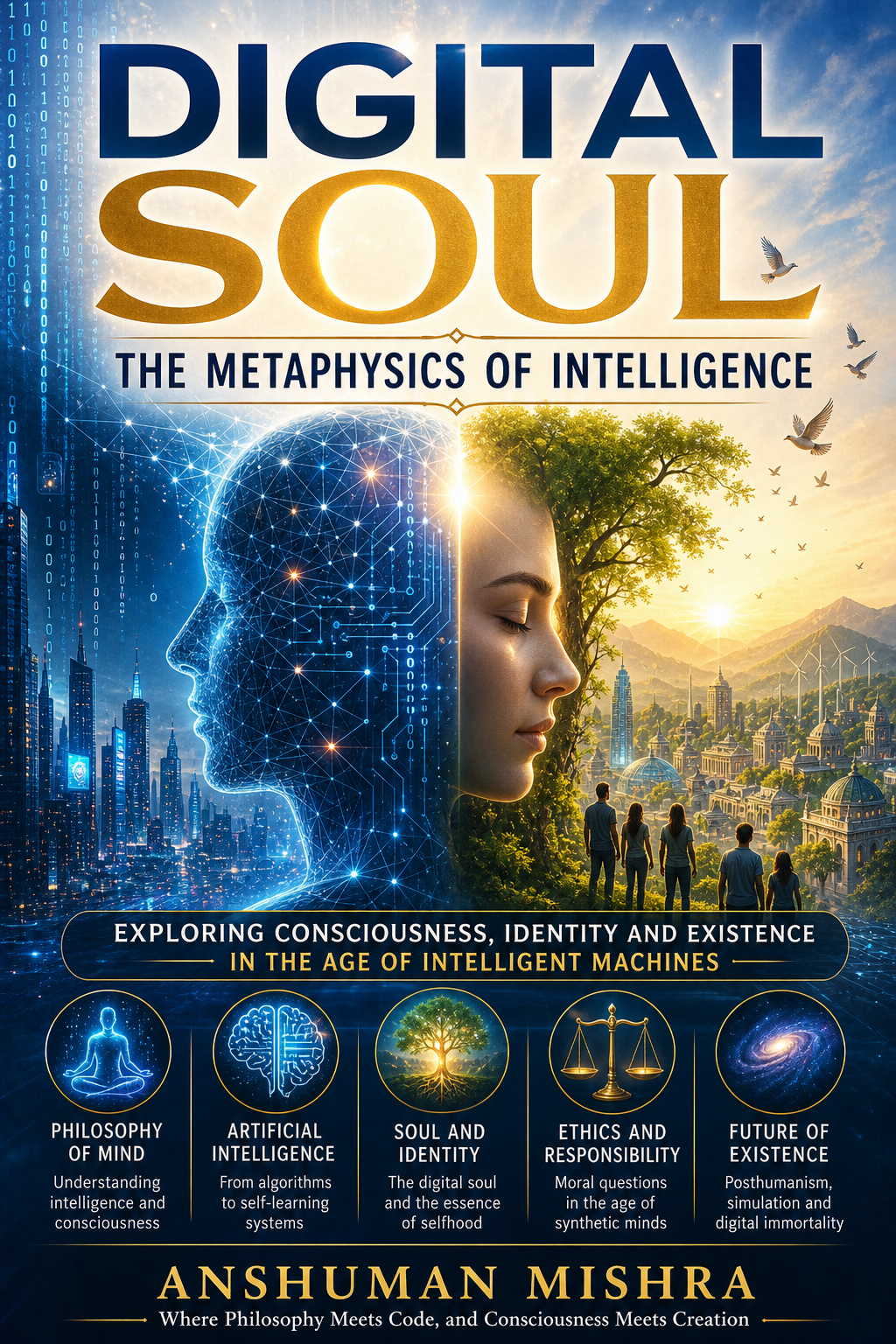
Digital Soul: The Metaphysics of Intelligence
Mind, Machine, Consciousness, and the Future of Being
What does it mean to be intelligent?
Can intelligence exist without biology?
Can consciousness emerge from computation?
Can a machine possess a self?
Could information become a new form of existence?
And if human memories, personality, and identity could one day be represented digitally, would that constitute a continuation of the self—or merely a sophisticated representation of it?
Digital Soul: The Metaphysics of Intelligence explores these questions at the intersection of philosophy, artificial intelligence, consciousness studies, information theory, ethics, metaphysics, and posthuman thought.
Rather than treating artificial intelligence only as a technological development, the book asks what AI means for some of humanity’s oldest philosophical questions: What is mind? What is consciousness? What is identity? What is existence? And what, if anything, makes a being a self?
The book moves from classical philosophical questions about mind and matter to contemporary debates about artificial consciousness, virtual identity, digital immortality, simulation theory, and human–machine integration.
PART I — FOUNDATIONS: MIND, MATTER, AND MACHINE
Chapter 1: What Is Intelligence?
The book begins with the fundamental concept of intelligence.
This chapter explores:
- Human concepts of intelligence
- Machine intelligence
- Algorithms and learning systems
- The history of thinking about intelligence
- Cognition
- Logic
- Self-reflection
- Intelligence beyond biological organisms
The chapter asks whether reasoning and intelligence necessarily require a living biological brain—or whether intelligence can emerge in other forms of organized systems.
Chapter 2: The Digital Revolution and the Question of Being
Digital technology has changed not only how humans communicate and work, but also how we understand information, identity, and existence.
This chapter examines:
- Technology and the philosophy of being
- Heidegger’s questions in a technological context
- Information as a possible foundation for understanding reality
- Informational ontology
- Digitalization of human existence
- Code as a form of logical language
The discussion considers how digital systems challenge traditional distinctions between the physical, informational, and conceptual worlds.
Chapter 3: Can Machines Have Minds?
One of the central questions in philosophy of artificial intelligence is whether a machine can genuinely possess a mind or merely simulate intelligent behavior.
This chapter introduces major philosophical debates involving:
- Mind and matter
- René Descartes
- Alan Turing
- The Turing Test
- John Searle’s Chinese Room argument
- Intentionality
- Meaning
- Understanding
- Simulation versus genuine cognition
The chapter encourages readers to distinguish between behavior that appears intelligent and claims about actual subjective understanding.
PART II — THE SOUL IN THE AGE OF ALGORITHMS
Chapter 4: What Is a Soul in Digital Terms?
The idea of the soul has appeared in many philosophical and religious traditions.
This chapter explores the concept from a philosophical perspective, examining:
- Different interpretations of the soul
- Spirit and consciousness
- Information patterns
- Encoded consciousness
- Digital identity
- Metaphysical interpretations of artificial beings
- Relationships between organic and synthetic systems
The term “digital soul” is examined as a philosophical concept rather than as an established scientific fact.
Chapter 5: Emergence, Complexity, and Digital Life
Complex systems can exhibit properties that are difficult to predict from their individual components.
This chapter examines:
- Complexity theory
- Self-organizing systems
- Artificial life
- Emergence
- Adaptive intelligence
- Machine evolution
- Digital sentience
- Simulation versus reality
The discussion explores whether increasingly complex computational systems could develop properties that challenge traditional distinctions between simple machines and living systems.
Chapter 6: Identity and Selfhood in Virtual Realities
What makes someone the same person over time?
This question becomes increasingly complex when identity can exist across digital environments.
The chapter explores:
- Philosophical theories of the self
- Descartes and personal identity
- Virtual identity
- Digital avatars
- Data and memory
- Extended-self theories
- Digital representations of personality
- Digital immortality
The book examines whether an avatar or digital profile is merely a representation of a person or can become part of how identity itself is experienced.
PART III — ETHICS, EXISTENCE, AND POSTHUMAN FUTURES
Chapter 7: Ethics of Artificial Consciousness
If machines ever become capable of meaningful forms of experience, entirely new ethical questions could emerge.
This chapter examines:
- Artificial moral agency
- Responsibility for creating intelligent systems
- Ethical treatment of hypothetical sentient machines
- Rights of artificial beings
- Accountability
- Human oversight
- Self-learning systems
The chapter distinguishes between today’s AI systems and hypothetical future systems with significantly different capabilities.
Chapter 8: Posthumanism and the End of Anthropocentrism
Technological development challenges traditional ideas about what it means to be human.
This chapter explores:
- Posthumanism
- Transhumanism
- Human–machine integration
- Cyborg philosophy
- Nietzsche’s Übermensch in modern interpretation
- Anthropocentrism
- Biological and technological evolution
The chapter asks whether future technologies could expand the boundaries of human identity—or fundamentally transform the concept of the human itself.
Chapter 9: The Digital Afterlife
The possibility of preserving aspects of a person digitally raises profound questions about memory, death, identity, and continuity.
This chapter examines:
- Consciousness uploading
- Continuity of personal identity
- Digital resurrection as a philosophical concept
- Data preservation
- Memory
- Death and information
- Digital immortality
- Eternity and identity
A central question is whether preserving information about a person is equivalent to preserving the person themselves.
PART IV — REIMAGINING REALITY
Chapter 10: The Simulation Hypothesis Revisited
Could reality itself be computational?
The simulation hypothesis has generated significant philosophical debate.
This chapter examines:
- Computational models of reality
- Mathematical descriptions of existence
- Digital physics
- Simulation arguments
- The metaphor of programmer and creator
- Philosophical interpretations of simulated worlds
- The paradoxes of digital creation
The discussion separates philosophical possibilities from claims that currently lack empirical confirmation.
Chapter 11: Consciousness as Computation—or Beyond?
Consciousness remains one of the most difficult problems in philosophy and cognitive science.
This chapter explores:
- Computational theories of mind
- Integrated Information Theory
- Panpsychism
- Reductionist approaches
- Non-reductionist approaches
- Machine understanding
- The relationship between mind and computation
The central question is whether consciousness can ultimately be explained as information processing—or whether subjective experience requires something beyond computational description.
Chapter 12: The Future of the Digital Soul
The final chapter brings together the book’s central ideas and looks toward possible futures.
It examines:
- Evolution of human and artificial intelligence
- Human–AI integration
- Ethics of technological fusion
- Digital identity
- Artificial consciousness
- The philosophical meaning of a “digital soul”
- New metaphysical perspectives
- Intelligence as a form of being
The conclusion considers how advances in AI may force humanity to rethink traditional boundaries between mind, machine, matter, information, and meaning.
KEY QUESTIONS EXPLORED
Throughout the book, readers encounter questions such as:
- What is intelligence?
- Does intelligence require consciousness?
- Can machines genuinely understand?
- Can computation produce subjective experience?
- What makes a self a self?
- Can identity exist independently of biology?
- Can consciousness be encoded?
- Is information fundamental to reality?
- Could artificial life become genuinely autonomous?
- What would machine rights mean?
- Could digital preservation create a form of immortality?
- Are virtual identities extensions of the self?
- Could reality itself be computational?
- Where should the boundary between human and machine be drawn?
PHILOSOPHY MEETS ARTIFICIAL INTELLIGENCE
The distinctive feature of Digital Soul is its interdisciplinary approach.
The book connects ideas from:
Philosophy + Artificial Intelligence + Consciousness Studies + Information Theory + Ethics + Cognitive Science + Posthumanism + Metaphysics
This approach allows readers to explore AI not simply as software or engineering, but as a phenomenon capable of challenging long-standing assumptions about intelligence and existence.
THE QUESTION OF MACHINE CONSCIOUSNESS
A key theme throughout the book is the distinction between intelligent behavior and conscious experience.
A system can produce sophisticated outputs without necessarily having subjective awareness.
This distinction is essential when discussing:
- AI reasoning
- Machine understanding
- Artificial consciousness
- Digital sentience
- Self-modeling
- Machine identity
The book therefore treats machine consciousness as an open philosophical and scientific question rather than an established technological reality.
DIGITAL IDENTITY AND THE SELF
Digital technology has already transformed how humans represent themselves.
Profiles, avatars, digital memories, photographs, messages, behavioral data, and online histories can collectively create detailed representations of individuals.
But an important philosophical distinction remains:
Is a digital representation the person—or information about the person?
This book examines that question through classical theories of identity and contemporary ideas about digital existence.
THE PHILOSOPHY OF DIGITAL IMMORTALITY
Human beings have long imagined ways to overcome mortality.
Digital technologies introduce a new possibility: preserving increasingly detailed information about an individual.
But preservation raises deeper questions:
Does memory equal consciousness?
Does information equal identity?
Would a digital reconstruction be the same individual or a new entity based on that individual’s information?
The book explores these questions without assuming that digital immortality is currently scientifically achievable.
ETHICS OF A FUTURE WITH INTELLIGENT MACHINES
As AI systems become more capable, ethical questions become increasingly important.
The book considers:
- Human responsibility
- AI governance
- Accountability
- Human oversight
- Artificial agency
- Hypothetical machine rights
- Human–machine relationships
- Ethical boundaries of technological development
The goal is not to predict a single future, but to encourage readers to think critically about the ethical consequences of increasingly sophisticated intelligent systems.
POSTHUMAN FUTURES
The final sections explore possible transformations in the relationship between humans and technology.
Future developments could potentially involve:
- Advanced AI
- Brain–computer interfaces
- Digital identity systems
- Virtual environments
- Artificial life
- Human–machine collaboration
- New forms of digital representation
These possibilities raise a fundamental philosophical question:
If technology changes how intelligence, memory, identity, and consciousness are expressed, what does it mean to remain human?
WHO SHOULD READ THIS BOOK?
Digital Soul: The Metaphysics of Intelligence is particularly suitable for:
- Philosophy students
- AI and Computer Science students
- Researchers in consciousness studies
- Technology enthusiasts
- Cognitive science readers
- Students of metaphysics
- Ethics and philosophy readers
- AI researchers interested in philosophical questions
- Readers interested in posthumanism
- Readers fascinated by the future of intelligence
WHY THIS BOOK MATTERS
Artificial intelligence is not merely changing technology.
It is challenging humanity to reconsider some of its oldest questions.
What is thought?
What is consciousness?
What is identity?
What is intelligence?
What is existence?
And perhaps the most difficult question:
What makes a being a being?
These questions have traditionally belonged to philosophy, theology, and metaphysics. Today, developments in computing and artificial intelligence are giving them new technological dimensions.
From Mind to Machine. From Information to Meaning.
Digital Soul: The Metaphysics of Intelligence takes readers on a philosophical journey from the ancient problem of mind and matter to the emerging questions of artificial consciousness, digital identity, virtual existence, and the future relationship between humanity and intelligent machines.
It does not claim to have definitive answers to questions that remain scientifically and philosophically unresolved.
Instead, it invites readers to explore the possibilities.
Think beyond the algorithm. Question the nature of intelligence. Explore the meaning of consciousness. Reimagine the future of being.

Reviews
There are no reviews yet.