Description
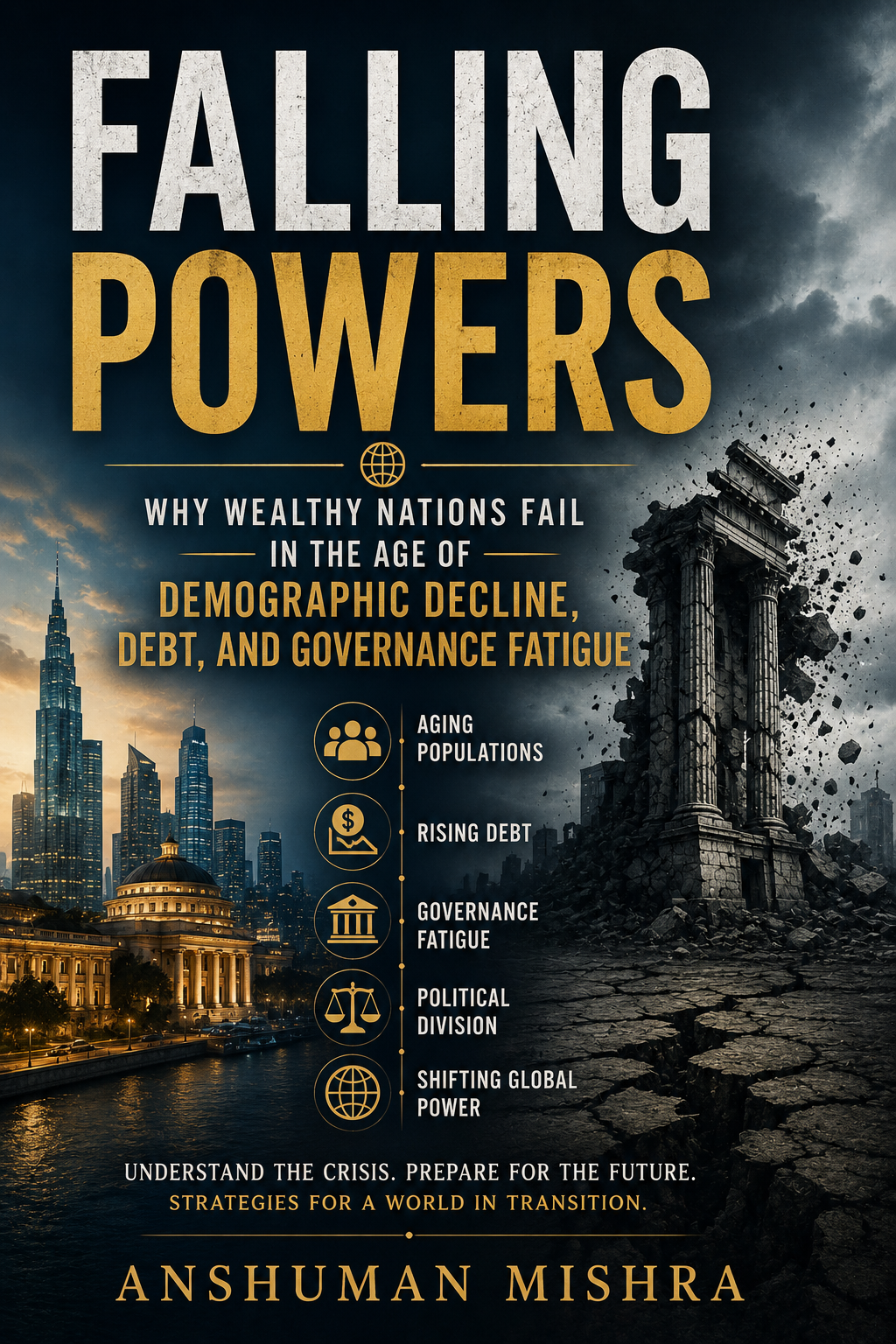
Falling Powers: Why Wealthy Nations Fail in the Age of Demographic Decline, Debt, and Governance Fatigue
A Structural Analysis of Economic Stagnation, Institutional Resilience, and the Future of Advanced Economies
Economic prosperity is often viewed as a guarantee of national strength. High GDP, sophisticated financial markets, technological leadership, and global influence can create the impression that wealthy nations are inherently resilient. History, however, suggests a more nuanced reality. Nations rarely remain powerful simply because they are rich. Long-term success depends on their ability to adapt to demographic shifts, institutional challenges, fiscal pressures, technological change, and evolving global competition.
Falling Powers: Why Wealthy Nations Fail in the Age of Demographic Decline, Debt, and Governance Fatigue presents a comprehensive, evidence-based examination of the structural forces that may influence the long-term trajectory of advanced economies. Drawing on economics, political economy, public policy, governance studies, demography, and international affairs, the book explores how prosperity can coexist with underlying vulnerabilities and why sustained resilience requires more than financial wealth alone.
Rather than predicting inevitable decline, the book investigates the conditions under which economically successful nations may experience prolonged stagnation, reduced adaptability, or slower long-term growth. It emphasizes that economic performance is shaped by interconnected factors including population dynamics, institutional effectiveness, productivity, fiscal sustainability, social cohesion, technological capacity, and strategic governance.
The opening chapters examine common misconceptions surrounding national power and explain why GDP, while valuable, offers only a partial measure of economic health. Readers explore the distinction between headline growth and deeper indicators such as productivity, innovation, institutional quality, labor force participation, and long-term resilience.
A major focus is placed on demographic transformation. The book analyzes declining fertility rates, population aging, shrinking workforces, migration, dependency ratios, and their implications for economic growth, labor markets, healthcare systems, pension sustainability, and innovation. It explains how demographic trends unfold over decades and why they represent one of the most significant structural challenges facing many advanced economies.
Governance and institutional performance are examined as equally important drivers of long-term prosperity. Readers gain insight into bureaucratic complexity, policy continuity, regulatory effectiveness, administrative capacity, political accountability, and the importance of institutional reform. The discussion highlights how strong institutions support economic adaptation while excessive rigidity may reduce responsiveness to emerging challenges.
The book also explores public debt, fiscal sustainability, welfare systems, productivity growth, technological innovation, automation, artificial intelligence, financial markets, labor force dynamics, social trust, political polarization, immigration policy, and economic resilience. Rather than treating these issues in isolation, it demonstrates how they interact to shape the long-term competitiveness of modern economies.
Technology is presented as a powerful enabler of productivity and innovation, while acknowledging that technological progress alone cannot resolve demographic pressures, institutional weaknesses, or governance challenges. The analysis encourages balanced consideration of how AI, automation, and digital transformation complement broader policy reforms.
Comparative chapters examine characteristics commonly associated with both rising and mature economies, identifying patterns of institutional adaptability, demographic sustainability, innovation capacity, fiscal discipline, and strategic planning. The concluding chapters discuss possible pathways for renewal, emphasizing evidence-based reform, institutional resilience, and long-term governance rather than deterministic predictions.
Inside This Book You’ll Discover
- Why economic prosperity does not always guarantee long-term strength
- The limits of GDP as a measure of national resilience
- Demographic decline, fertility trends, and aging populations
- Workforce transformation and labor productivity
- Governance quality and institutional effectiveness
- Public debt, fiscal sustainability, and economic stability
- Welfare systems and long-term policy challenges
- Political polarization and social cohesion
- Innovation, automation, artificial intelligence, and productivity
- Immigration, labor markets, and demographic policy
- Financial markets versus the real economy
- Comparative analysis of rising and mature economies
- Institutional reform and strategic adaptability
- Long-term economic resilience and national competitiveness
- Policy frameworks for sustainable national development
Written in a balanced, accessible, and research-oriented style, this book is intended for economists, policymakers, civil servants, researchers, students of economics and political science, international relations scholars, investors, business leaders, and readers interested in the future of global economic leadership.
Whether you are studying comparative political economy, analyzing demographic transitions, researching public policy, preparing for competitive examinations, or seeking a deeper understanding of how advanced economies evolve over time, Falling Powers offers a rigorous framework for evaluating the structural forces that influence national resilience and long-term prosperity.
By moving beyond short-term economic indicators and focusing on enduring institutional, demographic, fiscal, and governance factors, this book encourages readers to think critically about what enables nations not only to become wealthy—but to remain resilient in an increasingly complex and uncert




Reviews
There are no reviews yet.