Description
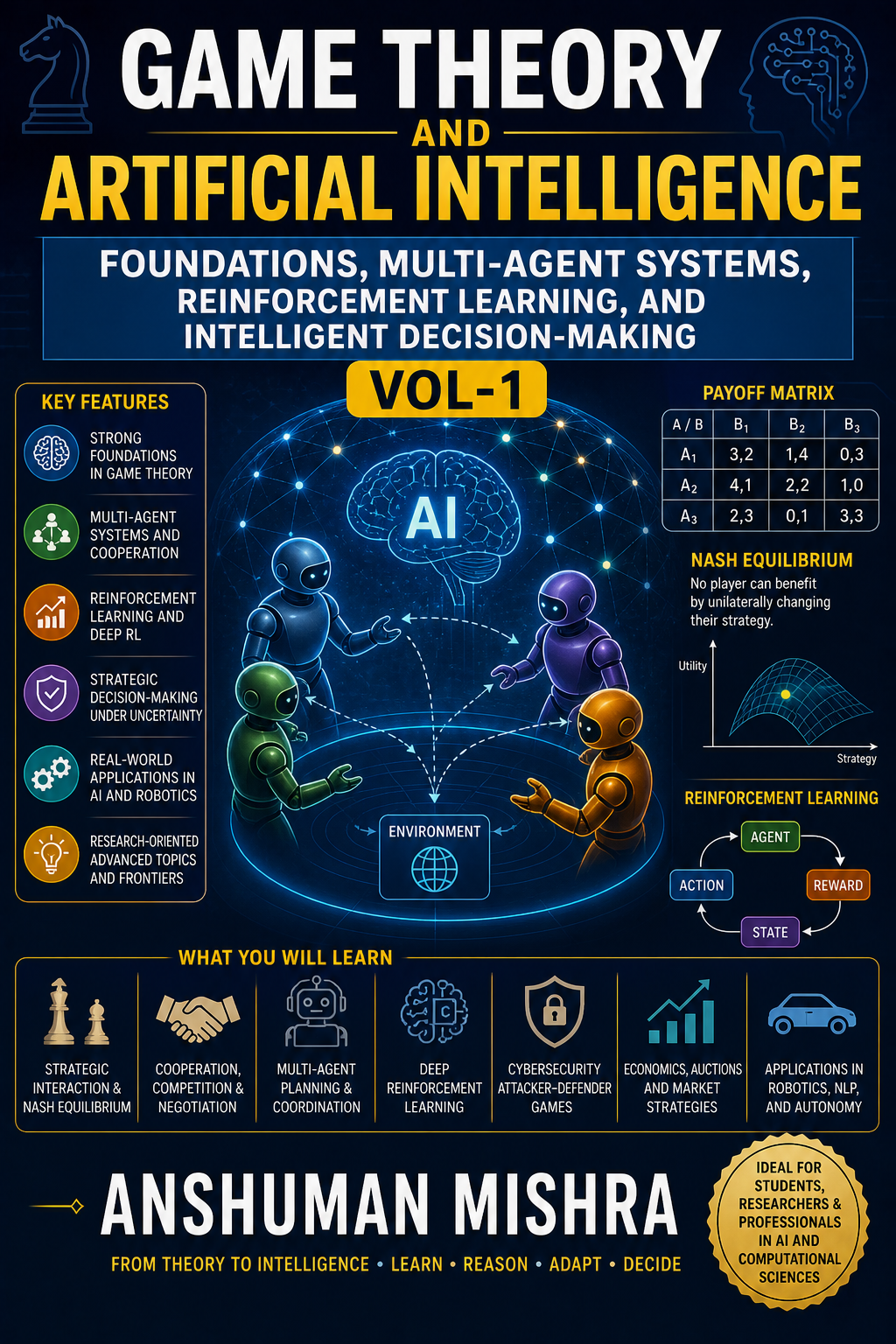
Game Theory and Artificial Intelligence: Foundations, Multi-Agent Systems, Reinforcement Learning, and Intelligent Decision-Making
Subtitle
A Comprehensive Guide for Students, Researchers, and Professionals
Author: Anshuman Mishra
Artificial Intelligence has rapidly transformed the way intelligent systems learn, reason, plan, and make decisions. From autonomous vehicles and robotics to financial markets, cybersecurity, healthcare, online recommendation systems, and large-scale distributed networks, intelligent agents increasingly operate in environments where multiple decision-makers interact, compete, and cooperate simultaneously. Understanding these interactions requires more than traditional optimization—it demands the mathematical framework of Game Theory.
Game Theory and Artificial Intelligence: Foundations, Multi-Agent Systems, Reinforcement Learning, and Intelligent Decision-Making presents a modern, comprehensive, and application-oriented exploration of the fascinating relationship between game theory and AI. The book explains how mathematical models of strategic interaction form the foundation of intelligent decision-making, multi-agent coordination, autonomous planning, reinforcement learning, and next-generation AI systems.
Designed for undergraduate and postgraduate students, researchers, faculty members, AI practitioners, data scientists, robotics engineers, economists, and professionals, this book bridges theoretical foundations with practical AI applications. It provides readers with a structured learning path from fundamental concepts to advanced topics such as multi-agent reinforcement learning, Bayesian games, coalition formation, distributed optimization, mechanism design, and intelligent autonomous systems.
Unlike conventional textbooks that focus only on mathematical theory or AI algorithms, this book integrates both disciplines into a unified framework, demonstrating how game-theoretic reasoning enables intelligent agents to make optimal decisions under competition, cooperation, uncertainty, and incomplete information.
Purpose and Vision of the Book
The objective of this book is to provide a complete understanding of how Game Theory supports the design, analysis, and implementation of intelligent AI systems capable of strategic reasoning.
The book follows five guiding principles:
- Develop a strong mathematical foundation.
- Connect theory with real-world AI applications.
- Explain concepts through intuitive examples and case studies.
- Build practical understanding of multi-agent decision systems.
- Prepare readers for advanced research and industry applications.
Rather than presenting isolated mathematical definitions, every concept is linked to modern AI technologies, enabling readers to understand why game theory has become indispensable in contemporary artificial intelligence.
Who Should Read This Book?
This book is ideal for:
- Undergraduate students (BCA, B.Sc., B.Tech.)
- Postgraduate students (MCA, M.Tech., M.Sc.)
- Ph.D. scholars
- AI researchers
- Machine learning engineers
- Robotics engineers
- Data scientists
- Economists working with computational models
- Cybersecurity researchers
- Software developers
- Autonomous systems engineers
- Operations research professionals
- Decision scientists
- Faculty members teaching AI and Game Theory
- Competitive examination aspirants
No prior background in advanced game theory is assumed. The book gradually develops mathematical concepts before applying them to AI systems.
What Makes This Book Unique?
Unlike many traditional Game Theory books that emphasize economics or mathematics alone, this book focuses specifically on the needs of modern Artificial Intelligence.
1. Complete Integration of AI and Game Theory
Readers learn how strategic decision-making influences:
- Autonomous agents
- Multi-agent collaboration
- Robotics
- Reinforcement learning
- Resource allocation
- Distributed AI
- Federated learning
- Autonomous vehicles
- Smart cities
- Intelligent networks
2. Strong Mathematical Foundations
The book introduces:
- Utility functions
- Payoff matrices
- Optimization
- Nash equilibrium
- Bayesian reasoning
- Evolutionary game theory
- Coalition formation
- Strategic optimization
Every concept is explained step-by-step with practical examples.
3. Multi-Agent Artificial Intelligence
Modern AI rarely involves isolated agents.
Readers explore:
- Multi-agent environments
- Distributed planning
- Communication protocols
- Negotiation models
- Cooperative AI
- Competitive AI
- Resource sharing
- Swarm intelligence
- Distributed constraint optimization
4. Reinforcement Learning Meets Game Theory
The book demonstrates how reinforcement learning extends naturally into multi-agent environments through topics such as:
- Markov Decision Processes (MDPs)
- Bellman equations
- Q-Learning
- SARSA
- Policy Gradient methods
- Multi-Agent Reinforcement Learning (MARL)
- Decentralized learning
- Cooperative learning
- Competitive learning
5. Real-World Applications
Throughout the book, readers encounter practical applications in:
- Autonomous robots
- Self-driving vehicles
- Financial markets
- Online advertising
- Cybersecurity
- Network routing
- Healthcare systems
- Smart manufacturing
- Cloud computing
- Resource allocation
- Blockchain systems
- Distributed AI platforms
Key Features
- Comprehensive introduction to Game Theory
- AI-oriented mathematical explanations
- Step-by-step derivations
- Multi-agent systems in depth
- Reinforcement learning integration
- Bayesian games and uncertainty modeling
- Cooperative and non-cooperative strategies
- Extensive-form and strategic-form games
- Nash equilibrium analysis
- Coalition formation techniques
- Intelligent planning algorithms
- Resource allocation models
- Swarm intelligence
- Practical case studies
- Research-oriented discussions
- Chapter summaries
- Exercises and review questions
- Real-world AI examples
- Industry-focused applications
Teaching Philosophy
The book is based on the philosophy that strategic reasoning should be learned through understanding rather than memorization.
Each chapter follows a structured approach:
- Fundamental concepts
- Mathematical formulation
- Algorithmic understanding
- AI implementation
- Practical examples
- Real-world case studies
- Exercises for self-assessment
This progression enables readers to build both theoretical knowledge and practical problem-solving skills.
Applications Covered
Readers will discover how Game Theory powers intelligent systems in:
- Artificial Intelligence
- Machine Learning
- Deep Learning
- Multi-Agent Systems
- Robotics
- Autonomous Vehicles
- Cybersecurity
- Smart Grids
- Blockchain
- Cloud Computing
- Network Optimization
- Internet of Things (IoT)
- Financial Engineering
- Auction Design
- Online Marketplaces
- Recommendation Systems
- Distributed Computing
- Defense and Strategic Planning
- Healthcare Decision Support
- Smart Cities
About the Author
Anshuman Mishra is an experienced academician, educator, researcher, and author specializing in Computer Science, Artificial Intelligence, Machine Learning, Mathematical Foundations of AI, and Emerging Technologies. Through years of teaching, curriculum development, and research, he has focused on making advanced computational concepts accessible to students and professionals.
His writing combines mathematical rigor with practical implementation, enabling readers to understand complex theories while appreciating their real-world applications. This book reflects his commitment to bridging the gap between academic knowledge and industry practice.
Why This Book Matters
The future of Artificial Intelligence lies in systems capable of reasoning strategically, cooperating intelligently, and making optimal decisions in uncertain environments. Game Theory provides the mathematical language that makes such intelligent behavior possible.
Whether designing autonomous robots, developing reinforcement learning algorithms, building intelligent networks, or conducting advanced AI research, understanding Game Theory is becoming an essential skill for every AI professional.
Game Theory and Artificial Intelligence: Foundations, Multi-Agent Systems, Reinforcement Learning, and Intelligent Decision-Making equips readers with the knowledge, mathematical tools, and practical insights needed to understand and build the next generation of intelligent systems.
It is more than a textbook—it is a comprehensive roadmap to mastering strategic intelligence in the age of Artificial Intelligence.
Reviews
There are no reviews yet.