Description
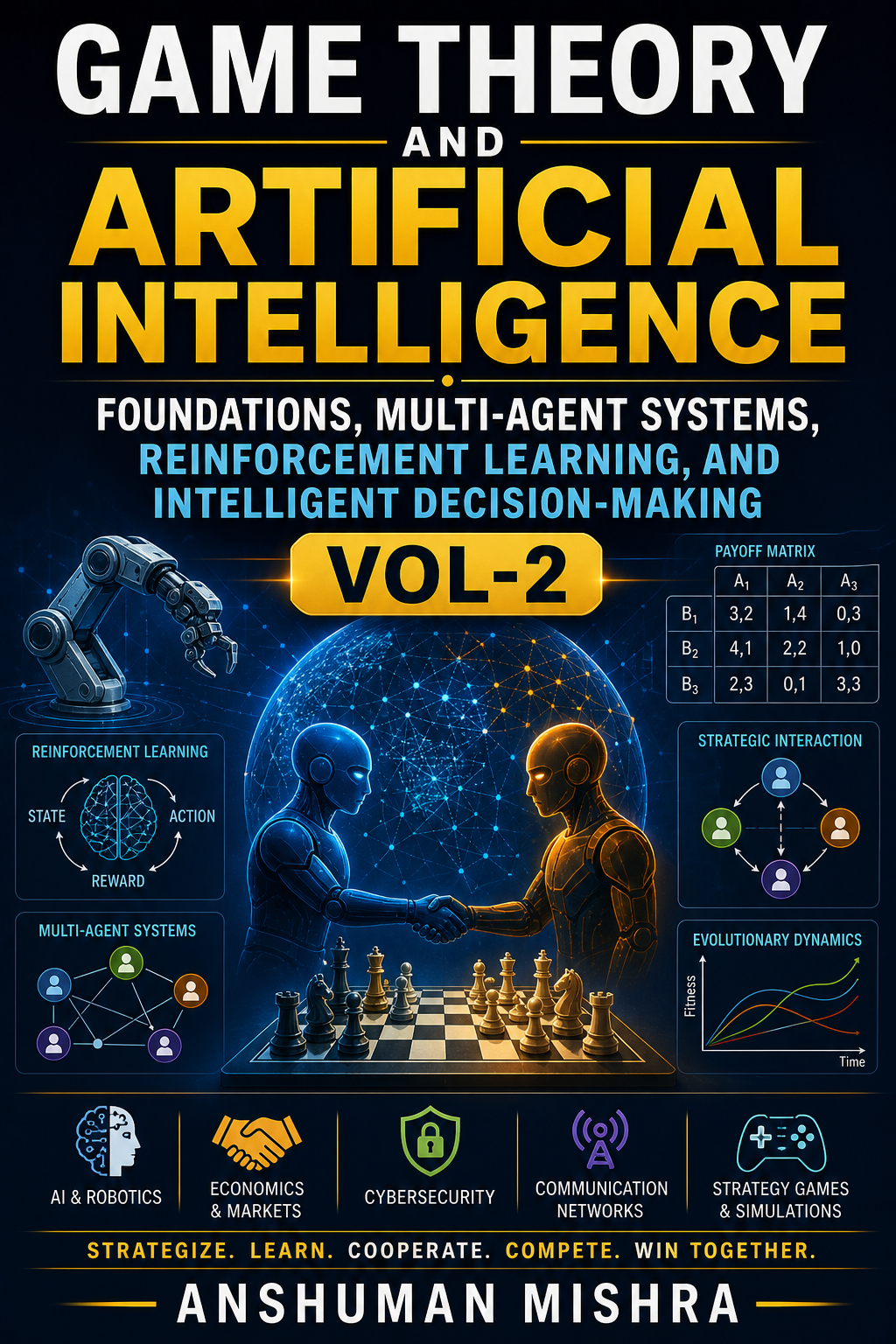
Game Theory and Artificial Intelligence: Foundations, Multi-Agent Systems, Reinforcement Learning, and Intelligent Decision-Making (Vol. 2)
Subtitle
A Comprehensive Guide for Students, Researchers, and Professionals
Author: Anshuman Mishra
Artificial Intelligence has entered an era where intelligent systems are no longer isolated problem solvers. Autonomous agents negotiate, cooperate, compete, coordinate, and learn continuously in dynamic environments shared with humans and other intelligent machines. As AI expands into autonomous vehicles, robotics, smart cities, cybersecurity, finance, communication networks, and large-scale distributed systems, the need for strategic reasoning has become more critical than ever.
Game Theory and Artificial Intelligence: Foundations, Multi-Agent Systems, Reinforcement Learning, and Intelligent Decision-Making (Vol. 2) continues the journey begun in Volume 1 by exploring the most advanced developments at the intersection of Game Theory, Artificial Intelligence, Deep Reinforcement Learning, and Multi-Agent Systems. It provides readers with a comprehensive understanding of how intelligent agents make strategic decisions, cooperate under uncertainty, compete in adversarial environments, and learn optimal behaviors through interaction.
This volume is designed for undergraduate and postgraduate students, researchers, academicians, AI practitioners, robotics engineers, data scientists, economists, operations researchers, and professionals seeking to master the mathematical and computational foundations of strategic artificial intelligence. The topics covered reflect the latest research directions shaping the future of AI, including game-theoretic reinforcement learning, mechanism design, AI governance, evolutionary learning, quantum game theory, and large-scale multi-agent intelligence.
Purpose and Vision of the Book
The primary goal of this volume is to demonstrate how advanced game-theoretic concepts enable the development of intelligent systems capable of learning, adapting, negotiating, coordinating, and making robust decisions in complex environments.
Unlike traditional books that separately discuss game theory, reinforcement learning, or distributed AI, this volume integrates these disciplines into a unified framework that reflects how modern AI systems are actually designed and deployed.
The book is built around five guiding principles:
- Build advanced strategic reasoning skills.
- Integrate deep reinforcement learning with game theory.
- Explain multi-agent intelligence using practical examples.
- Bridge academic theory with industrial AI applications.
- Prepare readers for cutting-edge research and innovation.
What This Volume Covers
This second volume extends the foundations established in Volume 1 into advanced research and real-world implementation. Readers will explore:
- Game-Theoretic Reinforcement Learning
- Multi-Agent Deep Reinforcement Learning
- Decision Making Under Uncertainty
- Mechanism Design
- Social Choice Theory
- AI Strategy and Competitive Learning
- Robotics and Autonomous Systems
- Communication Networks
- Cybersecurity Games
- Economic Strategy
- Evolutionary Game Theory
- Quantum Game Theory
- AI Safety and Alignment
- Multi-Agent Large Language Models
- Emerging Research Directions
Each topic combines rigorous mathematical concepts with modern AI applications, making the material suitable for both academic study and professional practice.
Key Features of the Book
1. Advanced Multi-Agent Reinforcement Learning
Readers gain a deep understanding of modern multi-agent learning algorithms, including:
- Nash Q-Learning
- Correlated-Q Learning
- Minimax-Q
- Gradient-Based Game Learning
- Equilibrium Learning
- Multi-Agent Credit Assignment
- Deep Q Networks (DQN)
- Actor–Critic Architectures
- MADDPG
- QMIX
- VDN
- Centralized Training with Decentralized Execution (CTDE)
These algorithms represent the state of the art in collaborative and competitive AI research.
2. Intelligent Decision-Making Under Uncertainty
Real-world AI systems rarely operate in perfectly predictable environments.
This volume introduces mathematical models for reasoning under uncertainty through:
- Expected Utility Theory
- Prospect Theory
- Risk Analysis
- Ambiguity Modeling
- Robust Decision-Making
- Adaptive Strategies
- Stochastic Optimization
Readers learn how intelligent agents make rational decisions when information is incomplete or constantly changing.
3. Mechanism Design and Incentive Engineering
Modern AI increasingly depends on designing systems where independent agents behave cooperatively while pursuing their own objectives.
The book explains:
- Auction Theory
- Vickrey Auctions
- Combinatorial Auctions
- Advertisement Auctions
- Incentive Alignment
- Contract Design
- Resource Allocation
- Mechanism Design Principles
These concepts are essential in digital marketplaces, blockchain systems, federated learning, cloud computing, and autonomous economic agents.
4. AI in Real-World Strategic Systems
One of the strengths of this volume is its strong emphasis on practical applications.
Readers discover how Game Theory powers intelligent systems in:
- Autonomous robotics
- Multi-robot coordination
- Swarm intelligence
- Self-driving vehicles
- Cybersecurity defense
- Wireless communication
- Network optimization
- Smart transportation
- Financial trading
- Supply chain optimization
- Market competition
- Distributed AI systems
Each application demonstrates how theoretical concepts become practical engineering solutions.
5. Evolutionary Learning and Future AI
The final chapters explore emerging research areas shaping the future of artificial intelligence.
Topics include:
- Evolutionary Game Theory
- Replicator Dynamics
- Population-Based Training
- Quantum Game Theory
- AI Alignment
- Multi-Agent Safety
- Reward Hacking
- Large Language Models (LLMs)
- Hierarchical Multi-Agent Reinforcement Learning
- Simulation-to-Reality Transfer
- Emergent Cooperation
- Future Open Research Problems
These chapters provide valuable insights for postgraduate students, PhD scholars, and AI researchers interested in the next generation of intelligent systems.
Who Should Read This Book?
This book is ideal for:
- BCA students
- MCA students
- B.Tech students
- M.Tech students
- Computer Science researchers
- Artificial Intelligence researchers
- Machine Learning engineers
- Robotics engineers
- Data Scientists
- Operations Research professionals
- Cybersecurity researchers
- Economists
- AI developers
- Autonomous Systems engineers
- Faculty members
- PhD scholars
- Competitive examination aspirants
No prior expertise in advanced game-theoretic reinforcement learning is required, as the material is presented progressively with clear explanations and practical examples.
Why This Book Is Unique
Unlike many specialized texts that focus exclusively on game theory or machine learning, this book presents a unified framework that connects mathematics, artificial intelligence, strategic optimization, and multi-agent decision-making.
Key strengths include:
- Comprehensive integration of Game Theory and AI
- Modern reinforcement learning algorithms
- Multi-agent system architectures
- Decision-making under uncertainty
- Mechanism design and incentive engineering
- AI ethics and governance
- Industry-oriented case studies
- Research-focused discussions
- Clear mathematical explanations
- Practical AI applications
The writing style balances academic rigor with accessibility, making complex concepts understandable without sacrificing technical depth.
Applications Covered
The concepts discussed in this volume have applications across numerous domains, including:
- Artificial Intelligence
- Machine Learning
- Deep Reinforcement Learning
- Multi-Agent Systems
- Robotics
- Autonomous Vehicles
- Cybersecurity
- Communication Networks
- Wireless Systems
- Internet of Things (IoT)
- Smart Cities
- Cloud Computing
- Blockchain
- Digital Markets
- Algorithmic Trading
- Healthcare AI
- Logistics and Supply Chains
- Defense Systems
- Recommendation Systems
- Distributed Computing
- Human–AI Collaboration
About the Author
Anshuman Mishra is an experienced academician, educator, researcher, and author specializing in Computer Science, Artificial Intelligence, Machine Learning, Mathematical Foundations of AI, Multi-Agent Systems, and Emerging Technologies. Through extensive teaching, curriculum development, and research, he has consistently focused on making advanced computational concepts accessible, practical, and relevant for students, professionals, and researchers.
His writing combines strong mathematical foundations with real-world implementation, enabling readers to understand both the theory and practical applications of modern AI technologies.
Conclusion
The future of Artificial Intelligence will be shaped not only by better algorithms but also by smarter strategic reasoning. As intelligent systems increasingly interact with one another in collaborative and competitive environments, Game Theory will remain one of the most important mathematical foundations of AI.
Game Theory and Artificial Intelligence: Foundations, Multi-Agent Systems, Reinforcement Learning, and Intelligent Decision-Making (Vol. 2) equips readers with the advanced knowledge, computational techniques, and strategic insights needed to understand, design, and implement the next generation of intelligent autonomous systems.
Whether you are preparing for academic research, industry innovation, competitive examinations, or advanced AI development, this book serves as a complete guide to mastering strategic intelligence in modern artificial intelligence.

Reviews
There are no reviews yet.