Description
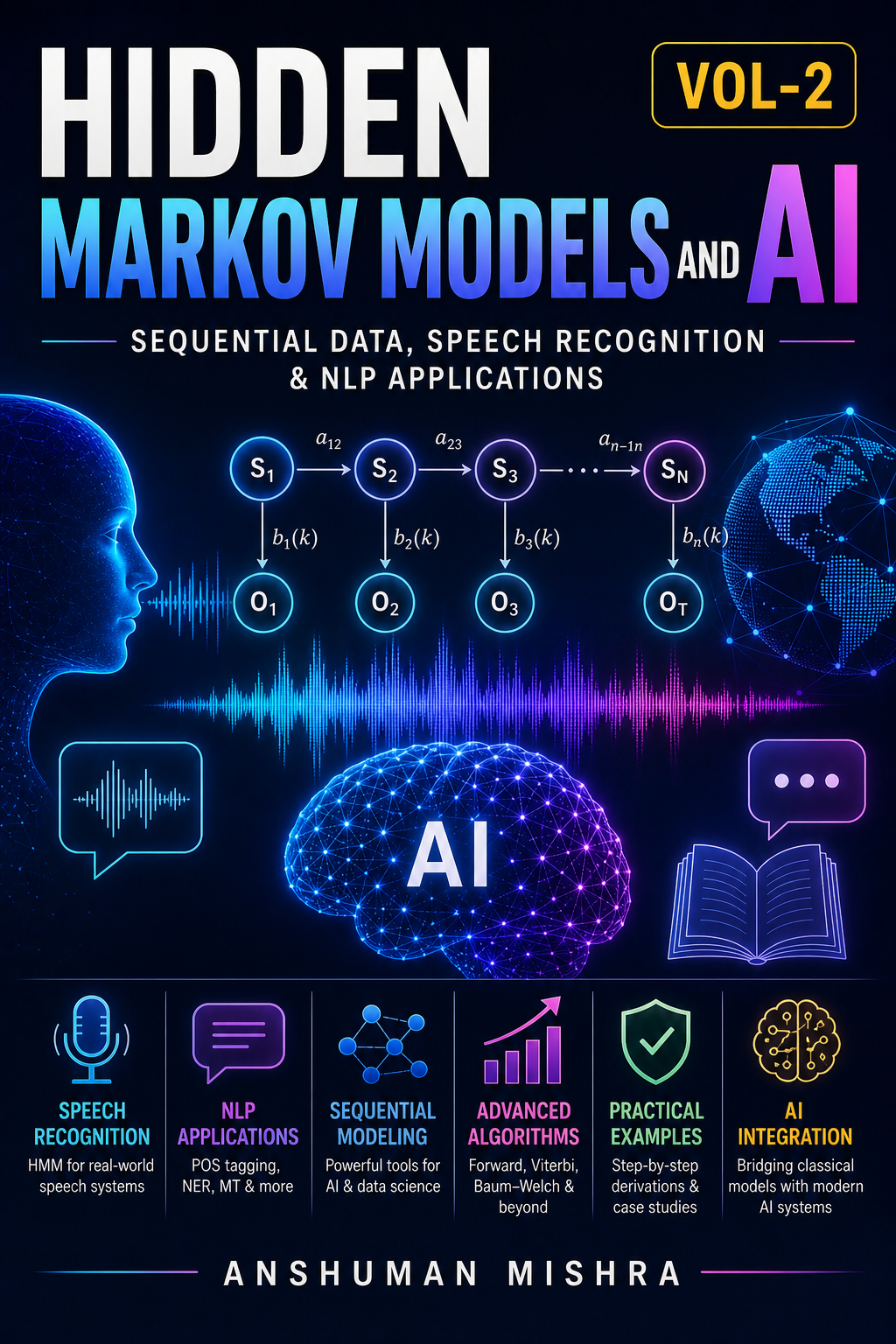
Hidden Markov Models and AI: Sequential Data, Speech Recognition & NLP Applications (Vol. 2)
Author: Anshuman Mishra
Artificial Intelligence has evolved from performing isolated computational tasks to understanding complex sequences of events, language, speech, and human interactions. Every spoken sentence, written paragraph, financial transaction, biological sequence, or sensor measurement unfolds over time, making sequential intelligence one of the most important challenges in modern AI.
Although deep learning has revolutionized sequence modeling, probabilistic graphical models—especially Hidden Markov Models (HMMs)—continue to provide elegant, interpretable, and computationally efficient solutions for many real-world applications. Combined with techniques such as Markov Decision Processes (MDPs), Conditional Random Fields (CRFs), and modern speech and language processing systems, HMMs remain foundational in both research and industrial AI.
Hidden Markov Models and AI: Sequential Data, Speech Recognition & NLP Applications (Vol. 2) builds upon the mathematical foundations established in Volume 1 and focuses on advanced sequence learning, speech technologies, natural language processing, and intelligent conversational systems. The book demonstrates how probabilistic sequence models can solve challenging AI problems involving uncertainty, temporal dependencies, and hidden state estimation while complementing modern deep learning architectures.
Designed for undergraduate and postgraduate students, AI researchers, speech engineers, NLP specialists, data scientists, and industry professionals, this volume provides a balanced combination of theoretical rigor, algorithmic understanding, practical implementation, and real-world applications.
Purpose and Vision of the Book
The objective of this volume is to demonstrate how Hidden Markov Models extend beyond theoretical probability into practical Artificial Intelligence systems that process speech, language, sequential events, and intelligent decision-making.
The book follows five guiding principles:
- Connect probabilistic models with practical AI systems.
- Explain sequential learning through intuitive examples.
- Compare classical probabilistic approaches with modern deep learning.
- Bridge theory and real-world implementation.
- Prepare readers for advanced research and industrial AI applications.
Why This Book Matters
Many AI systems must understand information that evolves over time rather than static data. Whether recognizing speech, translating languages, tracking dialogue states, or predicting future events, AI must reason about hidden structures within sequential observations.
This book illustrates how Hidden Markov Models continue to play a significant role in applications such as:
- Automatic Speech Recognition
- Speaker Verification
- Natural Language Processing
- Machine Translation
- Dialogue Systems
- Intelligent Chatbots
- Robotics
- Sequential Decision Making
- Human–Computer Interaction
- Computer Vision
- Medical Signal Processing
- Financial Time-Series Analysis
Readers will understand how probabilistic sequence models complement neural architectures and why they remain essential in modern AI research.
What This Volume Covers
Part III – Sequence Modeling and Learning
The book begins by exploring the nature of sequential information and the preprocessing techniques required before probabilistic modeling.
Topics include:
- Sequential Data Types
- Temporal Dependencies
- State Transition Modeling
- Signal Processing
- Feature Engineering
- Sliding Windows
- Context Windows
- Noise Reduction
- Missing Data Handling
- Outlier Detection
Readers learn how raw sequential observations are transformed into meaningful representations suitable for probabilistic learning.
Markov Decision Processes
Building upon Hidden Markov Models, the book introduces Markov Decision Processes (MDPs) as a framework for intelligent sequential decision-making.
Coverage includes:
- Relationship between HMMs and MDPs
- Reward-Based Learning
- Bellman Equations
- Value Functions
- Dynamic Programming
- Reinforcement Learning
- Robotics Planning
- Autonomous Decision Systems
These chapters demonstrate how probabilistic reasoning evolves into intelligent action selection.
Conditional Random Fields
Modern sequence labeling often relies on discriminative models rather than purely generative approaches.
The book explains:
- Generative vs. Discriminative Learning
- Conditional Random Fields
- Mathematical Foundations of CRFs
- Sequence Labeling
- Structured Prediction
- HMM vs. CRF
- HMM vs. RNN
- Comparative Advantages
- Applications in NLP and Computer Vision
Readers gain a clear understanding of when to choose HMMs, CRFs, or neural sequence models.
Speech Recognition Applications
One of the most important application areas of Hidden Markov Models is speech recognition.
The book provides comprehensive coverage of:
- Human Speech Production
- Digital Speech Processing
- Acoustic Feature Extraction
- Mel-Frequency Cepstral Coefficients (MFCC)
- Linear Predictive Coding (LPC)
- Perceptual Linear Prediction (PLP)
- Speech Corpora
- Acoustic Models
- Language Models
Readers understand the complete pipeline of modern speech recognition systems.
Hidden Markov Models in Speech Recognition
Dedicated chapters explain why Hidden Markov Models dominated speech recognition research for decades and continue to influence modern hybrid systems.
Topics include:
- HMM-Based Speech Architectures
- Word-Level Modeling
- Phone-Level Modeling
- Left-to-Right HMMs
- Viterbi Decoding
- Gaussian Mixture HMM Systems
- Real-Time Speech Recognition
- End-to-End Speech Pipelines
Step-by-step case studies demonstrate how speech signals are converted into recognized text.
Speaker Identification and Verification
Voice biometrics has become increasingly important in authentication and security.
The book explores:
- Speaker Identification
- Speaker Verification
- Text-Dependent Systems
- Text-Independent Systems
- Voice Biometrics
- Gaussian Mixture HMM Models
- Likelihood Scoring
- Practical System Design
- Real Audio Case Studies
These chapters connect probabilistic modeling with real-world biometric applications.
Natural Language Processing
Hidden Markov Models remain foundational in many classical NLP systems.
Readers learn how HMMs are applied to:
- Part-of-Speech Tagging
- Named Entity Recognition
- Word Segmentation
- Spelling Correction
- Text Classification
- Sequence Labeling
- Language Modeling
Practical examples demonstrate how probabilistic inference supports language understanding.
Machine Translation and Speech-to-Text
The book explains the historical development of statistical machine translation using Hidden Markov Models.
Topics include:
- Classical HMM Translation Models
- Word Alignment
- Noisy Channel Models
- Speech-to-Text Integration
- Building Translation Systems
- HMM vs. Transformer Models
Readers understand the evolution from probabilistic translation systems to modern neural architectures.
Dialogue Systems and Intelligent Chatbots
The final chapters explore conversational Artificial Intelligence using Hidden Markov Models.
Coverage includes:
- Dialogue State Tracking
- User Intent Recognition
- Conversation Flow Modeling
- Probabilistic Dialogue Management
- Hybrid HMM–Neural Chatbots
- Conversational AI Case Studies
These chapters demonstrate how sequential probabilistic reasoning supports natural human–computer interaction.
Key Features of the Book
✔ Advanced sequence modeling techniques
✔ Comprehensive speech recognition pipeline
✔ Practical NLP applications
✔ Markov Decision Processes
✔ Conditional Random Fields
✔ Comparative analysis of HMM, CRF, RNN, and Transformers
✔ Real-world AI case studies
✔ Mathematical foundations with intuitive explanations
✔ Research-oriented discussions
✔ Practical implementation guidance
Who Should Read This Book?
This book is suitable for:
- BCA Students
- MCA Students
- B.Tech Students
- M.Tech Students
- Artificial Intelligence Students
- Machine Learning Engineers
- NLP Engineers
- Speech Recognition Engineers
- Robotics Researchers
- Data Scientists
- Bioinformatics Researchers
- Signal Processing Engineers
- Faculty Members
- PhD Scholars
- AI Researchers
- Competitive Examination Aspirants
Readers who have completed Volume 1 or possess a basic understanding of Hidden Markov Models will benefit most from this advanced volume.
Applications Covered
The concepts discussed in this volume have applications in:
- Artificial Intelligence
- Machine Learning
- Sequential Learning
- Hidden Markov Models
- Speech Recognition
- Speaker Recognition
- Speaker Verification
- Natural Language Processing
- Machine Translation
- Conversational AI
- Intelligent Chatbots
- Dialogue Systems
- Human–Computer Interaction
- Robotics
- Reinforcement Learning
- Markov Decision Processes
- Conditional Random Fields
- Information Extraction
- Named Entity Recognition
- Part-of-Speech Tagging
- Speech-to-Text Systems
- Time-Series Prediction
- Biomedical Signal Processing
- Financial Analytics
- Intelligent Monitoring Systems
About the Author
Anshuman Mishra is an experienced academician, educator, researcher, and author specializing in Artificial Intelligence, Machine Learning, Data Science, Computer Science, Applied Mathematics, and Emerging Technologies. Through years of teaching and research, he has focused on presenting advanced computational concepts in a structured, intuitive, and application-oriented manner.
His books integrate mathematical rigor with practical AI implementation, enabling students, professionals, and researchers to develop both conceptual understanding and real-world problem-solving skills.
Conclusion
Sequential intelligence lies at the heart of modern Artificial Intelligence. Whether processing speech, understanding language, predicting future events, or managing conversations, AI systems must reason under uncertainty while modeling hidden temporal structures.
Hidden Markov Models and AI: Sequential Data, Speech Recognition & NLP Applications (Vol. 2) equips readers with the advanced theoretical foundations, computational algorithms, and practical applications required to master probabilistic sequence modeling. By integrating Hidden Markov Models with speech recognition, natural language processing, reinforcement learning, and conversational AI, this volume provides a complete roadmap for understanding and developing intelligent sequential systems.
Whether you are preparing for academic research, industrial AI development, or advanced machine learning applications, this book serves as a comprehensive guide to the enduring power of Hidden Markov Models in modern Artificial Intelligence.


Reviews
There are no reviews yet.