Description
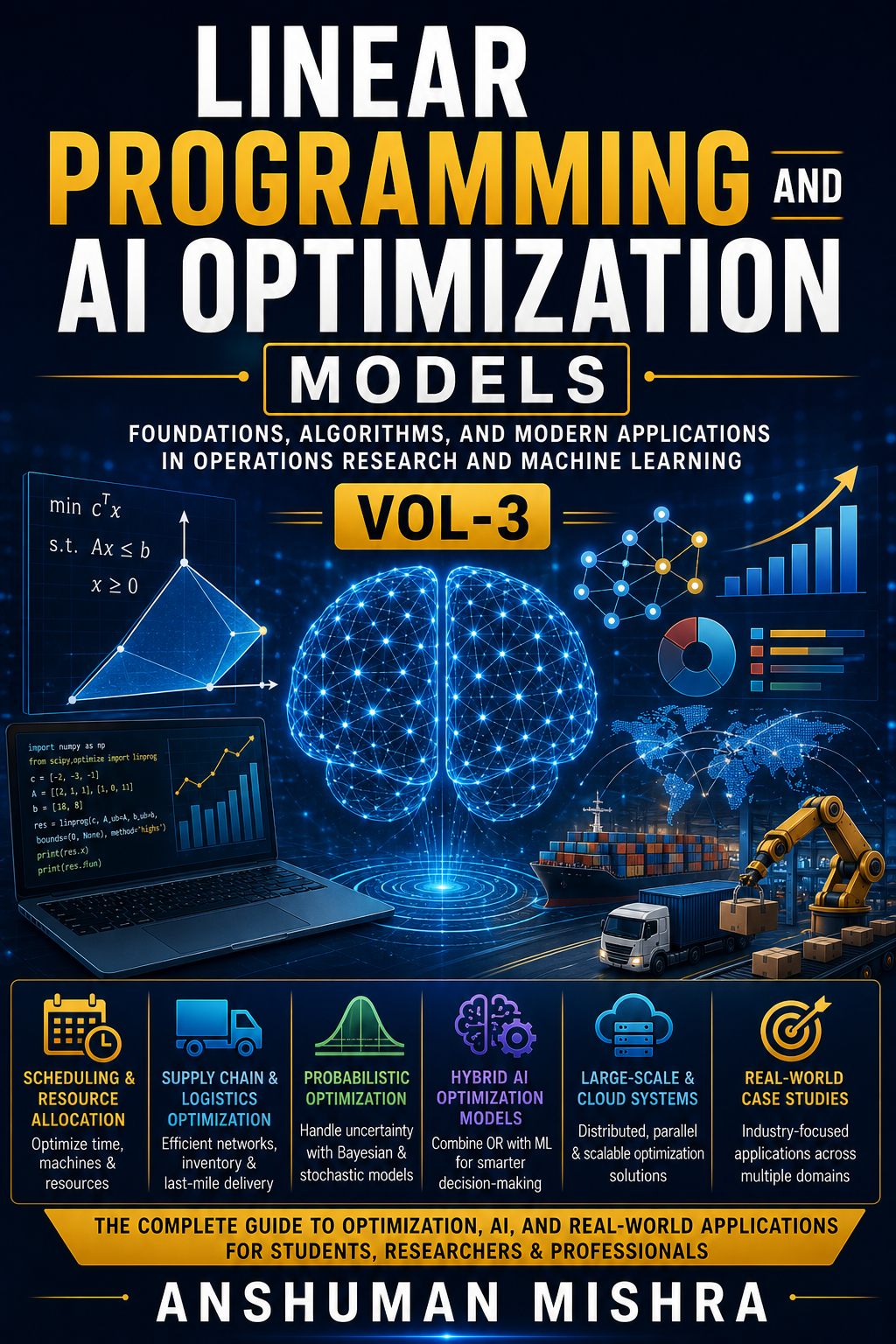
Linear Programming and AI Optimization Models: Foundations, Algorithms, and Modern Applications in Operations Research and Machine Learning – VOL-3 takes the concepts developed in the earlier volumes toward advanced practical optimization models, modern AI-driven frameworks, computational implementation, real-world case studies, and future research directions.
Optimization is increasingly becoming a core technology behind intelligent decision-making. Modern organizations use optimization for scheduling employees and machines, managing supply chains, routing vehicles, optimizing energy consumption, planning healthcare resources, setting prices, controlling robots, and managing large-scale computational systems.
This volume focuses on how classical Operations Research models can be integrated with Artificial Intelligence, Machine Learning, Cloud Computing, Big Data, Python, scalable optimization solvers, and emerging intelligent technologies.
It is designed to bridge the gap between theoretical optimization concepts and practical implementation.
What You Will Learn
This volume provides an extensive exploration of:
- Machine Scheduling
- Job Shop Scheduling
- Flow Shop Scheduling
- PERT/CPM Project Scheduling
- Resource Allocation
- Resource Planning
- Real-Time Scheduling with AI
- Inventory Optimization
- Distribution Network Optimization
- Vehicle Routing Problems
- Warehouse Optimization
- Last-Mile Delivery Optimization
- Bayesian Optimization
- Gaussian Processes
- Stochastic Optimization
- Monte Carlo Optimization
- Uncertainty Modeling
- Hybrid OR and Machine Learning Models
- MILP and Machine Learning
- AI-Based Constraint Solving
- Neuro-Symbolic Optimization
- AI-Assisted Operations Research
- Distributed Optimization
- Parallel Optimization Solvers
- GPU/TPU-Based Optimization
- Scalable Optimization Solvers
- Big Data Optimization
- Python for Optimization
- NumPy and SciPy
- Linear Programming with PuLP
- Mixed-Integer Optimization with OR-Tools
- Constraint Programming with CP-SAT
- Machine Learning Optimization with PyTorch and TensorFlow
- Real-world optimization case studies
- Quantum Optimization
- Differentiable Optimization Layers
- LLM-Assisted Optimization
- Autonomous Systems Optimization
- AI Safety Optimization
- Multi-Agent Optimization
- Edge Optimization for IoT
- Sustainability Optimization
PART VII – MODERN AI-OPTIMIZATION FRAMEWORKS
Chapter 17: Scheduling & Resource Allocation Models
Scheduling and resource allocation are fundamental Operations Research problems. This chapter examines mathematical and AI-driven approaches for allocating limited resources efficiently while satisfying operational requirements.
Key Topics
- Machine Scheduling
- Job Shop Models
- Flow Shop Models
- PERT/CPM Project Scheduling
- Resource Allocation
- Resource Planning
- Real-Time Scheduling with AI
The chapter demonstrates how optimization can support manufacturing, project management, workforce planning, computing systems, and real-time intelligent decision-making.
Chapter 18: Supply Chain & Logistics Optimization
Modern supply chains require optimization across inventory, transportation, warehouses, distribution networks, and last-mile delivery.
This chapter explores:
- Inventory Models
- Distribution Network Optimization
- Vehicle Routing Problems
- Warehouse Layout and Optimization
- Last-Mile Delivery Optimization
These models can help address complex logistics challenges involving costs, capacity, transportation routes, delivery times, inventory levels, and resource utilization.
PART VII – MODERN AI-OPTIMIZATION FRAMEWORKS
Chapter 19: Probabilistic Optimization
Real-world optimization problems often involve uncertainty. Probabilistic optimization provides methods for making decisions when data, outcomes, or system parameters are uncertain.
The chapter introduces:
- Bayesian Optimization
- Gaussian Processes
- Stochastic Gradient Methods
- Monte Carlo Optimization
- Uncertainty Modeling in Optimization
These techniques are particularly relevant to expensive optimization problems, machine learning model tuning, experimental design, and uncertain decision environments.
Chapter 20: Hybrid Optimization Models
Modern intelligent systems increasingly combine mathematical optimization with Machine Learning and Artificial Intelligence.
This chapter explores:
- Combining Operations Research and Machine Learning
- MILP + Machine Learning
- Constraint Solving with AI
- Neuro-Symbolic Optimization
- AI-Assisted Operations Research
The chapter highlights how data-driven models and mathematical optimization can work together to create intelligent decision-support systems.
Chapter 21: Large-Scale Optimization & Cloud Systems
Large optimization problems can involve millions of variables, constraints, data points, or possible decisions. Such problems require scalable computational infrastructure.
This chapter covers:
- Distributed Optimization
- Parallel Solvers
- GPU/TPU Optimization
- Scalable Optimization Solvers
- CPLEX
- Gurobi
- OR-Tools
- Big Data Optimization
The chapter introduces the computational perspective of modern optimization and explains how cloud and high-performance computing technologies can support large-scale problem solving.
PART VIII – PRACTICAL MODELS & IMPLEMENTATION
Chapter 22: Optimization with Python
Python has become an important platform for implementing optimization, data science, and machine learning solutions.
This chapter introduces practical optimization tools and frameworks including:
- NumPy
- SciPy
- PuLP
- OR-Tools
- CP-SAT
- PyTorch
- TensorFlow
The chapter demonstrates how mathematical optimization models can be translated into computational implementations and integrated with modern Machine Learning workflows.
Practical Implementation Areas
Readers can explore the use of Python for:
- Linear Programming
- Mixed-Integer Programming
- Constraint Programming
- Machine Learning Optimization
- Scheduling
- Routing
- Resource Allocation
- Mathematical Modeling
- Optimization Experiments
This makes the volume particularly useful for readers who want to move from optimization theory toward practical computational implementation.
Chapter 23: Case Studies
The book presents optimization through practical application areas.
Airline Scheduling
Optimization techniques can be used for flight scheduling, crew allocation, aircraft assignment, and operational planning.
Energy Consumption Optimization
Optimization models can support efficient energy usage, resource planning, and intelligent energy management.
Hospital & Healthcare Optimization
Optimization can assist with resource allocation, scheduling, capacity planning, and operational decision-making in healthcare environments.
E-Commerce Pricing Optimization
AI and optimization can be combined to support pricing decisions, demand-related planning, inventory decisions, and business optimization.
Robotics Path Planning
Optimization techniques can be used to develop efficient paths for robotic systems while considering obstacles, distance, cost, and operational constraints.
Manufacturing Optimization
Manufacturing systems can use optimization for production planning, machine scheduling, resource allocation, inventory management, and process improvement.
PART IX – RESEARCH TRENDS & FUTURE DIRECTIONS
Chapter 24: Emerging Trends
The field of optimization is rapidly evolving with developments in Artificial Intelligence and next-generation computing.
This chapter explores emerging areas such as:
- Quantum Optimization
- Differentiable Optimization Layers
- LLM-Assisted Optimization
- Autonomous Systems Optimization
These emerging approaches represent new opportunities for combining optimization with advanced AI architectures and intelligent computational systems.
Chapter 25: Future Research Opportunities
The final chapter focuses on research directions where AI and optimization are expected to play an increasingly important role.
Key research areas include:
- AI Safety Optimization
- Multi-Agent Optimization
- Edge Optimization for IoT
- Sustainability Optimization Models
These areas provide opportunities for researchers to explore optimization techniques for safe, distributed, resource-efficient, autonomous, and sustainable intelligent systems.
Key Highlights
✓ Advanced scheduling and resource allocation
✓ Supply chain and logistics optimization
✓ Vehicle Routing Problems
✓ Inventory and warehouse optimization
✓ Bayesian Optimization
✓ Gaussian Processes
✓ Stochastic and probabilistic optimization
✓ Hybrid OR + Machine Learning models
✓ MILP + Machine Learning
✓ Neuro-Symbolic Optimization
✓ AI-Assisted Operations Research
✓ Distributed and parallel optimization
✓ GPU/TPU optimization
✓ Cloud-based large-scale optimization
✓ CPLEX, Gurobi, and OR-Tools
✓ Python-based optimization
✓ PuLP and SciPy
✓ Constraint Programming and CP-SAT
✓ PyTorch and TensorFlow optimization
✓ Real-world optimization case studies
✓ Quantum Optimization
✓ Differentiable Optimization
✓ LLM-Assisted Optimization
✓ Autonomous Systems
✓ Multi-Agent Optimization
✓ AI Safety
✓ Edge AI and IoT Optimization
✓ Sustainable Optimization
Real-World Applications
The concepts covered in this volume can be applied to numerous domains, including:
- Manufacturing
- Supply Chain Management
- Logistics
- Transportation
- E-Commerce
- Healthcare
- Energy Management
- Robotics
- Aviation
- Project Management
- Workforce Scheduling
- Warehouse Management
- Smart Cities
- Internet of Things
- Cloud Computing
- Artificial Intelligence
- Machine Learning
- Autonomous Systems
Who Should Read This Book?
This volume is suitable for:
- Computer Science students
- BCA and MCA students
- Engineering students
- Artificial Intelligence students
- Machine Learning students
- Data Science students
- Operations Research students
- Mathematics students
- Researchers
- University teachers and educators
- AI/ML professionals
- Optimization practitioners
- Supply Chain and Logistics professionals
- Research scholars
It can be used as a textbook, reference book, practical learning resource, teaching material, project reference, or research foundation for optimization and AI-related subjects.
From Mathematical Models to Intelligent Systems
The major objective of VOL-3 is to connect mathematical optimization with practical intelligent systems.
Readers move from traditional scheduling and logistics problems toward probabilistic optimization, hybrid AI-OR frameworks, distributed optimization, Python implementation, real-world case studies, and emerging research areas.
This makes the book particularly relevant for readers interested in the convergence of:
Operations Research + Optimization + Artificial Intelligence + Machine Learning + Cloud Computing + Big Data + Intelligent Systems
Conclusion
Linear Programming and AI Optimization Models – VOL-3 provides a practical and forward-looking exploration of advanced optimization models and their applications.
The volume moves beyond fundamental mathematical techniques and focuses on real-world decision-making, AI-assisted optimization, scalable computing, Python implementation, practical case studies, and emerging research directions.
From airline scheduling and supply chain optimization to robotics, healthcare, energy, e-commerce, cloud systems, and autonomous technologies, the book demonstrates the broad role of optimization in modern intelligent systems.
Together, VOL-1, VOL-2, and VOL-3 provide a progressive learning journey from the foundations of Linear Programming and mathematical optimization to advanced AI-driven optimization models, practical implementations, real-world applications, and future research opportunities.
VOL-3 is an ideal resource for readers who want to understand how optimization is moving from traditional mathematical models toward scalable, intelligent, AI-assisted, and autonomous decision-making systems.

Reviews
There are no reviews yet.