Description
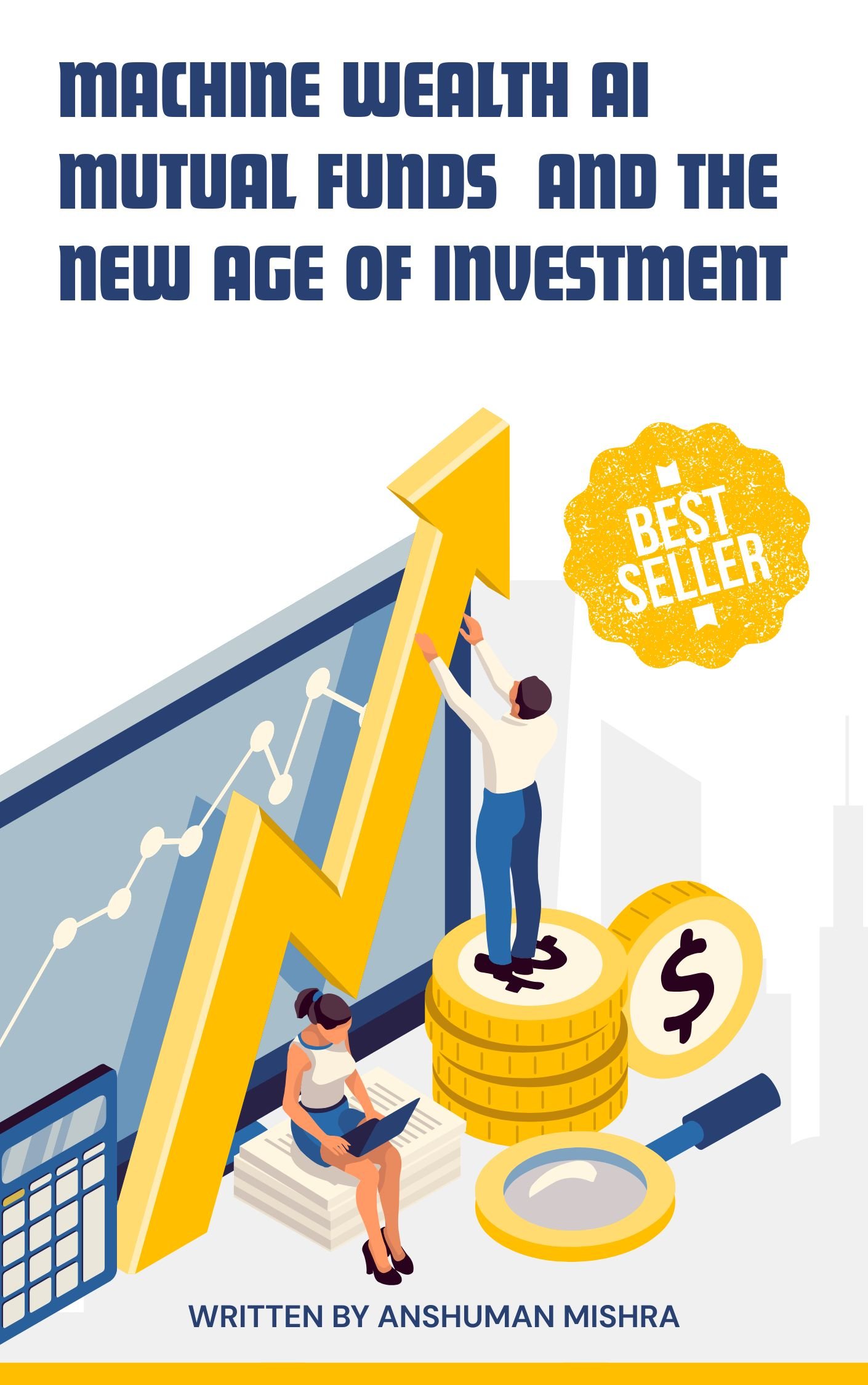
Machine Wealth: AI, Mutual Funds, and the New Age of Investment
How Artificial Intelligence is Redefining Wealth Creation, Risk, and Financial Freedom
Author: Anshuman Mishra, M.Tech (Computer Science)
Assistant Professor, Doranda College, Ranchi
The New Age of Intelligent Investing
The world of investment is undergoing a fundamental technological transformation.
For generations, investment decisions depended heavily on human experience, financial analysis, market research, intuition, and the expertise of fund managers. Today, these traditional approaches are increasingly being supported by Artificial Intelligence, machine learning, Big Data, cloud computing, natural language processing, automation, and financial analytics.
Modern financial systems can process enormous volumes of information, identify patterns, evaluate risks, analyze market sentiment, and support portfolio decisions at a scale that would be difficult for humans to achieve alone.
Machine Wealth: AI, Mutual Funds, and the New Age of Investment explores this transformation and examines how AI is changing the way investors understand mutual funds, portfolio management, market behavior, risk, financial technology, and wealth creation.
The book does not simply present AI as a magical solution to investment problems. Instead, it explores both the potential and limitations of intelligent financial systems, emphasizing responsible decision-making, transparency, risk awareness, and human oversight.
From Human Intuition to Machine Intelligence
Investment has evolved through several technological stages.
From newspapers and telephone-based transactions to online brokerage platforms, mobile investment applications, algorithmic trading, robo-advisors, and AI-powered analytics, technology has progressively changed how people interact with financial markets.
This book examines that evolution and asks an important question:
What happens when investment intelligence becomes increasingly computational?
Readers explore how algorithms can analyze:
- Historical market data
- Mutual fund performance
- NAV movements
- Investor sentiment
- Financial news
- Macroeconomic indicators
- Risk measurements
- Portfolio characteristics
The result is a new investment environment in which human judgment and machine intelligence increasingly work together.
Understanding Mutual Funds in the Digital Era
Before exploring AI, the book establishes a foundation in mutual fund concepts.
Readers learn about:
- NAV
- AUM
- Expense ratios
- Equity funds
- Debt funds
- Hybrid funds
- Portfolio allocation
- Fund performance
- Risk and return
The book then explains how digital tools and analytics are changing traditional fund analysis.
Instead of relying exclusively on manual calculations and static reports, modern investors can use computational tools to analyze historical information, compare funds, visualize performance, and study risk patterns.
The AI Engine Behind Modern Investment
The second major focus of the book is the technology that powers intelligent investment systems.
Readers are introduced to concepts such as:
- Machine learning
- Predictive modeling
- Time-series analysis
- Natural Language Processing
- Sentiment analysis
- Reinforcement learning
- Neural networks
- Portfolio optimization
- Explainable AI
These technologies are examined from a financial perspective so that readers can understand where AI can be useful and where its limitations must be recognized.
Predictive Modeling for Fund Analysis
One of the fascinating applications of AI in finance is predictive modeling.
The book introduces approaches such as:
- Regression
- Classification
- ARIMA
- LSTM
- Machine learning models
- Hybrid predictive approaches
Readers explore how historical financial data can be prepared and analyzed to investigate patterns in fund performance and market behavior.
The emphasis is not on promising guaranteed predictions, but on understanding the process, assumptions, limitations, and risks of financial forecasting models.
Sentiment Analysis and Market Psychology
Financial markets are influenced not only by numerical data but also by human expectations and emotions.
News reports, social media discussions, search trends, analyst commentary, and investor behavior can influence market sentiment.
The book explores how Natural Language Processing (NLP) can be used to analyze textual information and generate sentiment indicators.
Topics include:
- Financial sentiment analysis
- News analysis
- Social-media sentiment
- NLP
- Sentiment scoring
- Investor psychology
- Text-based financial signals
Readers are introduced to tools and concepts that can be used to experiment with sentiment-based financial analysis.
AI-Driven Portfolio Design and Automation
The book examines the emerging idea of intelligent portfolio management.
AI systems can potentially assist with:
- Portfolio analysis
- Asset allocation
- Rebalancing
- Risk monitoring
- Scenario analysis
- Performance tracking
- Financial data processing
The book also introduces reinforcement learning and neural-network concepts in the context of portfolio optimization.
However, the discussion maintains an important distinction:
Automation does not eliminate investment risk.
AI models depend on data, assumptions, model design, market conditions, and implementation quality. Historical patterns may not continue into the future.
This balanced perspective is central to the book.
Explainable AI and Financial Transparency
As algorithms become increasingly involved in financial decisions, another question becomes critical:
Can humans understand why an AI system made a particular recommendation?
This is the purpose of Explainable AI (XAI).
The book introduces concepts and tools such as:
- SHAP
- LIME
- Model interpretability
- Feature importance
- Algorithmic bias
- Data fairness
- Overfitting
- Transparency
Readers learn why explainability matters in financial applications and why a highly accurate model is not necessarily a trustworthy model.
Risk Management in the Age of AI
Investment involves risk, and AI cannot remove that fundamental reality.
The book examines different categories of investment risk, including:
- Systematic risk
- Unsystematic risk
- Market volatility
- Model risk
- Data risk
- Algorithmic risk
It also introduces analytical concepts such as:
- GARCH
- Value at Risk (VaR)
- Monte Carlo simulation
- Volatility modeling
- Stress testing
Practical examples demonstrate how computational tools can be used to explore hypothetical market scenarios.
Ethical and Responsible AI in Finance
Technology can improve financial analysis, but it can also introduce new challenges.
The book explores questions such as:
- Can an AI model be biased?
- Who is responsible for an automated decision?
- How should financial algorithms be audited?
- What happens when historical data contains hidden biases?
- How much transparency should an AI financial system provide?
- Should automated systems make decisions without human oversight?
The discussion introduces the principles of:
Fairness + Accountability + Transparency
These concepts are increasingly important as AI becomes integrated into financial services.
Practical Learning with Python, Power BI and Financial Data
A major strength of Machine Wealth is its practical orientation.
The book does not stop at theoretical explanations.
Readers are introduced to practical projects involving:
- Python
- Financial datasets
- Open financial data sources
- Scikit-learn
- NLP tools
- Power BI
- Python Dash
- Financial APIs
- AI-assisted analysis
Projects include concepts such as:
Smart Fund Tracker
A dashboard concept for monitoring mutual fund performance and related information.
Sentiment Dashboard
An experimental system for analyzing financial text and sentiment.
AI Fund Optimizer
A learning project exploring portfolio optimization using computational methods.
AI Fund Advisor Assistant
A prototype concept combining financial data with AI-based analytical assistance.
These projects are intended for educational and experimental learning, rather than guaranteed investment outcomes.
Real-World Case Studies
The book connects concepts with examples from the global and Indian financial technology ecosystem.
Topics include organizations and platforms associated with:
- AI-based financial analytics
- Automated investment management
- Robo-advisory
- Portfolio optimization
- Algorithmic decision support
- ESG analytics
- Digital wealth management
These case studies help readers understand how ideas discussed in the book relate to real financial technology systems.
The Future of Investment
The book looks beyond today’s AI systems toward the next generation of financial technology.
Future-oriented topics include:
- Quantum computing and finance
- AI-powered portfolio optimization
- Blockchain and financial systems
- Web3 and decentralized finance
- Personalized wealth ecosystems
- Autonomous financial agents
- Continuous-learning systems
- Human-AI collaboration
The book asks a larger question:
Will the future investor be a human using AI, or an AI working on behalf of humans?
The answer may ultimately be a combination of both.
From Investor to Innovator
Modern financial literacy increasingly overlaps with technological literacy.
The book therefore encourages readers to develop skills across multiple disciplines:
Finance + Data + AI + Analytics + Ethics
Readers interested in careers in this field can explore learning pathways involving:
- Financial data science
- FinTech
- AI in finance
- Quantitative analysis
- Financial analytics
- Machine learning
- Portfolio analytics
- AI product development
The objective is to help learners move beyond being passive consumers of financial technology and become informed users, analysts, researchers, and innovators.
Who Should Read This Book?
Machine Wealth is designed for a broad audience, including:
Finance Students and Professionals
Those who want to understand how AI is changing financial services and investment management.
Data Scientists and Engineers
Those interested in applying machine learning and data analytics to financial problems.
Investors and Financial Learners
Those who want to understand how AI tools can support research and financial analysis.
Educators and Researchers
Those looking for an interdisciplinary reference connecting computer science, AI, finance, and FinTech.
FinTech Entrepreneurs
Those exploring ideas for intelligent financial applications and wealth-management platforms.
Students
Particularly learners from fields such as:
- Computer Science
- BCA
- MCA
- MBA
- Data Science
- Artificial Intelligence
- Finance
- FinTech
Key Features
✓ AI and mutual funds explained together
✓ Introduction to intelligent investing
✓ Mutual fund fundamentals
✓ NAV, AUM and expense ratios
✓ AI and machine learning in finance
✓ Predictive modeling
✓ ARIMA and LSTM concepts
✓ Sentiment analysis and NLP
✓ AI-driven portfolio optimization
✓ Reinforcement learning concepts
✓ Explainable AI
✓ SHAP and LIME
✓ Algorithmic bias and fairness
✓ Financial risk management
✓ GARCH, VaR and Monte Carlo concepts
✓ Ethical AI in finance
✓ Python-based financial projects
✓ Power BI dashboards
✓ Financial data analysis
✓ Robo-advisory concepts
✓ Real-world case studies
✓ Future trends in AI and finance
✓ Human-AI collaboration
Learning Outcomes
After studying this book, readers can develop the ability to:
- Explain the relationship between AI and modern investment
- Understand mutual fund fundamentals
- Analyze the role of data in investment decisions
- Understand predictive modeling in financial applications
- Explore time-series forecasting concepts
- Understand sentiment analysis for financial data
- Explore AI-based portfolio optimization
- Understand investment risk and volatility
- Recognize model bias and overfitting
- Understand Explainable AI
- Explore financial data using Python
- Build educational financial analytics projects
- Create basic dashboards for financial information
- Understand the ethical challenges of algorithmic finance
- Explore emerging FinTech technologies
- Develop interdisciplinary AI + Finance skills
A Balanced View of AI and Wealth Creation
One of the central messages of Machine Wealth is that AI should not be viewed as a guaranteed path to financial success.
Financial markets are uncertain.
Models can fail.
Historical data can be misleading.
Algorithms can contain biases.
Unexpected events can disrupt even sophisticated strategies.
Therefore, the book promotes a more responsible philosophy:
Use AI to improve understanding—not to eliminate judgment.
The future of intelligent investing is likely to depend on collaboration between human expertise, financial knowledge, data science, and machine intelligence.
Important Educational Disclaimer
This book is intended for educational and informational purposes. Examples, models, simulations, projections, and AI-based strategies discussed in the book should not be interpreted as personalized investment advice, guaranteed returns, or recommendations to buy or sell any particular financial product. Financial decisions should be made after considering individual circumstances, risk tolerance, applicable regulations, and advice from appropriately qualified professionals.
The Future of Machine Wealth
The next generation of investors will need more than traditional financial literacy.
They will need to understand:
Data.
Algorithms.
Risk.
AI.
Ethics.
Human judgment.
Machine Wealth brings these ideas together in one interdisciplinary journey.
From the foundations of mutual funds to predictive analytics, sentiment intelligence, automated portfolio systems, explainable AI, risk management, ethical finance, and future FinTech innovation, the book provides a roadmap for understanding the changing relationship between technology and wealth creation.


Reviews
There are no reviews yet.