Description
Artificial Intelligence is rapidly moving toward systems that can operate intelligently with greater autonomy, efficiency, and adaptability. However, the increasing computational requirements of modern AI models have created new challenges related to energy consumption, latency, scalability, and real-time processing.
Neuromorphic computing offers an alternative approach by taking inspiration from the way biological nervous systems process information.
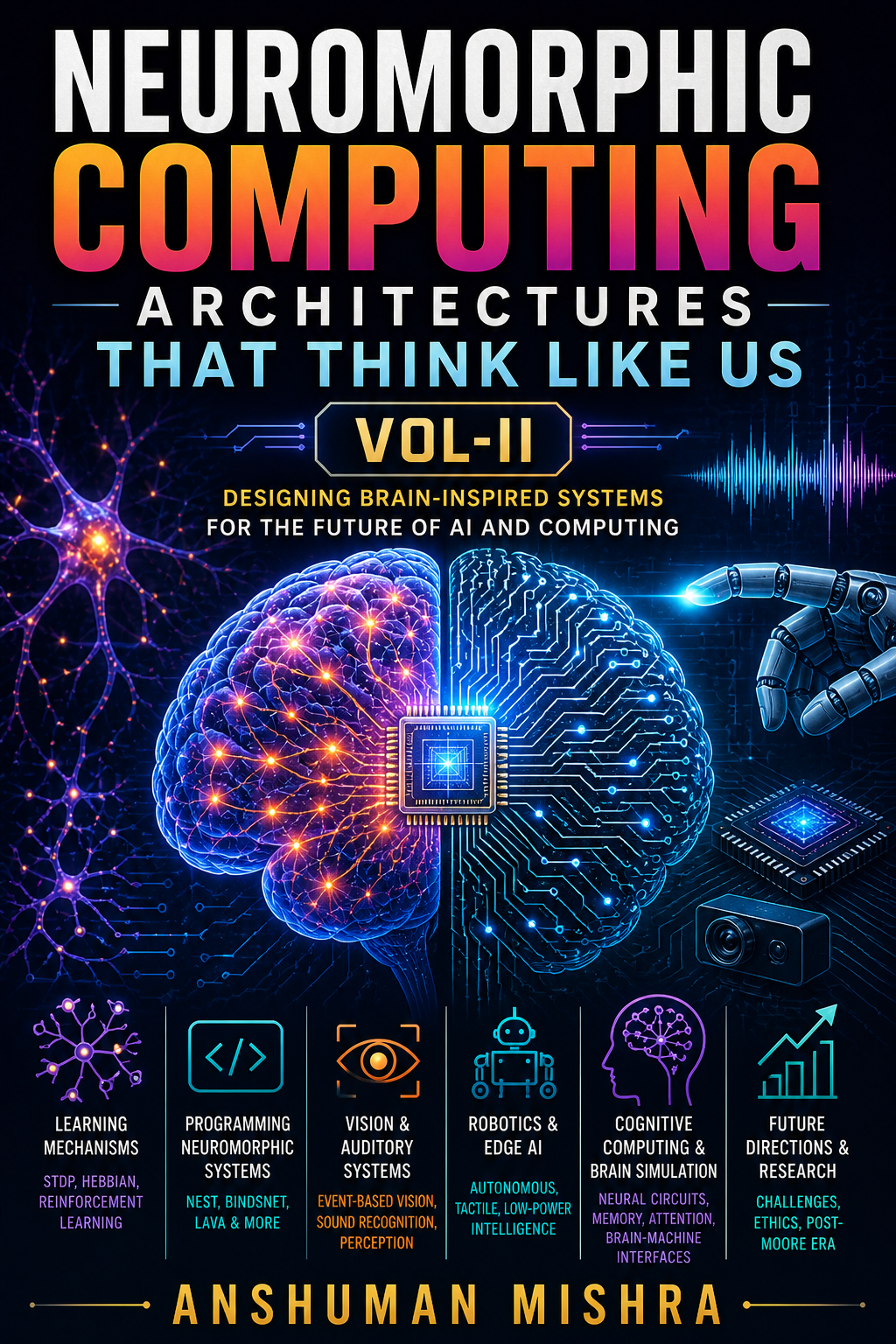
Neuromorphic Computing: Architectures That Think Like Us – VOL-II continues the journey introduced in Volume I and moves from fundamental concepts and hardware architectures toward learning algorithms, programming frameworks, intelligent sensing, robotics, cognitive computing, and emerging research directions.
The book explores how brain-inspired principles can be transformed into practical computational systems capable of processing information through spikes, events, local learning mechanisms, and highly parallel architectures.
From Neuromorphic Foundations to Intelligent Systems
Volume I introduced the biological foundations, spiking neural networks, neuromorphic principles, hardware architectures, and important neuromorphic platforms.
Volume II takes the next step:
Learning → Programming → Perception → Robotics → Cognitive Computing → Research Frontiers
The objective is to help readers understand not only what neuromorphic computing is, but also how neuromorphic systems learn, how they can be programmed, where they can be applied, and what challenges remain before widespread adoption.
Part III – Algorithms and Learning Mechanisms
The first section of this volume focuses on the algorithms and learning mechanisms that enable neuromorphic systems to adapt to their environments.
Chapter 7 – Learning in Neuromorphic Systems
Learning is one of the most important characteristics of biological intelligence.
This chapter explores learning approaches designed for neuromorphic systems, including:
- Online learning
- Unsupervised learning
- Hebbian learning
- Local learning rules
- Spike-Timing-Dependent Plasticity
- Reinforcement learning
- Adaptive neural systems
Online and Unsupervised Learning
Unlike conventional machine-learning pipelines that may require large offline training datasets, neuromorphic systems can be designed to learn continuously as new events arrive.
Readers explore the principles behind incremental and online adaptation.
Hebbian and Local Learning
The book examines local learning mechanisms inspired by biological neural systems, including the relationship between neuronal activity and synaptic adaptation.
STDP in Practice
The theoretical foundation of STDP introduced earlier is extended toward practical learning scenarios.
Readers explore how spike timing can influence synaptic weights and enable adaptive behavior.
Reinforcement Learning
The chapter also introduces reinforcement-learning approaches relevant to neuromorphic systems, connecting:
States → Actions → Rewards → Neural Adaptation
This creates an important bridge between neuromorphic computing and intelligent decision-making.
Chapter 8 – Programming Neuromorphic Systems
Building neuromorphic systems requires programming approaches that are different from conventional sequential computing.
This chapter introduces important development frameworks and programming concepts.
Topics include:
- Neuromorphic development frameworks
- NEST
- BindsNET
- Lava
- Event-driven programming
- Spike-based computation
- Neural simulation
- Programming workflows
- From code to execution
Readers learn how software frameworks can be used to construct and simulate spiking neural networks and experiment with brain-inspired computational models.
The chapter emphasizes the relationship between:
Neural Model → Code → Simulation → Event Processing → Intelligent Behavior
Part IV – Applications and Case Studies
The second major section demonstrates how neuromorphic technologies can be applied to real-world intelligent systems.
Chapter 9 – Neuromorphic Vision and Auditory Systems
Biological organisms continuously process visual and auditory information from their environments.
Neuromorphic systems attempt to replicate some of these characteristics through event-based sensing and spike-based processing.
The chapter covers:
- Event-based cameras
- Dynamic Vision Sensors (DVS)
- Event-driven vision
- Spiking vision systems
- Sound recognition
- Spiking auditory networks
- Bio-inspired perception
- Robotics applications
Event-Based Vision
Unlike conventional cameras that capture complete frames at fixed intervals, event-based sensors can represent changes in a scene as events.
This makes them particularly interesting for:
- Fast-motion detection
- Robotics
- Autonomous systems
- Low-latency vision
- Edge AI
Auditory Processing
The book also examines how spiking neural networks can be used for sound recognition and event-based auditory processing.
Chapter 10 – Robotics and Edge AI
Robotics is one of the most promising application areas for neuromorphic computing.
Robots must frequently process sensory information and make decisions under strict requirements for:
- Low latency
- Energy efficiency
- Real-time response
- Continuous adaptation
This chapter explores:
- Autonomous navigation
- Event-based sensing
- Tactile sensors
- Haptic feedback
- Edge intelligence
- Low-power embedded AI
- Neuromorphic robotics
Autonomous Navigation
Neuromorphic systems can potentially help robots respond rapidly to changing environments while reducing computational requirements.
Tactile Intelligence
The book explores how neuromorphic approaches can be combined with tactile sensors to help intelligent systems process touch-related information.
Low-Power Embedded Intelligence
This section is particularly relevant to edge devices where computational resources and energy availability may be limited.
Chapter 11 – Cognitive Computing and Brain Simulation
Neuromorphic computing is closely connected to attempts to understand and simulate aspects of biological intelligence.
This chapter explores:
- Neural circuit simulation
- Cognitive computing
- Memory models
- Attention mechanisms
- Brain simulation
- Brain-inspired cognitive architectures
- Brain-Machine Interfaces
Simulating Neural Circuits
Readers examine how computational models can represent neural circuits and investigate their behavior.
Memory and Attention
The book explores how concepts inspired by biological memory and attention can influence artificial cognitive systems.
Brain-Machine Interfaces
The chapter also introduces the conceptual relationship between neuromorphic systems and Brain-Machine Interfaces (BMI), an emerging interdisciplinary area connecting neuroscience, computing, and intelligent technology.
Part V – Future Directions and Research Frontiers
The final section of the book moves beyond existing technologies and examines the major challenges and research questions that will influence the future of neuromorphic computing.
Chapter 12 – Challenges and Open Problems
Despite significant progress, neuromorphic computing remains an active research field.
This chapter examines challenges including:
- Scalability
- Generalization
- Training complexity
- Hardware limitations
- Software ecosystem development
- Standardization
- Benchmarking
- Interoperability
- Integration with conventional AI
- Integration with emerging computing paradigms
A major theme is the question of how neuromorphic systems can move from experimental research platforms toward scalable, reliable, and widely usable computing systems.
Integration with Classical and Quantum AI
The chapter also explores the possibility of combining neuromorphic approaches with other computational paradigms.
Potential directions include:
Classical Computing + Neuromorphic Computing
AI/ML + Neuromorphic Systems
Neuromorphic + Quantum Computing
These hybrid approaches may provide new opportunities for solving complex computational problems.
Chapter 13 – The Future of Neuromorphic Computing
The final chapter takes a forward-looking view of the field.
It explores:
- Human-level intelligence
- Brain-inspired AI
- Next-generation computing
- Energy-efficient intelligence
- Post-Moore computing
- Ethical considerations
- Social implications
- Future research directions
Toward Human-Level Intelligence
The chapter considers whether brain-inspired architectures could contribute to future systems capable of increasingly sophisticated perception, learning, adaptation, and decision-making.
Ethics and Society
As intelligent systems become more capable, questions surrounding:
- Privacy
- Autonomy
- Human-machine interaction
- Responsible AI
- Accessibility
- Social impact
become increasingly important.
The book therefore considers neuromorphic computing not only as a technological challenge but also as a broader societal development.
Key Features of VOL-II
1. Learning-Centered Approach
The book explains how neuromorphic systems can learn through local, online, unsupervised, and reinforcement-learning mechanisms.
2. Programming and Frameworks
Readers are introduced to neuromorphic development environments including NEST, BindsNET, and Lava.
3. Real-World Applications
The book connects neuromorphic computing with:
- Computer vision
- Auditory processing
- Robotics
- Edge AI
- Autonomous navigation
- Cognitive computing
- Brain-machine interfaces
4. Research-Oriented Perspective
The final chapters focus on scalability, standardization, benchmarking, hybrid AI, ethics, and open research problems.
5. Future-Focused Content
The book explores how neuromorphic computing could contribute to the post-Moore era of computing and the development of more energy-efficient intelligent systems.
What You Will Learn
After completing this volume, readers will be able to:
✔ Understand learning mechanisms used in neuromorphic systems
✔ Explain online and unsupervised learning
✔ Understand Hebbian learning and local learning rules
✔ Explain STDP and its computational significance
✔ Understand reinforcement learning in neuromorphic systems
✔ Explore neuromorphic programming frameworks
✔ Understand event-driven programming
✔ Develop a conceptual understanding of spiking neural simulations
✔ Understand event-based vision
✔ Explore Dynamic Vision Sensors
✔ Understand neuromorphic auditory processing
✔ Explore neuromorphic robotics
✔ Understand autonomous navigation concepts
✔ Explore tactile and haptic sensing
✔ Understand low-power edge intelligence
✔ Explore cognitive computing and neural circuit simulation
✔ Understand memory and attention models
✔ Learn about Brain-Machine Interfaces
✔ Identify major challenges in neuromorphic computing
✔ Explore the integration of neuromorphic and other AI paradigms
✔ Understand important future research directions
Applications of Neuromorphic Computing
Neuromorphic technologies have potential applications across multiple domains.
🤖 Robotics
Autonomous robots, navigation, perception, tactile intelligence and adaptive control.
👁️ Computer Vision
Event-based cameras, motion detection, object recognition and low-latency visual processing.
🎧 Auditory Intelligence
Sound recognition, speech-related processing and event-based auditory systems.
📱 Edge AI
Low-power intelligent processing on devices close to the data source.
🏭 Industrial Systems
Real-time monitoring, anomaly detection and intelligent automation.
🚗 Autonomous Systems
Fast perception and decision-making for intelligent vehicles and robots.
🧠 Cognitive Computing
Brain-inspired memory, attention and decision-making systems.
🔬 Research
Neural simulation, computational neuroscience, AI architectures and emerging computing paradigms.
Who Should Read This Book?
This book is suitable for:
- BCA students
- B.Tech / BE students
- MCA students
- M.Tech students
- Computer Science students
- Artificial Intelligence students
- Machine Learning students
- Data Science students
- Robotics students
- Electronics and VLSI students
- Embedded Systems students
- AI/ML professionals
- Robotics engineers
- Computer architecture researchers
- Neuroscience and computational neuroscience learners
- Neuromorphic computing researchers
- University faculty
- Technology enthusiasts
Why This Book Is Important
The future of computing is not simply about increasing processor speed. It is increasingly about achieving greater intelligence with greater efficiency.
Neuromorphic computing approaches this challenge by exploring architectures that are:
Event-driven + Parallel + Adaptive + Energy-efficient + Brain-inspired
By combining neuroscience, artificial intelligence, computer architecture, robotics, and emerging hardware technologies, neuromorphic computing represents an important research direction for next-generation intelligent systems.
VOL-II takes readers from the fundamental learning mechanisms of neuromorphic systems to practical application areas and finally toward the open research questions that will shape the field’s future.
Book Details
Book Title: Neuromorphic Computing: Architectures That Think Like Us
Subtitle: Designing Brain-Inspired Systems for the Future of AI and Computing
Volume: VOL-II
Subject: Neuromorphic Computing, Spiking Neural Networks, AI, Robotics, Edge Computing and Brain-Inspired Systems
Level: Undergraduate, Postgraduate, Professional and Research
Author: Anshuman Mishra

Reviews
There are no reviews yet.