Description
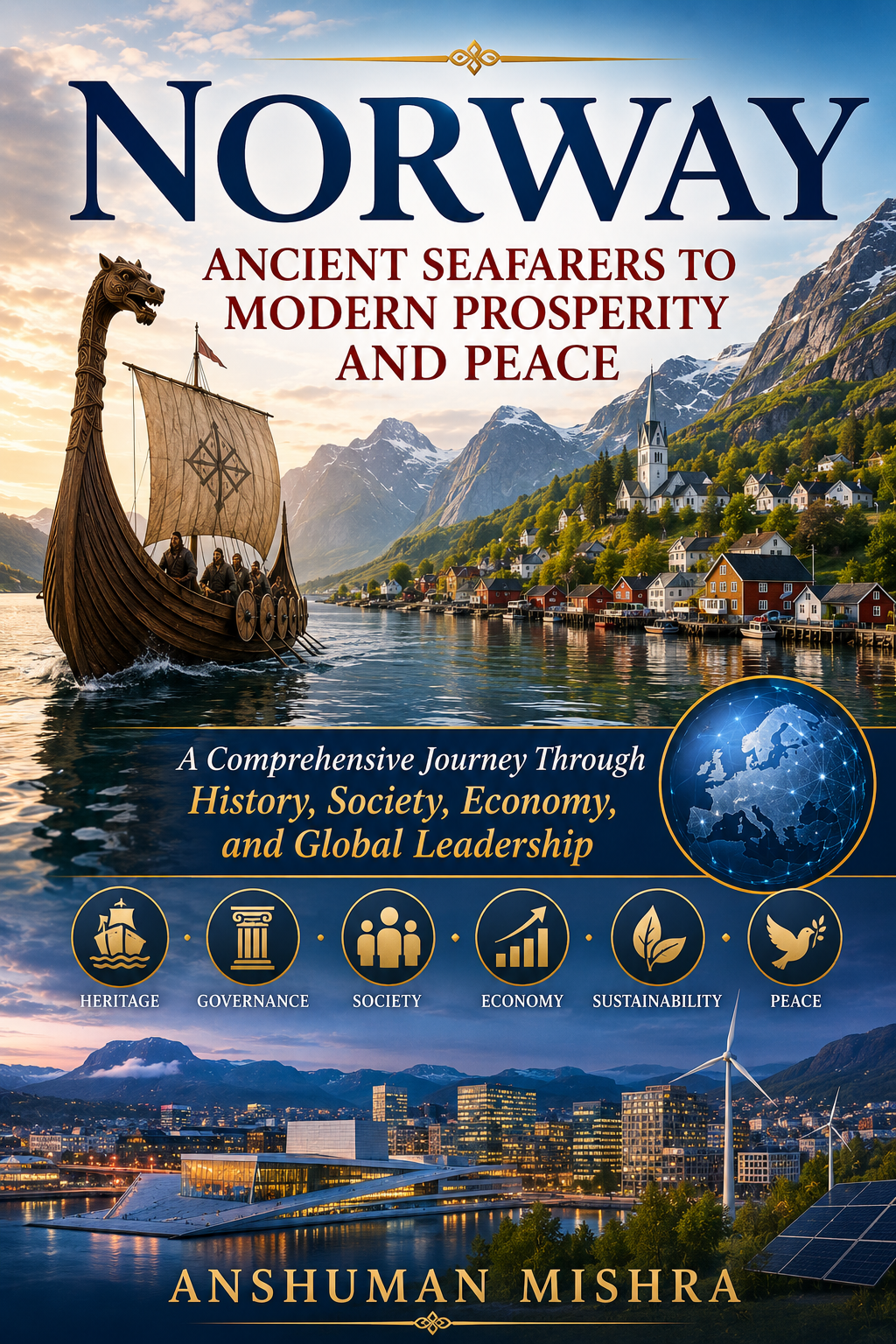
Norway: Ancient Seafarers to Modern Prosperity and Peace
A Comprehensive Journey Through History, Society, Economy, and Global Leadership
Discover the extraordinary story of one of the world’s most peaceful, prosperous, and well-governed nations through Norway: Ancient Seafarers to Modern Prosperity and Peace. This comprehensive and academically grounded book traces Norway’s evolution from its earliest human settlements and maritime traditions to its emergence as a global leader in democracy, sustainability, innovation, social welfare, and international peacebuilding.
Rather than presenting history as a sequence of isolated events, this book adopts a long-view civilizational perspective. It explains how geography, climate, seafaring traditions, governance, education, natural resource management, social values, and cultural resilience combined to shape Norway’s remarkable historical journey.
The narrative begins with Norway’s dramatic landscapes of mountains, fjords, forests, and rugged coastlines. Readers discover how geography and climate influenced early human migration, coastal settlements, navigation, fishing, trade, and community life. The sea became not only a source of survival but also the foundation of Norway’s economic development, cultural identity, and international connections.
The book explores the Age of Seafaring, highlighting maritime exploration, trade networks, technological innovation in shipbuilding, legal traditions, assemblies, and cultural exchange. It examines how these early experiences helped establish enduring values such as cooperation, local governance, responsibility, and adaptability.
Readers then follow Norway’s transformation through the medieval kingdom, Christianization, periods of political union, constitutional development, nation-building, industrialization, and the gradual strengthening of democratic institutions. Rather than focusing only on political events, the book emphasizes institutional evolution, cultural continuity, education, and civic participation.
A major section examines Norway’s modern economic success, explaining how careful management of natural resources, responsible public policy, long-term planning, transparency, and accountable governance transformed the country into one of the world’s most prosperous economies. The book provides valuable insights into sustainable resource management, sovereign wealth, innovation, and intergenerational responsibility.
The Norwegian welfare model is explored as a system built on education, healthcare, social security, gender equality, labor rights, and social inclusion. The book presents both the strengths and the ongoing debates surrounding the welfare state, offering readers a balanced understanding of its achievements and challenges.
Modern Norway is also examined through its leadership in environmental protection, renewable energy, climate policy, scientific research, digital governance, and the knowledge economy. Readers learn how innovation and sustainability have become central pillars of Norway’s national development strategy.
The final chapters focus on Norway’s role in global affairs, including diplomacy, humanitarian assistance, peace mediation, international cooperation, regional partnerships, multiculturalism, and sustainable development. Rather than portraying Norway simply as a successful nation, the book explains how its historical experiences continue to shape its constructive engagement with the wider world.
Inside This Book You’ll Discover
- Norway’s geography, climate, and environmental foundations
- Early settlements and maritime traditions
- Seafaring expansion, navigation, and trade networks
- Medieval Norway, Christianization, and constitutional development
- Nation-building, democracy, and political institutions
- Industrialization and economic modernization
- Responsible management of natural resources
- The Norwegian welfare state and social democracy
- Education, healthcare, equality, and human development
- Scientific research, technology, and the knowledge economy
- Environmental leadership and renewable energy
- Foreign policy, peace diplomacy, and humanitarian engagement
- Globalization, multiculturalism, and international cooperation
- Contemporary challenges and future opportunities
- Lessons from Norway’s model of peaceful and sustainable development
Written in a clear, balanced, and academically accessible style, this book is ideal for university students, competitive examination aspirants, educators, researchers, policymakers, development professionals, and readers interested in Scandinavian history, Nordic governance, sustainable development, international relations, and world civilizations.
Whether you are studying Norway’s historical evolution, exploring successful governance models, researching sustainable development, or seeking to understand one of the world’s most respected societies, this book provides a comprehensive, objective, and engaging guide.
Discover how Norway’s maritime heritage, democratic traditions, responsible resource management, commitment to equality, environmental stewardship, and culture of peace continue to inspire societies around the world.





Reviews
There are no reviews yet.