Description
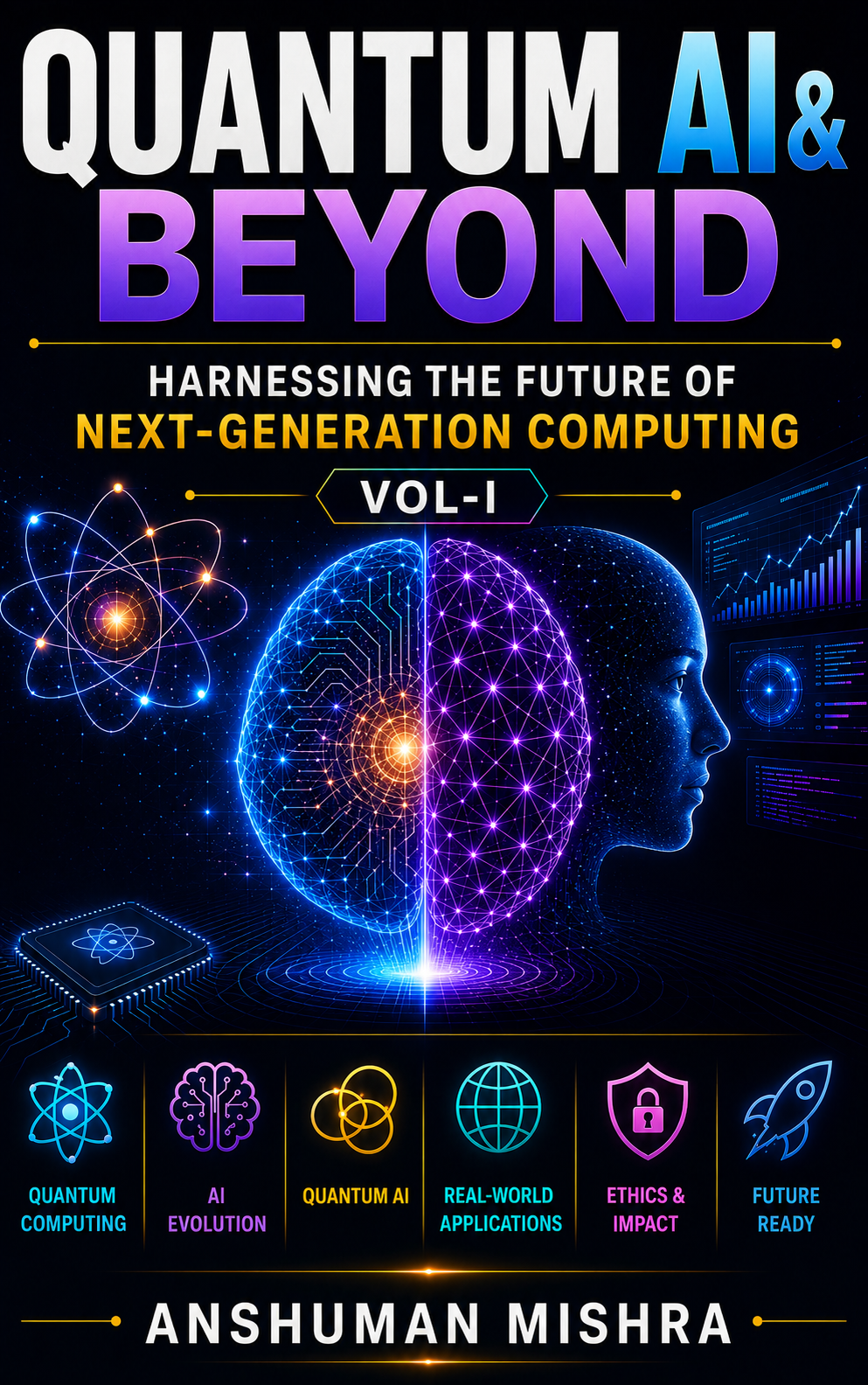
Quantum AI & Beyond: Harnessing the Future of Next-Generation Computing (Vol. I)
Subtitle
Exploring the Intersection of Quantum Mechanics, Artificial Intelligence, and the Computing Revolution
Author
Anshuman Mishra
The twenty-first century is witnessing one of the greatest technological revolutions in human history. Artificial Intelligence has transformed industries through intelligent automation, machine learning, and data-driven decision making, while Quantum Computing promises computational capabilities far beyond the limits of today’s classical computers. Individually, each technology represents a monumental breakthrough. Together, they form an entirely new scientific discipline—Quantum Artificial Intelligence (Quantum AI)—that has the potential to redefine computation, scientific discovery, engineering, healthcare, finance, cybersecurity, and countless other domains.
Quantum AI & Beyond: Harnessing the Future of Next-Generation Computing (Vol. I) serves as a comprehensive introduction to this revolutionary field. Designed for students, researchers, engineers, educators, technology professionals, and innovators, this volume provides a structured journey from the historical evolution of computing to the mathematical foundations of quantum mechanics, the principles of artificial intelligence, modern quantum computing architectures, and the emergence of quantum-enhanced machine learning.
Rather than assuming extensive prior knowledge, the book introduces complex concepts gradually through clear explanations, practical examples, conceptual diagrams, and real-world applications. Readers gain both theoretical understanding and an appreciation of how quantum technologies are expected to shape the future of intelligent computing.
Purpose of the Book
The primary objective of this book is to bridge the gap between classical computing, artificial intelligence, and quantum computing by presenting them within a unified educational framework.
The book aims to:
- Introduce the historical evolution of computing and artificial intelligence.
- Explain the principles of quantum mechanics underlying quantum computation.
- Build a strong conceptual foundation in quantum computing architectures and algorithms.
- Explore the emerging field of Quantum Machine Learning (QML).
- Demonstrate how quantum computing can enhance modern AI systems.
- Present practical applications of Quantum AI across multiple industries.
- Inspire future research in intelligent quantum technologies.
- Encourage responsible innovation and ethical development of next-generation computing systems.
Why This Book Matters
Today’s AI systems require enormous computational resources for training increasingly sophisticated models. Classical computing architectures are approaching physical and engineering limitations, while the demand for faster optimization, larger datasets, and more complex simulations continues to grow.
Quantum computing introduces entirely new computational principles through:
- Superposition
- Quantum Entanglement
- Quantum Interference
- Quantum Parallelism
These principles allow certain computational problems to be solved dramatically more efficiently than with classical computers.
This book explains how combining these quantum principles with Artificial Intelligence creates new possibilities for:
- Accelerated machine learning
- Faster optimization algorithms
- Scientific simulations
- Drug discovery
- Financial modeling
- Secure communication
- Intelligent robotics
- Autonomous decision-making
- Large-scale data analysis
What This Book Covers
Part I – Foundations of the Future
The opening chapters establish the scientific and technological foundations required to understand Quantum AI.
Readers explore:
History of Computing
The book traces computing from:
- Alan Turing’s theoretical machines
- Mechanical computation
- Vacuum tubes
- Transistors
- Integrated circuits
- Personal computers
- Cloud computing
- Artificial Intelligence
- Modern intelligent systems
Special attention is given to the limitations imposed by Moore’s Law and why new computational paradigms are becoming necessary.
Fundamentals of Quantum Mechanics
Quantum mechanics forms the scientific basis of quantum computing.
Topics include:
- Classical bits versus quantum bits (qubits)
- Superposition
- Quantum entanglement
- Quantum interference
- Quantum measurement
- Decoherence
- Quantum error correction
The explanations emphasize conceptual understanding while avoiding unnecessary mathematical complexity.
Artificial Intelligence Fundamentals
Before studying Quantum AI, readers build a solid understanding of modern AI technologies.
Coverage includes:
- Machine Learning
- Deep Learning
- Neural Networks
- Data-driven learning
- Supervised learning
- Unsupervised learning
- Reinforcement learning
- AI limitations
- Computational challenges
Readers learn why AI increasingly requires new computational paradigms.
Part II – Enter Quantum Computing
The second section introduces quantum computing as a revolutionary computing model.
Topics include:
Quantum Computing Architecture
Readers discover:
- Quantum processors
- Quantum gates
- Quantum circuits
- Quantum computation models
- Gate-based quantum computers
- Quantum annealers
- Topological quantum computing
These concepts are illustrated with practical examples and intuitive explanations.
Quantum Supremacy
The book examines major milestones in quantum computing development.
Topics include:
- Google Quantum Supremacy
- IBM Quantum Systems
- Rigetti Computing
- IonQ
- Quantum benchmarks
- Current hardware capabilities
- Hype versus practical reality
Readers gain a balanced understanding of the current state of quantum technology.
Quantum Algorithms
Several foundational algorithms are introduced, including:
- Shor’s Algorithm
- Grover’s Algorithm
- Quantum Search
- Quantum Optimization
- Quantum Simulation
Each algorithm is discussed conceptually, with emphasis on its significance and applications.
Quantum Hardware Infrastructure
Building practical quantum computers presents major engineering challenges.
This chapter explores:
- Superconducting qubits
- Photonic quantum computing
- Trapped-ion systems
- Cryogenic cooling
- Quantum control electronics
- Cloud quantum computing
- AWS Braket
- IBM Quantum Experience
- Scalability challenges
Readers understand the technological infrastructure required to build quantum computers.
Part III – The Rise of Quantum AI
The final section focuses on the integration of quantum computing with Artificial Intelligence.
Quantum Machine Learning
Topics include:
- Fundamentals of Quantum Machine Learning
- Quantum data encoding
- Hybrid quantum-classical learning
- Variational Quantum Eigensolver (VQE)
- Quantum Approximate Optimization Algorithm (QAOA)
- Parameterized quantum circuits
Readers learn how quantum computation enhances machine learning workflows.
Quantum-Enhanced Artificial Intelligence
The book discusses how quantum technologies may improve AI through:
- Faster optimization
- Improved search algorithms
- Accelerated training
- Enhanced feature selection
- Quantum-enhanced pattern recognition
- High-dimensional data processing
Current limitations and future opportunities are also explored.
Applications of Quantum AI
The concluding chapters present practical applications across multiple industries.
Examples include:
- Drug Discovery
- Genomics
- Precision Medicine
- Financial Risk Analysis
- Portfolio Optimization
- Cybersecurity
- Cryptography
- Smart Materials
- Chemical Simulation
- Logistics
- Supply Chain Optimization
Each application demonstrates the transformative potential of Quantum AI.
Key Features of the Book
✔ Beginner-friendly explanations
✔ Comprehensive coverage of Quantum Computing fundamentals
✔ Strong Artificial Intelligence foundation
✔ Introduction to Quantum Machine Learning
✔ Real-world industry applications
✔ Emerging research directions
✔ Clear conceptual illustrations
✔ Modern quantum algorithms
✔ Cloud quantum computing platforms
✔ Balanced discussion of opportunities and limitations
Who Should Read This Book?
This book is suitable for:
- Undergraduate Students
- Postgraduate Students
- PhD Researchers
- Computer Science Students
- Artificial Intelligence Students
- Quantum Computing Enthusiasts
- Physics Students
- Data Scientists
- Machine Learning Engineers
- Software Developers
- Research Scientists
- Technology Professionals
- Entrepreneurs
- Innovation Leaders
- Academicians
- Government Technology Advisors
No prior knowledge of quantum computing is assumed, making this an ideal starting point for readers entering the field.
Applications Covered
Readers will discover Quantum AI applications in:
- Artificial Intelligence
- Machine Learning
- Deep Learning
- Quantum Machine Learning
- Quantum Computing
- Drug Discovery
- Healthcare
- Medical Research
- Genomics
- Bioinformatics
- Financial Modeling
- Algorithmic Trading
- Risk Management
- Cybersecurity
- Cryptography
- Materials Science
- Chemistry
- Logistics
- Supply Chain Optimization
- Manufacturing
- Robotics
- Autonomous Systems
- Scientific Computing
- Climate Modeling
- Smart Cities
- Aerospace
- Defense
- Telecommunications
- High-Performance Computing
About the Author
Anshuman Mishra is an academician, educator, researcher, and author specializing in Artificial Intelligence, Quantum Computing, Computer Science, Data Science, Machine Learning, Emerging Technologies, and Applied Computing. With extensive teaching and research experience, he is committed to making advanced scientific concepts understandable, practical, and accessible for students, researchers, and professionals worldwide.
His books combine academic rigor, practical applications, and future-oriented perspectives, helping readers build strong foundations while preparing for the rapidly evolving technological landscape.
Conclusion
Quantum Computing and Artificial Intelligence are no longer independent disciplines—they are converging to create a new era of intelligent computation. As researchers continue to overcome current technological challenges, Quantum AI is expected to revolutionize optimization, learning, simulation, and decision-making across nearly every scientific and industrial domain.
Quantum AI & Beyond: Harnessing the Future of Next-Generation Computing (Vol. I) provides readers with the knowledge, concepts, and vision required to understand this transformation. By integrating the principles of quantum mechanics with modern artificial intelligence, this book offers a comprehensive roadmap for anyone seeking to explore one of the most exciting frontiers in computing.
Whether you are a student beginning your journey, a researcher exploring next-generation algorithms, or a professional preparing for the future of intelligent technologies, this volume will serve as an invaluable guide to the foundations of Quantum AI and the revolutionary computing era that lies ahead.
Reviews
There are no reviews yet.