Description
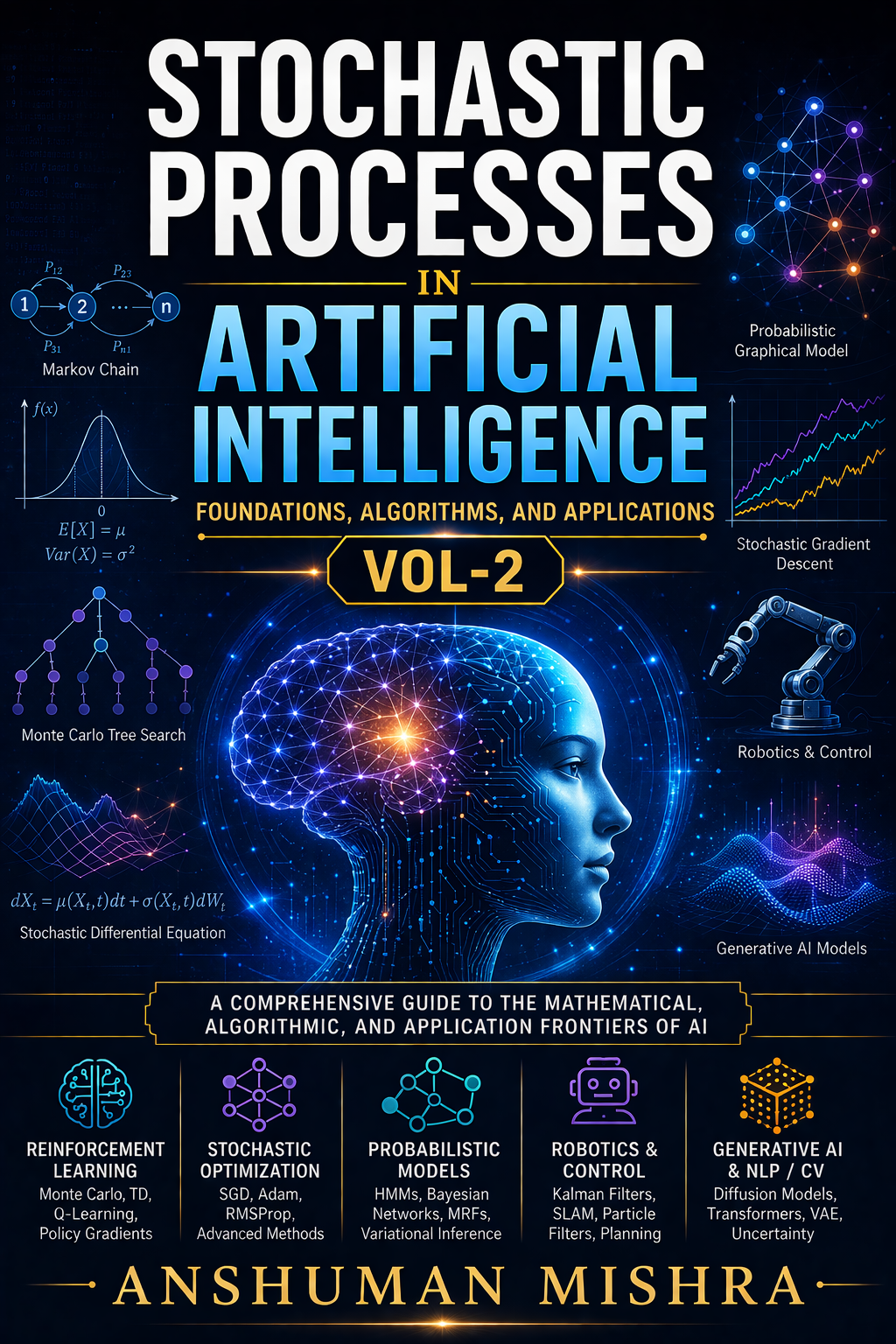
Stochastic Processes in Artificial Intelligence: Foundations, Algorithms, and Applications (VOL-II)
Author: Anshuman Mishra
Published: 2025
Language: English
Category: Artificial Intelligence | Machine Learning | Reinforcement Learning | Deep Learning | Generative AI | Probability | Computer Science
Book Overview
Modern Artificial Intelligence systems are increasingly built upon stochastic principles, enabling machines to learn from uncertain environments, optimize complex decisions, model probability distributions, and generate realistic data. From Reinforcement Learning and Deep Learning to Robotics, Computer Vision, Natural Language Processing, and Generative AI, stochastic processes play a central role in enabling intelligent behavior.
Stochastic Processes in Artificial Intelligence: Foundations, Algorithms, and Applications (VOL-II) continues the journey from Volume I by exploring advanced probabilistic algorithms and their practical applications in today’s AI landscape. This volume examines modern Reinforcement Learning techniques, probabilistic graphical models, Bayesian deep learning, stochastic optimization, diffusion models, stochastic differential equations, and the mathematical foundations behind state-of-the-art generative AI systems.
Blending rigorous mathematical concepts with intuitive explanations, practical examples, algorithmic insights, and real-world case studies, this book equips readers with the knowledge needed to understand, design, and evaluate intelligent systems operating under uncertainty.
Whether you are pursuing graduate studies, conducting AI research, or developing next-generation intelligent applications, this volume provides an essential roadmap to advanced stochastic Artificial Intelligence.
What You’ll Learn
Inside this book, you’ll master:
- Monte Carlo Learning
- Temporal Difference Learning
- Q-Learning
- SARSA
- Deep Q Networks (DQN)
- Policy Gradient Algorithms
- Actor-Critic Methods
- Trust Region Policy Optimization (TRPO)
- Proximal Policy Optimization (PPO)
- Multi-Agent Reinforcement Learning
- Stochastic Games
- Nash Equilibrium
- Mean Field Games
- Bayesian Deep Learning
- Probabilistic Graphical Models
- Bayesian Networks
- Markov Random Fields
- Gibbs Sampling
- Variational Inference
- Kalman Filters
- Particle Filters
- SLAM
- Robotics under Uncertainty
- Diffusion Models
- Transformers
- Language Models
- Stochastic Differential Equations
- Random Matrix Theory
- Neural Tangent Kernel
- Variational Autoencoders (VAE)
- Generative Stochastic Networks
- Probabilistic Deep Learning
Table of Contents
PART IV – Advanced Reinforcement Learning
Chapter 13 – Monte Carlo and Temporal Difference Learning
Explore learning algorithms that estimate value functions through experience.
Topics include:
- Monte Carlo Prediction
- First-Visit Monte Carlo
- Every-Visit Monte Carlo
- Temporal Difference Learning
- TD(0)
- TD(λ)
- Bootstrapping
- Bias–Variance Tradeoff
- Learning Under Uncertainty
- Applications in Games and Control Systems
Chapter 14 – Value-Based Reinforcement Learning
Master value-function approximation techniques used in modern AI.
Topics include:
- Q-Learning
- SARSA
- Deep Q Networks (DQN)
- Exploration Strategies
- Epsilon-Greedy
- Softmax Exploration
- Upper Confidence Bound (UCB)
- Noise Injection
- Learning Stability
- Practical Reinforcement Learning Applications
Chapter 15 – Policy Gradient Methods
Understand policy optimization techniques behind modern reinforcement learning.
Topics include:
- REINFORCE Algorithm
- Stochastic Gradient Estimation
- Actor-Critic Methods
- Trust Region Policy Optimization (TRPO)
- Proximal Policy Optimization (PPO)
- Policy Optimization
- Variance Reduction
- Noise in Policy Updates
Chapter 16 – Multi-Agent Stochastic Reinforcement Learning
Study intelligent decision-making among multiple interacting agents.
Topics include:
- Stochastic Games
- Nash Equilibrium
- Cooperative Learning
- Competitive Learning
- Mean-Field Games
- Randomized Cooperation
- Adversarial Reinforcement Learning
- Market Simulations
- Networked AI Systems
PART V – Stochastic Models in Modern AI Applications
Chapter 17 – Stochasticity in Deep Learning
Learn how randomness improves deep neural networks.
Topics include:
- Dropout
- Batch Normalization
- Random Weight Initialization
- Stochastic Regularization
- Bayesian Deep Learning
- Model Uncertainty
- Predictive Confidence
- Robust Learning
Chapter 18 – Probabilistic Graphical Models
Master graphical models for probabilistic reasoning.
Topics include:
- Bayesian Networks
- Markov Random Fields
- Gibbs Sampling
- Variational Inference
- Graphical Models
- Probabilistic AI Systems
- Knowledge Representation
- Practical Applications
Chapter 19 – Stochastic Processes in Robotics and Control
Explore uncertainty-aware robotics and autonomous systems.
Topics include:
- Robot Localization
- Simultaneous Localization and Mapping (SLAM)
- Kalman Filters
- Extended Kalman Filters
- Particle Filters
- Motion Planning
- Stochastic Control
- Autonomous Navigation
- Intelligent Robotics
Chapter 20 – Stochastic Models in NLP and Computer Vision
Understand probabilistic models behind language and visual intelligence.
Topics include:
- Language Modeling
- Markov Language Models
- Word Embeddings
- Random Walk Algorithms
- Diffusion Models
- Stochastic Denoising
- Transformer Architectures
- Probabilistic Attention
- Uncertainty in Vision Systems
- AI Perception
PART VI – Advanced Topics and Future Directions
Chapter 21 – Stochastic Differential Equations in AI
Study continuous stochastic dynamics used in modern AI research.
Topics include:
- Ito Calculus
- Stochastic Differential Equations (SDEs)
- Langevin Dynamics
- Continuous-Time Learning
- Stochastic Regularization
- SDE-Based Machine Learning
- Research Challenges
Chapter 22 – Random Matrix Theory and High-Dimensional Stochasticity
Understand the mathematics behind large-scale neural networks.
Topics include:
- Random Matrix Theory
- Eigenvalue Distributions
- Neural Tangent Kernel (NTK)
- Mean-Field Theory
- Chaos in Neural Networks
- Stability Analysis
- Optimization Applications
Chapter 23 – Stochasticity in Generative AI
Explore the probabilistic foundations of modern generative models.
Topics include:
- Variational Autoencoders (VAE)
- Generative Stochastic Networks
- Diffusion Models
- Score Matching
- Latent Variable Models
- Random Latent Spaces
- Probabilistic Image Generation
- Modern Generative AI
Chapter 24 – Challenges, Open Research Questions, and Future Directions
Discover emerging trends shaping the future of stochastic Artificial Intelligence.
Topics include:
- Limitations of Current Stochastic Models
- Open Problems in Reinforcement Learning
- Future of Stochastic Optimization
- Probabilistic Deep Learning Challenges
- Explainable Probabilistic AI
- Quantum-Inspired Stochastic Computing
- Emerging Research Directions
- Future AI Innovations
Key Features
- Advanced coverage of stochastic Artificial Intelligence
- Modern Reinforcement Learning algorithms
- Deep Learning under uncertainty
- Bayesian reasoning and probabilistic modeling
- Robotics and autonomous systems
- Natural Language Processing applications
- Computer Vision techniques
- Generative AI foundations
- Diffusion model introduction
- Mathematical rigor with intuitive explanations
- Research-oriented discussions
- Industry-relevant case studies
- Future AI trends and emerging technologies
Who Should Read This Book?
This book is ideal for:
- Artificial Intelligence Students
- Machine Learning Engineers
- Deep Learning Engineers
- Reinforcement Learning Researchers
- Data Scientists
- AI Researchers
- PhD Scholars
- M.Tech Students
- B.Tech Students
- MCA Students
- Computer Science Students
- Robotics Engineers
- NLP Researchers
- Computer Vision Engineers
- Research Scientists
- University Faculty
- Quantitative Analysts
- Software Engineers
- AI Professionals
- Technology Enthusiasts
Benefits of Reading This Book
By studying this volume, readers will be able to:
- Master advanced Reinforcement Learning algorithms
- Build probabilistic AI systems
- Understand Bayesian Deep Learning
- Apply stochastic optimization techniques
- Develop intelligent robotic systems
- Understand uncertainty in Computer Vision and NLP
- Explore modern Generative AI architectures
- Analyze diffusion models and stochastic differential equations
- Interpret cutting-edge AI research
- Prepare for graduate studies, industrial research, and advanced AI development
Career Opportunities
The knowledge gained from this book supports careers such as:
- Artificial Intelligence Engineer
- Machine Learning Engineer
- Reinforcement Learning Engineer
- Deep Learning Engineer
- Data Scientist
- AI Research Scientist
- Robotics Engineer
- NLP Engineer
- Computer Vision Engineer
- Autonomous Systems Engineer
- Research Fellow
- Quantitative Researcher
- Computational Scientist
- University Lecturer
- AI Product Developer
Book Details
Title: Stochastic Processes in Artificial Intelligence: Foundations, Algorithms, and Applications (VOL-II)
Author: Anshuman Mishra
Published: 2025
Language: English
Edition: Volume II
Category: Artificial Intelligence, Reinforcement Learning, Deep Learning, Probabilistic Modeling, Generative AI, Computer Science
Suitable For: Students, Researchers, Educators, Universities, AI Professionals, Machine Learning Engineers, Data Scientists, and Self-Learners
Why Buy This Book?
As Artificial Intelligence continues to evolve toward increasingly probabilistic and uncertainty-aware systems, mastering stochastic processes has become essential for understanding modern AI. Stochastic Processes in Artificial Intelligence (VOL-II) provides a comprehensive exploration of advanced reinforcement learning, Bayesian methods, probabilistic graphical models, robotics, deep learning, and generative AI. By combining strong mathematical foundations with practical applications and current research directions, this volume prepares readers to tackle real-world AI challenges, contribute to cutting-edge research, and build the next generation of intelligent systems.

Reviews
There are no reviews yet.