Description
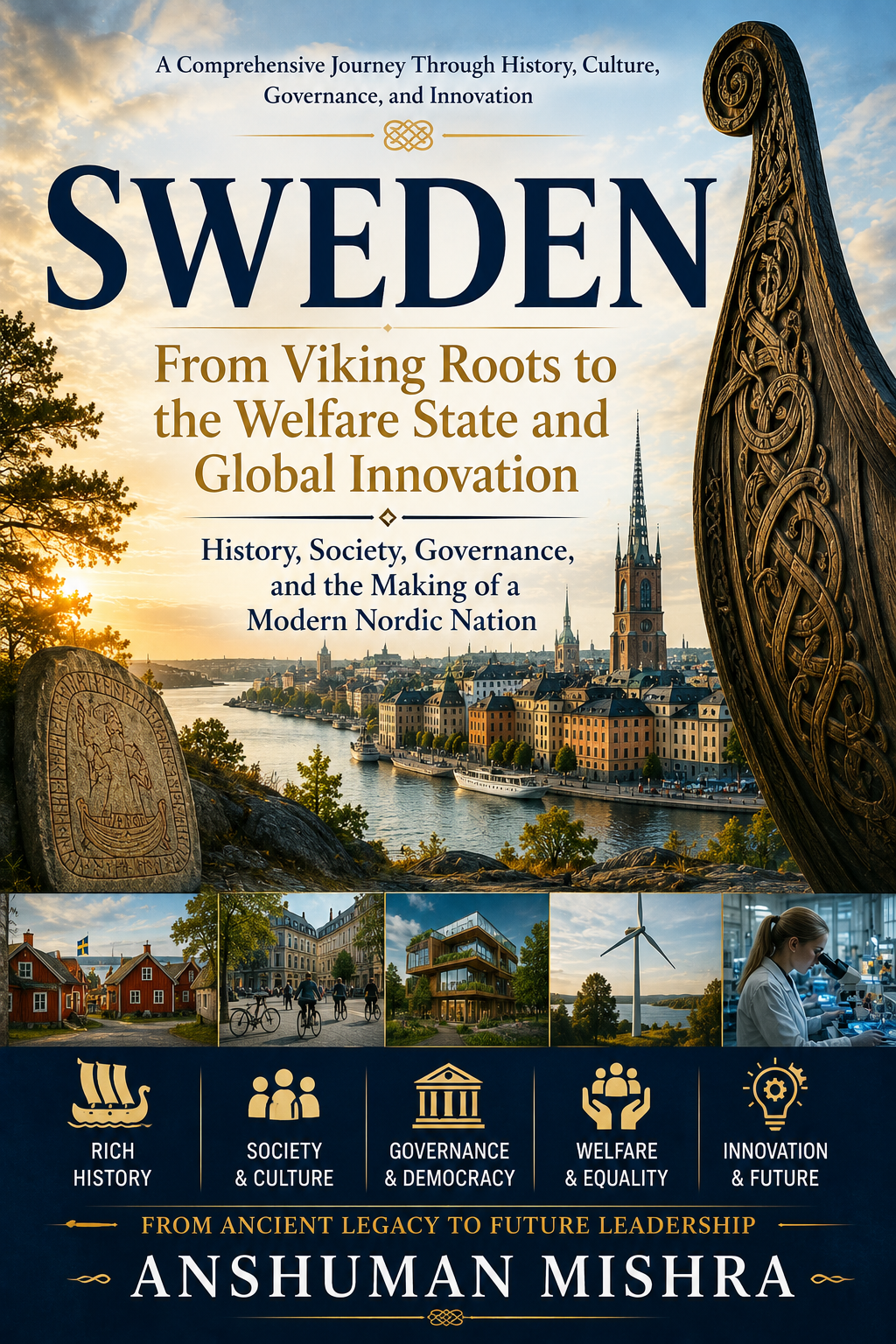
Sweden: From Viking Roots to the Welfare State and Global Innovation
History, Society, Governance, and the Making of a Modern Nordic Nation
Author: Anshuman Mishra
Sweden stands as one of the world’s most admired examples of democratic governance, social welfare, economic competitiveness, technological innovation, and environmental sustainability. From the legendary Viking Age and the emergence of the Swedish kingdom to its modern role as a global leader in innovation, education, green technology, and social development, Sweden’s history is a remarkable story of transformation, resilience, and institutional evolution.
Sweden: From Viking Roots to the Welfare State and Global Innovation provides a comprehensive, academically rigorous, and accessible examination of Sweden’s historical journey and contemporary achievements. Combining perspectives from history, political science, economics, sociology, international relations, environmental studies, public policy, and development studies, this book explains how centuries of institutional development, social cooperation, and policy innovation have shaped one of the world’s most successful Nordic societies.
Rather than presenting Sweden merely as a prosperous Scandinavian country, this book explores the deeper historical, cultural, and institutional foundations that continue to influence Swedish governance, social trust, innovation, and global leadership.
From Viking Society to a Modern Nation
The story of Sweden begins long before the emergence of the modern state.
The opening chapters examine the country’s geographical setting, natural environment, and the historical foundations of Swedish civilization. Readers explore how forests, coastlines, rivers, harsh winters, and access to the Baltic Sea influenced settlement patterns, economic development, maritime culture, and social organization.
Special attention is devoted to the Viking Age, examining:
- Viking society
- Scandinavian trade networks
- Maritime exploration
- Social organization
- Norse mythology
- Community governance
- Cultural exchange
- Early legal traditions
- Economic development
- Lasting historical influence
Rather than romanticizing the Viking era, the book presents it as a formative period that shaped Sweden’s political culture, commercial traditions, and collective identity.
The Formation of the Swedish Kingdom
The transition from pagan beliefs to Christianity marked a significant turning point in Swedish history.
Readers gain insight into:
- Christianization
- State formation
- Medieval institutions
- Royal authority
- Legal development
- Church influence
- Education
- Cultural transformation
- Administrative evolution
- Integration into medieval Europe
These developments established many of the political and institutional foundations that supported Sweden’s long-term stability and governance.
Sweden as a Regional Power
During the early modern era, Sweden emerged as one of Northern Europe’s most influential powers.
The book analyzes:
- State expansion
- Military organization
- Resource management
- Economic development
- Baltic politics
- Trade networks
- Administrative reforms
- Imperial ambitions
- Strategic diplomacy
- Lessons from imperial decline
Rather than focusing solely on military achievements, the discussion highlights how Sweden gradually shifted from expansionist ambitions toward internal development, institutional reform, and social progress.
Industrialization and Economic Transformation
Sweden’s transition from an agrarian society to an advanced industrial economy represents one of the most significant chapters in its history.
Readers explore:
- Agricultural modernization
- Industrial development
- Urbanization
- Infrastructure expansion
- Manufacturing
- Labor migration
- Labor movements
- Economic modernization
- Productivity growth
- Export-oriented development
The book explains how industrialization laid the foundation for Sweden’s later achievements in innovation, education, and social welfare.
Democracy, Neutrality, and Consensus Politics
Sweden is internationally recognized for its stable democratic institutions and political culture built upon dialogue, cooperation, and consensus.
Key topics include:
- Parliamentary democracy
- Constitutional reforms
- Political participation
- Electoral institutions
- Political parties
- Consensus governance
- Rule of law
- Public trust
- Administrative transparency
- Democratic accountability
The book also explores Sweden’s long-standing policy of neutrality and examines how this approach influenced its foreign policy, international reputation, and role in global diplomacy.
The Swedish Welfare State
One of Sweden’s defining characteristics is its comprehensive welfare model.
Rather than presenting it as a static system, this book examines its historical development, institutional design, strengths, and evolving challenges.
Topics include:
- Universal healthcare
- Social security
- Public education
- Family policy
- Gender equality
- Labor market institutions
- Collective bargaining
- Social insurance
- Income redistribution
- Welfare reform
Readers gain a balanced understanding of how social welfare has contributed to equality, economic stability, and high levels of public trust.
Culture, Language, and Social Values
Swedish society is shaped not only by institutions but also by shared cultural values.
The book explores:
- Swedish language
- Literature
- Art
- Music
- Cultural heritage
- Social responsibility
- Equality
- Civic participation
- Community trust
- National identity
These cultural traditions help explain Sweden’s distinctive approach to governance, cooperation, and public life.
Innovation and the Knowledge Economy
Sweden consistently ranks among the world’s most innovative nations.
This book examines the factors behind this success, including:
- Innovation policy
- Research and development
- Higher education
- Entrepreneurship
- Digital transformation
- Technology adoption
- Start-up ecosystems
- Knowledge industries
- Creative economy
- Global competitiveness
Readers discover how education, research institutions, business collaboration, and public policy work together to create an environment that encourages innovation and sustainable economic growth.
Sustainability and Climate Leadership
Environmental responsibility has become one of Sweden’s defining global contributions.
Topics include:
- Renewable energy
- Green technology
- Climate policy
- Sustainable cities
- Circular economy
- Environmental governance
- Biodiversity conservation
- Urban planning
- Climate adaptation
- Sustainable development
The book demonstrates how Sweden integrates environmental protection with long-term economic planning and technological innovation.
Migration, Diversity, and Social Integration
As a modern multicultural society, Sweden has experienced significant demographic and social change.
Readers examine:
- Historical migration
- Immigration policy
- Refugee integration
- Cultural diversity
- Social cohesion
- Inclusion
- Citizenship
- Labor migration
- Identity
- Public debate
The discussion presents multiple perspectives while emphasizing the complexity of building inclusive societies in an era of globalization.
Contemporary Challenges and Future Directions
No society is without challenges.
The final chapters analyze key issues shaping Sweden’s future, including:
- Economic inequality
- Aging population
- Digital transformation
- Labor market change
- Housing challenges
- Security policy
- Global competitiveness
- Welfare sustainability
- Democratic participation
- Climate resilience
The book concludes by reflecting on how Sweden can continue balancing innovation, equality, sustainability, and democratic governance in an increasingly interconnected world.
Key Topics Covered
- Swedish History
- Viking Civilization
- Scandinavian Studies
- Democracy
- Welfare State
- Political Institutions
- Economic Development
- Industrialization
- Innovation
- Technology
- Education
- Social Policy
- Gender Equality
- Environmental Sustainability
- Climate Leadership
- Renewable Energy
- Migration
- Nordic Society
- Public Administration
- Comparative Development
Ideal For
This book is written for:
- Undergraduate Students
- Postgraduate Students
- Researchers
- Teachers and Academicians
- Competitive Examination Aspirants
- Political Science Students
- History Students
- Sociology Students
- Economics Students
- Public Policy Professionals
- International Relations Scholars
- Development Practitioners
- Nordic Studies Enthusiasts
- General Readers Interested in Global Affairs
Why Read This Book?
Unlike books that focus only on Swedish history or contemporary policy, Sweden: From Viking Roots to the Welfare State and Global Innovation presents an integrated analysis of how historical experience, democratic governance, social trust, economic modernization, innovation, and sustainability have evolved together over centuries.
By connecting Sweden’s Viking heritage with its modern achievements in education, welfare, technology, environmental leadership, and democratic governance, the book offers readers a deeper understanding of one of the world’s most successful and resilient societies.
Whether you are studying comparative politics, Nordic history, economic development, public administration, sustainability, or global innovation, this book provides an authoritative, accessible, and thought-provoking guide to the making of modern Sweden and the valuable lessons it offers for the rest of the world.





Reviews
There are no reviews yet.