Description
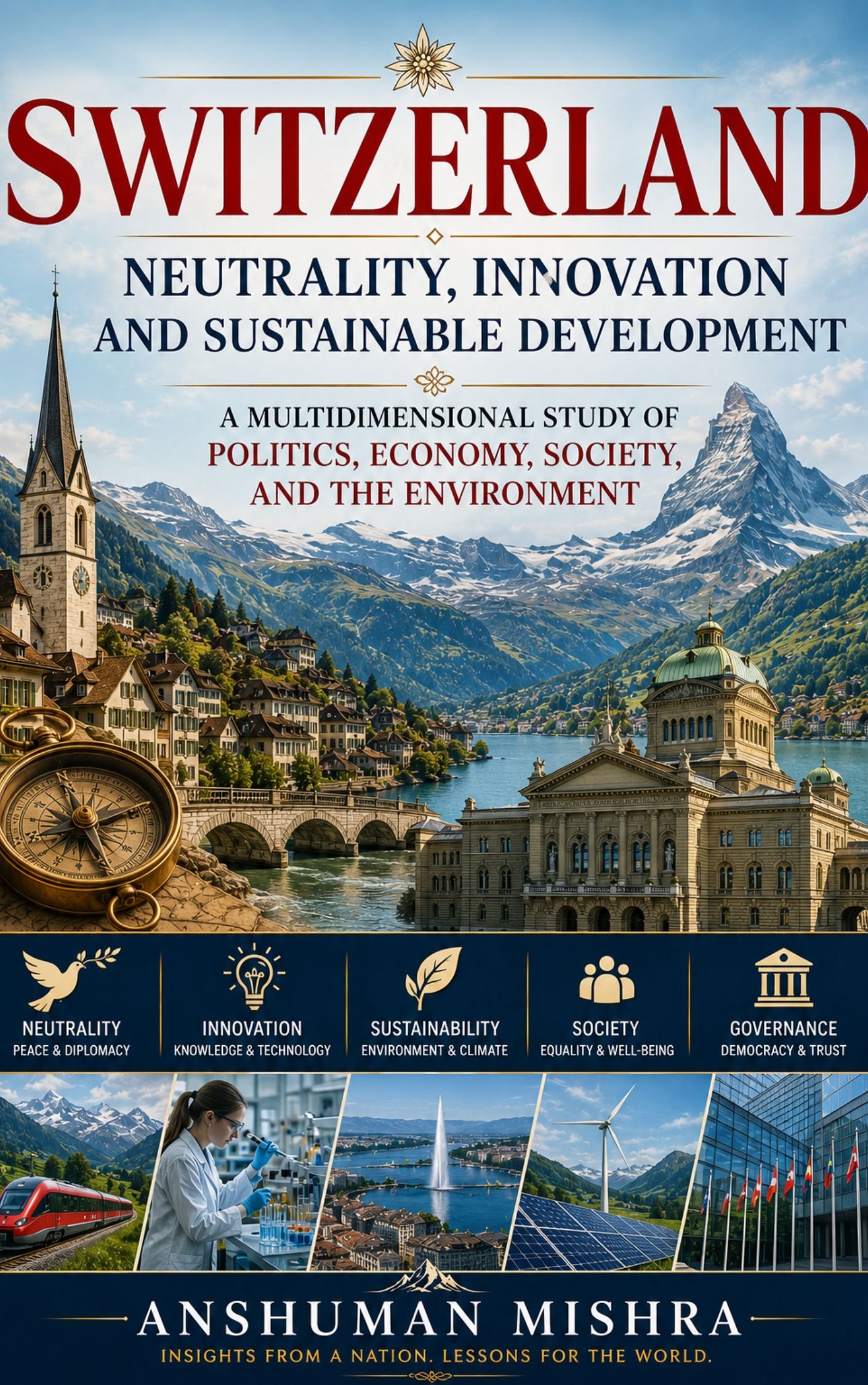
Switzerland: Neutrality, Innovation, and Sustainable Development
A Multidimensional Study of Politics, Economy, Society, and the Environment
Author: Anshuman Mishra
Switzerland is widely recognized as one of the world’s most successful examples of political stability, economic prosperity, scientific excellence, environmental responsibility, and democratic governance. Although relatively small in geographical size, Switzerland has earned global respect through its long-standing policy of neutrality, highly decentralized political system, world-class innovation ecosystem, strong financial institutions, exceptional quality of life, and unwavering commitment to sustainable development.
Switzerland: Neutrality, Innovation, and Sustainable Development presents a comprehensive and multidisciplinary examination of the historical, political, economic, technological, environmental, and social foundations that have shaped modern Switzerland. Combining insights from political science, economics, international relations, environmental studies, sociology, public policy, and development studies, this book provides readers with a balanced understanding of how Switzerland has emerged as one of the world’s most trusted and resilient nations.
Rather than presenting Switzerland merely as a prosperous European country, this book explores the deeper institutional, cultural, and ethical principles that have contributed to its long-term success and global influence.
Understanding the Evolution of Swiss Neutrality
Swiss neutrality is one of the country’s defining characteristics and has significantly influenced its international identity. However, neutrality is far more than a foreign policy doctrine—it represents a carefully developed political philosophy rooted in history, diplomacy, constitutional law, and national identity.
This book traces the historical evolution of Swiss neutrality from medieval Europe through the Treaty of Westphalia, the Napoleonic era, both World Wars, the Cold War, and contemporary geopolitical challenges. Readers gain insight into how neutrality has enabled Switzerland to act as an impartial mediator, host international organizations, facilitate humanitarian negotiations, and contribute to global peace without becoming directly involved in military conflicts.
The book also examines ongoing debates surrounding neutrality in the twenty-first century, including sanctions, international security, humanitarian responsibilities, cyber threats, and changing geopolitical dynamics.
Federalism, Democracy, and Political Stability
Switzerland is internationally admired for its unique political system based on federalism and direct democracy. Unlike many representative democracies, Swiss citizens regularly participate in referendums and popular initiatives that directly influence public policy.
The book explores:
- Federal governance and cantonal autonomy
- Direct democratic institutions
- Referendums and citizen participation
- Constitutional development
- Public accountability
- Political consensus-building
- Decentralized administration
- Governance transparency
- Civic participation
- Institutional trust
Readers will understand how Switzerland has successfully combined democratic participation with political stability, creating one of the world’s most effective governance systems.
Economic Prosperity Built on Innovation
Switzerland consistently ranks among the world’s strongest economies despite its limited natural resources. The country’s success stems from innovation, high-value manufacturing, financial services, advanced research, entrepreneurship, and international trade.
The book provides detailed discussions on:
- Economic transformation
- Banking and financial services
- Global trade competitiveness
- Precision engineering
- Pharmaceutical industry
- Biotechnology
- Advanced manufacturing
- Small and Medium Enterprises (SMEs)
- Productivity and competitiveness
- Economic resilience
Special emphasis is placed on how Switzerland transformed itself into one of the world’s leading knowledge-based economies through education, research, technological advancement, and strong collaboration between government, academia, and industry.
Science, Technology, and Innovation Leadership
Innovation lies at the heart of Swiss national development. Switzerland consistently ranks among the world’s top countries in research productivity, higher education quality, patent generation, technological innovation, and scientific excellence.
Readers will explore topics including:
- Artificial Intelligence
- Digital transformation
- Smart governance
- Precision engineering
- Robotics
- Biotechnology
- Pharmaceutical research
- Digital infrastructure
- Ethical innovation
- Global Innovation Index
The book also discusses how technological progress is balanced with ethical governance, privacy protection, environmental responsibility, and sustainable growth.
Sustainability and Environmental Responsibility
Environmental stewardship forms one of the central pillars of Swiss development. Through carefully designed environmental policies and long-term planning, Switzerland has become an international leader in sustainability.
Key topics include:
- Climate change mitigation
- Renewable energy
- Energy efficiency
- Carbon reduction
- Water resource management
- Waste management
- Circular economy
- Sustainable cities
- Rural development
- Environmental governance
A dedicated section examines the ecological significance of the Swiss Alps, biodiversity conservation, sustainable tourism, and climate resilience.
Social Welfare, Education, and Quality of Life
Switzerland consistently ranks among the highest countries globally in education, healthcare, employment, income, safety, and overall quality of life.
The book analyzes:
- Social security
- Universal healthcare
- Education system
- Vocational training
- Employment policies
- Workforce development
- Social inclusion
- Gender equality
- Well-being indicators
- Human development
Readers gain valuable insights into how Switzerland maintains social cohesion within a multilingual and multicultural society.
Migration, Diversity, and National Identity
Switzerland’s population reflects remarkable linguistic and cultural diversity. The book examines immigration, multiculturalism, citizenship, integration policies, demographic change, and the evolving relationship between diversity and national identity.
Rather than presenting an idealized narrative, it critically discusses contemporary challenges while highlighting policies that promote social integration and economic participation.
Switzerland in Global Governance
Although not a member of the European Union, Switzerland plays an influential role in international affairs through diplomacy, humanitarian assistance, peacebuilding, international law, and global cooperation.
Topics include:
- United Nations engagement
- Humanitarian diplomacy
- International organizations
- Peace mediation
- Development cooperation
- Economic diplomacy
- Global governance
- International law
- Ethical leadership
- Foreign policy
Readers will understand how Switzerland contributes to solving global challenges while preserving its independence and neutrality.
Contemporary Challenges and Future Prospects
No nation is without challenges. The final chapters examine critical policy debates including:
- Rising cost of living
- Housing affordability
- Climate risks
- Digital security
- Privacy protection
- Demographic ageing
- Technological disruption
- Global political polarization
- Sustainability transitions
- Future economic competitiveness
The book concludes by evaluating the future of Swiss neutrality, innovation, sustainability, democratic governance, and international cooperation in an increasingly interconnected world.
Key Topics Covered
- Swiss History
- Political Neutrality
- Federalism
- Direct Democracy
- International Relations
- Swiss Economy
- Banking System
- Innovation Policy
- Artificial Intelligence
- Digital Transformation
- Sustainable Development
- Climate Change
- Environmental Conservation
- Alpine Ecosystems
- Renewable Energy
- Education
- Healthcare
- Migration
- Social Integration
- Global Governance
Ideal For
This book is suitable for:
- Undergraduate Students
- Postgraduate Students
- Researchers
- University Faculty
- Policy Analysts
- Civil Service Aspirants
- Competitive Examination Candidates
- International Relations Scholars
- Political Science Students
- Economics Students
- Environmental Studies Students
- Public Policy Professionals
- Development Practitioners
- General Readers Interested in Global Affairs
Why Read This Book?
Unlike travel guides or introductory country profiles, Switzerland: Neutrality, Innovation, and Sustainable Development provides an academically rigorous yet accessible examination of one of the world’s most successful development models. It combines historical analysis, political institutions, economic strategies, scientific innovation, sustainability practices, and global diplomacy into a single comprehensive volume.
Readers will discover how Switzerland has balanced neutrality with international engagement, innovation with tradition, prosperity with sustainability, and democratic participation with institutional stability. More importantly, the book explores how the Swiss experience offers valuable lessons for policymakers, researchers, students, and nations seeking inclusive, resilient, and sustainable development in the twenty-first century.





Reviews
There are no reviews yet.