Description
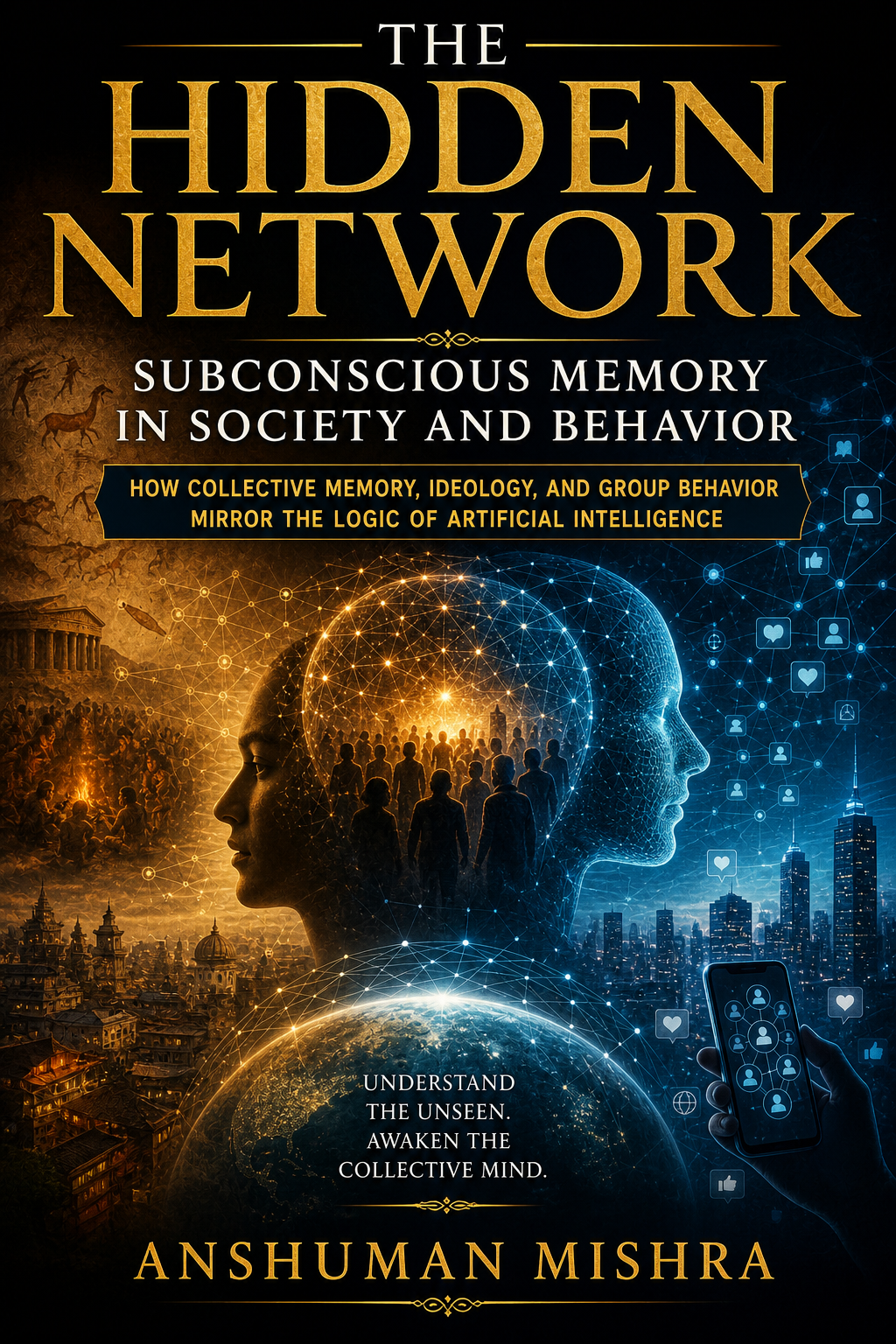
The Hidden Network: Subconscious Memory in Society and Behavior
How Collective Memory, Ideology, and Group Behavior Mirror the Logic of Artificial Intelligence
Human beings rarely think, remember, or make decisions in complete isolation.
Our beliefs are shaped by families, communities, cultures, institutions, stories, traditions, media, technology, and social networks. Memories can be preserved in rituals and monuments, emotions can spread through crowds, ideas can become deeply embedded in communities, and digital platforms can amplify certain patterns of attention and behavior.
But what happens when society itself begins to behave like a networked information-processing system?
The Hidden Network: Subconscious Memory in Society and Behavior explores this question by bringing together ideas from psychology, sociology, neuroscience, network theory, cultural studies, behavioral science, and Artificial Intelligence.
The book uses the concept of the collective subconscious as an interdisciplinary framework for examining how societies preserve information, reproduce patterns, transmit emotions, form beliefs, and coordinate behavior.
It also explores intriguing parallels between human social networks and artificial neural networks—while recognizing that these are conceptual comparisons rather than claims that societies and AI systems are literally identical.
Chapter 1 — The Origins of the Social Mind
The book begins with the evolutionary foundations of human social behavior.
Humans evolved as highly cooperative social beings, and survival depended heavily on communication, imitation, empathy, shared attention, and coordination.
This chapter explores:
- Evolution and social cooperation
- Human connection
- Empathy
- Mirror-neuron research
- Shared attention
- Primate communication
- Symbolic behavior
- Social learning
- The biological foundations of social memory
The chapter establishes the foundation for understanding how individual minds became deeply connected to collective social systems.
Chapter 2 — The Invisible Threads: Society as a Living Network
Human societies can be understood as complex networks of relationships and information exchange.
From small communities and tribes to modern online platforms, people continuously exchange information, emotions, beliefs, and cultural signals.
This chapter explores:
- Social networks
- Network theory
- The social brain
- Information flow
- Gossip and storytelling
- Myths and cultural transmission
- Digital memes
- Network effects
- AI and neural-network analogies
The chapter examines how collective intelligence can emerge from interactions between individuals, even when no single person controls the entire system.
Chapter 3 — Memory Without a Mind: The Subconscious of Society
Can a society “remember” even though society itself does not have a single brain?
This chapter explores collective memory as a distributed social phenomenon.
Topics include:
- Collective memory
- Cultural memory
- Rituals
- Traditions
- Myths
- Social trauma
- Cultural forgetting
- Social amnesia
- Symbols
- Digital archives
- Online traces
A society can preserve information through stories, traditions, institutions, monuments, media, and technologies. In the digital age, these memory systems are increasingly supported and reorganized by algorithms.
Chapter 4 — Emotion in the Crowd
Emotions do not remain confined to individual minds.
Fear, excitement, anger, enthusiasm, and empathy can spread through groups and influence collective behavior.
This chapter examines:
- Emotional contagion
- Crowd psychology
- Collective emotion
- Empathy
- Social cohesion
- Mass movements
- Moral emotions
- Political emotion
- Digital emotional signals
- AI-based emotion recognition
The chapter also considers the ethical implications of technologies capable of measuring, classifying, or responding to large-scale patterns of human emotion.
Chapter 5 — Ideology as a Dream
Societies construct narratives about who they are, where they came from, and what they value.
These narratives can unite communities but can also create divisions.
This chapter explores:
- Social myths
- Collective narratives
- Archetypal patterns
- National identity
- Religious and cultural narratives
- Propaganda
- Identity formation
- Ideological communities
- Digital belief systems
- Algorithmic tribes
The metaphor of ideology as a collective dream is used to explore how powerful narratives can influence perception, identity, and group behavior.
Chapter 6 — The Architecture of Belief
How do ideas become beliefs?
And why do groups sometimes become more confident in an idea as more members of the group accept it?
This chapter investigates:
- Cognitive bias
- Confirmation bias
- Social validation
- Persuasion
- Groupthink
- Collective certainty
- Moral frameworks
- Social learning
- Feedback loops
The chapter then draws conceptual parallels with AI learning systems, where repeated exposure, feedback, optimization, and patterns in data influence model behavior.
Chapter 7 — The Algorithmic Tribe
Social media has transformed the way people form communities and exchange information.
Digital platforms can recreate some of the social dynamics found in earlier human communities while introducing algorithmic systems that influence what users see and interact with.
This chapter examines:
- Digital tribes
- Echo chambers
- Virality
- Attention algorithms
- Likes and shares
- Social validation
- Recommendation systems
- AI-generated narratives
- Human-machine feedback loops
The central question is:
What happens when ancient social instincts operate inside algorithmically optimized digital environments?
Chapter 8 — The Shadow Network: Power, Manipulation, and Control
Every connected system creates opportunities for influence.
This chapter examines the darker dimensions of networked society, including:
- Behavioral influence
- Persuasive technologies
- Surveillance
- Nudging
- Behavioral design
- Social compliance
- Obedience
- Propaganda
- Personalized information
- Algorithmic influence
The discussion focuses on understanding these mechanisms rather than presenting manipulation as inevitable.
The chapter also emphasizes the importance of privacy, autonomy, transparency, and ethical technology design.
Chapter 9 — Art, Story, and the Social Subconscious
Art and storytelling preserve and express collective experiences.
From prehistoric cave paintings to novels, music, cinema, television, and digital media, creative works can act as cultural memory systems.
This chapter explores:
- Art and collective identity
- Myths
- Storytelling
- Music
- Rhythm
- Group synchronization
- Cinema
- Popular culture
- Media as cultural mirrors
- AI-generated art
The chapter considers how creative expression can reveal what societies remember, fear, desire, celebrate, or struggle to understand.
Chapter 10 — Social Synchrony
Groups can sometimes behave as coordinated systems even when individuals make decisions independently.
This chapter examines the mathematics and science of collective behavior.
Topics include:
- Cooperation
- Coordination
- Emergence
- Crowd intelligence
- Collective decision-making
- Swarm behavior
- Self-organization
- Social patterns
- Predictive modeling
- AI simulations
The chapter asks whether mathematical models can help us understand how large groups move from individual decisions to collective outcomes.
Chapter 11 — Learning Machines, Learning Societies
Both societies and AI systems change through feedback.
People learn from experiences, social reactions, institutions, and cultural environments. Machine-learning systems learn from data, objectives, and feedback processes.
This chapter explores:
- Cultural feedback loops
- Computational learning
- Neural-network metaphors
- Evolutionary adaptation
- Learning through error
- Social adaptation
- Human-AI symbiosis
- Coevolution
- Social learning systems
The comparison provides a framework for thinking about how human and artificial systems may increasingly influence one another.
Chapter 12 — The Future of the Collective Mind
The final chapter looks toward the future of increasingly connected societies.
It explores:
- Networked intelligence
- Collective empathy
- Digital communities
- Social reconciliation
- Collective healing
- Shared intelligence
- Ethical AI
- Human-AI collaboration
- Responsible information systems
- The future of collective cognition
One of the central challenges of the future will be determining how increasingly powerful communication and AI systems can strengthen human cooperation without sacrificing individual autonomy, privacy, diversity, or critical thinking.
Key Topics Covered
- Collective Memory
- Social Psychology
- Subconscious Behavior
- Human Behavior
- Social Networks
- Network Theory
- Cultural Memory
- Collective Unconscious
- Social Learning
- Group Behavior
- Crowd Psychology
- Emotional Contagion
- Social Influence
- Ideology and Identity
- Cognitive Bias
- Groupthink
- Digital Communities
- Social Media Algorithms
- Echo Chambers
- AI and Society
- Artificial Intelligence
- Human-AI Interaction
- Algorithmic Influence
- Behavioral Design
- AI Ethics
- Cultural Storytelling
- Collective Intelligence
- Swarm Intelligence
- Social Synchrony
- Future of Society
The Hidden Network Behind Human Behavior
Every society contains visible structures—institutions, organizations, laws, communities, markets, and technologies.
But beneath these visible structures are less obvious networks:
memories, emotions, beliefs, symbols, habits, narratives, social expectations, and patterns of interaction.
These invisible structures can influence how individuals perceive the world and how groups respond to change.
In the digital age, these networks increasingly interact with algorithms.
A social-media platform can observe patterns of attention. A recommendation system can identify relationships between interests. An AI system can process enormous amounts of human-generated information. Digital communities can form and transform at unprecedented speed.
The result is a new kind of environment in which human social behavior and machine computation continuously interact.
Human Networks and Artificial Networks
One of the book’s central themes is the conceptual relationship between social networks and artificial neural networks.
Both involve:
- Connections
- Information flow
- Distributed patterns
- Feedback
- Adaptation
- Emergence
- Memory
- Learning
However, the book also recognizes important differences.
Human societies contain biological organisms with emotions, experiences, cultures, institutions, and subjective perspectives. AI systems are computational systems whose capabilities arise from their architectures, training processes, data, and deployment environments.
The comparison is therefore best understood as a framework for inquiry, not as a claim that human society and AI are the same type of system.
Why This Book Is Different
The Hidden Network combines multiple disciplines to explore a question that is becoming increasingly important:
How do individual minds become collective patterns—and how are those patterns now being reshaped by artificial intelligence?
The book moves from evolutionary psychology and cultural memory to network theory, social media, behavioral influence, AI systems, and the future of collective intelligence.
It is designed to encourage readers to look beyond individual behavior and examine the network of relationships and information surrounding every individual.
Who Should Read This Book?
This book is particularly suitable for:
- Psychology students
- Sociology students
- Computer Science and AI students
- Researchers
- Social scientists
- AI professionals
- Digital-media professionals
- Marketing professionals
- Business and management students
- Technology enthusiasts
- Readers interested in human behavior
- Readers interested in the future of AI and society
Understanding the Collective Mind
Human civilization is built from billions of individual decisions, but the result is something larger than any single individual.
Languages emerge.
Cultures evolve.
Traditions survive.
Ideas spread.
Movements form.
Communities organize.
And increasingly, algorithms participate in these processes.
The Hidden Network: Subconscious Memory in Society and Behavior invites readers to explore the invisible connections behind these phenomena and to consider how collective memory, emotion, belief, technology, and Artificial Intelligence are shaping the next chapter of human society.
Understand the network. Understand the memory. Understand the behavior.




Reviews
There are no reviews yet.