Description
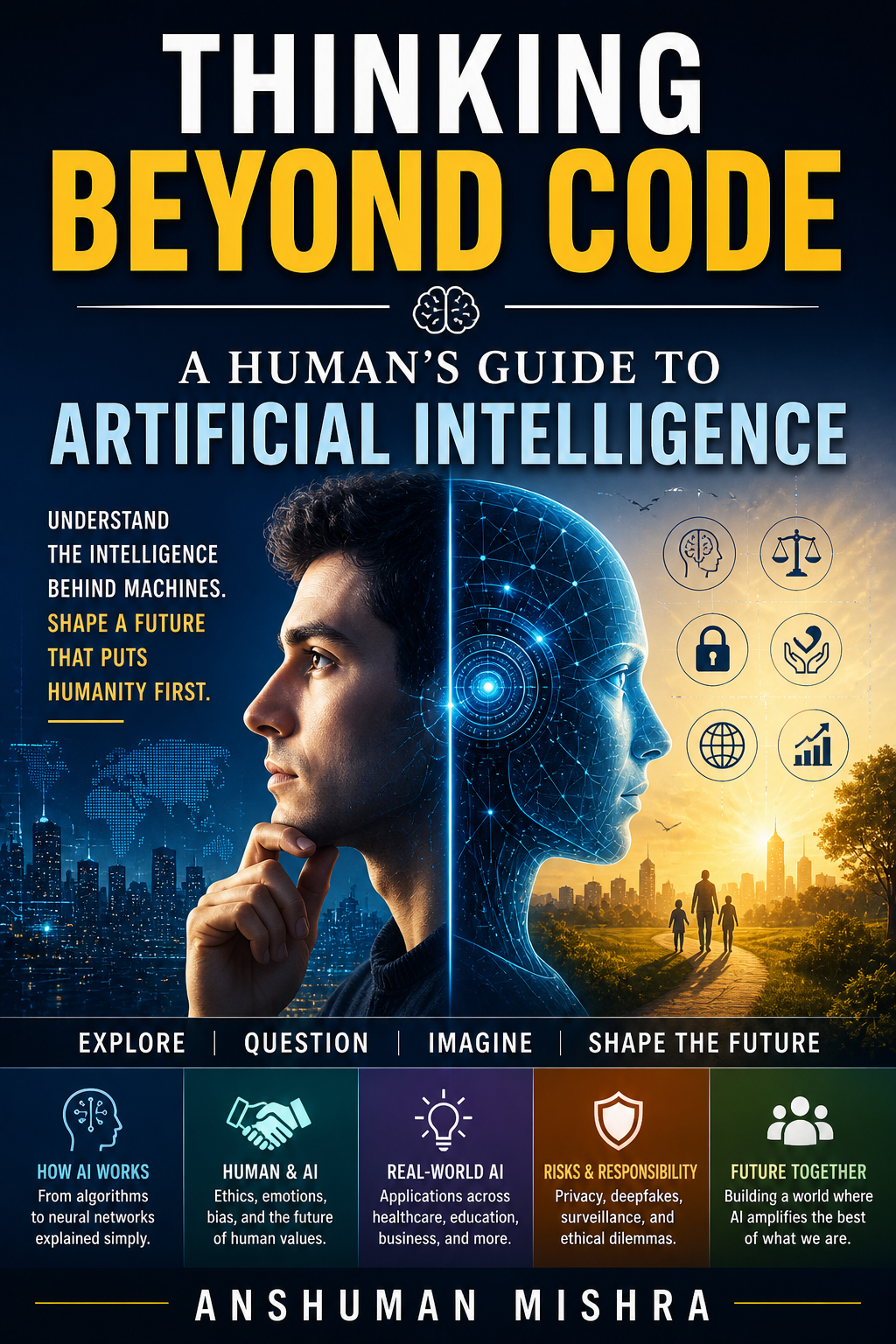
Thinking Beyond Code: A Human’s Guide to Artificial Intelligence
Understanding Artificial Intelligence Through Human, Ethical, Creative, and Social Perspectives
Artificial Intelligence is no longer a distant idea from science fiction.
It is already part of everyday life.
AI influences what we watch, what we read, what products we discover, how businesses operate, how organizations analyze information, and how professionals approach their work. It is being used across healthcare, education, finance, transportation, entertainment, communication, scientific research, and countless other areas.
Yet as AI becomes more powerful, one important challenge remains:
Do we understand the technology that is increasingly shaping our world?
Thinking Beyond Code: A Human’s Guide to Artificial Intelligence is written to help readers answer that question.
This book is not primarily a programming manual. It is not designed to teach readers how to build complex AI systems from scratch.
Instead, it provides a human-centered exploration of artificial intelligence—explaining important AI concepts while examining their implications for individuals, organizations, society, creativity, ethics, employment, and the future.
The central message is simple:
Understanding AI is not only about learning how machines work. It is also about understanding what those machines mean for humans.
Why This Book?
Artificial intelligence is often presented through technical terminology, mathematical models, programming frameworks, and rapidly changing technologies.
For readers without a technical background, this can make AI seem difficult or inaccessible.
But AI is no longer only a subject for programmers and data scientists.
Teachers need to understand AI because it is changing education.
Business leaders need to understand AI because it is transforming decision-making and productivity.
Artists and creators need to understand AI because it is changing creative workflows.
Students need to understand AI because it is influencing future careers.
Policymakers need to understand AI because intelligent systems require appropriate governance.
And ordinary citizens need to understand AI because these technologies increasingly influence everyday life.
Thinking Beyond Code therefore focuses on understanding rather than technical complexity.
It encourages readers to ask:
- What is AI?
- How does AI learn?
- Why can AI make mistakes?
- Why can AI become biased?
- Can machines really think?
- Can AI be creative?
- Will AI replace human jobs?
- Who is responsible when AI makes a harmful decision?
- How should AI be governed?
- Can humans and machines collaborate effectively?
- What kind of future should we build with AI?
Part 1 — The Big Picture of Artificial Intelligence
The first part introduces the foundations of artificial intelligence.
Chapter 1 — Introduction to Artificial Intelligence
The book begins with a simple question:
What is AI, really?
Artificial intelligence is often surrounded by exaggerated expectations and fears.
Some people imagine machines that will soon possess human-level intelligence in every area. Others see AI primarily as sophisticated automation.
The reality is more nuanced.
The chapter explores the evolution of AI from early ideas about intelligent machines to modern machine learning and generative AI systems.
Readers examine:
- The meaning of artificial intelligence
- Historical development of AI
- Major milestones
- Common AI applications
- AI myths
- AI capabilities and limitations
The objective is to establish a balanced understanding of AI beyond hype and fear.
Chapter 2 — The Core Components of AI
AI is not a single technology.
It is a broad field containing multiple approaches and techniques.
This chapter introduces some of the most important components of modern AI:
Machine Learning
Machine learning allows systems to learn patterns from data rather than relying entirely on explicitly programmed rules.
Deep Learning
Deep learning uses multi-layer neural network architectures to learn complex representations from data.
Neural Networks
Inspired loosely by aspects of biological information processing, artificial neural networks provide a foundation for many modern AI systems.
Natural Language Processing
NLP enables machines to process and work with human language.
Applications include:
- Chatbots
- Translation
- Sentiment analysis
- Text generation
- Information extraction
Computer Vision
Computer vision enables machines to analyze and interpret visual information.
Applications include:
- Image classification
- Object detection
- Facial recognition
- Medical imaging
- Visual inspection
Together, these technologies provide the foundation for many modern AI applications.
Chapter 3 — How AI “Thinks”
The word thinking can be misleading when applied to machines.
AI systems process information through algorithms, mathematical operations, learned representations, and computational procedures.
This chapter explores how AI systems make decisions and learn from data.
Readers are introduced to:
- Algorithms
- Decision-making
- Training data
- Supervised learning
- Unsupervised learning
- Reinforcement learning
- Pattern recognition
- AI bias
The chapter also explains why AI systems can produce impressive results while still having important limitations.
A machine can identify patterns without necessarily understanding them in the same way a human does.
Part 2 — Understanding the Human-AI Relationship
AI is ultimately created, deployed, and used within human society.
Part 2 therefore moves from technical concepts toward the relationship between humans and intelligent machines.
Chapter 4 — Humans vs. Machines: What’s Different?
What makes human intelligence different from artificial intelligence?
The chapter explores concepts including:
- Consciousness
- Intuition
- Creativity
- Emotion
- Ethics
- Reasoning
- Human judgment
It also revisits the philosophical question:
Can machines “think”?
Rather than treating human and machine intelligence as identical, the book examines their similarities, differences, strengths, and limitations.
The chapter encourages readers to consider whether intelligence should be defined solely by observable behavior or whether consciousness and subjective experience should also matter.
Chapter 5 — Ethical AI: Friend or Foe?
Technology itself does not determine how it will affect society.
Human choices determine how technologies are designed, deployed, governed, and used.
AI therefore creates important ethical questions.
The chapter examines:
- Moral dilemmas
- Human rights
- Fairness
- Accountability
- Transparency
- Responsibility
- AI decision-making
One of the central questions is:
Who is responsible when an AI system makes a consequential decision?
Is it the developer?
The organization deploying it?
The user?
The data provider?
Or should responsibility be distributed across the entire AI lifecycle?
These questions are becoming increasingly important as AI systems are integrated into high-impact environments.
Chapter 6 — AI and Human Jobs: Threat or Transformation?
Few questions about AI generate as much public discussion as employment.
Will AI eliminate jobs?
Will it create new opportunities?
Will entire professions change?
This chapter explores automation and the changing nature of work.
Rather than presenting a simple “AI will replace humans” narrative, it examines how technology can:
- Automate repetitive tasks
- Augment human capabilities
- Change job responsibilities
- Create new roles
- Increase demand for new skills
The chapter also discusses the importance of developing skills for an AI-enabled economy.
The future of work may involve increasingly close collaboration between human expertise and machine capabilities.
Part 3 — Inside the Black Box
Part 3 takes readers deeper into the technical foundations of AI without turning the book into a programming textbook.
Chapter 7 — Demystifying Machine Learning
Machine learning can appear mysterious when viewed only from the outside.
This chapter explains what actually happens during the training process.
Readers explore:
- Training data
- Features
- Labels
- Patterns
- Model learning
- Predictions
- Generalization
- Overfitting
- Underfitting
The chapter explains why a model can perform extremely well on training data but perform poorly on unfamiliar data.
Understanding these concepts is essential for developing a realistic understanding of machine learning.
Chapter 8 — Deep Learning and Neural Networks
Deep learning has transformed many areas of artificial intelligence.
The chapter introduces neural networks through accessible explanations of:
- Artificial neurons
- Layers
- Activation functions
- Weights
- Learning rates
- Training
- Optimization
Readers also explore important neural architectures such as:
- Convolutional Neural Networks (CNNs)
- Recurrent Neural Networks (RNNs)
The objective is to help readers understand the basic architecture behind many AI systems without requiring advanced mathematical treatment.
Chapter 9 — Understanding Natural Language Processing
Language is one of the most important interfaces between humans and machines.
This chapter explains how AI systems process human language and explores applications such as:
- Sentiment analysis
- Chatbots
- Language translation
- Text classification
- Text generation
- Conversational AI
The chapter also introduces the rise of large language models, including systems such as ChatGPT, and discusses at a conceptual level how modern AI models can generate and process language.
Part 4 — Real-World AI Applications
AI is not restricted to research laboratories.
It is increasingly embedded into everyday technologies.
Chapter 10 — AI in Everyday Life
Readers explore how AI is becoming part of:
- Smartphones
- Smart homes
- Smart cities
- Healthcare
- Education
- Finance
- Entertainment
Recommendation systems, voice assistants, personalized services, fraud detection, medical decision-support tools, and intelligent automation demonstrate how AI can operate behind the scenes.
The chapter encourages readers to identify AI systems in their own everyday environments.
Chapter 11 — AI in Creativity and the Arts
One of the most fascinating questions surrounding modern AI is whether machines can be creative.
AI systems can now assist with:
- Music
- Images
- Writing
- Design
- Video
- Creative brainstorming
But does generating something new make an AI system an artist?
The chapter examines different perspectives on:
- Creativity
- Originality
- Human intention
- Artistic expression
- AI-generated content
- Human-AI creative collaboration
Rather than simply declaring AI to be an artist—or denying its creative capabilities—the book encourages readers to examine what we mean by creativity itself.
Chapter 12 — The Dark Side: Surveillance, Deepfakes, and Misinformation
Powerful technologies can be used for beneficial or harmful purposes.
AI introduces important concerns involving:
- Privacy
- Surveillance
- Deepfakes
- Misinformation
- Manipulated media
- Automated influence
- Security
The chapter examines how synthetic and manipulated content can make it increasingly difficult to distinguish authentic information from fabricated material.
It also discusses the importance of:
- Media literacy
- Verification
- Responsible technology use
- Privacy protection
- Institutional safeguards
The objective is not to create fear, but to develop informed awareness.
Part 5 — The Future of Intelligence
The final part looks beyond today’s AI systems and explores possible future directions.
Chapter 13 — Artificial General Intelligence: Dream or Nightmare?
Artificial General Intelligence, commonly called AGI, refers broadly to hypothetical AI systems capable of performing a wide range of intellectual tasks at a level approaching or exceeding human capabilities.
The chapter explores:
- What AGI means
- How AGI differs from specialized AI
- Possible approaches to general intelligence
- Potential benefits
- Potential risks
- Questions surrounding machine consciousness
Importantly, the book treats AGI as an area of ongoing research and debate rather than an established technological reality.
The chapter encourages readers to think critically about both optimistic and pessimistic predictions.
Chapter 14 — Humans + AI: The Future of Collaboration
The future may not be about humans versus machines.
It may be about humans working with machines.
This chapter introduces the concept of augmented intelligence, where AI systems enhance human capabilities rather than simply replacing them.
Examples include:
- AI-assisted research
- AI-supported education
- Decision-support systems
- Creative collaboration
- Productivity tools
- Scientific discovery
The central idea is that humans can provide qualities such as context, values, judgment, responsibility, and lived experience, while AI can provide speed, pattern recognition, large-scale analysis, and computational assistance.
Chapter 15 — Can We Trust AI with Our Future?
The final chapter addresses one of the most important questions of the AI era:
How can society ensure that AI develops in ways that benefit humanity?
The discussion focuses on:
- AI governance
- Regulation
- Accountability
- Responsible AI
- Human oversight
- Safety
- Transparency
- Human-centered innovation
The book argues that technological progress should not be measured solely by how powerful AI becomes.
We should also ask:
Is it useful?
Is it safe?
Is it fair?
Is it accountable?
Does it respect human dignity and agency?
A Human-Centered Approach to AI
The central philosophy of Thinking Beyond Code is that AI literacy should not be limited to technical professionals.
Every individual affected by AI should have an opportunity to understand it.
The book therefore focuses on three interconnected dimensions:
Understand
Learn what AI is, how it works, and what it can and cannot do.
Question
Examine assumptions, limitations, ethical dilemmas, and societal consequences.
Participate
Use AI thoughtfully while contributing to discussions about how AI should shape our collective future.
Who Should Read This Book?
Curious Readers
For readers who want to understand AI without becoming programmers.
Students
Useful for students from computer science, business, humanities, social sciences, philosophy, arts, and other disciplines who want an interdisciplinary introduction to AI.
Educators
Teachers can use the book to understand AI concepts and discuss their implications in education.
Professionals
Managers, healthcare professionals, business professionals, policymakers, and other professionals can develop AI literacy relevant to their fields.
Entrepreneurs
Startup founders and business leaders can gain a broader understanding of AI opportunities and challenges.
Creatives
Artists, writers, designers, musicians, and other creators can explore how AI is transforming creative processes.
Philosophy and Ethics Enthusiasts
Readers interested in consciousness, creativity, responsibility, morality, and the future of intelligence will find numerous questions for reflection.
You Do Not Need to Be a Programmer
One of the defining characteristics of this book is its accessibility.
You do not need:
- Advanced mathematics
- A computer science degree
- Programming experience
- Machine learning expertise
What you need is curiosity and a willingness to think critically.
The book emphasizes conceptual understanding rather than code-heavy implementation.
How to Study This Book
Readers can approach the book in different ways.
Sequential Reading
Read from Part 1 through Part 5 to develop a progressive understanding of AI.
Topic-Based Reading
Jump directly to areas of personal interest.
Interested in ethics? Explore Part 2.
Interested in machine learning? Explore Part 3.
Interested in real-world applications? Explore Part 4.
Interested in AGI and the future? Explore Part 5.
Reflective Reading
Pause after major topics and consider how AI affects your own field, profession, education, and daily life.
The book encourages readers to move beyond passive consumption and develop their own informed perspectives.
Key Questions Explored
Throughout the book, readers encounter questions such as:
- What is artificial intelligence?
- How does machine learning work?
- Why do AI systems make mistakes?
- Can AI systems be biased?
- Are machines capable of genuine thinking?
- What makes human intelligence different?
- Can AI be creative?
- Can AI understand emotions?
- Will AI replace human jobs?
- How should AI be governed?
- Can AI systems be trusted?
- What is AGI?
- Could machines ever become conscious?
- How can humans and AI collaborate?
- What does responsible AI development look like?
These questions transform the book from a simple introduction to AI into a broader exploration of technology and humanity.
The Core Message
Thinking Beyond Code argues that the future of AI should not be designed exclusively around technological capability.
It should also be shaped by:
Human values + Critical thinking + Ethical responsibility + Creativity + Collaboration
AI can be extraordinarily powerful, but power alone does not determine whether a technology creates a better future.
The choices made by humans—developers, organizations, governments, educators, professionals, and citizens—will influence how AI affects society.
Final Perspective
Thinking Beyond Code: A Human’s Guide to Artificial Intelligence is an invitation to understand artificial intelligence from a broader perspective.
It explores the technology behind AI while simultaneously examining its effects on human intelligence, creativity, employment, ethics, privacy, society, and the future.
The book does not ask readers to blindly embrace AI.
Nor does it ask them to fear it.
Instead, it encourages a third approach:
Understand it. Question it. Use it responsibly. Shape it thoughtfully.
The future of artificial intelligence is still being written.
And that future will not be determined by algorithms alone.
It will be shaped by the people who design them, the organizations that deploy them, the governments that regulate them, and the societies that decide what role intelligent machines should play in human life.
The most important skill in the AI era may therefore not be knowing how to code every algorithm.
It may be knowing how to think about AI itself.
That is the journey of Thinking Beyond Code.

Reviews
There are no reviews yet.