Description
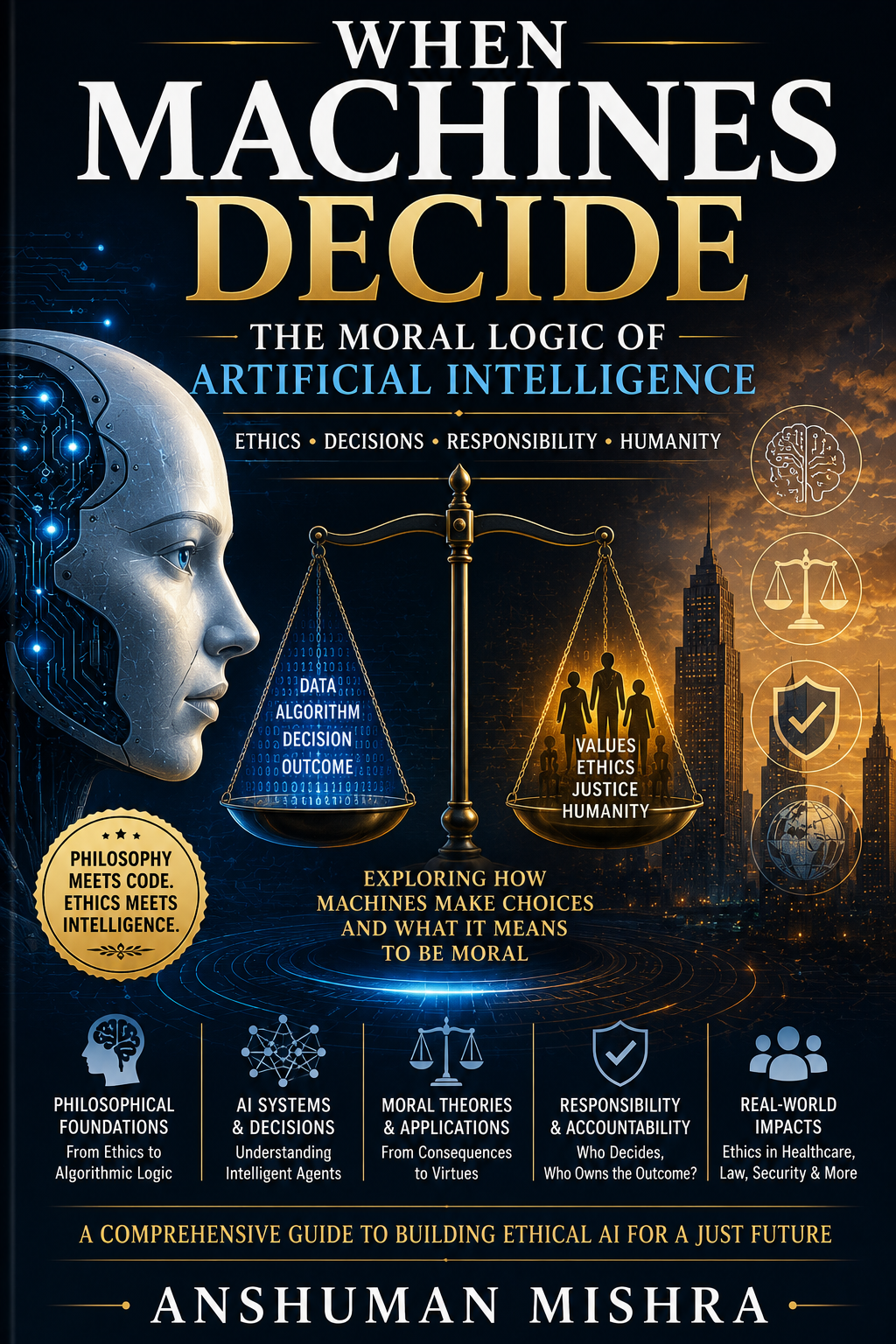
When Machines Decide: The Moral Logic of Artificial Intelligence
Exploring Ethics, Philosophy, and the Future of Intelligent Decision-Making
Artificial Intelligence is rapidly transforming the way societies make decisions. From healthcare and finance to education, criminal justice, transportation, governance, and scientific research, intelligent algorithms increasingly influence choices that affect millions of lives. As machines move beyond automation toward autonomous reasoning, one fundamental question becomes unavoidable:
Can machines make moral decisions?
When Machines Decide: The Moral Logic of Artificial Intelligence is a comprehensive, interdisciplinary exploration of one of the defining intellectual challenges of the twenty-first century. Combining philosophy, ethics, computer science, artificial intelligence, cognitive science, logic, and public policy, this book investigates how moral reasoning can be understood, modeled, and integrated into intelligent computational systems.
Rather than treating ethics as an external constraint applied after technology is built, the book argues that ethical reasoning must become a foundational component of intelligent system design. Responsible Artificial Intelligence requires more than technical excellence—it requires philosophical understanding, transparent reasoning, fairness, accountability, and respect for human values.
The book begins by tracing the historical evolution of logic and ethical reasoning, from Aristotle’s formal logic and classical philosophy to Alan Turing’s theory of computation and the emergence of modern Artificial Intelligence. Readers discover how centuries of philosophical inquiry into reason, morality, and decision-making laid the intellectual foundation for today’s intelligent machines.
The discussion then explores the architecture of intelligent agents, explaining how algorithms perceive information, process knowledge, evaluate alternatives, and generate decisions. Concepts such as autonomy, automation, machine intentionality, decision trees, neural networks, reinforcement learning, and artificial agents are presented in a way that connects computational intelligence with philosophical questions about responsibility and moral agency.
A major section introduces the world’s most influential ethical frameworks, including consequentialism, deontology, virtue ethics, ethics of care, and ethical pluralism. Rather than presenting these theories as abstract philosophy alone, the book demonstrates how they influence AI system design, optimization strategies, rule-based reasoning, fairness evaluation, and responsible decision-making algorithms.
Readers are introduced to one of the most important challenges in modern AI—the Value Alignment Problem. The book examines whether machines can represent human values, how algorithms learn from human-generated data, why bias emerges in intelligent systems, and how self-learning models may gradually diverge from intended ethical objectives. These discussions provide valuable insights into fairness, transparency, explainability, accountability, and trustworthy AI.
Building on these foundations, the book explores decision theory, rational choice, game theory, optimization, algorithmic justice, moral paradoxes, and computational ethics. It demonstrates that efficient decision-making alone cannot guarantee ethical outcomes, highlighting the importance of balancing performance with compassion, fairness, and human dignity.
One of the central themes of the book concerns responsibility. As AI systems increasingly participate in medical diagnosis, autonomous vehicles, financial services, predictive policing, recruitment, and public administration, questions of legal liability, moral accountability, and governance become increasingly important. The book examines the responsibility gap, collective accountability, AI regulation, and emerging global approaches to trustworthy AI governance.
Practical implementation receives significant attention through discussions on ethics-by-design, explainable AI (XAI), fairness-aware machine learning, human-in-the-loop systems, transparency, value-sensitive design, algorithm auditing, and ethical software engineering practices. These concepts help bridge the gap between philosophical principles and practical AI development.
The book further examines real-world case studies involving autonomous vehicles, healthcare AI, predictive policing, surveillance technologies, privacy, digital rights, government regulation, corporate responsibility, and the societal implications of automated decision-making. These examples demonstrate how ethical reasoning directly influences technology deployed in everyday life.
The concluding chapters explore future directions in Artificial Intelligence, including machine consciousness, posthumanism, artificial moral agents, evolutionary ethics, interdisciplinary collaboration, and the possibility of developing AI systems capable of increasingly sophisticated ethical reasoning. Rather than offering simplistic answers, the book encourages readers to critically examine the evolving relationship between humanity and intelligent machines.
Inside This Book You’ll Discover
- Foundations of AI Ethics and Moral Philosophy
- History of Logic and Computational Reasoning
- Artificial Intelligence and Intelligent Agents
- Machine Decision-Making Models
- Consequentialism, Deontology, and Virtue Ethics
- Ethics of Care and Ethical Pluralism
- Value Alignment Problem
- Moral Reasoning in Artificial Intelligence
- Explainable AI (XAI)
- Fairness, Bias, and Algorithmic Accountability
- AI Governance and Responsible Innovation
- Human-in-the-Loop AI Systems
- Autonomous Systems and Moral Responsibility
- Decision Theory and Game Theory
- Machine Learning Ethics
- Privacy, Surveillance, and Digital Rights
- Ethical AI Design Frameworks
- AI Regulation and Public Policy
- Philosophy of Technology
- Future of Artificial Intelligence and Society
Written in a rigorous yet accessible style, this book is ideal for Computer Science, Artificial Intelligence, Data Science, Machine Learning, Robotics, Software Engineering, Philosophy, Cognitive Science, Law, Public Policy, Ethics, and Technology Management students. It is equally valuable for AI researchers, software developers, technology leaders, educators, policymakers, legal professionals, ethicists, and innovation strategists seeking a deeper understanding of responsible Artificial Intelligence.
Whether you are designing intelligent systems, studying AI ethics, conducting interdisciplinary research, developing AI policies, or exploring the philosophical foundations of machine intelligence, When Machines Decide: The Moral Logic of Artificial Intelligence provides a comprehensive framework for understanding how ethics and computation must evolve together.
Combining philosophical insight, computational thinking, ethical analysis, and practical AI design principles, this book prepares readers to participate thoughtfully in one of the most important technological and moral conversations of our time—the future of intelligent decision-making.




Reviews
There are no reviews yet.