Description
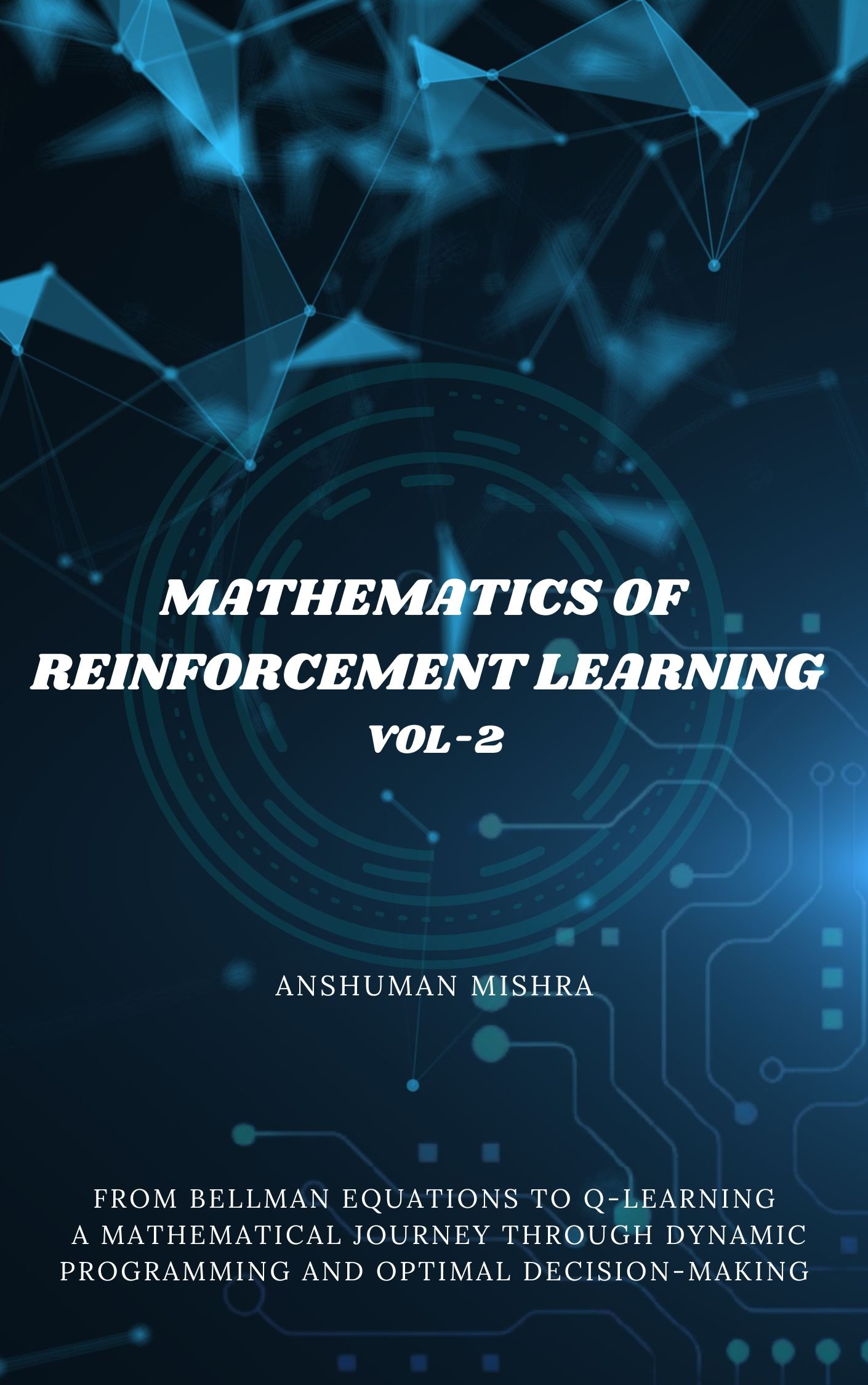
Mathematics of Reinforcement Learning – VOL-2
From Bellman Equations to Q-Learning: A Mathematical Journey through Dynamic Programming and Optimal Decision-Making
Author: Anshuman Mishra
Qualification: M.Tech (Computer Science)
Position: Assistant Professor, Doranda College, Ranchi University
Published by: Anshuman Mishra
Publication Year: 2025
About the Book
Reinforcement Learning has evolved from classical dynamic programming and tabular methods into a powerful framework capable of solving highly complex decision-making problems. Modern RL systems are now applied to robotics, autonomous navigation, financial optimization, healthcare decision support, games, recommendation systems, industrial automation, and intelligent control.
However, understanding advanced Reinforcement Learning requires more than knowing how to implement algorithms.
It requires a strong understanding of the mathematics of value functions, policy optimization, stochastic approximation, convergence, optimization, probability, function approximation, neural networks, and decision theory.
Mathematics of Reinforcement Learning – VOL-2 continues the mathematical journey started in Volume 1 and takes the reader from classical control algorithms to advanced and deep reinforcement learning.
The book begins with Sarsa and Q-Learning, develops the mathematics of function approximation and policy gradients, explores constrained and regularized reinforcement learning, and then progresses toward Deep Q-Networks (DQN), Double DQN, Dueling DQN, DDPG, TRPO, PPO, Multi-Agent RL, and Hierarchical RL.
The final modules focus heavily on convergence analysis, stability, mathematical proofs, theoretical foundations, research challenges, and future applications.
The objective is not merely to teach algorithms, but to help readers understand the mathematical principles that make these algorithms possible.
The Mathematical Journey
This volume follows a progressive mathematical path:
Sarsa → Q-Learning → Function Approximation → Policy Gradients → Actor-Critic → Constrained RL → Exploration Mathematics → DQN → Advanced Deep RL → Convergence → Proofs → Research
This progression allows readers to understand how Reinforcement Learning develops from simple tabular methods into modern intelligent decision-making systems.
Module IV – Control Algorithms: From Sarsa to Q-Learning
The fourth module introduces the mathematical foundations of RL control algorithms.
Readers move beyond value prediction and learn how agents can improve their policies through interaction with an environment.
Chapter 10 – On-Policy Control
This chapter introduces on-policy learning, where the policy used to generate experience is also the policy being evaluated and improved.
The chapter covers:
- Sarsa
- Sarsa update equation
- Expected Sarsa
- Epsilon-greedy exploration
- On-policy control
- Sarsa vs. Q-Learning
- Windy Grid World
- Convergence
- Parameter sensitivity
- Practical implementation
Special emphasis is given to understanding the mathematical update mechanism behind Sarsa.
Chapter 11 – Off-Policy Control
Off-policy methods allow an agent to learn about one policy while following another behavior policy.
This chapter develops the mathematical foundations of:
- Importance sampling
- Off-policy evaluation
- Off-policy estimation
- Q-Learning
- Q-value updates
- Convergence of Q-Learning
- Q-table updates
- On-policy vs. off-policy learning
- Double Q-Learning
The derivation of the Q-Learning update equation forms a central component of this chapter.
Chapter 12 – Function Approximation in Reinforcement Learning
Tabular methods become impractical when the state space becomes extremely large or continuous.
This chapter introduces mathematical function approximation techniques that allow RL algorithms to work with large and continuous state spaces.
Topics include:
- Curse of dimensionality
- Linear function approximation
- Gradient-based value estimation
- Mean Squared Error minimization
- Least Squares Temporal Difference (LSTD)
- Continuous state spaces
- Stability
- Divergence
- Feature engineering
This chapter establishes an important bridge between classical RL and modern Deep Reinforcement Learning.
Module V – Advanced Mathematical Tools and Extensions
The fifth module introduces advanced mathematical approaches for optimizing policies directly.
Chapter 13 – Policy Gradient and Actor-Critic Methods
Policy-gradient methods represent policies parametrically and optimize their parameters using gradients.
Readers explore:
- Policy parameterization
- Policy Gradient Theorem
- REINFORCE
- Variance reduction
- Actor-Critic architecture
- Actor updates
- Critic updates
- Mathematical derivations
- Two-state examples
- Convergence
The chapter provides the mathematical foundation for understanding modern policy-optimization algorithms.
Chapter 14 – Constrained and Regularized Reinforcement Learning
Real-world RL systems frequently operate under constraints.
An intelligent agent may need to maximize reward while simultaneously satisfying safety, resource, risk, or behavioral constraints.
This chapter covers:
- Constrained RL
- Policy regularization
- KL divergence
- Entropy regularization
- Lagrangian optimization
- Safe RL
- Risk-aware optimization
- Dual methods
- Entropy-regularized value functions
- Soft Actor-Critic intuition
The mathematical treatment helps readers understand how optimization objectives can incorporate both performance and constraints.
Chapter 15 – Exploration vs. Exploitation Mathematics
One of the central challenges in Reinforcement Learning is deciding whether an agent should:
Explore new possibilities or exploit existing knowledge.
This chapter develops the mathematical foundations of this dilemma through the Multi-Armed Bandit problem.
Topics include:
- Exploration-exploitation trade-off
- Multi-Armed Bandits
- Upper Confidence Bound (UCB)
- Thompson Sampling
- Information-theoretic exploration
- Entropy
- Mutual information
- Regret
- Regret bounds
- Practical exploration strategies
The chapter provides a mathematical perspective on how intelligent agents make decisions under uncertainty.
Module VI – Deep and Approximate Reinforcement Learning
Modern Reinforcement Learning increasingly relies on neural networks to approximate value functions and policies.
This module provides the mathematical foundations of Deep Reinforcement Learning.
Chapter 16 – Mathematical Foundation of Deep Q-Networks
Deep Q-Networks combine the principles of Q-Learning with neural network function approximation.
This chapter explains:
- Neural networks in RL
- Function approximation
- Bellman error
- DQN loss function
- Gradient descent
- Backpropagation
- Target networks
- Experience replay
- Maze environment
- DQN pseudocode
- Stability issues
- Performance evaluation
Readers learn why DQN requires special techniques such as experience replay and target networks to improve learning stability.
Chapter 17 – Advanced Deep RL Architectures
This chapter introduces several important extensions of Deep Reinforcement Learning.
Topics include:
- Double DQN
- Dueling DQN
- Advantage functions
- Prioritized Experience Replay
- Multi-Agent Reinforcement Learning
- Hierarchical Reinforcement Learning
- Options framework
- DDPG
- TRPO
- PPO
- Autonomous navigation
The mathematical discussion demonstrates how modern algorithms address limitations of basic Deep Q-Learning and policy optimization.
Module VII – Theoretical and Research Perspectives
The final module moves from algorithms toward theoretical analysis and research-level understanding.
Chapter 18 – Convergence Analysis and Stability
Theoretical guarantees are essential for understanding whether reinforcement learning algorithms will converge and under what assumptions.
This chapter investigates:
- Value Iteration convergence
- Robbins-Monro conditions
- TD convergence
- Q-Learning convergence
- Asynchronous learning
- Batch RL
- Nonlinear function approximation
- Actor-Critic stability
- Error propagation
- Regularization
- Open theoretical problems
This section is particularly valuable for students and researchers interested in the mathematical theory of RL.
Chapter 19 – Mathematical Proofs and Derivations
This chapter brings together some of the most important mathematical proofs associated with Reinforcement Learning.
Readers study derivations and theoretical arguments involving:
- Bellman Expectation Equation
- Bellman Optimality Equation
- Policy Gradient Theorem
- TD(λ) convergence
- Q-Learning convergence
- Contraction Mapping Theorem
- Dynamic Programming convergence
- RL lemmas and theorems
- Analytical proof walkthroughs
The chapter is designed to help readers transition from algorithmic understanding to mathematical reasoning and research-level analysis.
Chapter 20 – Applications and Future Directions
The final chapter connects the mathematical foundations of Reinforcement Learning with real-world applications and emerging research.
Applications discussed include:
- Robotics
- Autonomous systems
- Finance and trading
- Healthcare decision-making
- Games and simulation
- Edge computing
- IoT
- Quantum Reinforcement Learning
- Safe RL
- Explainable RL
The chapter also examines research challenges and future directions in intelligent decision-making.
Advanced Algorithms Covered
This volume provides mathematical and conceptual coverage of:
✔ Sarsa
✔ Expected Sarsa
✔ Q-Learning
✔ Double Q-Learning
✔ Policy Gradient
✔ REINFORCE
✔ Actor-Critic
✔ Soft Actor-Critic concepts
✔ DQN
✔ Double DQN
✔ Dueling DQN
✔ Prioritized Experience Replay
✔ DDPG
✔ TRPO
✔ PPO
✔ Multi-Agent RL
✔ Hierarchical RL
✔ Options Framework
✔ TD Learning with Function Approximation
✔ LSTD
Mathematical Concepts Covered
Readers will encounter and apply:
- Stochastic Processes
- Probability
- Conditional Probability
- Expectation
- Gradient Descent
- Optimization
- Function Approximation
- Mean Squared Error
- Bellman Error
- Policy Gradients
- KL Divergence
- Entropy
- Mutual Information
- Lagrangian Optimization
- Duality
- Regret Analysis
- Contraction Mapping
- Stochastic Approximation
- Robbins-Monro Conditions
- Convergence Analysis
- Stability Analysis
- Error Propagation
- Mathematical Proofs
Why This Volume Is Important
Volume 1 establishes the mathematical foundation of MDPs, Bellman equations, Dynamic Programming, Monte Carlo methods, and Temporal-Difference learning.
Volume 2 takes the reader further into the mathematical foundations of control, approximation, policy optimization, exploration, Deep RL, theoretical convergence, and research.
Together, the two volumes provide a structured pathway from fundamental RL mathematics to advanced reinforcement learning theory.
Key Features
1. Mathematics-Driven Approach
Algorithms are presented together with their mathematical formulations, assumptions, update equations, and theoretical interpretation.
2. From Classical to Deep RL
The book creates a continuous learning path from Sarsa and Q-Learning to DQN, PPO, TRPO, DDPG, and advanced RL architectures.
3. Research-Oriented Content
Convergence, stability, mathematical proofs, approximation errors, and open research problems provide valuable preparation for advanced study.
4. Practical Examples
Examples involving Grid World, bandits, maze environments, autonomous navigation, and other decision-making scenarios connect mathematics with practical applications.
5. Academic and Professional Reference
The material can be used for classroom teaching, postgraduate study, research preparation, competitive examinations, and professional AI/ML learning.
What You Will Learn
After completing Mathematics of Reinforcement Learning – VOL-2, readers will be able to:
✔ Understand on-policy and off-policy control
✔ Derive and implement Sarsa
✔ Understand the mathematical foundation of Q-Learning
✔ Analyze Q-Learning convergence
✔ Understand function approximation in RL
✔ Apply gradient-based value estimation
✔ Understand LSTD
✔ Derive policy-gradient methods
✔ Understand REINFORCE
✔ Explain Actor-Critic mathematics
✔ Understand constrained RL
✔ Apply entropy and KL-divergence concepts
✔ Analyze exploration and exploitation mathematically
✔ Understand UCB and Thompson Sampling
✔ Analyze regret
✔ Understand the mathematical foundation of DQN
✔ Explain target networks and experience replay
✔ Understand Double DQN and Dueling DQN
✔ Understand DDPG, TRPO, and PPO
✔ Explore Multi-Agent and Hierarchical RL
✔ Study convergence and stability
✔ Follow mathematical proofs and derivations
✔ Identify current research challenges in Reinforcement Learning
Who Should Read This Book?
This volume is particularly suitable for:
- BCA Students
- MCA Students
- B.Tech Students
- M.Tech Students
- B.Sc. Computer Science Students
- Artificial Intelligence Students
- Machine Learning Students
- Data Science Students
- Reinforcement Learning Students
- AI Researchers
- PhD Scholars
- Computer Science Researchers
- Robotics Researchers
- AI/ML Engineers
- Machine Learning Engineers
- Software Developers
- Faculty Members
- GATE Computer Science Aspirants
- UGC-NET Computer Science Aspirants
Academic and Research Applications
This book can be used as:
- An advanced Reinforcement Learning textbook
- A postgraduate reference book
- An AI/ML mathematics reference
- A research preparation guide
- A Deep RL foundation text
- A classroom teaching resource
- A self-study guide
- A reference for mathematical RL research
- A foundation for PhD-level RL study
Book Details
Book Title: Mathematics of Reinforcement Learning
Subtitle: From Bellman Equations to Q-Learning: A Mathematical Journey through Dynamic Programming and Optimal Decision-Making
Volume: VOL-2
Author: Anshuman Mishra
Qualification: M.Tech (Computer Science)
Position: Assistant Professor, Doranda College, Ranchi University
Publisher: Anshuman Mishra
Publication Year: 2025
Language: English
Subject: Reinforcement Learning, Artificial Intelligence, Machine Learning, Deep Learning, Mathematics
Level: Advanced Undergraduate, Postgraduate, Research
Reviews
There are no reviews yet.