Description
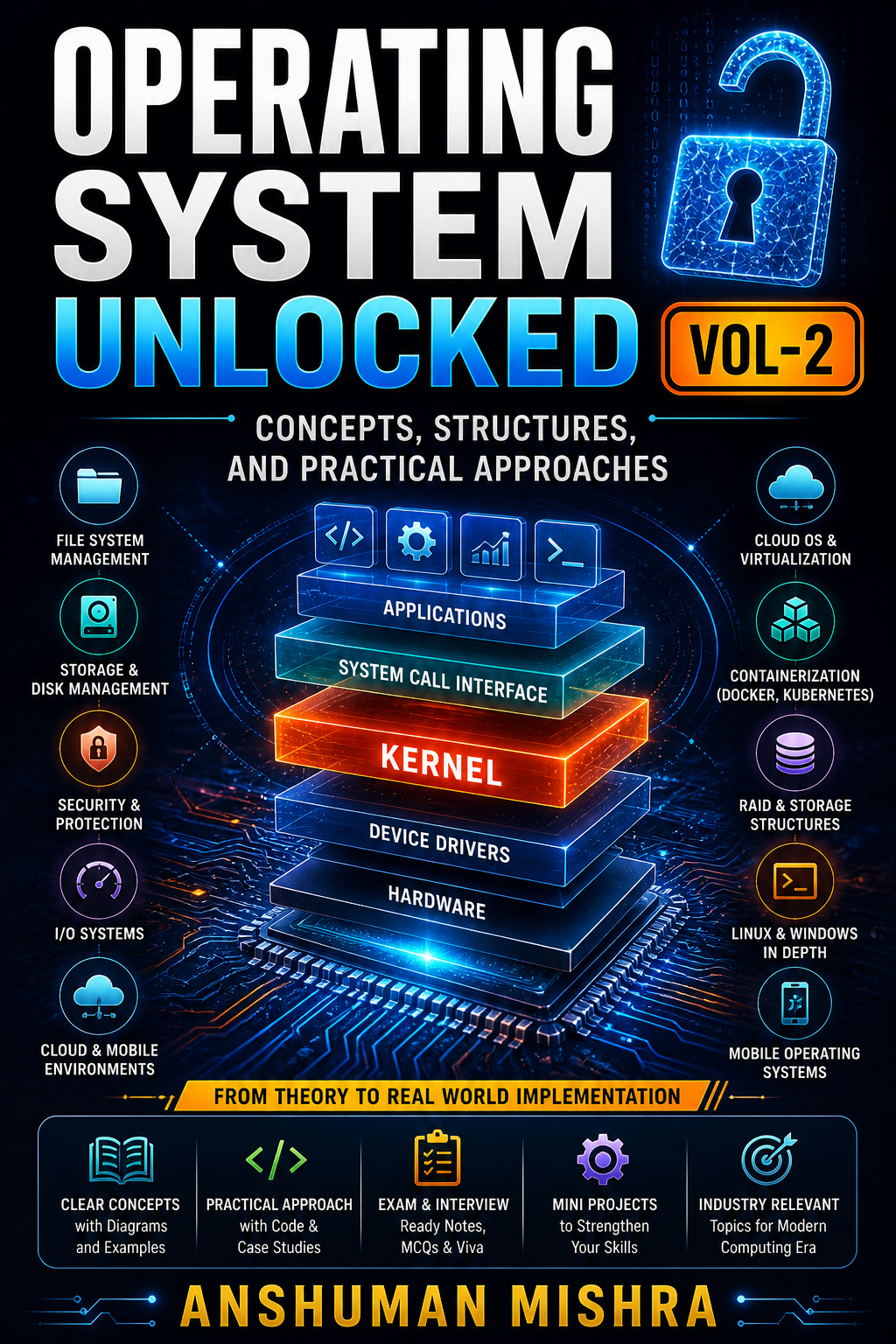
Modern computing systems depend on operating systems not only to manage processes and memory but also to organize files, communicate with hardware, manage storage, enforce security, and provide the foundation for cloud, mobile, and virtualized environments.
Operating Systems Unlocked: Concepts, Structures, and Practical Approaches (VOL-2) continues the learning journey of Volume-I and focuses on the advanced and practical dimensions of operating systems.
While Volume-I establishes the foundations of processes, threads, CPU scheduling, synchronization, deadlocks, memory management, and virtual memory, Volume-II moves further into the components that make complete computing environments possible.
Readers explore how operating systems manage:
Files → I/O Devices → Disks → Storage → Security → Linux/Windows → Mobile Systems → Virtual Machines → Containers → Cloud Environments
The book is written to bridge the gap between academic OS theory and modern system-level technologies.
What Makes This Book Valuable?
Traditional Operating Systems courses often concentrate on algorithms and theoretical concepts. However, today’s developers and IT professionals also need to understand how those concepts appear in actual systems.
This book therefore connects classical OS principles with modern technologies such as:
- Linux
- Windows
- Android
- iOS
- Virtualization
- Hypervisors
- Docker
- Kubernetes
- Cloud computing
- Network storage
- RAID
- System security
This approach allows students to understand not only what an operating system does, but also how modern operating environments are designed and deployed.
Chapter-Wise Coverage
Chapter 9: File System Management
Files are one of the most visible services provided by an operating system.
This chapter explains:
- File concepts
- File access methods
- File types
- File attributes
- File-system structure
- File-system implementation
- Directory structures
- File allocation techniques
- Contiguous allocation
- Linked allocation
- Indexed allocation
- Free-space management
- File protection
- File security
Readers learn how operating systems organize and protect persistent data.
Chapter 10: Input/Output Systems
Input/output operations connect software with the physical devices of a computer.
This chapter covers:
- I/O hardware
- Device interfaces
- Application I/O interfaces
- Kernel I/O subsystem
- I/O scheduling
- Disk scheduling
- FCFS
- SSTF
- SCAN
- C-SCAN
- RAID structures
- Buffering
- Error handling
The chapter provides an important understanding of how operating systems coordinate high-speed processors with comparatively slower I/O devices.
Chapter 11: Disk and Storage Management
Storage management is essential for modern operating systems and large-scale computing systems.
Topics include:
- Disk structure
- Disk formatting
- Disk scheduling
- Secondary storage
- Disk cache management
- Storage Area Networks
- SAN
- Network Attached Storage
- NAS
- RAID concepts
- Storage organization
Readers develop a foundation for understanding storage systems used in servers, enterprise computing, and cloud environments.
Chapter 12: Security and Protection
Security is a fundamental responsibility of modern operating systems.
This chapter explores:
- Security threats
- Common attack concepts
- Protection goals
- Protection mechanisms
- Access Control Matrix
- User authentication
- Authorization
- Password-based authentication
- Encryption fundamentals
- System protection
The chapter emphasizes how operating systems protect users, processes, files, memory, and system resources.
Chapter 13: Linux and Windows Operating Systems
Linux and Windows represent two important operating-system ecosystems.
This chapter provides a comparative understanding of:
- Linux architecture
- Windows architecture
- Linux system calls
- File systems
- Process management
- Memory management
- System utilities
- Command-line environments
- Shell scripting
- Cross-platform concepts
The comparison helps students understand how operating-system concepts are implemented differently across major platforms.
Chapter 14: Operating Systems in Cloud and Mobile Environments
Operating systems have evolved significantly with the growth of smartphones, cloud computing, virtualization, and containers.
This chapter introduces:
Mobile Operating Systems
- Mobile OS concepts
- Android
- iOS
- Mobile resource management
- Power and performance considerations
Cloud Operating Systems
- Cloud OS fundamentals
- Resource management
- Virtualized environments
- Distributed infrastructure
Virtualization
- Virtual machines
- Hypervisors
- Hardware virtualization
- Virtual resource management
Containerization
- Container concepts
- Docker
- Container-based application deployment
- Kubernetes fundamentals
- Containers vs. virtual machines
Cloud OS Challenges
- Scalability
- Resource allocation
- Security
- Isolation
- Reliability
- Performance
This chapter connects classical OS concepts with the infrastructure behind modern cloud applications.
Key Features of the Book
1. Student-Friendly Explanation
Complex operating-system concepts are presented in a structured and accessible manner.
2. Theory + Practical Learning
The book combines theoretical foundations with practical system concepts, algorithms, examples, and case studies.
3. Algorithmic Understanding
Important algorithms such as disk scheduling techniques are explained systematically.
4. Linux and Windows Comparison
Readers gain a cross-platform understanding of operating-system architecture and behavior.
5. Modern OS Technologies
The book goes beyond traditional OS topics to introduce:
Virtualization + Containers + Cloud + Mobile Computing
6. Security Awareness
Security and protection mechanisms are incorporated into the operating-system learning journey.
7. Exam and Interview Preparation
The concepts are highly relevant to university examinations, technical interviews, GATE, UGC-NET, and other computer-science assessments.
Benefits of Studying This Book
1. Academic Excellence
The book provides comprehensive coverage of important university-level OS topics, including:
- File systems
- I/O systems
- Disk scheduling
- Storage management
- Security
- Linux
- Windows
- Cloud computing
- Virtualization
2. Practical System Knowledge
Students develop an understanding of how operating systems interact with:
- Storage devices
- Hardware
- File systems
- Network resources
- Virtual machines
- Containers
3. Career Preparation
The concepts provide useful foundations for careers in:
- Systems Programming
- Linux Administration
- DevOps
- Cloud Computing
- Cybersecurity
- IT Infrastructure
- Backend Development
- System Administration
4. Modern Technology Awareness
Readers are introduced to technologies that have become important in contemporary computing environments, including Docker, Kubernetes, virtualization, cloud infrastructure, and mobile operating systems.
5. Strong Foundation for Advanced Subjects
The knowledge gained from this volume supports further study in:
- Distributed Systems
- Cloud Computing
- Computer Networks
- Cybersecurity
- Virtualization
- Embedded Systems
- DevOps
- System Design
What You Will Learn
After completing this book, you will be able to:
✔ Explain file-system structures and implementations
✔ Understand file allocation techniques
✔ Compare contiguous, linked, and indexed allocation
✔ Understand directory structures
✔ Explain free-space management
✔ Understand file protection mechanisms
✔ Explain I/O hardware and interfaces
✔ Understand kernel I/O subsystems
✔ Solve disk scheduling problems
✔ Compare FCFS, SSTF, SCAN, and C-SCAN
✔ Understand RAID and storage systems
✔ Explain SAN and NAS
✔ Understand disk caching and secondary storage
✔ Identify operating-system security threats
✔ Understand protection mechanisms
✔ Explain access-control models
✔ Understand authentication and encryption fundamentals
✔ Compare Linux and Windows architectures
✔ Understand Linux system calls
✔ Explore shell scripting and command-line utilities
✔ Understand mobile operating systems
✔ Explain cloud OS concepts
✔ Understand virtualization and hypervisors
✔ Differentiate virtual machines and containers
✔ Understand Docker and Kubernetes fundamentals
✔ Connect traditional OS concepts with modern cloud infrastructure
Who Should Read This Book?
This book is ideal for:
- BCA Students
- MCA Students
- B.Tech / BE Students
- M.Tech Students
- Computer Science Students
- Information Technology Students
- Software Engineering Students
- Linux Learners
- System Programmers
- DevOps Beginners
- Cloud Computing Students
- Cybersecurity Students
- IT Professionals
- Computer Science Faculty
- GATE Computer Science Aspirants
- UGC-NET Computer Science Aspirants
- Technical Interview Candidates
- System Administration Learners
Technologies and Concepts Covered
Operating Systems
- Linux
- Windows
- Android
- iOS
Storage
- RAID
- SAN
- NAS
- Disk Scheduling
- Disk Caching
Security
- Authentication
- Authorization
- Access Control
- Encryption
- Protection Mechanisms
Virtualization
- Virtual Machines
- Hypervisors
- Hardware Virtualization
Containers
- Docker
- Kubernetes
- Containerized Applications
System Administration
- Command-Line Utilities
- Shell Scripting
- Linux System Calls
Academic and Professional Applications
The concepts presented in this book can be applied to:
- Operating Systems laboratories
- Linux administration
- Cloud infrastructure
- DevOps environments
- Server management
- Storage systems
- System security
- Virtualized infrastructure
- Containerized applications
- Technical interview preparation
- Computer science research
Book Details
Book Title: Operating Systems Unlocked: Concepts, Structures, and Practical Approaches
Volume: VOL-2
Subject: Operating Systems / System Software / Computer Science
Level: Undergraduate to Postgraduate
Author: Anshuman Mishra
Publication Year: 2025
Format: Academic / Technical Reference Book


Reviews
There are no reviews yet.