Description
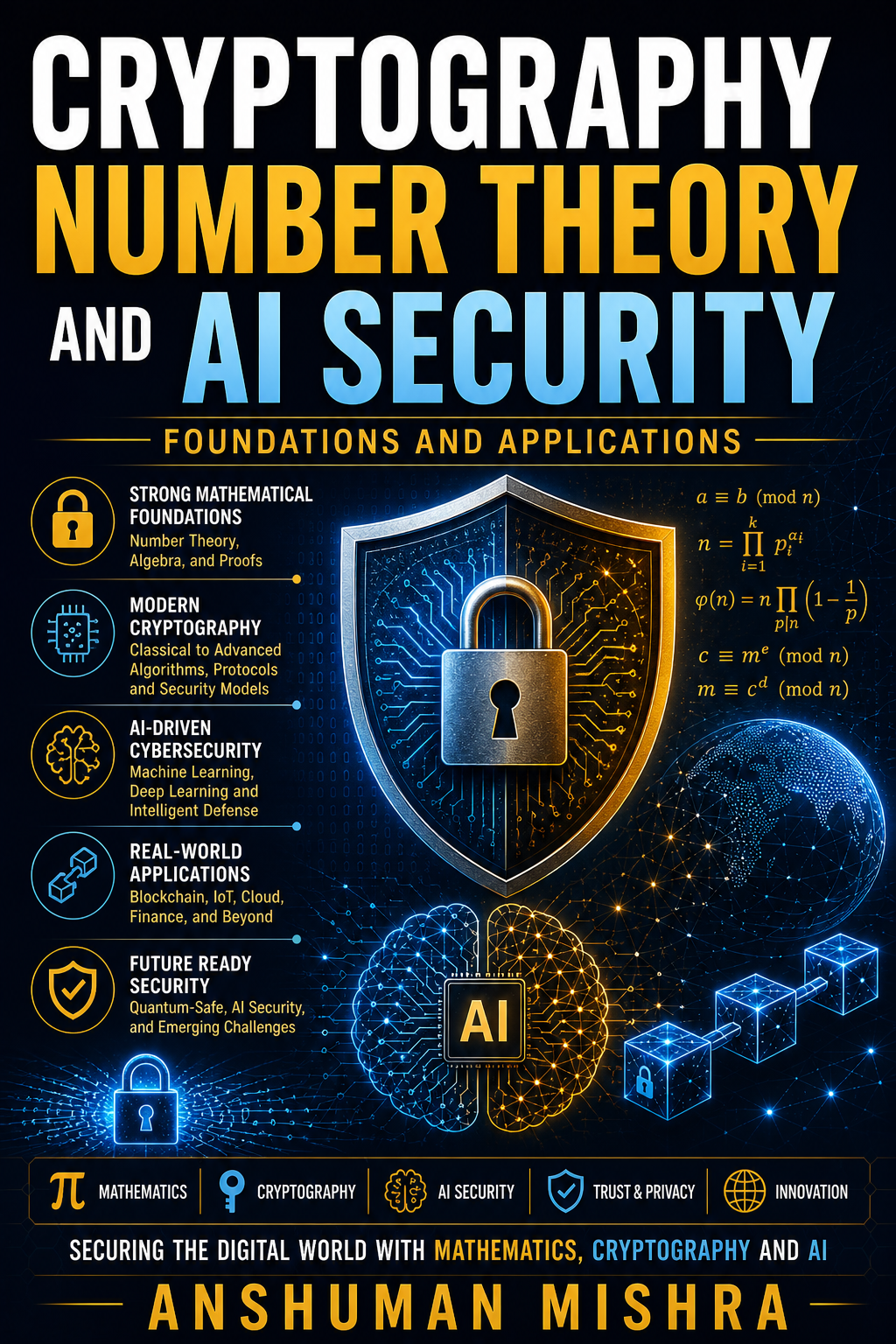
Cryptography, Number Theory, and AI Security
Foundations and Applications
Author: Anshuman Mishra
In an increasingly connected digital world, information security has become a fundamental requirement for communication, commerce, healthcare, banking, governance, education, and Artificial Intelligence. Every secure online transaction, digital identity, encrypted communication, and privacy-preserving application depends on mathematical and computational principles that protect information from unauthorized access and manipulation.
At the foundation of modern digital security lies cryptography, supported by powerful concepts from number theory and increasingly enhanced by Artificial Intelligence.
Cryptography, Number Theory, and AI Security: Foundations and Applications presents an interdisciplinary study of these three closely connected areas. The book explains how mathematical concepts such as prime numbers, modular arithmetic, congruences, Euler’s totient function, discrete logarithms, factorization, and elliptic curves support modern cryptographic systems, while AI introduces new opportunities and challenges for cybersecurity.
The book is designed to bridge mathematical theory with practical security applications, helping readers understand not only how cryptographic algorithms work but also why their mathematical foundations provide security and how intelligent systems are transforming cybersecurity.
The Convergence of Mathematics, Cryptography, and AI
Modern cybersecurity can be understood through three interconnected layers:
1. Number Theory — The Mathematical Foundation
Number theory provides many of the mathematical structures used in cryptographic algorithms.
Important concepts include:
- Prime numbers
- Divisibility
- Greatest Common Divisors
- Modular arithmetic
- Congruences
- Euler’s totient function
- Fermat’s Little Theorem
- Chinese Remainder Theorem
- Quadratic residues
- Discrete logarithms
- Integer factorization
- Elliptic curve mathematics
2. Cryptography — The Security Layer
Cryptography transforms mathematical principles into practical security mechanisms.
Applications include:
- Encryption
- Authentication
- Digital signatures
- Secure key exchange
- Message integrity
- Digital certificates
- Privacy protection
- Secure communication
3. AI Security — The Intelligent Defense Layer
Artificial Intelligence adds adaptive capabilities to cybersecurity.
AI can be applied to:
- Intrusion detection
- Malware analysis
- Phishing detection
- Fraud detection
- Anomaly detection
- Threat prediction
- Automated security response
At the same time, AI creates new security challenges such as adversarial attacks, data poisoning, model manipulation, and privacy risks.
This book examines the interaction among all three layers.
Chapter 1 — Introduction to Cryptography, Number Theory, and AI Security
The opening chapter introduces the historical and technological evolution of cryptography.
It examines:
- History of cryptography
- Development of secure communication
- Role of number theory
- Modern cybersecurity threats
- Artificial Intelligence in cybersecurity
- Mathematical foundations of secure systems
- Real-world security applications
Readers are introduced to the central idea that modern security is increasingly becoming a combination of mathematics, algorithms, and intelligent defense mechanisms.
Chapter 2 — Basics of Number Theory for Cryptography
Number theory is the mathematical language behind many cryptographic systems.
This chapter develops the necessary foundation through:
- Divisibility
- Prime numbers
- Greatest Common Divisors
- Fundamental Theorem of Arithmetic
- Modular arithmetic
- Congruence relations
- Euler’s totient function
- Fermat’s Little Theorem
- Chinese Remainder Theorem
- Quadratic residues
- Legendre symbol
- Computational number theory
The goal is to help readers understand why particular mathematical problems can be useful for constructing cryptographic security.
Chapter 3 — Classical Cryptography
Before modern computational cryptography, secure communication relied on classical substitution and transposition techniques.
This chapter covers:
- Substitution ciphers
- Transposition ciphers
- Monoalphabetic systems
- Polyalphabetic systems
- Caesar cipher
- Affine cipher
- Vigenère cipher
- Stream ciphers
- Block ciphers
- Classical cryptanalysis
These historical systems provide an important foundation for understanding how cryptography evolved toward modern mathematical security.
Chapter 4 — Modern Cryptographic Systems
This chapter introduces the major cryptographic mechanisms used in modern digital systems.
Topics include:
Symmetric-Key Cryptography
Study of systems where encryption and decryption rely on shared secret keys.
AES and Block Ciphers
Understanding the role of modern block-cipher design in secure communication and data protection.
Public-Key Cryptography
Introduction to asymmetric cryptography and its role in secure communication.
RSA
The mathematical foundations and security assumptions behind RSA.
Diffie–Hellman
Understanding secure key establishment over potentially insecure communication channels.
Elliptic Curve Cryptography
Introduction to elliptic curves and their applications in public-key cryptography.
Digital Signatures
How cryptographic techniques can support authentication, integrity, and digital identity.
Chapter 5 — Advanced Number Theory in Cryptography
This chapter explores more advanced mathematical problems that underpin cryptographic security.
It covers:
- Prime generation
- Prime testing
- Probabilistic primality testing
- Miller-Rabin testing
- AKS algorithm
- Discrete Logarithm Problem
- Integer factorization
- Computational hardness
- Lattice-based methods
- Post-quantum cryptography
- Mathematical security proofs
The chapter helps readers understand why computational difficulty is important in cryptographic design.
Chapter 6 — Cryptographic Protocols and Security Models
Cryptography is not limited to individual algorithms. Secure systems require protocols that combine multiple cryptographic components.
This chapter explores:
- Authentication protocols
- Key exchange
- Hash functions
- Message integrity
- Zero-Knowledge Proofs
- Digital certificates
- Public Key Infrastructure
- Blockchain security
- Distributed ledger security
- Quantum-safe cryptographic approaches
Readers gain an understanding of how cryptographic algorithms operate within larger security architectures.
Chapter 7 — Artificial Intelligence in Cybersecurity
Artificial Intelligence is transforming modern cyber defense.
This chapter explores applications of AI in:
Intrusion Detection
Machine Learning models can analyze network behavior and identify suspicious patterns.
Malware Detection
Deep Learning can assist in identifying potentially malicious software and behavioral patterns.
Phishing Detection
AI-based systems can analyze messages, websites, and communication patterns to identify suspicious activity.
Fraud Detection
Machine Learning can help identify unusual transaction behavior and potential financial fraud.
Reinforcement Learning
Adaptive learning approaches can be explored for automated security response and decision-making.
Adversarial AI
The chapter also introduces the security risks created when attackers manipulate or exploit AI systems.
Chapter 8 — Cryptography Meets AI Security
This chapter forms the central bridge between cryptographic technology and Artificial Intelligence.
Important topics include:
- AI-assisted cryptanalysis
- Privacy-preserving AI
- Homomorphic Encryption
- Federated Learning
- Differential Privacy
- Secure data sharing
- Blockchain and AI
- Secure Multiparty Computation
- AI security in emerging computing environments
Homomorphic Encryption
The chapter introduces the concept of performing certain computations on protected data without requiring direct exposure of the underlying information.
Federated Learning
Readers explore how distributed learning can reduce the need to centralize sensitive training data, while also considering the associated security challenges.
Differential Privacy
The book explains how mathematical privacy mechanisms can help reduce the risk of exposing individual information in data-driven systems.
Chapter 9 — Applications and Case Studies
The theoretical concepts are connected with practical applications across multiple domains.
Secure Communication
Cryptographic systems protect communication across digital networks.
Internet of Things
Connected devices require efficient security mechanisms for authentication, communication, and data protection.
Financial Security
Banks and financial institutions depend on cryptography and AI for transaction security, identity verification, fraud detection, and risk management.
Cloud Computing
Cloud environments require secure storage, authentication, encryption, and privacy-preserving computation.
Edge Computing
Distributed computing environments introduce additional requirements for secure communication and data protection.
National and Critical Infrastructure Security
The book discusses the broader role of cryptography and AI in protecting important digital infrastructure.
Chapter 10 — Future Directions and Challenges
The final chapter looks toward the future of cryptography and AI security.
Major themes include:
- Quantum computing threats
- Post-quantum cryptography
- AI-driven cyberattacks
- AI-based security defense
- Secure AI architectures
- Privacy-preserving Machine Learning
- Ethical considerations
- Legal and policy challenges
- Emerging research directions
The chapter emphasizes the need for security systems that can adapt to increasingly sophisticated computational and AI-driven threats.
Why This Book Is Important
1. It Connects Three Critical Domains
The book integrates:
Number Theory + Cryptography + Artificial Intelligence
rather than treating them as isolated subjects.
2. It Explains the Mathematics Behind Security
Instead of presenting cryptographic algorithms as black boxes, the book introduces the mathematical principles that support them.
Readers explore concepts such as:
- Prime numbers
- Modular arithmetic
- Congruences
- Factorization
- Discrete logarithms
- Elliptic curves
- Lattices
3. It Connects Classical Cryptography with Modern Security
Readers progress from classical ciphers to modern cryptographic systems and then toward AI-powered cybersecurity.
The learning progression is:
Classical Ciphers → Modern Cryptography → Security Protocols → AI Cybersecurity → AI-Cryptography Integration → Post-Quantum Security
4. It Addresses Emerging AI Security Threats
Modern AI introduces new attack surfaces.
The book examines concepts related to:
- Adversarial AI
- Model security
- Data privacy
- Secure Machine Learning
- AI-assisted attacks
- AI-driven defense
- Privacy-preserving AI
5. It Introduces Post-Quantum Security
Quantum computing could threaten some widely used public-key cryptographic assumptions.
The book therefore introduces:
- Quantum-era security challenges
- Lattice-based approaches
- Post-quantum cryptography
- Quantum-safe security strategies
Key Features of the Book
📘 Strong Mathematical Foundation
Covers number theory concepts required for understanding cryptographic algorithms.
🔐 Comprehensive Cryptography Coverage
Includes classical and modern cryptographic systems, protocols, digital signatures, certificates, and secure communication.
🤖 AI-Centric Cybersecurity
Explores Machine Learning and Deep Learning applications in intrusion detection, malware detection, fraud detection, and threat response.
🧠 Cryptography + AI Integration
Covers privacy-preserving AI, federated learning, homomorphic encryption, differential privacy, and secure computation.
🌐 Real-World Applications
Connects theory with IoT, cloud computing, finance, banking, blockchain, communication, and critical infrastructure.
⚛️ Future-Ready Perspective
Introduces post-quantum cryptography and the security challenges of the quantum computing era.
🔬 Research-Oriented
Highlights emerging research areas and open challenges at the intersection of mathematics, cryptography, and AI security.
Who Should Read This Book?
🎓 Computer Science Students
Suitable for BCA, B.Tech, MCA, M.Tech, and related Computer Science programs.
🔐 Cybersecurity Students and Professionals
Useful for understanding the mathematical and computational foundations of modern security systems.
🤖 AI and Machine Learning Professionals
Helps AI practitioners understand security, privacy, adversarial threats, and cryptographic foundations.
📐 Mathematics Students
Provides practical applications of number theory in modern technology.
🔬 Researchers
Useful for research involving:
- Cryptography
- Number Theory
- AI Security
- Privacy-Preserving AI
- Post-Quantum Cryptography
- Secure Machine Learning
- Blockchain Security
👨🏫 Educators
Can serve as supplementary material for courses in:
- Cryptography
- Cybersecurity
- Number Theory
- Artificial Intelligence
- Network Security
- Information Security
- Machine Learning Security
Learning Outcomes
After studying this book, readers will be able to:
- Understand the fundamental principles of cryptography.
- Explain the role of number theory in secure communication.
- Work with modular arithmetic and congruences.
- Understand prime numbers and computational number theory.
- Explain classical cryptographic systems.
- Understand symmetric and asymmetric cryptography.
- Explain the mathematical foundations of RSA.
- Understand Diffie–Hellman key exchange.
- Explore the principles of Elliptic Curve Cryptography.
- Understand digital signatures and certificates.
- Explain cryptographic hash functions.
- Understand Zero-Knowledge Proof concepts.
- Explore Public Key Infrastructure.
- Understand the role of AI in cybersecurity.
- Explore Machine Learning for intrusion detection.
- Understand AI applications in malware and fraud detection.
- Recognize major AI security threats and adversarial challenges.
- Understand privacy-preserving AI approaches.
- Explore federated learning and differential privacy.
- Understand the basic principles of homomorphic encryption.
- Explore blockchain and secure distributed systems.
- Understand post-quantum cryptographic challenges.
- Identify emerging research directions in AI security.
Practical Applications
The concepts discussed in this book are relevant to:
🔐 Cybersecurity
Encryption, authentication, intrusion detection, threat analysis, and secure communication.
🏦 Banking and Finance
Transaction security, fraud detection, digital identity, and risk assessment.
🌐 Internet of Things
Device authentication, secure communication, and distributed security.
☁️ Cloud Computing
Data protection, access control, encryption, and privacy.
🤖 Artificial Intelligence
Secure Machine Learning, adversarial AI defense, privacy-preserving models, and AI threat detection.
⛓️ Blockchain
Cryptographic hashing, digital signatures, distributed trust, and ledger security.
⚛️ Post-Quantum Security
Preparing cryptographic systems for future quantum computing capabilities.
The Security Architecture Presented in the Book
A central framework of the book can be represented as:
Number Theory
↓
Cryptographic Algorithms
↓
Security Protocols
↓
Secure Data & Communication
↓
AI-Based Threat Detection
↓
Privacy-Preserving AI
↓
Adaptive Cyber Defense
↓
Post-Quantum Security
This framework demonstrates how mathematical foundations can support increasingly intelligent security architectures.
Future Research Directions
The convergence of cryptography and AI creates numerous opportunities for future research.
Important areas include:
- AI-assisted cryptanalysis
- Secure Machine Learning
- Adversarial Machine Learning
- Privacy-preserving AI
- Federated Learning Security
- Homomorphic Encryption
- Differential Privacy
- Secure Multiparty Computation
- Post-Quantum Cryptography
- AI-powered threat detection
- Blockchain and AI security
- Quantum-resistant AI infrastructure
- Explainable and trustworthy security systems
Final Perspective
Cryptography, Number Theory, and AI Security: Foundations and Applications presents cybersecurity as an interdisciplinary field where mathematics, algorithms, and intelligent systems work together.
The book takes readers on a journey from the fundamental properties of integers and prime numbers to modern encryption, cryptographic protocols, AI-powered cybersecurity, privacy-preserving computation, and post-quantum security.
Its central learning path can be summarized as:
Mathematics → Cryptography → Secure Systems → Artificial Intelligence → Intelligent Cyber Defense → Quantum-Resilient Security
For students, the book provides a structured foundation.
For professionals, it connects mathematical principles with practical security applications.
For researchers, it highlights emerging areas where cryptography, number theory, and AI are converging.
Ultimately, the book emphasizes that the future of cybersecurity will require more than stronger algorithms. It will require mathematical rigor, intelligent defense, privacy awareness, and continuous adaptation to emerging technologies.

Reviews
There are no reviews yet.