Description
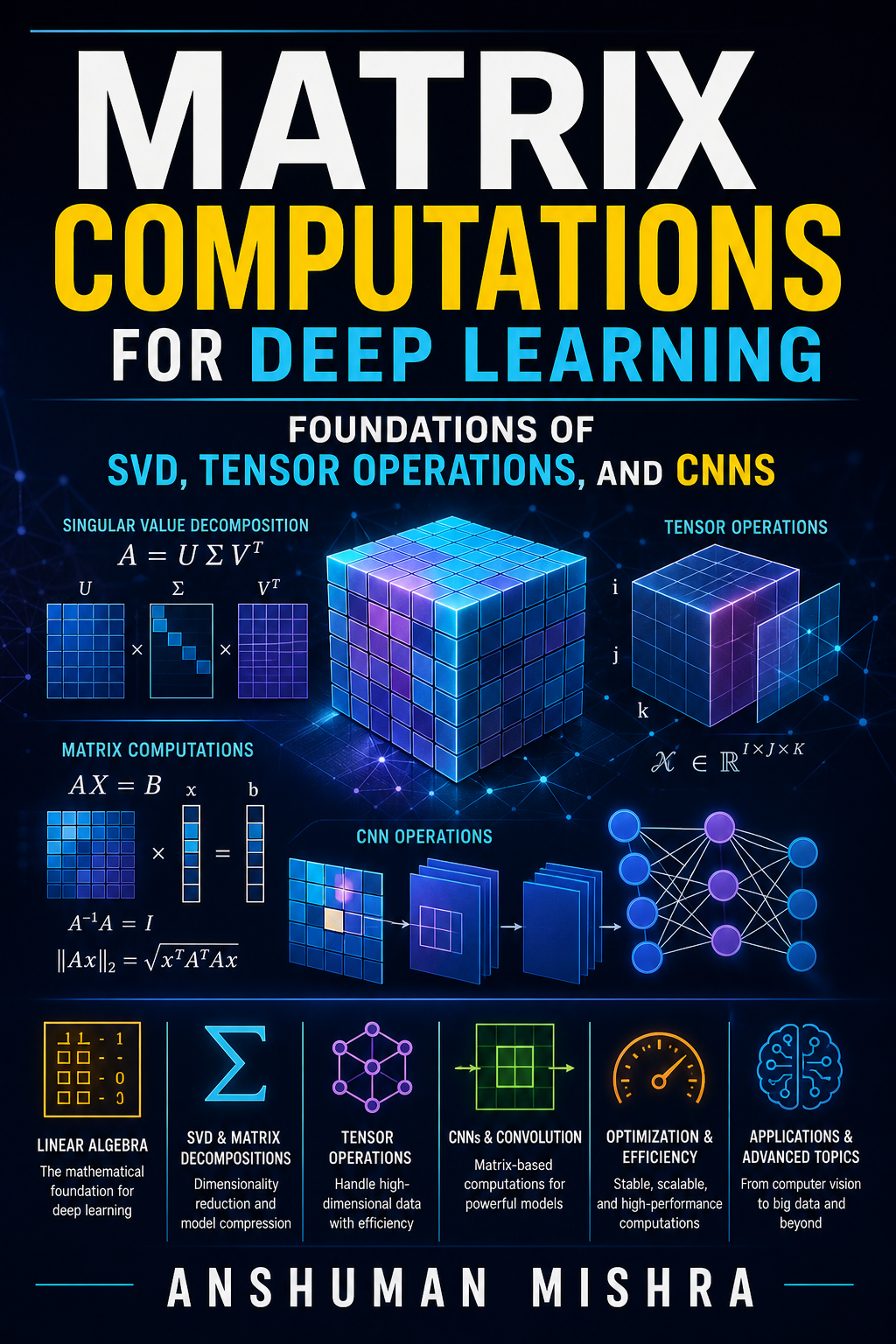
Matrix Computations for Deep Learning
Foundations of SVD, Tensor Operations, and CNNs
Author: Anshuman Mishra
Modern Artificial Intelligence and Deep Learning are powered by mathematics. Beneath every neural network, image-processing pipeline, convolutional architecture, and large-scale AI model lies a vast number of mathematical operations involving vectors, matrices, tensors, decompositions, transformations, and numerical computations.
Although Deep Learning frameworks such as PyTorch, TensorFlow, and JAX perform many of these calculations automatically, understanding the mathematics behind them is essential for developing strong intuition, improving computational efficiency, diagnosing numerical problems, and designing advanced AI systems.
Matrix Computations for Deep Learning: Foundations of SVD, Tensor Operations, and CNNs provides a systematic exploration of the mathematical and computational techniques that form the foundation of modern Deep Learning.
The book connects classical linear algebra and numerical matrix computation with practical applications in Machine Learning, Deep Learning, Computer Vision, Convolutional Neural Networks, dimensionality reduction, model compression, large-scale computation, and tensor-based AI systems.
Why Matrix Computations Matter in Deep Learning
A neural network can be viewed as a sequence of mathematical transformations.
At a simplified level, a neural network repeatedly performs operations such as:
Input → Matrix Multiplication → Transformation → Activation → Matrix Multiplication → Output
Modern architectures extend this idea through:
- High-dimensional tensors
- Convolution operations
- Attention mechanisms
- Matrix factorizations
- Tensor decompositions
- Optimization algorithms
- GPU-accelerated computation
Understanding these operations allows readers to move beyond simply using AI libraries and develop a deeper understanding of how intelligent models actually process information.
Part I — Foundations of Matrix Computations
Chapter 1 — Introduction to Matrix Computations in AI
The opening chapter introduces the central role of matrix computation in Artificial Intelligence.
It explores:
- Why matrices are fundamental to Deep Learning
- Historical development of linear algebra
- Evolution from matrix mathematics to neural networks
- Matrix operations in Machine Learning
- Applications in Computer Vision
- Matrix computations in modern AI architectures
Readers are introduced to the idea that many Deep Learning operations can ultimately be expressed through structured mathematical transformations.
Chapter 2 — Linear Algebra Refresher for Deep Learning
This chapter establishes the essential linear algebra required for understanding Deep Learning.
Topics include:
- Vectors
- Matrices
- Tensors
- Matrix addition
- Matrix multiplication
- Transposition
- Determinants
- Matrix inverses
- Eigenvalues
- Eigenvectors
- Orthogonality
- Projections
The chapter connects each concept with AI applications rather than treating linear algebra as purely abstract mathematics.
Chapter 3 — Vector Spaces and Norms
Vector spaces provide the mathematical environment in which many Machine Learning representations exist.
This chapter covers:
- Inner products
- Distance measures
- Vector norms
- Lp norms
- Regularization
- Numerical conditioning
- Condition numbers
- Computational stability
Readers learn how norms and numerical properties influence optimization, model regularization, and computational reliability.
Part II — Matrix Decompositions for Deep Learning
Chapter 4 — Singular Value Decomposition
Singular Value Decomposition (SVD) is one of the most powerful matrix factorization techniques in computational mathematics and AI.
This chapter explores:
- Definition of SVD
- Mathematical properties
- Singular values and singular vectors
- Low-rank approximation
- Matrix compression
- Dimensionality reduction
- PCA and SVD
- SVD in neural networks
The discussion demonstrates how SVD can help reduce computational complexity and represent high-dimensional data more efficiently.
Chapter 5 — QR and LU Decomposition
Matrix factorization provides efficient approaches for solving linear systems and performing numerical computations.
This chapter covers:
- QR decomposition
- LU decomposition
- Matrix factorization
- Solving linear systems
- Optimization applications
- Backpropagation-related computations
- Numerical stability
- Computational efficiency
Readers gain an understanding of why different matrix decompositions are useful for different computational tasks.
Chapter 6 — Eigenvalue Decomposition and Spectral Methods
Eigenvalue methods provide important tools for understanding the structure of matrices and graphs.
Topics include:
- Eigenvalue decomposition
- Spectral analysis
- Spectral clustering
- Graph Laplacians
- Network embeddings
- Graph-based Machine Learning
- Connections with attention mechanisms
This chapter introduces the reader to spectral approaches that appear in modern AI research.
Part III — Tensor Operations in Deep Learning
Chapter 7 — Introduction to Tensor Algebra
Deep Learning models operate on data that frequently goes beyond two-dimensional matrices.
This chapter explains the transition:
Scalar → Vector → Matrix → Higher-Order Tensor
Topics include:
- Tensor representation
- Tensor dimensions
- Tensor rank
- Tensor operations
- Tensor factorization
- Computational challenges
Readers learn why tensors are fundamental to modern neural network frameworks.
Chapter 8 — Tensor Decompositions and Applications
Tensor decomposition provides techniques for representing high-dimensional data more efficiently.
This chapter covers:
CP Decomposition
Also known as CANDECOMP/PARAFAC decomposition, this method represents a tensor as a combination of simpler components.
Tucker Decomposition
A flexible tensor factorization approach useful for dimensionality reduction and data representation.
Tensor Train Decomposition
A structured approach for representing large tensors efficiently.
Applications include:
- Model compression
- Knowledge representation
- Multi-dimensional data
- Multi-modal learning
- Large-scale AI
Chapter 9 — Efficient Tensor Computations in Deep Learning
Modern Deep Learning requires massive numbers of tensor operations.
This chapter explores:
- GPU acceleration
- Sparse tensor representations
- Computational efficiency
- Automatic differentiation
- Tensor libraries
- PyTorch
- TensorFlow
- JAX
The chapter demonstrates how software and hardware architectures work together to execute large-scale tensor computations.
Part IV — Matrix Computations for Convolutional Neural Networks
Chapter 10 — Foundations of Convolutions
Convolution is one of the fundamental operations behind CNNs.
This chapter explains convolution from a mathematical matrix perspective.
Topics include:
- Convolution as matrix multiplication
- Toeplitz matrices
- Circulant matrices
- Stride
- Padding
- Dilation
- Structured matrix representations
- Fourier connections
- Wavelet connections
This approach helps readers understand convolution beyond the conventional “sliding filter” explanation.
Chapter 11 — CNN Layer Computations
This chapter examines the mathematical computations performed inside CNN architectures.
It covers:
- Convolution layers
- Linear transformations
- Pooling
- Matrix representations
- Batch normalization
- Matrix scaling
- Feature maps
- Computational efficiency
Readers can understand how image information is transformed layer by layer within a CNN.
Chapter 12 — Optimization and Training of CNNs
Training neural networks involves repeated numerical optimization.
This chapter explores:
- Gradient descent
- Matrix-based optimization
- Backpropagation
- Tensor operations
- CNN gradient computation
- Dropout
- Weight decay
- Norm constraints
- Regularization
The chapter connects mathematical optimization with practical Deep Learning training.
Part V — Applications and Advanced Topics
Chapter 13 — Matrix Computations in Dimensionality Reduction
High-dimensional data can create computational and statistical challenges.
This chapter examines:
- Principal Component Analysis
- SVD and PCA
- Linear Discriminant Analysis
- Low-rank representations
- Autoencoders
- Dimensionality reduction
Readers learn how matrix methods can transform complex datasets into more manageable representations.
Chapter 14 — Matrix and Tensor Methods for Computer Vision
Computer Vision relies heavily on matrix and tensor representations.
This chapter covers:
- Image representation
- Image compression
- Tensor-based image processing
- Object recognition
- Feature representation
- Multi-modal Deep Learning
The chapter demonstrates how matrix and tensor techniques support AI systems that process visual information.
Chapter 15 — Scalable Matrix Computations for Big Data
Large datasets and modern neural networks require computationally efficient algorithms.
This chapter explores:
- Randomized matrix algorithms
- Approximate matrix computations
- Large-scale decomposition
- Distributed matrix computation
- Parallel processing
- Large-scale CNN training
A case study illustrates the computational challenges associated with training large neural networks.
Part VI — Practical Implementations
Chapter 16 — Numerical Stability and Computational Efficiency
Numerical errors can significantly affect AI computations.
This chapter examines:
- Floating-point arithmetic
- Numerical errors
- Conditioning
- Stability
- CPU computation
- GPU computation
- Parallelization
- Computational optimization
Readers learn why numerical stability is essential for reliable Deep Learning systems.
Chapter 17 — Hands-On with Python and Deep Learning Frameworks
Theoretical concepts are connected with practical implementation.
The chapter introduces:
NumPy
For fundamental matrix and vector operations.
SciPy
For advanced numerical and scientific computations.
PyTorch
For tensor computation, automatic differentiation, and neural networks.
TensorFlow
For large-scale machine learning and tensor-based computation.
JAX
For high-performance numerical computing and automatic differentiation.
Practical case studies include:
- Implementing SVD
- Performing matrix operations
- Working with tensors
- Implementing CNN computations
- Comparing computational approaches
Chapter 18 — Future of Matrix Computations in Deep Learning
The final chapter explores emerging directions in mathematical computation for AI.
Topics include:
- Quantum computing
- Quantum matrix operations
- Emerging tensor methods
- Efficient AI architectures
- Large-scale computation
- Advanced model compression
- Open research problems
The chapter encourages readers to explore how mathematical computation may evolve alongside future AI systems.
Why This Book Is Important
1. It Builds Mathematical Intuition
Deep Learning can appear to be a collection of complex algorithms. Matrix computation provides a common mathematical language for understanding many of these algorithms.
2. It Connects Theory with Practice
The book does not treat matrix mathematics as an isolated prerequisite.
Instead, it connects concepts directly with:
- Neural networks
- CNNs
- Computer Vision
- Machine Learning
- Optimization
- Model compression
- Tensor computation
3. It Explains SVD and Matrix Decompositions
SVD, QR, LU, and eigenvalue decompositions are powerful computational tools.
They can support:
- Dimensionality reduction
- Compression
- Numerical optimization
- Feature analysis
- Efficient computation
4. It Provides a Strong Tensor Foundation
Modern AI frameworks operate heavily on tensors.
Understanding tensor algebra and decomposition provides a stronger foundation for advanced Deep Learning research.
5. It Helps Readers Understand CNNs Mathematically
Rather than treating convolution as simply a sliding-window operation, the book explains its relationship with structured matrices and linear transformations.
This provides a deeper understanding of CNN computation.
6. It Addresses Computational Efficiency
Modern AI models require enormous computational resources.
The book discusses:
- Sparse representations
- Low-rank approximations
- GPU acceleration
- Parallel computation
- Distributed systems
- Numerical stability
These topics are important for both research and industry applications.
Key Features of the Book
📘 Comprehensive Mathematical Foundation
Covers vectors, matrices, tensors, norms, eigenvalues, projections, decompositions, and numerical stability.
🧮 SVD and Matrix Decompositions
Detailed treatment of SVD, QR, LU, and eigenvalue methods with AI applications.
🔢 Tensor Algebra
Introduces higher-order tensors and advanced tensor decomposition methods.
🧠 Deep Learning Applications
Connects mathematical computations with neural networks, CNNs, dimensionality reduction, and optimization.
👁️ Computer Vision
Explores image representation, compression, object recognition, and multi-modal AI.
💻 Practical Python Implementation
Uses NumPy, SciPy, PyTorch, TensorFlow, and JAX for computational examples.
⚡ Computational Efficiency
Covers GPUs, sparse matrices, parallel processing, distributed computation, and numerical optimization.
🔬 Research Perspective
Introduces emerging areas such as quantum computation, tensor methods, and scalable AI.
Who Should Read This Book?
🎓 Undergraduate Students
Useful for students studying:
- Computer Science
- Artificial Intelligence
- Machine Learning
- Data Science
- Mathematics
- Engineering
It provides the mathematical background needed for advanced AI courses.
🎓 Postgraduate Students
MCA, M.Tech, MSc, and related students can use the book to strengthen their mathematical understanding of Deep Learning.
🔬 Researchers
Particularly useful for research involving:
- Deep Learning
- Matrix Computation
- Tensor Methods
- Computer Vision
- Numerical Optimization
- Model Compression
- Large-Scale AI
💻 AI/ML Engineers
Professionals can learn how mathematical representations affect:
- Model efficiency
- Memory consumption
- Computational speed
- Numerical stability
- Training scalability
👨🏫 Educators
The book can support courses in:
- Linear Algebra for AI
- Mathematical Foundations of Machine Learning
- Deep Learning
- Numerical Computing
- Computer Vision
- Tensor Computation
Learning Outcomes
After studying this book, readers will be able to:
- Understand the role of matrix computation in Deep Learning.
- Perform fundamental vector and matrix operations.
- Understand vector spaces and norms.
- Analyze eigenvalues and eigenvectors.
- Understand orthogonality and projections.
- Apply Singular Value Decomposition.
- Use low-rank approximations for efficient representation.
- Understand QR and LU decomposition.
- Analyze numerical stability and conditioning.
- Understand tensor algebra and higher-order tensors.
- Explore CP, Tucker, and Tensor Train decompositions.
- Understand GPU-accelerated tensor computation.
- Explain convolution using matrix representations.
- Understand Toeplitz and circulant matrices.
- Analyze CNN layer computations.
- Understand matrix-based backpropagation.
- Apply SVD and PCA to dimensionality reduction.
- Explore tensor methods in Computer Vision.
- Understand scalable matrix computations for Big Data.
- Implement matrix and tensor operations using Python.
- Work with NumPy, SciPy, PyTorch, TensorFlow, and JAX.
- Identify numerical and computational bottlenecks in AI systems.
- Explore advanced research directions in matrix and tensor computation.
Practical Applications
The concepts in this book are relevant to:
🤖 Deep Learning
Neural network computation, optimization, tensor operations, and model compression.
👁️ Computer Vision
Image representation, CNNs, image compression, feature extraction, and object recognition.
📊 Data Science
PCA, dimensionality reduction, matrix factorization, and high-dimensional data analysis.
🧠 Model Compression
Low-rank approximation and tensor decomposition can help develop more computationally efficient model representations.
⚡ High-Performance AI
GPU acceleration, parallelization, sparse representations, and distributed computation.
🔬 AI Research
Spectral methods, tensor methods, numerical optimization, and emerging quantum-inspired approaches.
From Mathematics to Deep Learning
A central theme of the book can be summarized as:
Linear Algebra
↓
Matrix Computation
↓
Matrix Decomposition
↓
Tensor Operations
↓
Convolution
↓
Neural Network Computation
↓
Optimization
↓
Efficient Deep Learning
This progression helps readers understand how foundational mathematical operations become the computational building blocks of modern AI.
Future Research Directions
The book also prepares readers to explore emerging research areas such as:
- Efficient Deep Learning
- Tensor Networks
- Low-Rank Neural Networks
- Model Compression
- Randomized Linear Algebra
- Distributed Matrix Computation
- Spectral Deep Learning
- Graph Neural Networks
- Quantum Machine Learning
- Quantum Matrix Computation
- Multi-Modal AI
- Large-Scale Neural Network Optimization
Final Perspective
Matrix Computations for Deep Learning: Foundations of SVD, Tensor Operations, and CNNs presents the mathematics of Deep Learning as an essential part of understanding modern Artificial Intelligence.
The book builds a clear progression:
Vectors → Matrices → Decompositions → Tensors → Convolutions → Neural Networks → Optimization → Scalable AI
For students, it provides a strong mathematical foundation.
For researchers, it introduces computational techniques relevant to advanced AI research.
For professionals, it demonstrates how matrix and tensor computations influence the efficiency, stability, and scalability of real-world AI systems.
Ultimately, the book encourages readers to look inside the mathematical machinery of Deep Learning and understand that behind every neural network is a powerful computational language:
Matrix mathematics is not merely supporting Deep Learning—it is one of the languages through which Deep Learning works.
Reviews
There are no reviews yet.