Description
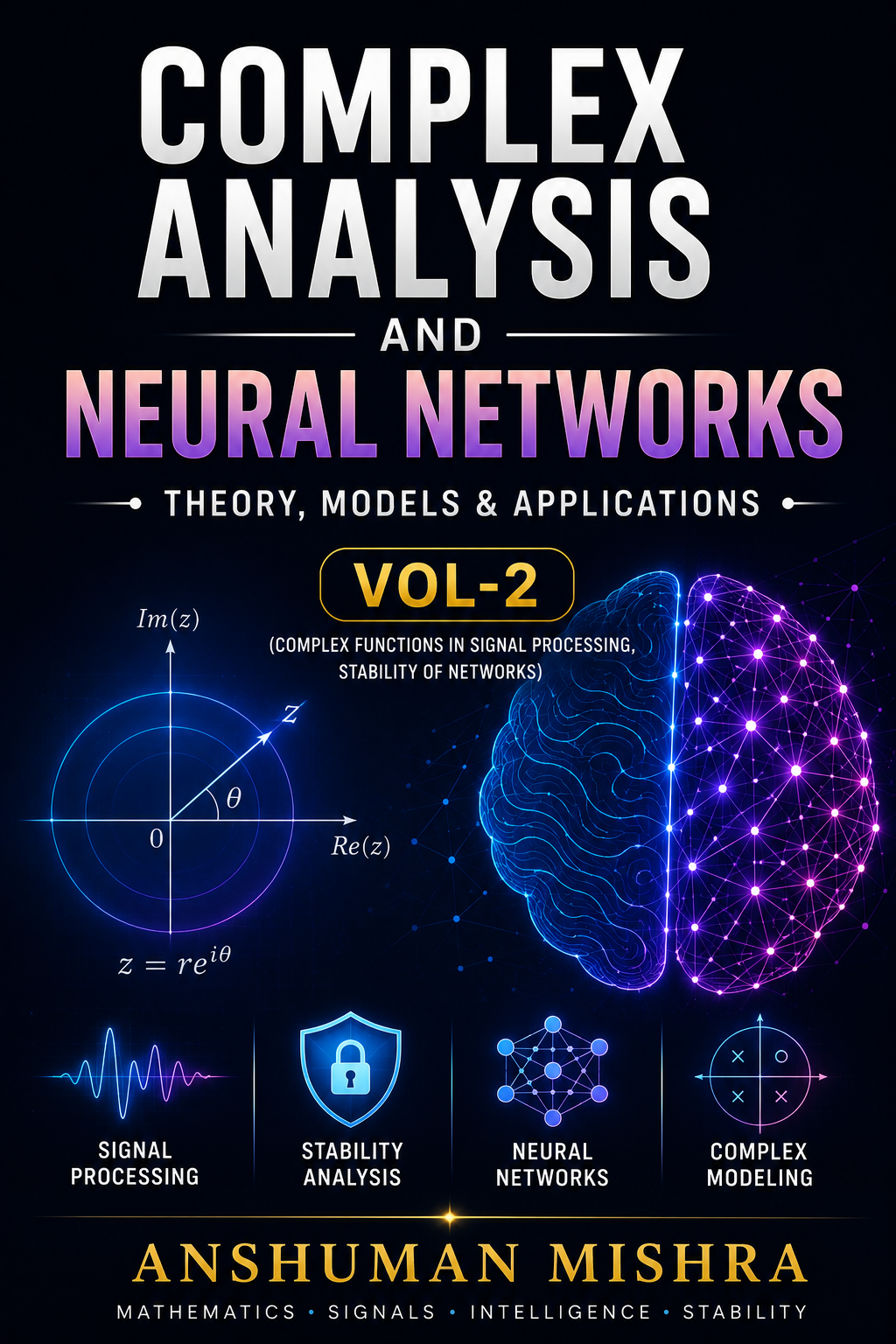
Complex Analysis and Neural Networks: Theory, Models & Applications (Vol. 2)
Complex Functions in Signal Processing, Stability of Networks
Artificial Intelligence is entering a new era where mathematical sophistication determines computational intelligence. As modern applications increasingly rely on complex-valued data—including radar signals, wireless communications, medical imaging, speech recognition, quantum-inspired computing, and autonomous systems—the limitations of conventional real-valued neural networks have become increasingly apparent.
Complex Analysis and Neural Networks: Theory, Models & Applications (Vol. 2) presents an advanced exploration of how Complex Analysis provides the mathematical foundation for designing stable, efficient, and high-performance neural networks capable of processing complex-valued information.
Building upon the theoretical foundations introduced in Volume 1, this volume focuses on stability theory, complex optimization, dynamical systems, signal processing, computer vision, robotics, wireless communications, implementation strategies, and emerging research directions in Complex-Valued Neural Networks (CVNNs).
Readers learn how neural networks behave as nonlinear dynamical systems, how Lyapunov stability guarantees convergence, how complex-domain optimization improves training efficiency, and how advanced architectures such as Complex CNNs, Complex RNNs, Complex LSTMs, Complex Transformers, and Complex Reinforcement Learning models outperform conventional approaches in specialized domains.
The book further demonstrates the practical applications of complex-valued computation in radar imaging, MRI reconstruction, biomedical signal analysis, EEG classification, beamforming, 5G/6G communications, autonomous robotics, computer vision, holography, and intelligent control systems.
Unlike traditional mathematical texts, this book combines rigorous theoretical foundations with practical implementation using Python, PyTorch, and modern AI frameworks, enabling readers to build and evaluate complex-valued neural models for real-world research and industrial applications.
Designed for postgraduate students, AI researchers, engineers, and advanced practitioners, this book bridges the gap between advanced mathematics and next-generation Artificial Intelligence.
What You’ll Learn
✔ Neural Networks as Dynamical Systems
✔ Complex Dynamical Systems
✔ Phase Portrait Analysis
✔ Fixed Points
✔ Limit Cycles
✔ Lyapunov Stability
✔ Complex Lyapunov Functions
✔ Stability Analysis
✔ Pole-Zero Analysis
✔ Frequency Response
✔ Gradient Explosion
✔ Gradient Vanishing
✔ Stable Neural Architectures
✔ Complex Optimization
✔ Complex Stochastic Gradient Descent
✔ Second-Order Optimization
✔ Complex Hessian Matrix
✔ Curvature Analysis
✔ Convergence Analysis
✔ Chaotic Training Dynamics
✔ Signal Processing with CVNN
✔ Speech Recognition
✔ Audio Processing
✔ Biomedical Signal Processing
✔ EEG Analysis
✔ ECG Signal Classification
✔ Spectrum Estimation
✔ Radar Signal Processing
✔ Sonar Systems
✔ OFDM Communication
✔ MIMO Systems
✔ Beamforming
✔ Wireless Communications
✔ 5G and 6G AI Systems
✔ Computer Vision
✔ Complex Gabor Filters
✔ Phase-Based Motion Detection
✔ MRI Reconstruction
✔ CT Image Processing
✔ Complex CNN
✔ Texture Analysis
✔ Holographic Imaging
✔ Optical Computing
✔ Robotics Control
✔ Reinforcement Learning
✔ Autonomous Systems
✔ PyTorch Implementation
✔ Complex Layers
✔ Model Debugging
✔ Research Methodologies
Table of Contents
Module IV – Stability & Dynamics of Neural Networks
Chapter 13
Dynamical Systems & Complex Analysis
Chapter 14
Stability Criteria in Complex-Valued Neural Networks
Chapter 15
Complex Domain Optimization
Module V – Applications of Complex Analysis in Neural Networks
Chapter 16
Signal Processing Applications
Chapter 17
Radar, Sonar & Wireless Communications
Chapter 18
Computer Vision & Imaging
Chapter 19
Robotics & Control Systems
Module VI – Research Directions & Case Studies
Chapter 20
Challenges and Open Research Problems
Chapter 21
Industrial and Research Case Studies
Chapter 22
Python & PyTorch Implementation Guide
Who Should Read This Book?
This book is ideal for:
- Artificial Intelligence Researchers
- Machine Learning Engineers
- Deep Learning Researchers
- Signal Processing Engineers
- Computer Vision Engineers
- Robotics Engineers
- Communication Engineers
- Wireless Network Researchers
- Applied Mathematics Students
- Computer Science Students
- Electronics Engineers
- Electrical Engineering Students
- PhD Scholars
- M.Tech Students
- Data Scientists
- Biomedical Engineers
- Autonomous Systems Developers
- Research Scientists
- University Faculty
- AI Industry Professionals
Key Features
✅ Advanced coverage of Complex-Valued Neural Networks (CVNN)
✅ Mathematical treatment of neural network stability and convergence
✅ Lyapunov theory and nonlinear dynamical systems for AI
✅ Complex optimization algorithms and training strategies
✅ Applications in radar, wireless communications, robotics, biomedical engineering, and computer vision
✅ Real-world implementation using Python and PyTorch
✅ Comprehensive research case studies and benchmarking techniques
✅ Covers cutting-edge topics including Complex Transformers, Complex Reinforcement Learning, and next-generation communication systems
✅ Suitable for postgraduate courses, industrial R&D, and AI research laboratories
✅ Bridges advanced mathematics with practical Artificial Intelligence development
Why This Book?
Many real-world signals—including electromagnetic waves, biomedical measurements, radar reflections, communication channels, and optical systems—are naturally represented in the complex domain. Traditional neural networks often discard valuable phase information by relying solely on real-valued representations.
This book demonstrates how Complex Analysis and Complex-Valued Neural Networks overcome these limitations by providing mathematically rigorous methods for modeling, optimization, stability analysis, and intelligent decision-making.
Readers will discover how concepts such as analyticity, holomorphic functions, Lyapunov stability, complex gradients, and frequency-domain analysis directly influence the performance of modern AI systems.
Whether developing advanced communication systems, intelligent medical diagnostics, autonomous robots, complex signal-processing pipelines, or conducting frontier AI research, this volume provides the mathematical depth and implementation guidance required to build reliable, efficient, and next-generation intelligent systems.
Book Details
Title: Complex Analysis and Neural Networks: Theory, Models & Applications (Vol. 2)
Subtitle: Complex Functions in Signal Processing, Stability of Networks
Author: Anshuman Mishra
Publisher: Anshuman Mishra
Publication Year: 2025
Language: English
Category: Artificial Intelligence, Neural Networks, Complex Analysis, Signal Processing, Applied Mathematics, Deep Learning, Computer Vision





Reviews
There are no reviews yet.