Description
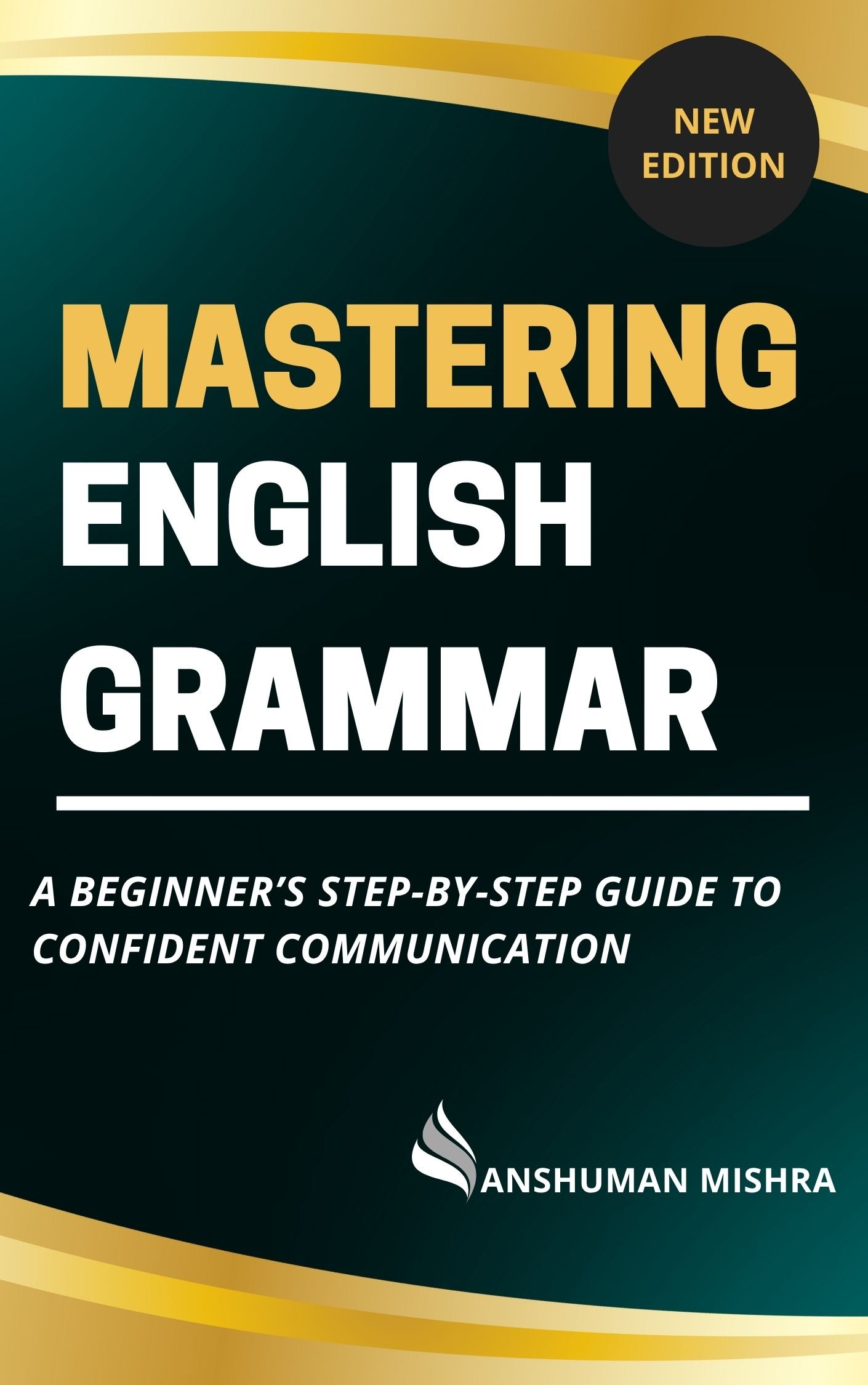
Mastering English Grammar
A Beginner’s Step-by-Step Guide to Confident Communication
English grammar is the foundation of clear communication. Whether you are speaking with others, writing an email, preparing for an examination, attending an interview, creating professional documents, or communicating online, a strong understanding of grammar can make your message clearer and more effective.
Mastering English Grammar: A Beginner’s Step-by-Step Guide to Confident Communication is designed to make English grammar easier to understand, practice, and apply.
Instead of presenting grammar as a collection of complicated rules, this book follows a step-by-step learning approach, beginning with the fundamentals and gradually moving toward sentence construction, tenses, advanced usage, common errors, and practical communication.
A Complete Grammar Foundation for Beginners
Many English learners know individual words but struggle to combine them correctly into sentences.
This book begins with the basics and builds knowledge systematically.
Readers first learn:
- What grammar is
- Why grammar matters
- How English sentences are structured
- What parts of speech are
- How words function within sentences
- How capitalization and punctuation improve communication
The goal is to establish a strong foundation before moving into more complex grammatical concepts.
Section 1 — Foundations of Grammar
The first section introduces the basic building blocks of English.
Readers learn the fundamental sentence pattern:
Subject + Verb + Object
For example, understanding how the different components of a sentence work together provides a foundation for constructing grammatically correct sentences.
The section also introduces:
- Grammar fundamentals
- Sentence structure
- Parts of speech
- Words and sentences
- Capitalization
- Basic punctuation
This makes the book suitable for learners who are starting their English-learning journey.
Section 2 — Parts of Speech
Parts of speech are the core units of English grammar.
The book provides separate chapters for the major categories so that learners can understand not only what each type of word means, but also how it functions within a sentence.
Nouns
Readers learn about:
- Proper nouns
- Common nouns
- Collective nouns
- Abstract nouns
- Countable nouns
- Uncountable nouns
- Singular and plural nouns
- Possessive nouns
The chapter also explains common patterns and mistakes involving nouns.
Pronouns
Pronouns help avoid unnecessary repetition and make communication more natural.
The book covers:
- Personal pronouns
- Reflexive pronouns
- Demonstrative pronouns
- Interrogative pronouns
- Relative pronouns
- Pronoun-antecedent agreement
- Common pronoun mistakes
Verbs
Verbs are essential to sentence construction.
Readers explore:
- Main verbs
- Auxiliary verbs
- Transitive verbs
- Intransitive verbs
- Regular verbs
- Irregular verbs
- Base forms
- Past forms
- Past participles
The book helps learners understand how verbs change and how correct verb forms contribute to accurate sentences.
Adjectives
Adjectives add description and detail to language.
This chapter covers:
- Types of adjectives
- Descriptive adjectives
- Degrees of comparison
- Comparative forms
- Superlative forms
- Order of adjectives
- Adjective versus adverb confusion
Adverbs
Readers learn how adverbs modify verbs, adjectives, and other adverbs.
Topics include:
- Adverbs of manner
- Adverbs of place
- Adverbs of time
- Adverbs of frequency
- Adverbs of degree
- Comparative adverbs
- Superlative adverbs
The chapter also helps learners distinguish between adjectives and adverbs.
Prepositions
Prepositions can be challenging for English learners because their usage often depends on context.
The book explains:
- Prepositions of time
- Prepositions of place
- Prepositions of direction
- Prepositional phrases
- Common preposition errors
Conjunctions and Interjections
Readers learn how conjunctions connect words, phrases, and clauses.
The chapter introduces:
- Coordinating conjunctions
- Subordinating conjunctions
- Correlative conjunctions
- Interjections
- Their role in everyday communication
Section 3 — Tenses and Verb Forms
Tenses are one of the most important areas of English grammar.
They help communicate when an action happens, whether it is continuing, and whether it has been completed.
This book presents the tense system in a structured and learner-friendly manner.
Understanding the Tense System
The book first explains why tenses matter and how tense structures are formed.
Learners are introduced to:
- Positive sentences
- Negative sentences
- Interrogative sentences
- Basic tense patterns
This creates a framework for understanding the individual tenses.
Present Tenses
The book explains the four major present-tense forms:
- Simple Present
- Present Continuous
- Present Perfect
- Present Perfect Continuous
Each form is studied according to its structure and practical usage.
Past Tenses
Readers explore:
- Simple Past
- Past Continuous
- Past Perfect
- Past Perfect Continuous
These concepts help learners describe completed actions, ongoing past activities, and relationships between past events.
Future Tenses
The future section covers:
- Simple Future
- Future Continuous
- Future Perfect
- Future Perfect Continuous
Learners develop the ability to talk about plans, predictions, ongoing future actions, and actions expected to be completed in the future.
Modals and Auxiliary Verbs
Modal verbs are essential for expressing ideas such as possibility, permission, ability, advice, intention, and necessity.
The book explains:
- Can
- Could
- Will
- Would
- Shall
- Should
- May
- Might
- Must
Practical usage charts help learners understand how different modal verbs function in everyday communication.
Section 4 — Sentence Structure and Formation
Once learners understand words and tenses, the next step is constructing accurate sentences.
This section focuses on the architecture of English sentences.
Articles: A, An and The
Articles are small words, but they can create major difficulties for learners.
The book explains:
- Definite articles
- Indefinite articles
- Rules for using a
- Rules for using an
- Uses of the
- Important exceptions
- Common article mistakes
Subject-Verb Agreement
Correct subject-verb agreement is essential for grammatically accurate sentences.
The book covers:
- Singular subjects
- Plural subjects
- Collective nouns
- Indefinite pronouns
- Common agreement errors
Learners develop a better understanding of why the form of the verb changes according to the subject.
Sentence Types
The book introduces both functional and structural sentence types.
Functional Types
- Declarative
- Interrogative
- Imperative
- Exclamatory
Structural Types
- Simple sentences
- Compound sentences
- Complex sentences
Understanding these categories helps learners create greater variety in both speaking and writing.
Negatives and Questions
Forming questions correctly is essential for everyday communication.
This chapter covers:
- Negative sentences
- Yes/No questions
- WH-questions
- Question formation
- Common question errors
Examples help learners understand how statements can be transformed into questions and negative forms.
Active and Passive Voice
The book introduces the relationship between active and passive sentences.
Readers learn:
- What active voice means
- What passive voice means
- Voice transformation principles
- Tense-wise transformations
- Practical usage
This topic is particularly useful for students, academic writing, formal communication, and examinations.
Direct and Indirect Speech
Reported speech allows us to communicate what another person said.
The book explains:
- Direct speech
- Indirect speech
- Pronoun changes
- Tense changes
- Time-expression changes
- Reported questions and statements
The explanations are designed to make this traditionally difficult topic easier for beginners.
Section 5 — Usage, Errors and Practice
Grammar knowledge becomes valuable when learners can identify and correct mistakes.
The final section focuses on practical grammar improvement.
Common Grammar Mistakes
The book highlights frequently confused forms such as:
- Your / You’re
- Its / It’s
- Their / There / They’re
- Common verb errors
- Double negatives
- Misplaced modifiers
- Incorrect sentence structures
Learning common mistakes helps students become more confident editors of their own writing.
Punctuation Power
Correct punctuation can completely change the clarity of a sentence.
The book introduces:
- Full stops
- Commas
- Semicolons
- Colons
- Apostrophes
- Quotation marks
The focus is on practical usage rather than memorizing complicated terminology.
Everyday Grammar in Use
Grammar is not limited to classrooms and examinations.
The book shows how grammatical accuracy applies to:
- Emails
- Conversations
- Messages
- Social media
- Online communication
- Everyday writing
This makes the book especially relevant for modern learners who use English across multiple communication platforms.
Bonus Chapter — Vocabulary Builder
The book concludes with a useful vocabulary-building section.
Learners are introduced to:
- 100 essential beginner-level words
- Synonyms
- Antonyms
- Prefixes
- Suffixes
- Basic word formation
Grammar and vocabulary work together, so strengthening both can improve overall communication.
Why This Book is Useful
Mastering English Grammar is designed around a simple principle:
Learn → Understand → Practice → Apply → Communicate
Instead of overwhelming beginners with advanced terminology, the book gradually develops their understanding.
It can help readers move from:
Individual Words → Correct Sentences → Better Writing → Better Speaking → Confident Communication
Who Should Read This Book?
This book is particularly suitable for:
- School students
- College students
- English beginners
- ESL/EFL learners
- Competitive-exam aspirants
- Job seekers
- Interview candidates
- Teachers and tutors
- Adult learners
- Professionals improving workplace English
- Anyone who wants to strengthen basic English grammar
Key Features
✓ Beginner-friendly explanations
✓ Step-by-step grammar learning
✓ Complete coverage of parts of speech
✓ Detailed tense explanations
✓ Modal and auxiliary verb guidance
✓ Sentence formation techniques
✓ Articles and subject-verb agreement
✓ Active and passive voice
✓ Direct and indirect speech
✓ Question and negative sentence formation
✓ Common grammar mistakes
✓ Punctuation guidance
✓ Everyday English usage
✓ Vocabulary-building bonus chapter
✓ Useful for academic and professional communication
✓ Suitable for self-study and classroom learning
Learning Outcomes
After completing this book, readers can develop the ability to:
- Understand the basic principles of English grammar
- Identify different parts of speech
- Construct grammatically correct sentences
- Use nouns and pronouns accurately
- Apply correct verb forms
- Understand and use English tenses
- Use modal and auxiliary verbs appropriately
- Choose articles correctly
- Apply subject-verb agreement
- Form questions and negative sentences
- Convert active sentences into passive structures
- Understand direct and indirect speech
- Recognize and correct common grammar mistakes
- Use punctuation more effectively
- Improve everyday written communication
- Expand basic English vocabulary
Build Your English with Confidence
Learning grammar does not have to be complicated.
With the right sequence, clear explanations, regular practice, and attention to common mistakes, learners can gradually develop stronger English skills.
Mastering English Grammar: A Beginner’s Step-by-Step Guide to Confident Communication provides a structured foundation for anyone who wants to improve their English from the basics and use it more accurately in education, work, conversation, writing, interviews, and everyday life.
Reviews
There are no reviews yet.