Description
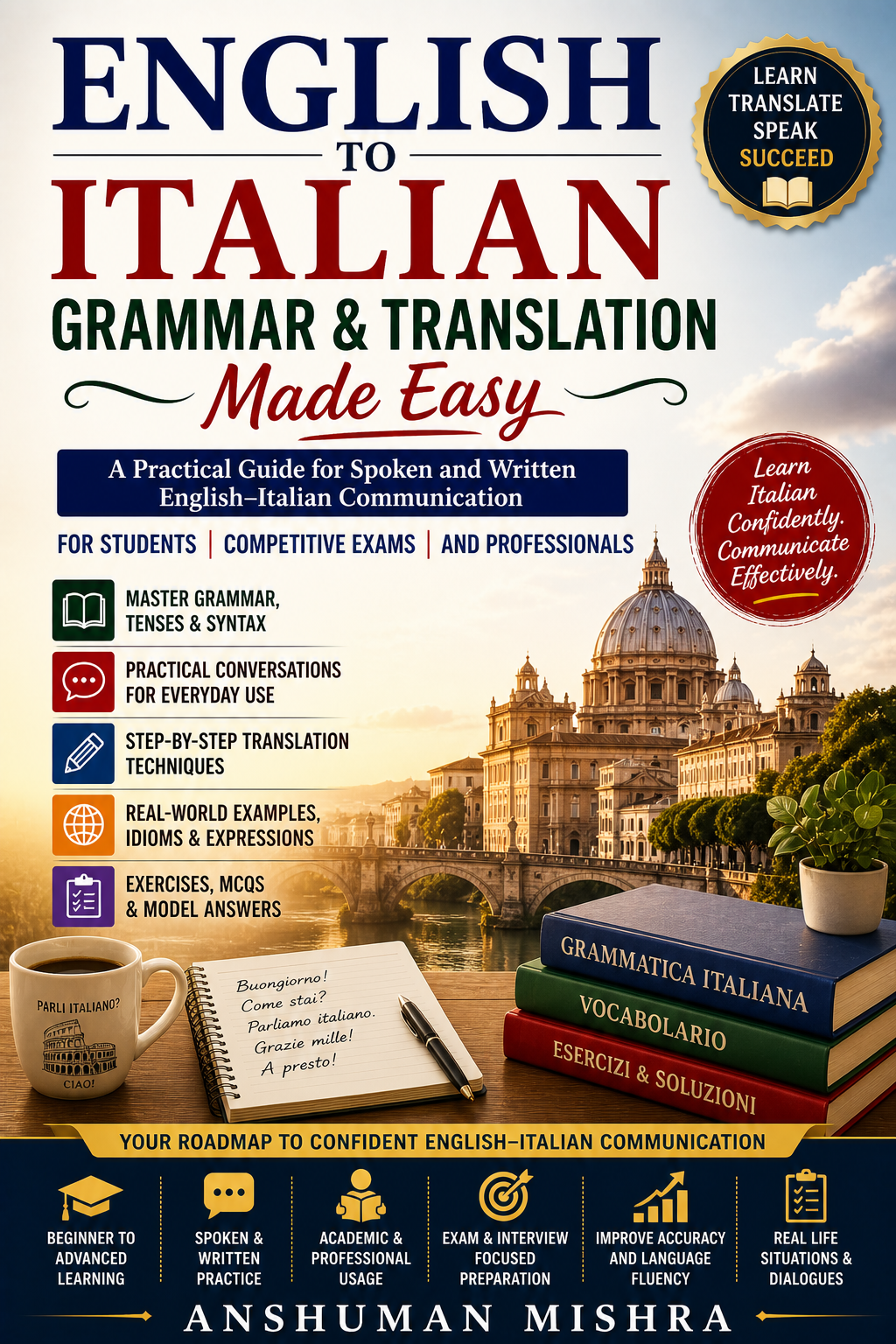
English to Italian Grammar & Translation Made Easy
A Practical Guide for Spoken and Written English–Italian Communication
For Students, Competitive Exams, and Professionals
Learning Italian through English becomes much easier when learners understand not only vocabulary, but also the grammatical structures, sentence patterns, expressions, and cultural conventions that distinguish the two languages.
English to Italian Grammar & Translation Made Easy is a practical and structured guide designed to help learners develop both English-to-Italian translation skills and practical Italian communication abilities.
The book combines comparative grammar, vocabulary development, translation techniques, spoken communication, professional language, academic translation, error correction, and examination practice.
From basic language foundations to complex sentences and professional communication, the book provides a systematic pathway for students, professionals, competitive-exam candidates, and independent learners.
PART I — INTRODUCTION AND LANGUAGE FOUNDATIONS
Chapter 1: Introduction to English–Italian Language Learning
The book begins by introducing the relationship between English and Italian and explaining why Italian is valuable for communication, education, travel, culture, and professional interaction.
This chapter explores:
- Importance of Italian in global communication
- Applications of English-to-Italian translation
- Structural differences between English and Italian
- Spoken versus written Italian
- Common learning challenges
- Effective ways to use the book
Readers gain a clear foundation before moving into detailed grammar and translation practice.
PART II — CORE ENGLISH GRAMMAR FOR ITALIAN TRANSLATION
Chapter 2: Parts of Speech — English to Italian Perspective
A strong understanding of grammar is essential for accurate translation.
This chapter covers:
- Nouns and grammatical gender
- Definite articles
- Indefinite articles
- Partitive articles
- Subject pronouns
- Object pronouns
- Reflexive pronouns
- Possessive pronouns
- Adjectives
- Agreement rules
- Adverbs
- Prepositions
Special attention is given to differences between English and Italian structures that frequently cause problems for learners.
Chapter 3: Verbs and Tense System
Italian verbs are central to both translation and communication.
This chapter introduces:
- Regular verbs
- Irregular verbs
- Presente
- Passato prossimo
- Imperfetto
- Future tense
- Conditional forms
- Imperative forms
Learners develop an understanding of how Italian expresses time, action, possibility, commands, and hypothetical situations.
PART III — SENTENCE STRUCTURE AND TRANSFORMATION
Chapter 4: Sentence Formation and Syntax
Translating individual words is not enough to produce natural Italian.
This chapter examines:
- English word order
- Italian word order
- Affirmative sentences
- Negative sentences
- Interrogative sentences
- Subject-pronoun usage
- Subject omission
- Question formation
Learners discover how sentence structure can change between English and Italian while preserving the same meaning.
Chapter 5: Voice, Narration, and Transformation
This chapter develops more advanced sentence-transformation skills.
Topics include:
- Active voice
- Passive voice
- Causative structures
- Direct speech
- Indirect speech
- Reported speech
- Italian narration patterns
The chapter emphasizes preserving meaning while adapting the structure naturally for Italian.
PART IV — FUNCTIONAL GRAMMAR AND COMPLEX STRUCTURES
Chapter 6: Modal Verbs and Functional Expressions
Many everyday English expressions require different grammatical constructions in Italian.
This chapter covers expressions for:
- Ability
- Possibility
- Permission
- Obligation
- Necessity
- Suggestions
- Requests
- Polite communication
- Formal communication
The emphasis is on translating the intended function and meaning, rather than simply replacing English words with Italian equivalents.
Chapter 7: Conditionals and Complex Sentences
Complex sentences require careful attention to relationships between ideas.
This chapter explores:
- Conditional sentence types
- If-clauses
- Italian conditional structures
- Complex sentence formation
- Translation strategies
- Context-based interpretation
Learners gain confidence in translating longer and more sophisticated sentences.
PART V — VOCABULARY AND USAGE DEVELOPMENT
Chapter 8: Vocabulary Building for Translation
Vocabulary is one of the foundations of effective communication.
This chapter develops vocabulary in areas such as:
- Daily-use words
- Academic vocabulary
- Professional terminology
- Idioms
- Phrases
- Proverbs
- False friends
- Commonly confused words
- Synonyms
- Antonyms
- Collocations
The focus is on learning vocabulary through context and practical usage.
PART VI — SPOKEN ENGLISH TO ITALIAN COMMUNICATION
Chapter 9: Daily Conversation and Spoken Practice
Translation skills become more useful when learners can apply them to real conversations.
This chapter includes practical language for:
- Greetings
- Introductions
- Social conversations
- Family conversations
- Expressing opinions
- Expressing emotions
- Polite requests
- Responses
The chapter helps learners connect grammatical knowledge with everyday spoken communication.
Chapter 10: Travel, Public, and Service Communication
Italian is particularly useful in travel and tourism contexts.
This chapter covers:
- Transportation
- Travel conversations
- Hotels
- Restaurants
- Tourism
- Shopping
- Markets
- Public services
- Emergency communication
Practical situations help learners develop confidence in using Italian outside the classroom.
PART VII — PROFESSIONAL AND ACADEMIC COMMUNICATION
Chapter 11: Office and Workplace Communication
Professional communication requires appropriate vocabulary, tone, and formality.
This chapter examines:
- Formal and informal language
- Emails
- Letters
- Meetings
- Job interviews
- Presentations
- Telephone conversations
- Online communication
Learners gain useful English-to-Italian communication patterns for workplace environments.
Chapter 12: Academic, Technical, and Professional Translation
Translation skills can be applied across many professional and academic fields.
This chapter covers:
- Essays
- Reports
- Scientific texts
- Technical texts
- Business communication
- Basic legal terminology
- Professional writing
- Common translation errors
The chapter emphasizes clarity, accuracy, appropriate terminology, and context.
PART VIII — TRANSLATION STRATEGIES AND ACCURACY
Chapter 13: Principles of English–Italian Translation
Effective translation requires more than grammatical knowledge.
This chapter explores:
- Literal translation
- Free translation
- Contextual translation
- Functional translation
- Cultural adaptation
- Idiomatic usage
- Word-for-word translation problems
One of the key principles of the book is:
Translate the meaning, not merely the individual words.
A natural Italian translation may require a different sentence structure from the original English sentence.
Chapter 14: Common Errors and Language Refinement
Recognizing common mistakes is an essential part of becoming a better translator.
This chapter focuses on:
- Grammar errors
- Agreement errors
- Tense mistakes
- Preposition errors
- Article mistakes
- Pronoun errors
- Fluency problems
- Accuracy improvement
Learners are encouraged to identify why a translation is incorrect and how it can be improved.
PART IX — PRACTICE, EVALUATION, AND EXAM READINESS
Chapter 15: Practice, Self-Assessment, and Competitive Preparation
The final chapter brings together the skills developed throughout the book.
It provides practice in:
- Sentence-level translation
- Paragraph translation
- Dialogue translation
- Multiple-choice questions
- Error detection
- Revision tests
- Interview preparation
- Viva-voce practice
- Examination exercises
- Model translations
- Answer keys
This chapter helps learners evaluate their progress and prepare for practical or academic assessments.
KEY TOPICS COVERED
- English to Italian Translation
- Italian Grammar
- English–Italian Grammar
- Italian Vocabulary
- Italian Pronunciation and Usage
- Italian Nouns
- Italian Gender
- Italian Articles
- Italian Pronouns
- Italian Adjectives
- Italian Adverbs
- Italian Prepositions
- Italian Verbs
- Italian Conjugation
- Presente
- Passato Prossimo
- Imperfetto
- Italian Future Tense
- Italian Conditional
- Italian Imperative
- Sentence Formation
- Italian Sentence Structure
- Active and Passive Voice
- Reported Speech
- Italian Modal Expressions
- Italian Conditionals
- Italian Idioms
- Italian False Friends
- Spoken Italian
- Business Italian
- Academic Italian
- Translation Practice
- Italian Exam Preparation
A PRACTICAL APPROACH TO ENGLISH–ITALIAN TRANSLATION
Translation is not simply the process of substituting English words with Italian words.
A successful translation requires:
Meaning + Grammar + Context + Structure + Culture + Register
For example, a sentence may be grammatically correct when translated word-for-word but still sound unnatural in Italian.
This book therefore encourages learners to understand the relationship between the two languages and develop the ability to express the same idea naturally.
FROM GRAMMAR TO REAL-WORLD COMMUNICATION
The book follows a progressive learning path:
Language Foundations → Grammar → Verbs → Sentence Structure → Complex Sentences → Vocabulary → Conversation → Travel → Workplace Communication → Academic Translation → Translation Strategies → Error Correction → Exam Practice
This structure allows learners to build skills gradually.
Beginners can start with fundamental concepts, while intermediate and advanced learners can focus on translation accuracy, complex structures, professional communication, and examination preparation.
ENGLISH TO ITALIAN TRANSLATION FOR STUDENTS
Students can use this book to strengthen:
- Grammar
- Vocabulary
- Translation
- Sentence construction
- Reading comprehension
- Written communication
- Examination skills
The practice-oriented structure makes it suitable for classroom learning as well as independent study.
ENGLISH TO ITALIAN FOR PROFESSIONALS
Professionals increasingly interact with international clients, colleagues, organizations, and institutions.
The book introduces useful language for:
- Emails
- Meetings
- Presentations
- Interviews
- Telephone communication
- Online meetings
- Business correspondence
- Professional documents
This makes the book useful for learners who need Italian for professional communication.
SPOKEN ITALIAN FOR EVERYDAY SITUATIONS
Language learning becomes more meaningful when it can be applied to real-life situations.
The book therefore includes practical contexts such as:
Greetings → Family → Social Conversations → Travel → Hotels → Restaurants → Shopping → Public Services → Workplace → Professional Communication
This approach helps learners connect grammar with actual communication.
PREPARATION FOR COMPETITIVE EXAMS
The final section of the book provides an examination-oriented approach through:
- Translation exercises
- Grammar questions
- MCQs
- Error detection
- Sentence transformation
- Revision tests
- Model answers
- Interview practice
- Viva-voce preparation
Learners can use these exercises to evaluate their understanding and identify areas requiring further practice.
WHO SHOULD READ THIS BOOK?
English to Italian Grammar & Translation Made Easy is suitable for:
- School and college students
- University students
- Italian language learners
- Translation students
- Competitive-exam candidates
- Professionals
- Travelers
- Language teachers
- Self-learners
- Aspiring translators
- International communication learners
WHY THIS BOOK IS USEFUL
This book brings together several areas that are often studied separately:
Grammar + Translation + Vocabulary + Spoken Communication + Professional Language + Exam Practice
Instead of learning isolated grammar rules, readers are encouraged to understand how those rules function in real translation and communication.
The result is a practical learning framework that moves from basic language knowledge to confident English–Italian communication.
Master Grammar. Translate Naturally. Communicate Confidently.
Learning Italian through English is a journey from understanding structures to expressing ideas naturally.
English to Italian Grammar & Translation Made Easy provides a systematic pathway for developing that ability through comparative grammar, practical examples, vocabulary, communication exercises, translation strategies, and exam-oriented practice.
Whether your goal is academic learning, professional communication, travel, translation, or competitive examination preparation, this book provides a structured foundation for improving your English-to-Italian skills.
Learn the structure. Understand the context. Translate naturally. Speak with confidence.

Reviews
There are no reviews yet.