Description
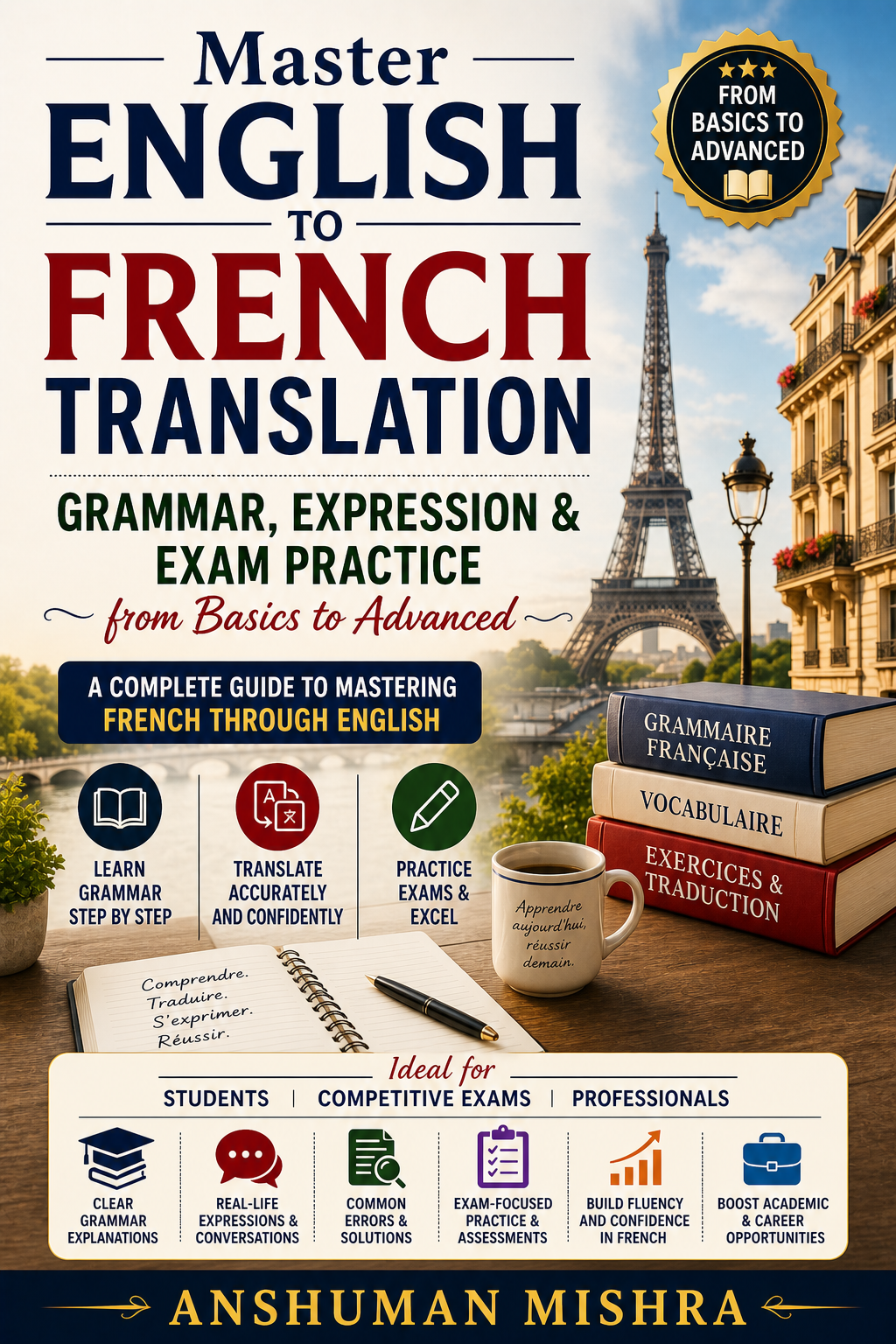
Master English to French Translation
Grammar, Expression & Exam Practice from Basics to Advanced
Learning to translate accurately from English into French requires much more than replacing English words with French words. A good translation must preserve meaning, grammar, context, tone, style, and cultural expression.
Master English to French Translation: Grammar, Expression & Exam Practice from Basics to Advanced is designed as a structured learning resource for students, language learners, aspiring translators, teachers, professionals, and competitive-exam candidates who want to develop practical English-to-French translation skills.
The book combines comparative grammar, vocabulary development, sentence transformation, translation principles, practical communication, error correction, and examination-oriented exercises into one comprehensive framework.
Chapter 1: Introduction to English–French Language and Translation
The book begins with a foundation in both languages.
This chapter explores:
- Structure of English
- Structure of French
- Similarities between English and French
- Grammatical differences
- Importance of grammar in translation
- Common learner difficulties
- Academic and professional applications of translation
Understanding how the two languages work provides the foundation for producing accurate and natural French translations.
Chapter 2: Alphabet, Pronunciation, and Phonetics
Pronunciation can significantly affect language learning and communication.
This chapter covers:
- English alphabet and pronunciation
- French alphabet
- French pronunciation
- Accents and diacritical marks
- Silent letters
- Liaison
- English–French sound differences
- Pronunciation-related translation mistakes
Learners develop awareness of important features that distinguish written and spoken French from English.
Chapter 3: Parts of Speech — A Comparative Approach
Grammar is at the heart of accurate translation.
This chapter provides a comparative study of:
- Nouns
- French grammatical gender
- Singular and plural forms
- Definite articles
- Indefinite articles
- Partitive articles
- Pronouns
- Possessive and reflexive forms
- Adjectives
- Adverbs
- Prepositions
Special attention is given to areas where English and French differ significantly.
Chapter 4: Sentence Structure and Word Order
Correct vocabulary alone does not guarantee a correct translation.
This chapter explores:
- Basic English sentence structures
- Basic French sentence structures
- Subject–verb–object patterns
- French inversion
- Emphasis
- Negative constructions
- Questions
- Word-order differences
Learners understand how English sentences can be reorganized to produce grammatically appropriate French expressions.
Chapter 5: Verbs and Conjugation System
French verbs can present significant challenges for English-speaking learners.
This chapter examines:
- French verb classification
- Regular verbs
- Conjugation patterns
- Irregular verbs
- Common exceptions
- Être and avoir
- Infinitives
- Reflexive verbs
- Agreement rules
- Verb placement
The chapter provides a foundation for understanding French verb structures required for effective translation.
Chapter 6: Present Tense and Its Translation
The present tense does not always correspond to identical structures in English and French.
This chapter covers:
- English simple present
- French présent
- Habits
- General truths
- Ongoing actions
- Professional communication
- Common translation errors
- Practice sentences
Examples and exercises help learners understand how present-time meaning is expressed naturally in French.
Chapter 7: Past Tenses in English–French Translation
Past-time expressions are among the most important areas of English–French translation.
This chapter introduces:
- English simple past
- Passé composé
- Imparfait
- Plus-que-parfait
- Choosing appropriate past forms
- Narrative translation
- Practice exercises
Learners develop an understanding of how French distinguishes completed actions, background descriptions, ongoing situations, and earlier past events.
Chapter 8: Future and Conditional Tenses
This chapter focuses on expressing future events, possibilities, conditions, and hypothetical situations.
Topics include:
- English simple future
- Futur simple
- Futur proche
- Conditional expressions
- Hypothetical situations
- Polite requests
- Probability
- Future-oriented translation strategies
Practical exercises reinforce the differences between English and French expressions.
Chapter 9: Voice and Sentence Transformation
Translation often requires changing sentence structures while preserving meaning.
This chapter explores:
- Active voice
- Passive voice
- French impersonal constructions
- Emphasis
- Cleft structures
- Sentence transformation
- Common transformation errors
The focus is on creating natural French rather than mechanically copying English sentence structures.
Chapter 10: Modal Verbs and Functional Expressions
English modal verbs often require different grammatical constructions in French.
This chapter examines expressions related to:
- Ability
- Possibility
- Permission
- Suggestion
- Obligation
- Necessity
- Probability
- Formal communication
- Informal communication
- Academic and professional contexts
Learners develop strategies for translating the intended function rather than translating modal verbs word-for-word.
Chapter 11: Clauses and Complex Structures
Advanced translation requires an understanding of relationships between clauses.
This chapter covers:
- Independent clauses
- Dependent clauses
- Relative clauses
- Relative pronouns
- Conditional clauses
- Reported speech
- Subjunctive mood
- Clause transformation
The chapter helps learners progress from simple sentences to more sophisticated English–French structures.
Chapter 12: Principles and Methods of Translation
This chapter focuses directly on the art and methodology of translation.
It examines:
- Literal translation
- Free translation
- Context-based translation
- Cultural adaptation
- Equivalence
- Register
- Tone
- Style
- Accuracy
- Clarity
A major principle emphasized throughout the book is:
Good translation communicates meaning naturally rather than simply replacing individual words.
Chapter 13: Common Translation Errors and Solutions
Identifying mistakes is an important part of developing translation skills.
This chapter addresses:
- False friends and faux amis
- Gender mistakes
- Agreement errors
- Tense mismatches
- Article confusion
- Preposition errors
- Sentence structure problems
- Error correction techniques
Understanding common mistakes helps learners improve accuracy and confidence.
Chapter 14: Vocabulary Development for Translation
A strong vocabulary is essential for effective translation.
This chapter develops vocabulary in several areas:
- Daily-use words
- Academic vocabulary
- Professional terminology
- Technical terms
- Idioms
- Expressions
- Phrasal verbs
- French equivalents
- Context-based vocabulary
The emphasis is on learning words within meaningful contexts rather than memorizing isolated vocabulary lists.
Chapter 15: Translation for Daily Communication
Translation skills become particularly useful when learners can apply them to everyday situations.
This chapter includes practical language for:
- Greetings
- Introductions
- Family conversations
- Social situations
- Travel
- Public places
- Shopping
- Services
- Requests
- Responses
- Polite communication
These examples help bridge the gap between classroom grammar and real-world communication.
Chapter 16: Academic and Competitive Exam Translation
The final chapter is designed for learners preparing for academic assessments and competitive examinations.
It covers:
- Grammar-based translation questions
- Sentence transformation
- Translation-based error identification
- Model answers
- Explanations
- Practice exercises
- Exam strategies
The chapter helps learners approach translation questions systematically and improve both accuracy and speed.
Key Topics Covered
- English to French Translation
- French Grammar
- English Grammar
- French Pronunciation
- French Phonetics
- French Alphabet
- French Articles
- French Gender
- French Pronouns
- French Adjectives
- French Prepositions
- French Verbs
- French Conjugation
- French Tenses
- Passé Composé
- Imparfait
- Plus-que-Parfait
- Futur Simple
- Futur Proche
- French Conditional
- French Subjunctive
- Sentence Transformation
- Translation Techniques
- Translation Errors
- French Vocabulary
- French Idioms
- Daily French Communication
- Academic Translation
- Competitive Exam Translation
- English–French Language Learning
A Practical Approach to Translation
One of the central principles of this book is that translation is not simply a word-for-word conversion.
Effective translation requires understanding:
Meaning + Grammar + Context + Culture + Register + Style
A sentence that is grammatically correct may still sound unnatural if it follows English sentence patterns too closely.
This book therefore encourages learners to compare English and French structures and develop the ability to express the same meaning naturally in French.
From Grammar to Practical Translation
The learning journey progresses systematically:
Language Foundations → Pronunciation → Grammar → Sentence Structure → Verbs → Tenses → Complex Clauses → Translation Principles → Error Correction → Vocabulary → Communication → Exam Practice
This structure makes the book useful for learners at different stages.
Beginners can establish a strong foundation, while more advanced learners can focus on translation techniques, complex structures, vocabulary, and examination practice.
Who Should Read This Book?
Master English to French Translation is suitable for:
- Students learning French
- English-speaking French learners
- French language students
- Translation students
- Aspiring translators
- Language teachers
- Competitive-exam candidates
- Academic learners
- Professionals working with French
- Travelers and international communication learners
- Self-learners
- Anyone interested in English–French translation
Why This Book Is Useful
Learning French becomes easier when learners understand how it differs from English.
This book provides a comparative framework that helps readers identify:
- What remains similar
- What changes
- Why a direct translation may not work
- How French grammar changes sentence meaning
- How context affects word choice
- How to avoid common translation mistakes
The result is a practical learning experience that connects grammar knowledge with actual translation practice.
Master the Language of Meaning
Translation is more than converting sentences from one language to another.
It is the process of carrying an idea, message, intention, and tone across linguistic boundaries.
Master English to French Translation: Grammar, Expression & Exam Practice from Basics to Advanced provides a structured pathway for developing this ability—from the fundamentals of grammar and pronunciation to advanced sentence structures, practical communication, and exam-oriented translation.
Learn the grammar. Understand the context. Translate naturally. Communicate confidently.
Reviews
There are no reviews yet.