Description
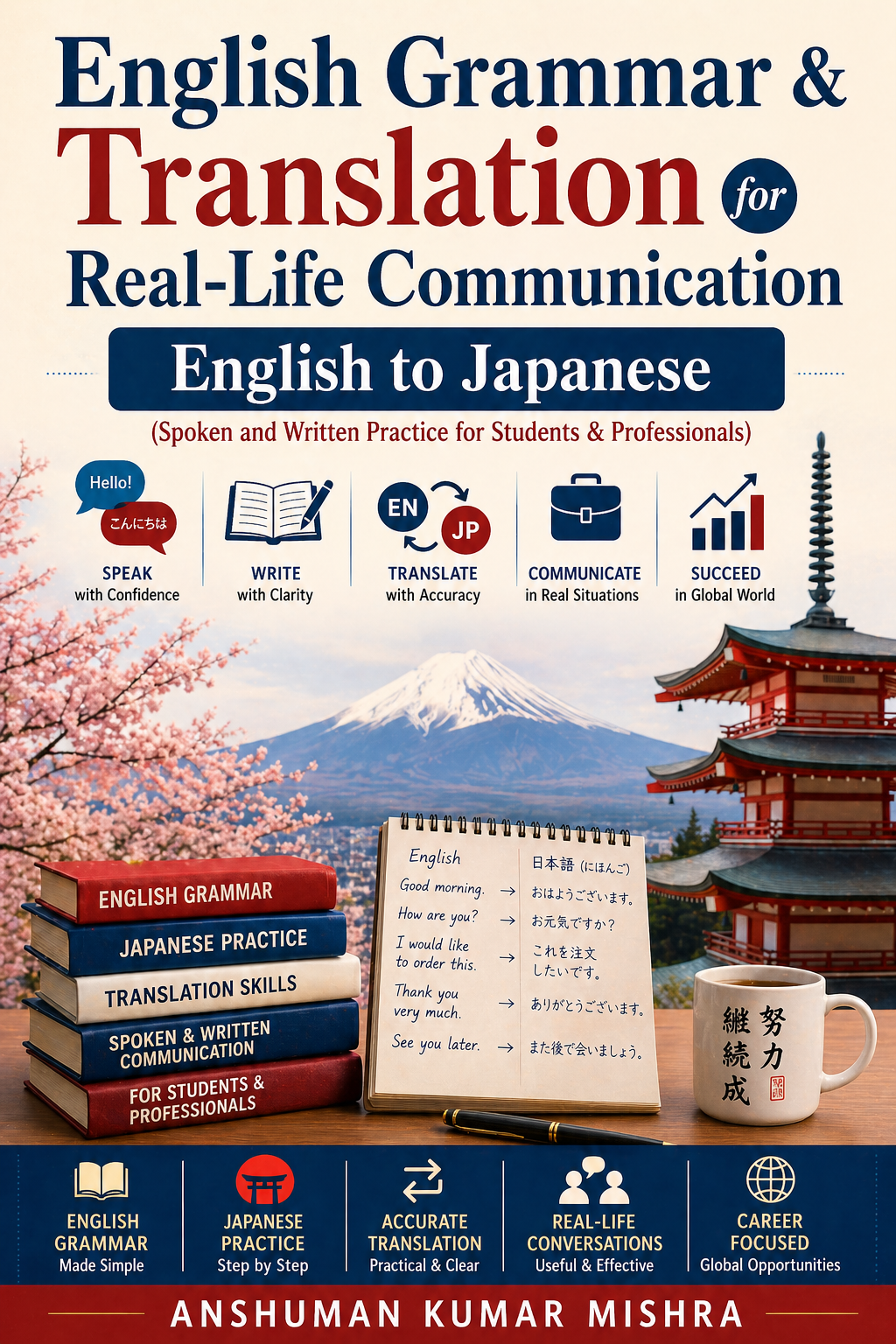
English Grammar & Translation for Real-Life Communication
English to Japanese: Spoken and Written Practice for Students & Professionals
Book Description
In an increasingly interconnected world, the ability to communicate across languages has become an important academic, professional, and cultural skill. English serves as a major language of international communication, while Japanese plays an important role in business, technology, engineering, education, tourism, research, manufacturing, entertainment, and global collaboration.
English Grammar & Translation for Real-Life Communication: English to Japanese – Spoken and Written Practice for Students & Professionals is a practical and structured guide designed to help learners understand how English grammar, sentence structure, meaning, tone, and context can be effectively expressed in Japanese.
Rather than treating translation as simple word replacement, this book presents translation as a process of transferring meaning, intention, tone, context, and communicative purpose from one language to another. It combines English grammar, Japanese language structures, translation techniques, spoken communication, written practice, cultural awareness, and professional usage in one comprehensive learning framework.
Purpose and Vision of the Book
The primary purpose of this book is to bridge the gap between English grammar knowledge and practical English-to-Japanese communication.
Learners often understand individual English grammar rules but face difficulties when attempting to express the same ideas naturally in Japanese. Differences in sentence order, particles, tense, subject omission, politeness, honorifics, context, and cultural expectations can make direct translation challenging.
This book addresses these difficulties through a step-by-step approach that:
- Explains important English grammar concepts clearly
- Introduces their Japanese equivalents and functional patterns
- Compares English and Japanese sentence structures
- Demonstrates natural translation rather than word-for-word substitution
- Provides spoken and written communication examples
- Identifies common translation and grammar mistakes
- Develops practical communication confidence
The emphasis throughout is on accuracy, natural expression, cultural appropriateness, and real-world usability.
What the Book Covers
The book begins with the foundations of English–Japanese communication and gradually progresses toward professional translation and communication.
1. Foundations of English–Japanese Communication
The opening chapters introduce learners to the relationship between English and Japanese. Readers become familiar with Japanese writing systems, pronunciation, sentence patterns, politeness levels, and the fundamental differences between the two languages.
Particular attention is given to Hiragana, Katakana, Kanji, sentence endings, formal and informal speech, and honorific expressions.
2. English Grammar for Translation
The book then develops a strong foundation in English grammar, covering nouns, pronouns, verbs, adjectives, adverbs, particles, tense, aspect, and sentence construction.
Instead of studying grammar in isolation, learners are shown how English grammatical concepts can be interpreted and naturally expressed within Japanese structures.
3. Sentence Structure and Translation Techniques
One of the central sections compares English and Japanese sentence organization.
Readers explore:
- Subject–Verb–Object and Subject–Object–Verb patterns
- Topic and subject markers
- Particles
- Word-order differences
- Questions and negative sentences
- Articles and their Japanese equivalents
- Active and passive constructions
- Conditional expressions
- Causative structures
These comparisons help learners understand why literal translation frequently produces unnatural Japanese.
Real-Life Spoken Communication
A major strength of the book is its focus on practical communication.
Learners practice English-to-Japanese expressions for:
- Greetings and introductions
- Asking questions
- Making requests
- Giving suggestions
- Expressing opinions
- Accepting and refusing politely
- Apologizing
- Travel and tourism
- Shopping and restaurants
- Telephone conversations
- Online communication
- Everyday social situations
The inclusion of dialogues and role-play activities encourages learners to move beyond passive reading toward active communication practice.
Professional and Workplace Communication
Modern language learning must prepare students for professional environments. Therefore, the book includes dedicated material on workplace communication.
Topics include:
- Office vocabulary
- Professional expressions
- Emails
- Notices and announcements
- Reports
- Meetings
- Presentations
- Interviews
- Business etiquette
- Polite and honorific Japanese
- Common workplace translation mistakes
These sections are particularly useful for professionals working with Japanese organizations, clients, colleagues, or international teams.
Cultural Context and Communication
Language cannot be separated completely from culture.
Japanese communication often places considerable importance on context, relationships, politeness, social roles, indirect expression, and appropriate levels of formality. The book therefore explains how cultural factors can influence the meaning and interpretation of expressions.
Readers learn about:
- Formal and informal communication
- Honorific language
- Social hierarchy
- Indirect communication
- Context-dependent meaning
- Silence and implied meaning
- Cross-cultural communication
- Appropriate professional behavior
The objective is not simply to produce grammatically correct Japanese, but to encourage appropriate and respectful communication.
Common Errors and Language Refinement
A dedicated section focuses on the mistakes that learners frequently make while translating from English into Japanese.
These include:
- Word-for-word translation
- Incorrect particle selection
- Inappropriate sentence endings
- Incorrect levels of politeness
- Overly formal expressions
- Under-formal expressions
- Directly transferring English sentence patterns into Japanese
- Misinterpreting context
By identifying these problems, learners can gradually develop more natural and confident communication.
Practice, Evaluation, and Self-Assessment
The book is designed as a learning resource rather than simply a reference text.
It includes opportunities for:
- Multiple-choice questions
- Fill-in-the-blank exercises
- Grammar correction
- Translation assignments
- Spoken practice
- Dialogue practice
- Sentence construction
- Academic writing
- Model answers and explanations
These activities allow learners to evaluate their progress and identify areas that require further practice.
Academic and Career Preparation
The book also considers the growing professional demand for multilingual communication.
It provides guidance for learners interested in careers such as:
- Translation
- Interpretation
- Japanese-language support
- Corporate communication
- International business
- Education and training
- Tourism
- Localization
- Freelance translation
- Cross-cultural communication
It also discusses the skills required to develop a professional career in translation and interpretation, including language accuracy, cultural awareness, research ability, technology skills, and continuous learning.
Who This Book Is For
This book is suitable for a wide range of learners, including:
Students
- Undergraduate and postgraduate students
- English and Japanese language learners
- Linguistics and translation students
- International relations and Asian studies students
- Students preparing for academic examinations
- Learners preparing for study-abroad opportunities
Professionals
- IT professionals
- Engineers
- Researchers
- Managers
- Consultants
- Business executives
- Employees working with Japanese organizations or clients
Language Learners and Translators
- Aspiring translators and interpreters
- Freelance language professionals
- Localization professionals
- English teachers
- Japanese-language trainers
- Independent learners
The book follows a progressive structure, making it useful for beginners while also providing valuable material for intermediate and advanced learners.
Key Features
Grammar + Translation
English grammar is connected directly with practical Japanese translation patterns.
Spoken + Written Practice
The book develops both conversational and written communication skills.
Real-Life Examples
Examples are based on everyday, academic, travel, social, and professional situations.
Cultural Awareness
Learners are introduced to the importance of context, politeness, hierarchy, and communication style.
Error-Based Learning
Common mistakes are identified and explained so that learners can avoid them.
Career-Oriented Learning
The final sections connect language learning with translation, interpretation, workplace communication, freelancing, and professional development.
Why This Book Matters
Learning a language is more than memorizing vocabulary and grammar rules. Effective communication requires understanding how language functions in real situations.
A sentence that is grammatically correct in English may require a completely different structure in Japanese. Similarly, an expression that sounds natural in one language may sound too direct, too formal, or inappropriate when translated literally into another.
This book addresses that important gap.
Its central philosophy can be summarized simply:
Translate the meaning, not merely the words.
By combining grammar, translation, communication, cultural understanding, and practical exercises, English Grammar & Translation for Real-Life Communication provides learners with a structured pathway toward more accurate, natural, and confident English-to-Japanese communication.
Final Thoughts
English and Japanese represent two distinct linguistic systems, but effective communication between them becomes possible when learners understand not only vocabulary and grammar, but also structure, context, culture, intention, and tone.
This book is designed to make that journey systematic and practical.
Whether the goal is to communicate with Japanese colleagues, study Japanese, prepare for academic examinations, work in international organizations, pursue translation as a career, or simply develop stronger cross-cultural communication skills, this book provides a practical foundation for continued learning.
English Grammar & Translation for Real-Life Communication: English to Japanese – Spoken and Written Practice for Students & Professionals is ultimately a bridge between two languages—and between the people, ideas, and cultures that use them.


Reviews
There are no reviews yet.