Description
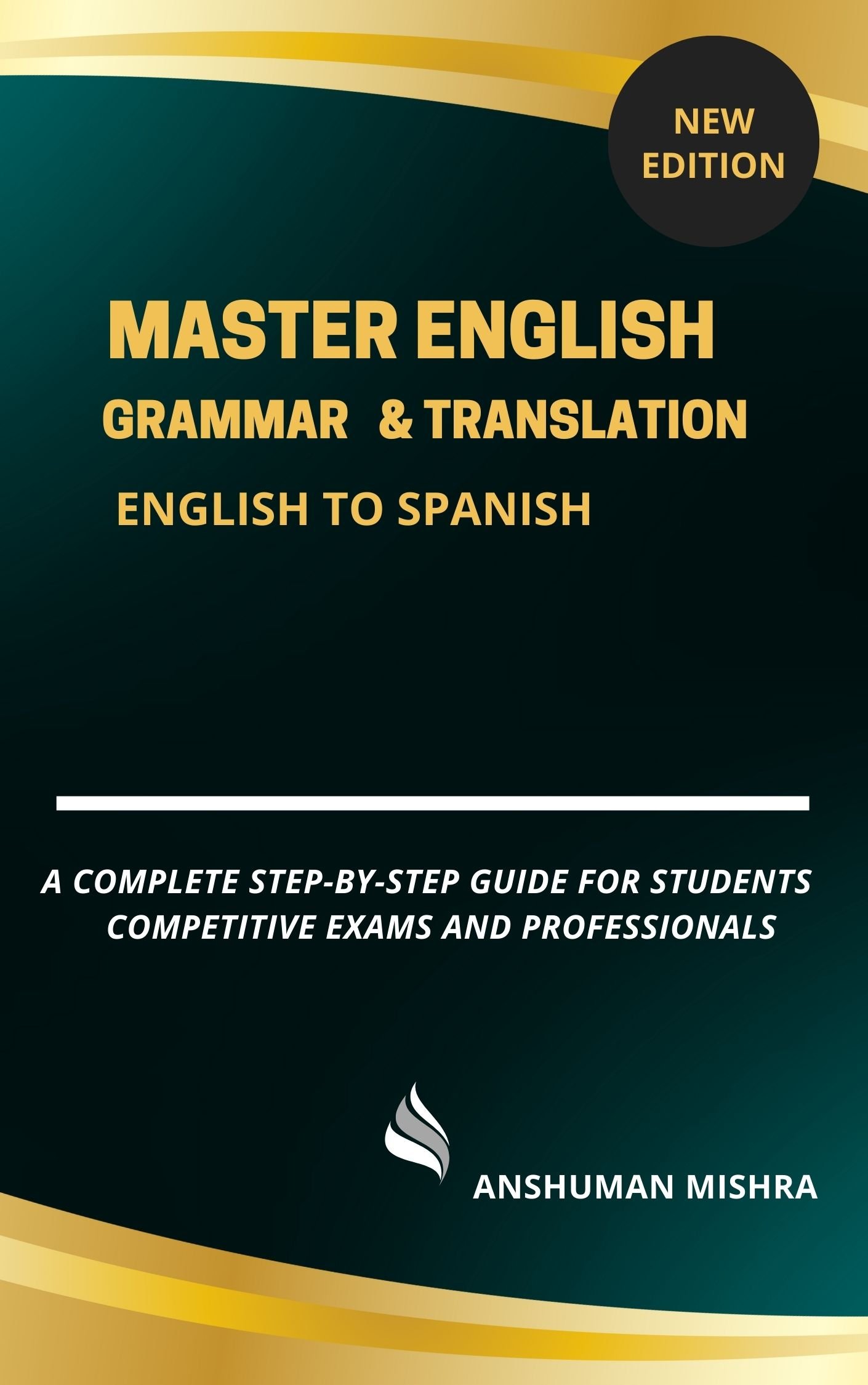
Master English Grammar & Translation: English to Spanish
A Complete Step-by-Step Guide for Students, Competitive Exams, and Professionals
Author: Anshuman Mishra
In an increasingly connected world, the ability to communicate across languages has become an important academic and professional skill. English continues to play a major role in international education, technology, science, business, and professional communication, while Spanish is one of the world’s most widely spoken languages and has significant importance across Europe, Latin America, North America, tourism, education, business, and international communication.
Master English Grammar & Translation: English to Spanish brings these two language skills together through a structured approach to English grammar and English-to-Spanish translation.
The book is designed to help learners understand English grammar first, compare it with Spanish structures, and then apply that knowledge to practical translation.
Grammar + Translation in One Complete Guide
Learning a language involves more than memorizing vocabulary.
A learner may know hundreds of English and Spanish words but still struggle to create a grammatically correct translation.
Why?
Because languages differ in:
- Word order
- Verb structures
- Gender
- Number
- Articles
- Pronoun placement
- Tense usage
- Agreement
- Sentence construction
- Contextual meaning
This book focuses on these differences and helps learners understand how English structures can be transformed into natural Spanish expressions.
Its central learning principle is:
Understand the Grammar → Compare the Structures → Translate the Meaning → Practice the Pattern
Why English-to-Spanish Translation Requires Grammar
Literal word-for-word translation can often produce unnatural or incorrect sentences.
For example, English and Spanish may express the same idea using different grammatical structures.
A successful translator therefore needs to understand more than vocabulary.
The learner must consider:
Meaning + Grammar + Context + Word Order + Agreement + Verb Form
The book develops these skills progressively, beginning with fundamental concepts and moving toward more advanced translation structures.
18 Structured Chapters for Progressive Learning
The book is organized into 18 chapters, creating a systematic learning path from foundational grammar to practical translation and comprehensive revision.
Chapter 1 — Introduction to English–Spanish Grammar and Translation
The book begins by introducing the relationship between English grammar and Spanish translation.
Readers explore:
- The importance of grammar in translation
- Structural differences between English and Spanish
- Word-order transformation
- Tense and agreement
- Gender in Spanish
- Literal versus contextual translation
- Common learner mistakes
This chapter establishes the foundation for everything that follows.
Chapter 2 — English Sounds, Pronunciation and Translation Accuracy
Translation is closely connected with pronunciation and communication.
This chapter examines:
- English pronunciation
- Spanish pronunciation
- Sound-system differences
- Stress
- Intonation
- Pronunciation and meaning
- Practice-based translation
The goal is to help learners recognize how spoken language can influence communication and translation accuracy.
Chapter 3 — Parts of Speech and Spanish Equivalents
Parts of speech form the basic building blocks of grammar.
The book introduces:
- Nouns
- Pronouns
- Verbs
- Adjectives
- Adverbs
- Articles
- Functional words
Learners compare their functions in English and Spanish and understand how these grammatical categories behave during translation.
Chapter 4 — Nouns and Articles
Nouns and articles present several important differences between English and Spanish.
The chapter covers:
- Types of nouns
- Singular and plural forms
- English articles
- Spanish articles
- Gender in Spanish
- Agreement
- Translation practice
Special attention is given to situations where English and Spanish do not use articles in exactly the same way.
Chapter 5 — Pronouns and Possessive Structures
Pronouns are another area where English and Spanish can differ significantly.
Readers study:
- Personal pronouns
- Subject pronouns
- Object pronouns
- Possessive structures
- Reflexive pronouns
- Pronoun placement
- Common translation mistakes
The chapter helps learners understand how context and sentence structure influence pronoun usage.
Chapter 6 — Adjectives and Degrees of Comparison
Adjectives often require special attention when translating into Spanish because of differences in position, gender, and number agreement.
Topics include:
- Types of adjectives
- Adjective placement
- Gender agreement
- Number agreement
- Comparative forms
- Superlative forms
- Translation exercises
This section helps learners avoid common adjective-related translation errors.
Chapter 7 — Verbs and Verb Classification
Verbs are at the heart of sentence construction.
The chapter explains:
- Main verbs
- Auxiliary verbs
- Regular verbs
- Irregular verbs
- Transitive verbs
- Intransitive verbs
- Verb agreement
- Verb phrases
Readers learn how to identify the function of an English verb and select an appropriate Spanish structure.
Chapter 8 — Present Tense Translation
Tenses are among the most challenging parts of English-to-Spanish translation.
This chapter focuses on:
- Simple Present
- Present Continuous
- Present Perfect
- Present Perfect Continuous
- Spanish present-tense usage
The emphasis is on understanding meaning and context, rather than translating tense names mechanically.
Chapter 9 — Past Tense Translation
The book then moves into past-tense structures.
Readers study:
- Simple Past
- Past Continuous
- Past Perfect
- Past Perfect Continuous
- Spanish past-tense usage
This chapter helps learners understand how English past forms correspond to Spanish structures and why context is important when selecting the appropriate tense.
Chapter 10 — Future Tense and Time Expressions
Future communication requires careful handling of both verb forms and time expressions.
Topics include:
- Simple Future
- Future Continuous
- Future Perfect
- Going-to structures
- Spanish future forms
- Time expressions
Learners develop the ability to communicate plans, predictions, intentions, and future events more accurately.
Chapter 11 — Modal Verbs and Functional Expressions
Modal verbs carry important meanings that may require different expressions in Spanish.
The book examines:
- Ability
- Possibility
- Permission
- Suggestion
- Obligation
- Necessity
- Professional usage
Learners understand how English modal meanings can be expressed naturally in Spanish rather than relying on direct word-for-word substitution.
Chapter 12 — Active and Passive Voice
The voice of a sentence changes the relationship between the subject and the action.
This chapter explains:
- Active voice
- Passive voice
- Tense-wise passive structures
- Passive constructions in Spanish
- Translation strategies
This topic is particularly useful for academic writing, formal documents, examinations, and professional translation.
Chapter 13 — Narration and Reported Speech
Reported speech is an important part of both grammar and translation.
Readers learn about:
- Direct speech
- Indirect speech
- Tense changes
- Pronoun changes
- Time-expression changes
- Spanish reported speech
- Translation practice
The chapter helps learners understand how the original message changes structurally while preserving its meaning.
Chapter 14 — Conditional Sentences
Conditional structures allow speakers to discuss possibilities, hypothetical situations, consequences, and imagined scenarios.
The chapter covers:
- Different types of conditionals
- Real conditions
- Unreal conditions
- Mixed conditionals
- Spanish conditional mood
- Translation exercises
Learners gain a structured understanding of how conditional meaning moves between English and Spanish.
Chapter 15 — Prepositions, Conjunctions and Connectors
Small connecting words can create significant translation difficulties.
This chapter focuses on:
- Common prepositions
- Differences in preposition usage
- Coordinating conjunctions
- Subordinating conjunctions
- Connectors
- Error correction
The emphasis is on meaning and context rather than mechanical substitution.
Chapter 16 — Sentence Structure and Word Order
English and Spanish may share many similarities, but their sentence structures are not always identical.
Readers explore:
- Simple sentences
- Compound sentences
- Complex sentences
- English word order
- Spanish word order
- Structural transformations
- Translation practice
This chapter helps learners move from individual-word translation toward complete sentence-level translation.
Chapter 17 — Practical Translation for Daily and Professional Use
The book moves from grammar theory to real-world communication.
Examples and practice areas include:
Daily Communication
Common sentences and expressions used in everyday situations.
Travel
Language useful for:
- Airports
- Hotels
- Restaurants
- Directions
- Public places
- General travel communication
Workplace English
Professional expressions for:
- Offices
- Meetings
- Workplace communication
- Professional interaction
Email and Formal Communication
Learners explore how English messages can be translated into appropriate Spanish structures for formal and professional contexts.
Chapter 18 — Comprehensive Practice, Errors and Mastery
The final chapter consolidates the learning from the entire book.
It includes:
- Common translation errors
- Grammar revision charts
- Practice sets
- Beginner-level exercises
- More advanced translation practice
- Error correction
- Answer key
- Self-assessment
This makes the final chapter particularly useful for revision, exam preparation, and independent study.
English-to-Spanish Translation Through Understanding
A major principle of this book is that effective translation should not depend entirely on memorizing bilingual sentences.
Instead, learners should understand the structure behind the sentence.
The book encourages learners to ask:
What is the grammatical structure?
What is the intended meaning?
How is this meaning normally expressed in Spanish?
Does the Spanish sentence require a different word order?
Does the noun require gender agreement?
Does the verb form need to change?
This approach helps develop genuine translation ability.
Useful for Students and Competitive Exams
The structured grammar coverage makes the book useful for students preparing for academic assessments and competitive examinations where English grammar, sentence transformation, comprehension, and translation skills may be important.
Topics such as:
- Tenses
- Voice
- Narration
- Conditionals
- Prepositions
- Sentence structure
- Error correction
- Grammar revision
provide a strong foundation for systematic preparation.
Useful for Professionals
Professionals working in international environments can benefit from the book’s practical focus.
It introduces language patterns relevant to:
- Business communication
- Workplace interaction
- Travel
- Hospitality
- Education
- International communication
- Formal emails
The objective is to help readers develop greater confidence when working between English and Spanish.
Useful for Self-Learners
The book is also designed for independent learners.
Its chapter-by-chapter structure allows readers to progress systematically:
Basic Grammar → Structural Comparison → Tenses → Advanced Grammar → Practical Translation → Practice → Self-Assessment
This makes it suitable for learners who may not have access to a formal classroom course.
Key Features of the Book
✓ English grammar and Spanish translation in one integrated guide
✓ Step-by-step learning structure
✓ 18 comprehensive chapters
✓ English–Spanish structural comparisons
✓ Parts of speech and sentence formation
✓ Detailed tense translation
✓ Spanish gender and agreement concepts
✓ Pronoun and possessive structures
✓ Modal verbs and functional expressions
✓ Active and passive voice
✓ Direct and indirect speech
✓ Conditional sentences
✓ Prepositions and connectors
✓ English versus Spanish word order
✓ Daily and professional translation practice
✓ Common error analysis
✓ Grammar revision charts
✓ Practice exercises
✓ Answer key and self-assessment
✓ Suitable for beginners and developing learners
Who Should Read This Book?
Master English Grammar & Translation: English to Spanish is suitable for:
- School students
- College and university students
- Spanish language beginners
- English learners
- Translation students
- Competitive-exam aspirants
- Self-learners
- Teachers and trainers
- Professionals
- Business learners
- Travel and hospitality professionals
- International communication learners
Learning Outcomes
After working through this book, learners can develop the ability to:
- Understand fundamental English grammar
- Recognize major differences between English and Spanish
- Translate English sentences into Spanish more accurately
- Understand Spanish gender and agreement
- Handle English and Spanish word-order differences
- Translate present, past, and future structures
- Use modal meanings appropriately
- Understand passive constructions
- Convert and translate reported speech
- Handle conditional sentences
- Use prepositions and connectors appropriately
- Identify common translation errors
- Translate everyday and professional communication
- Improve independent translation skills
- Assess their progress through structured practice
A Practical Bridge Between Two Languages
Master English Grammar & Translation: English to Spanish is more than a conventional grammar textbook and more than a collection of translated sentences.
It is designed as a bridge between English grammar and Spanish expression.
By combining grammatical explanations, structural comparisons, translation strategies, practical examples, error correction, and practice exercises, the book helps learners develop a stronger understanding of how languages work.
Whether the goal is academic study, competitive examination preparation, professional communication, travel, teaching, self-learning, or translation practice, this book provides a structured starting point for developing English-to-Spanish language skills.

Reviews
There are no reviews yet.