Description
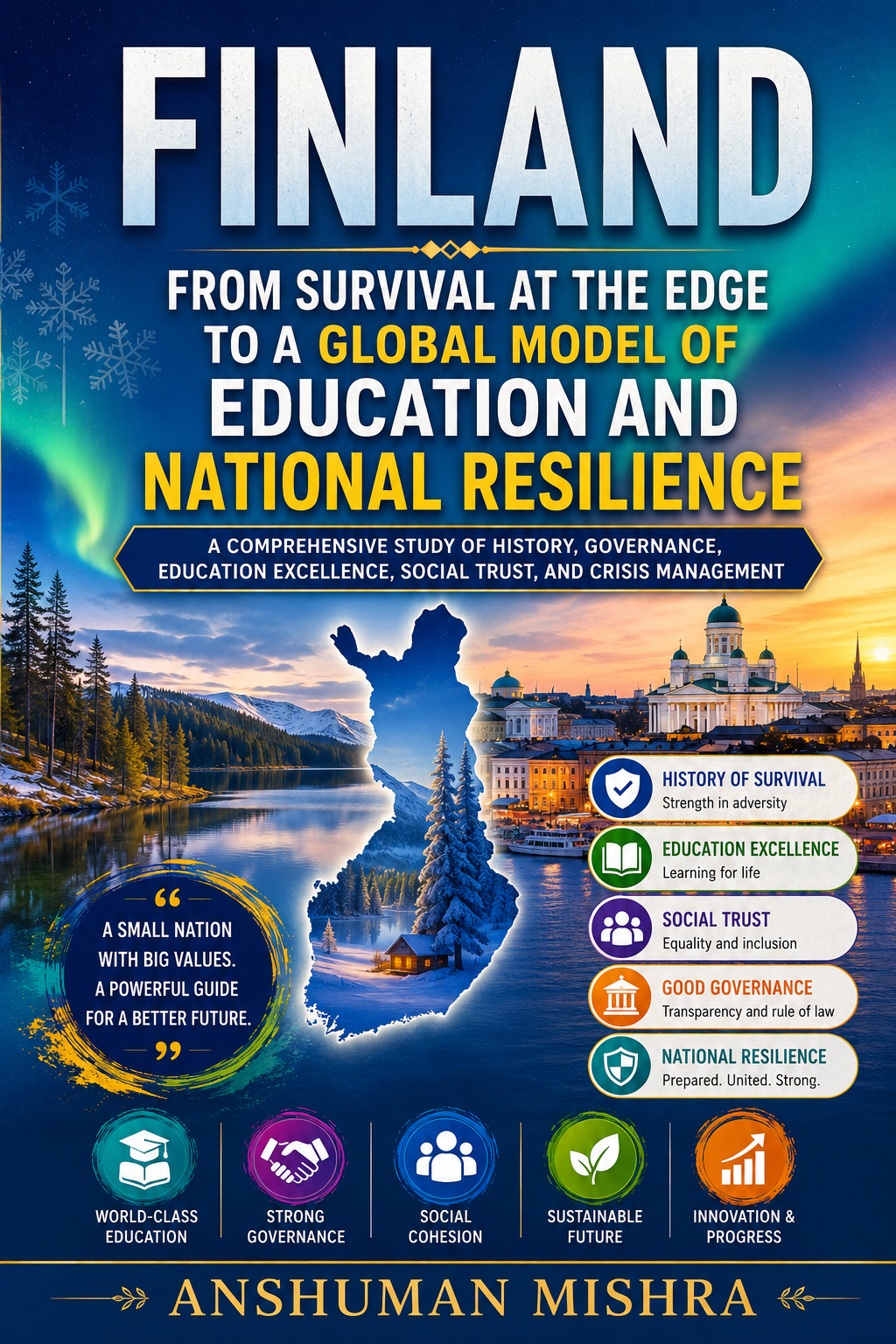
Finland: From Survival at the Edge to a Global Model of Education and National Resilience
A Comprehensive Study of History, Governance, Education Excellence, Social Trust, and Crisis Management
Author: Anshuman Mishra
About the Book
Finland is widely recognized for its strong education system, social trust, institutional stability, transparent governance, innovation capacity, and resilience in the face of national challenges. But Finland did not become a successful modern state overnight.
Its contemporary achievements are the result of a long historical process shaped by geography, survival, political transformation, institutional development, social compromise, education reform, economic modernization, and strategic adaptation.
Finland: From Survival at the Edge to a Global Model of Education and National Resilience examines this transformation in a comprehensive and critical manner.
The book begins with Finland’s geographical and historical circumstances and follows its journey through early settlement, Swedish rule, Russian rule, independence, civil conflict, World War II, post-war reconstruction, welfare-state development, educational transformation, technological modernization, and contemporary governance.
At the center of the book is a fundamental question:
How did a relatively small country facing difficult geographical, demographic, economic, and geopolitical conditions develop institutions capable of producing high levels of education, social trust, innovation, and resilience?
Rather than presenting Finland as a perfect or universally transferable model, this book examines both its achievements and limitations. It asks what other nations can realistically learn from Finland—and what cannot simply be copied.
From Survival to Strength
Finland’s story is fundamentally a story of adaptation.
For centuries, Finnish communities developed under demanding environmental and geopolitical conditions. The northern climate, forests, limited agricultural opportunities, and proximity to powerful neighboring states created persistent challenges.
Survival required:
- Adaptability
- Community cooperation
- Resource management
- Institutional development
- Cultural continuity
- Long-term planning
These characteristics gradually became important elements of Finnish national development.
The book explores how historical experiences helped shape the country’s later political culture and institutional priorities.
Chapter 1 — Finland at the Crossroads of Survival and Strategy
The opening chapter introduces Finland’s geography, climate, population, languages, and cultural foundations.
Readers explore why Finland provides an important case study for understanding:
- National resilience
- State capacity
- Education
- Social cohesion
- Strategic adaptation
The chapter also establishes the concepts of survival, resilience, and national strength that guide the rest of the book.
Chapter 2 — Early Finnish Society and Pre-State Survival
Before the modern Finnish state existed, communities developed distinctive social and economic systems adapted to the northern environment.
This chapter examines:
- Indigenous roots
- Early settlements
- Tribal organization
- Livelihood patterns
- Nature-based cultural traditions
- Social cooperation
- Survival in difficult environmental conditions
The discussion establishes the historical foundations of Finnish society.
Chapter 3 — Swedish Rule and the Formation of Institutions
Finland’s centuries under the Swedish Crown played an important role in the development of legal, administrative, religious, and institutional structures.
The chapter examines:
- Swedish political influence
- Law and administration
- Church institutions
- Finnish and Swedish languages
- Institutional legacies
It shows how historical governance structures contributed to the development of later Finnish institutions.
Chapter 4 — Russian Rule and the Struggle for Identity
The period of Russian rule represents another major stage in Finnish political and cultural development.
The chapter explores Finland as a Grand Duchy of the Russian Empire, including:
- Administrative autonomy
- Economic development
- Cultural awakening
- National consciousness
- Language and identity
- Russification policies
- Resistance and reform
The development of Finnish national identity is examined within its broader European context.
Chapter 5 — Independence and the Trauma of Civil War
Finland’s declaration of independence in 1917 marked a historic turning point.
However, independence was followed by a deeply divisive civil conflict.
This chapter examines:
- Independence
- Causes of the Finnish Civil War
- Social and political divisions
- Consequences of internal conflict
- Reconciliation
- Nation-building
The chapter emphasizes how societies can rebuild institutions after periods of internal division.
Chapter 6 — Winter War, Continuation War, and National Survival
World War II created some of the greatest challenges in modern Finnish history.
The chapter examines:
- The Winter War
- Finnish strategic responses
- The Continuation War
- Foreign-policy dilemmas
- National mobilization
- Civil preparedness
- Psychological resilience
Rather than romanticizing conflict, the discussion focuses on the broader lessons of preparedness, strategic decision-making, national cohesion, and survival under pressure.
Chapter 7 — Neutrality, Diplomacy, and Strategic Balance
Finland’s post-war foreign policy required careful navigation between competing geopolitical powers.
This chapter examines:
- Post-war constraints
- Neutrality
- Finlandization
- Cold War diplomacy
- Relations with East and West
- Strategic pragmatism
The book presents Finnish neutrality as an active strategy shaped by geopolitical realities rather than simple political isolation.
Chapter 8 — Foundations of the Finnish Welfare State
Finland’s transformation into a modern welfare society required extensive institutional development.
This chapter explores:
- Post-war reconstruction
- Social security
- Universal welfare
- Public services
- Equality
- Social capital
- Public trust
The welfare state is examined as a contributor to human capability and national resilience, rather than simply as a system of redistribution.
Chapter 9 — The Philosophy Behind Finnish Education
Education is one of the central themes of the book.
The chapter explores the idea that education can function as a national development strategy.
Key themes include:
- Equality
- Educational opportunity
- Teacher professionalism
- Institutional trust
- Democratic citizenship
- Long-term human-capital development
The book explains why Finland’s educational philosophy differs from systems that emphasize intense competition and frequent standardized testing.
Chapter 10 — Structure of the Finnish Education System
Readers receive a structured overview of Finnish education, from early childhood through higher education.
Topics include:
- Early childhood education
- Comprehensive schooling
- Teacher education
- Professional autonomy
- Assessment
- Student support
- Universities
- Universities of applied sciences
Particular attention is given to the role of highly trained teachers and institutional trust.
Chapter 11 — Finland as a Global Education Leader
Finland’s international reputation in education has attracted researchers and policymakers from around the world.
This chapter examines:
- International learning outcomes
- Pedagogical innovation
- Lifelong learning
- Adult education
- Teacher development
- Education policy
- Finland’s international educational influence
Importantly, the chapter also considers the limitations of international rankings and warns against reducing education quality to a single numerical indicator.
Chapter 12 — Economy, Innovation, and Technological Resilience
Finland’s transformation from an agrarian economy into a knowledge-intensive economy represents another major dimension of national development.
The chapter explores:
- Industrial transformation
- Research and development
- Technology
- Digitalization
- Start-up ecosystems
- Innovation policy
- Digital governance
- Economic adaptation
The discussion demonstrates how education, research, technology, and economic policy can reinforce one another.
Chapter 13 — Governance, Transparency, and Rule of Law
Strong institutions are essential to national resilience.
This chapter explores:
- Democratic institutions
- Political culture
- Rule of law
- Transparency
- Public accountability
- Anti-corruption mechanisms
- Local governance
- Evidence-based policymaking
The relationship between institutional quality and public trust receives particular attention.
Chapter 14 — Social Cohesion, Equality, and Inclusion
Social resilience depends not only on institutions but also on relationships between citizens.
This chapter discusses:
- Gender equality
- Family policy
- Minority rights
- Sámi issues
- Immigration
- Integration
- Social inclusion
- Changing demographics
The book takes a balanced approach, recognizing both Finland’s achievements and the challenges created by social and demographic change.
Chapter 15 — National Resilience and Crisis Management
One of the most important concepts explored in the book is comprehensive security.
National resilience includes much more than military preparedness.
It also involves:
- Civil preparedness
- Critical infrastructure
- Public communication
- Health systems
- Economic resilience
- Emergency planning
- Psychological resilience
- Citizen participation
The chapter examines how Finland approaches crises through cooperation among government, institutions, businesses, communities, and citizens.
Chapter 16 — Environmental Responsibility and Sustainability
Finland’s relationship with forests, water, energy, and natural resources is central to its long-term development.
This chapter examines:
- Forest management
- Water resources
- Climate policy
- Renewable energy
- Sustainable development
- Environmental education
- Resource management
Environmental sustainability is presented as an important component of long-term national resilience.
Chapter 17 — Finland in a Changing Global Order
Finland’s international position has evolved considerably over time.
This chapter examines:
- European Union membership
- European policy
- Security concerns
- Strategic realignment
- International cooperation
- Peacebuilding
- Global institutions
The chapter considers how Finland balances national interests with participation in broader regional and international systems.
Chapter 18 — Challenges and Critiques of the Finnish Model
No national model is perfect.
This chapter provides a critical examination of Finland’s current challenges, including:
- Population aging
- Economic pressures
- Labor-market concerns
- Education-system pressures
- Immigration debates
- Integration challenges
- Sustainability of the welfare state
The discussion helps readers understand why successful policies must continually evolve.
Chapter 19 — Comparative Lessons for the World
One of the book’s most practical sections asks:
Can Finland’s experience be replicated elsewhere?
The answer is complex.
Readers examine:
- Lessons for developing countries
- Policy transfer
- Institutional adaptation
- Education reform
- Social trust
- National resilience
- Risks of copying foreign models without contextual adaptation
The book argues that countries should learn from Finland’s principles, rather than simply copying its policies.
Chapter 20 — Survival, Learning, and the Future
The final chapter brings the historical and contemporary discussions together.
It reflects on:
- Finland’s journey from vulnerability to resilience
- Education as national capacity
- Institutional trust
- Social cohesion
- Strategic adaptation
- Future uncertainty
The conclusion asks readers to reconsider what national strength really means.
Is strength simply economic size or military power?
Or can a nation’s true strength also be measured through:
Education + Trust + Institutions + Innovation + Social Cohesion + Preparedness?
Key Themes of the Book
The book develops several interconnected themes.
Education as National Strategy
Education is treated not merely as an academic service but as a long-term investment in national capability.
Trust as Social Infrastructure
Trust can strengthen cooperation between citizens and institutions.
Resilience Through Preparation
National resilience develops through preparation before crises occur.
Institutions Matter
Strong legal and administrative institutions create continuity beyond individual political leaders.
Equality and Opportunity
Broad access to education and public services can contribute to social stability and human development.
Adaptation Over Imitation
Successful policies cannot always be transferred directly from one country to another.
Why This Book Is Important
For Students
The book provides a multidisciplinary case study connecting:
- History
- Political science
- Education
- Economics
- Public policy
- Governance
- International relations
- Social development
It can support university assignments, comparative studies, research projects, and competitive examination preparation.
For Educators
Teachers and education administrators can explore Finland’s educational philosophy, teacher preparation, institutional trust, and student-centered approaches.
For Policymakers
The book provides a framework for examining how education, governance, welfare, technology, and crisis preparedness can work together.
For Researchers
The Finnish case offers opportunities for comparative research in education policy, national resilience, social trust, welfare systems, and institutional development.
For General Readers
Readers interested in Finland, Nordic societies, education, history, governance, and national development will find a broad and accessible account of the country’s transformation.
Key Learning Outcomes
After studying this book, readers will be able to:
- Understand major stages of Finnish history.
- Explain the development of Finnish national identity.
- Analyze Finland’s experience under Swedish and Russian rule.
- Understand the challenges surrounding Finnish independence.
- Examine the impact of World War II on national strategy.
- Understand Finland’s post-war diplomatic approach.
- Explain the development of the Finnish welfare state.
- Analyze the philosophy behind Finnish education.
- Understand Finnish teacher education and professional autonomy.
- Examine the relationship between education and social equality.
- Understand the role of trust in governance.
- Analyze Finland’s approach to comprehensive security.
- Explore economic and technological transformation.
- Understand sustainability as a resilience strategy.
- Evaluate the strengths and limitations of the Finnish model.
- Identify lessons that may be adapted by other nations.
Finland as a Case Study of National Resilience
The central lesson of this book is not that Finland discovered a single formula for success.
Rather, Finland demonstrates the value of long-term institutional learning.
Its development reflects a combination of:
Historical experience
↓
Institution building
↓
Education and human capital
↓
Social trust
↓
Innovation and economic adaptation
↓
Crisis preparedness
↓
National resilience
This interconnected approach makes Finland a valuable case study for understanding how societies can respond to uncertainty.
A Balanced View of the Finnish Model
The book deliberately avoids presenting Finland as a flawless society.
Its purpose is not to say:
“Copy Finland.”
Instead, it encourages readers to ask:
“What principles behind Finland’s development can be adapted to our own circumstances?”
This distinction is particularly important for developing and transitional countries.
A successful education policy depends on:
- Teacher preparation
- Governance
- Funding
- Social conditions
- Cultural context
- Institutional capacity
- Political commitment
Similarly, social trust cannot simply be created through legislation. It develops through consistent institutions, accountability, fairness, and public experience over time.
Suitable For
This book is particularly useful for:
- B.A. and M.A. students
- Education students
- Political Science students
- History students
- Public Administration students
- International Relations students
- Development Studies students
- Education policymakers
- Teachers and academic administrators
- Competitive examination aspirants
- Researchers
- General readers interested in Finland
Conclusion
Finland: From Survival at the Edge to a Global Model of Education and National Resilience tells the story of a country that transformed difficult circumstances into an opportunity for long-term institutional development.
Its journey was neither simple nor perfect.
Finland experienced external domination, internal conflict, geopolitical pressure, economic transformation, and social change. Yet over time, it developed institutions that emphasized education, legality, trust, equality, innovation, preparedness, and adaptation.
The Finnish experience therefore offers a powerful lesson:
National resilience is not created in a single moment. It is built slowly through institutions, education, trust, preparation, and the ability to learn from history.
For readers seeking to understand how a small northern European country became internationally influential in education, governance, innovation, and resilience, this book provides a comprehensive and critical journey.
It is ultimately a book about Finland—but also about a much larger question:
How can nations transform vulnerability into strength, and how can education become one of the most powerful foundations of national resilience?
Finland’s story suggests that survival may be the beginning of national strength—but learning, trust, and adaptation determine how far that strength can grow.




Reviews
There are no reviews yet.