Description
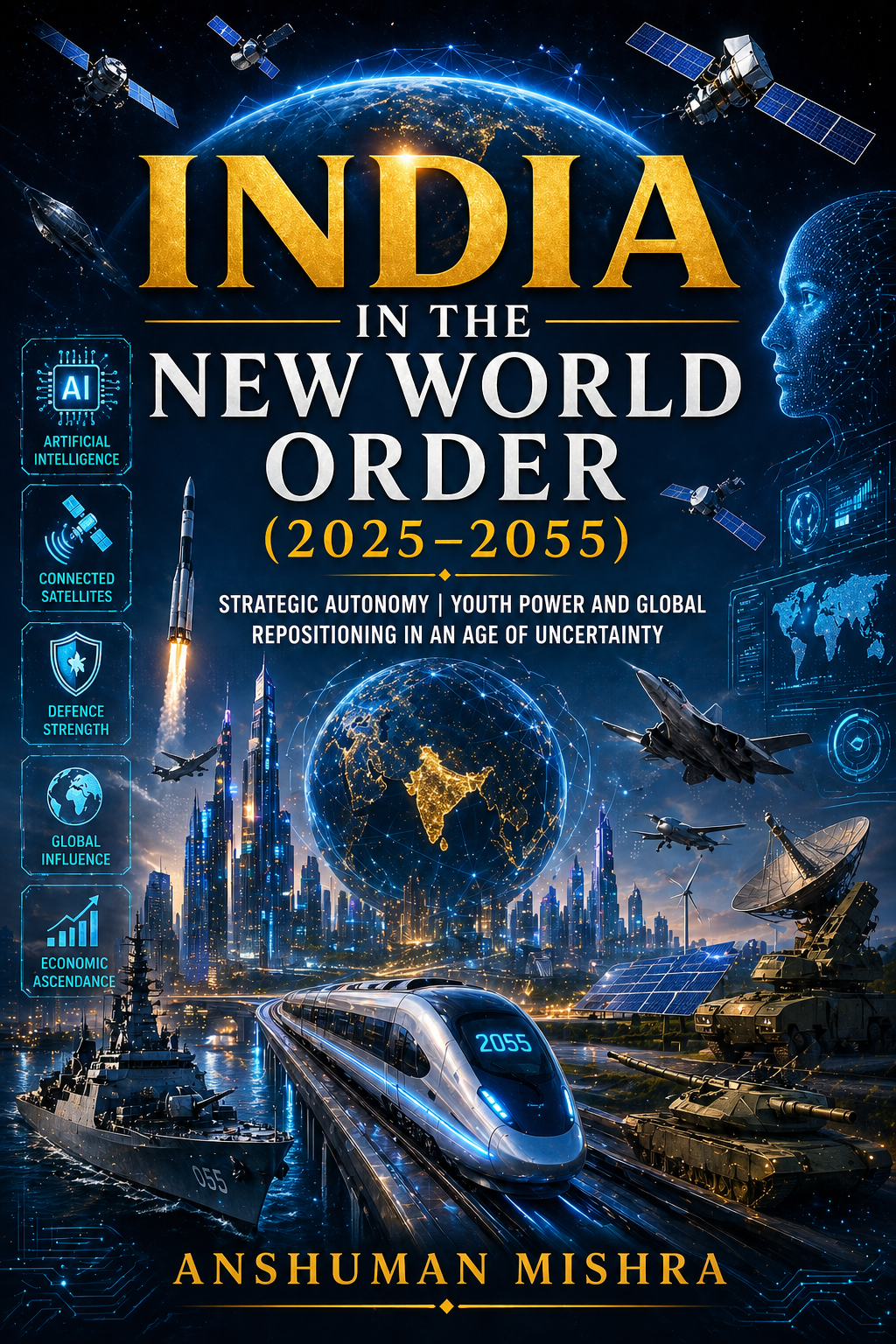
The world is entering a period of profound geopolitical transformation. The post-Cold War assumptions of stability, globalization, predictable alliances, and Western-led institutions are being challenged by strategic rivalry, economic nationalism, technological competition, fragmented power, and changing global alliances.
At the center of this transformation stands India.
India in the New World Order (2025–2055): Strategic Autonomy, Youth Power, and Global Repositioning in an Age of Uncertainty examines how India can navigate the next three decades of global uncertainty while balancing ambition with realism.
Rather than presenting India’s rise as inevitable or portraying the future as predetermined, this book takes a balanced strategic approach. It asks difficult but important questions: Can India convert its demographic advantage into productive economic power? Can strategic autonomy survive increasing global polarization? How should India manage competition with China while maintaining economic interests? What role will the United States and Russia play in India’s long-term strategy? Can manufacturing, artificial intelligence, digital infrastructure, and defense modernization transform India’s position in the global system?
The book begins by examining India’s geopolitical crossroads and the transformation of the international order. It explains the movement from a relatively unipolar world toward a more fragmented and multipolar system in which economic power, technology, military capability, supply chains, and diplomacy increasingly overlap.
A central theme is strategic autonomy. India’s traditional preference for maintaining independent decision-making has provided flexibility in dealing with competing global powers. However, strategic autonomy also carries costs. The book explores the difference between genuine autonomy, strategic ambiguity, neutrality, and indecision, while examining how India can preserve flexibility without becoming strategically isolated.
The relationship between India and the United States receives detailed attention, including defense cooperation, technology, trade, the Indo-Pacific, and the limitations of partnership without a formal alliance. At the same time, the book examines the complex India–China rivalry, including border tensions, economic interdependence, supply chains, technology competition, regional influence, and the importance of deterrence and escalation management.
India’s long-standing relationship with Russia and Eurasia is also examined through the lenses of defense, energy, sanctions, diversification, and changing geopolitical realities.
Beyond major powers, the book explores India’s neighborhood, including South Asia’s strategic vulnerabilities and India’s relationships with countries such as Pakistan, Bangladesh, Nepal, Sri Lanka, and Myanmar. It considers how India can exercise regional leadership without relying on coercion or dominance.
The Indo-Pacific and maritime domain form another major part of the analysis. As global trade and strategic competition increasingly depend on maritime routes, India’s geographic position provides both opportunities and responsibilities. The book examines naval power, maritime security, the QUAD, Southeast Asia, regional connectivity, and India’s long-term maritime strategy.
Economic strength remains fundamental to geopolitical influence. The book therefore devotes significant attention to trade wars, global supply chains, manufacturing, infrastructure, logistics, and industrial policy. It considers whether India can benefit from the restructuring of global production while overcoming domestic productivity and skill challenges.
One of the most important questions concerns India’s youth population. A large young population can become a powerful demographic dividend—but only when supported by quality education, skills, employment, entrepreneurship, infrastructure, and social stability. The book examines the risks of unemployment, skill mismatches, rapid urbanization, and demographic pressure while exploring how youth can become one of India’s greatest strategic assets.
The book also examines artificial intelligence, semiconductors, digital public infrastructure, data governance, and technological sovereignty. It takes a realistic approach to technological transformation, recognizing both the opportunities created by AI and the limitations created by dependence on critical technologies and global supply chains.
Defense modernization is analyzed through the realities of budgets, indigenous production, technology, joint ventures, military preparedness, and the challenges of maintaining credible deterrence. The emphasis is not on military dominance, but on sustainable strategic capability.
Other critical areas include energy security, climate change, green transition, governance capacity, institutional reform, federal complexity, and India’s role in global institutions such as the UN, WTO, and G20.
The book also presents an important warning: national ambition must remain connected to national capacity. History demonstrates that powers can weaken when strategic aspirations expand faster than economic, institutional, demographic, or military foundations. India’s long-term success will therefore depend not only on external diplomacy but also on internal governance and sustained reform.
The final chapters present a vision of India’s strategic path toward 2055—a path based on durable influence rather than dominance, strategic autonomy rather than isolation, economic growth combined with resilience, and youth power supported by institutions and opportunity.
Key Themes Covered
- India’s changing position in the global order
- Strategic autonomy and foreign-policy flexibility
- India–US strategic convergence
- India–China competition and deterrence
- India–Russia relations and Eurasian strategy
- South Asian neighborhood diplomacy
- Indo-Pacific and maritime strategy
- Global trade wars and supply-chain restructuring
- Manufacturing and industrial development
- Youth, employment, and demographic opportunity
- Artificial intelligence and digital sovereignty
- Semiconductor and technology dependence
- Defense modernization and strategic constraints
- Energy security and climate challenges
- Governance and institutional capacity
- India’s role in the UN, WTO, G20, and global diplomacy
- Risks of geopolitical overreach
- India’s strategic trajectory toward 2055
India in the New World Order (2025–2055) is ultimately a study of opportunity, responsibility, and strategic realism. It argues that India’s future influence will not be determined by slogans or short-term geopolitical headlines. It will depend on the country’s ability to build economic strength, educate and employ its youth, develop technological capability, strengthen institutions, maintain credible defense capacity, and pursue a flexible but disciplined foreign policy.
This book is ideal for students, researchers, policymakers, civil servants, strategic analysts, defense professionals, journalists, educators, and readers interested in India’s future role in world affairs.

Reviews
There are no reviews yet.