Description
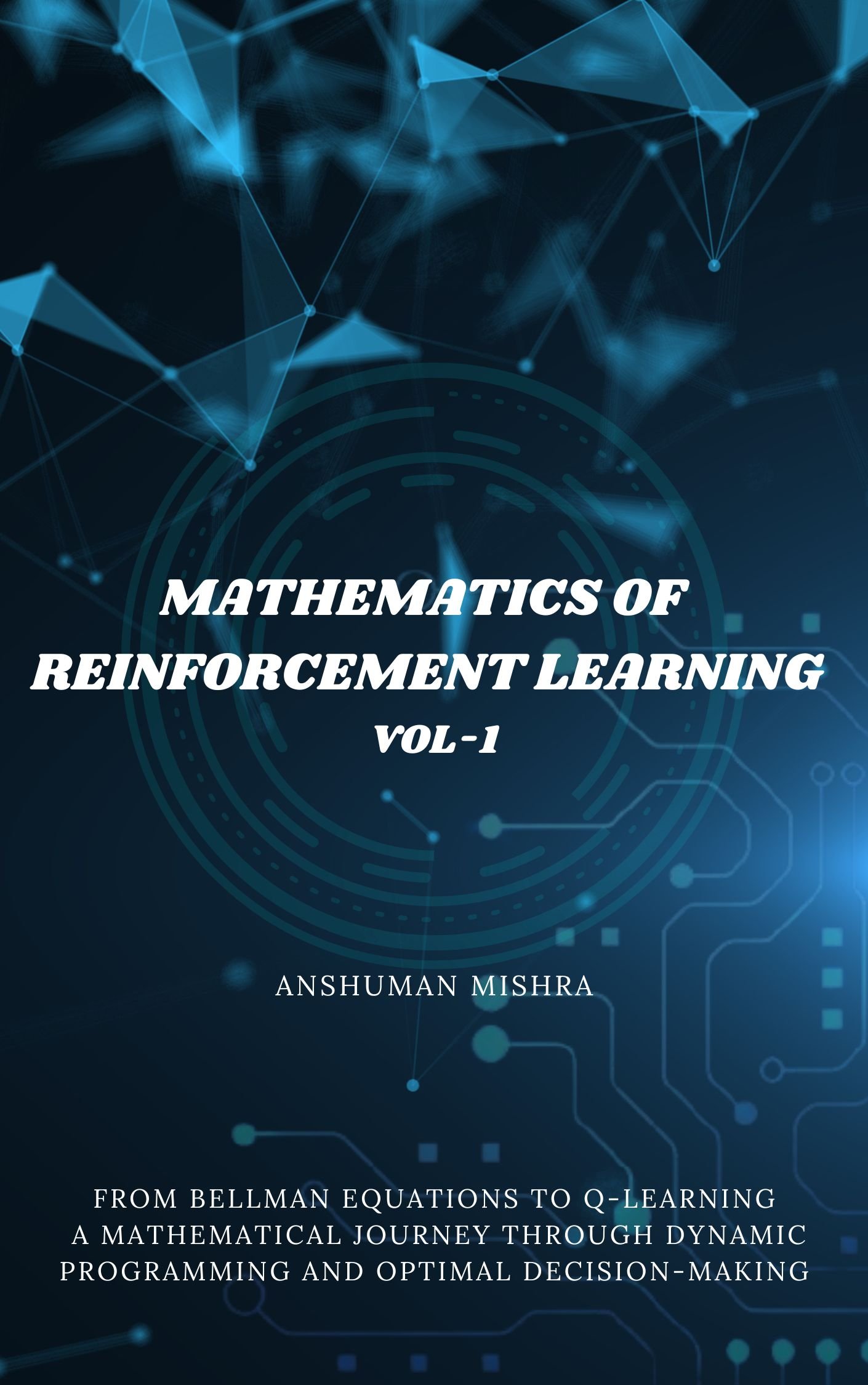
Mathematics of Reinforcement Learning – VOL-1
From Bellman Equations to Q-Learning: A Mathematical Journey through Dynamic Programming and Optimal Decision-Making
Author: Anshuman Mishra
Qualification: M.Tech (Computer Science)
Position: Assistant Professor, Doranda College, Ranchi University
Published by: Anshuman Mishra
Year: 2025
About the Book
Reinforcement Learning has emerged as one of the most important areas of modern Artificial Intelligence. From game-playing agents and robotics to autonomous systems, recommendation engines, resource optimization, and intelligent decision-making, Reinforcement Learning enables machines to learn through interaction with their environments.
At the heart of Reinforcement Learning lies mathematics.
Concepts such as probability, expectation, Markov processes, dynamic programming, Bellman equations, value functions, optimization, Monte Carlo estimation, and Temporal-Difference learning provide the theoretical foundation on which modern RL algorithms are built.
Mathematics of Reinforcement Learning – VOL-1 presents a structured mathematical journey from the fundamental concepts of Reinforcement Learning to advanced value-estimation techniques. The book is designed to help readers understand not only how RL algorithms work, but also why the mathematical equations behind them work.
Rather than presenting Reinforcement Learning as a collection of algorithms, this book develops the mathematical reasoning step by step.
Core Philosophy of the Book
The central idea of this book is simple:
To understand Reinforcement Learning deeply, one must understand the mathematics behind decision-making.
The book therefore connects:
- Probability → uncertainty in environments
- Linear Algebra → state-transition and value computations
- Calculus → optimization and gradients
- Markov Processes → sequential decision-making
- Bellman Equations → recursive value estimation
- Dynamic Programming → optimal policy computation
- Monte Carlo Methods → learning from complete episodes
- Temporal-Difference Learning → learning from partial experience
- Eligibility Traces → multi-step learning
This integrated approach enables readers to develop a strong theoretical foundation before moving toward advanced Reinforcement Learning algorithms.
What This Volume Covers
Module I – Introduction to Reinforcement Learning and Mathematical Foundations
The book begins with the fundamentals of Reinforcement Learning.
Readers are introduced to:
- Agent and environment
- States and actions
- Rewards
- Policies
- Value functions
- State-value and action-value concepts
- RL interaction cycles
- Episodic and continuing tasks
- Finite and infinite horizon problems
- Exploration vs. exploitation
- Reward functions
- Grid World problems
The introductory discussion establishes the mathematical vocabulary required for subsequent chapters.
Chapter 1 – Fundamentals of Reinforcement Learning
The first chapter explains the basic structure of an RL system and how an intelligent agent interacts with an environment.
The chapter covers the differences between supervised learning, unsupervised learning, and reinforcement learning, followed by detailed discussions of agents, environments, rewards, policies, and value functions.
A Grid World example is used to demonstrate how states, actions, transitions, and rewards combine to form an RL problem.
Readers also learn how reward functions can be represented mathematically and how Reinforcement Learning fits within the broader fields of Artificial Intelligence and Machine Learning.
Chapter 2 – Mathematical Preliminaries
A strong mathematical foundation is essential for understanding RL algorithms.
This chapter introduces:
- Probability theory
- Random variables
- Expectation
- Conditional probability
- Bayes’ theorem
- Vectors and matrices
- Eigenvalues and eigenvectors
- Matrix operations
- Derivatives and gradients
- Optimization
- Gradient descent
- Convexity
- Mathematical notation used throughout RL
Special attention is given to common mathematical mistakes that can cause confusion when implementing reinforcement learning algorithms.
Chapter 3 – Markov Processes and Decision Models
Sequential decision-making requires a mathematical framework for representing states and transitions.
This chapter introduces the Markov Property, Markov Chains, transition probabilities, state-transition matrices, stationary distributions, and Markov Reward Processes.
The discussion then progresses naturally toward the Markov Decision Process (MDP), which forms the mathematical foundation of most classical Reinforcement Learning problems.
The chapter introduces:
- States
- Actions
- Transition probabilities
- Reward functions
- Policies
- Discount factors
- Expected return
- Bellman Expectation Equation
- Bellman Optimality Equation
A two-state MDP example provides a simple mathematical demonstration.
Module II – Bellman Equations and Dynamic Programming
The second module focuses on one of the most important mathematical ideas in Reinforcement Learning: Bellman equations.
Bellman equations allow complex sequential decision problems to be decomposed into smaller recursive problems.
Readers learn how value functions can be represented recursively and how these equations lead naturally to algorithms for policy evaluation and optimal decision-making.
Chapter 4 – Bellman Equations
This chapter provides an in-depth treatment of:
- State-value functions
- Action-value functions
- Bellman Expectation Equation
- Bellman Optimality Equation
- Policy evaluation
- Bellman operators
- Convergence properties
- Matrix representation
- Grid World examples
The mathematical derivation of Bellman equations helps readers understand why value functions provide a powerful mechanism for evaluating future rewards.
Chapter 5 – Dynamic Programming Methods
Dynamic Programming provides a systematic approach for solving Markov Decision Processes when the environment model is available.
The chapter explains:
- Policy Evaluation
- Policy Improvement
- Policy Iteration
- Value Iteration
- Convergence
- Computational complexity
- Numerical iteration
A three-state MDP example demonstrates how an optimal policy can be obtained through repeated evaluation and improvement.
Chapter 6 – Generalized Policy Iteration (GPI)
Generalized Policy Iteration provides a conceptual framework that combines policy evaluation and policy improvement.
Readers explore:
- Evaluation-improvement relationships
- Convergence principles
- Step-by-step GPI
- Exploration
- Error propagation
- Grid World policy improvement
- Visualization of convergence
- GPI vs. standard Dynamic Programming
This chapter develops an important conceptual bridge between classical dynamic programming and later reinforcement learning algorithms.
Module III – Monte Carlo and Temporal-Difference Learning
The third module moves from model-based methods toward experience-based learning.
This is a major transition in Reinforcement Learning because the agent can learn from interaction without necessarily having complete knowledge of the environment’s transition dynamics.
Chapter 7 – Monte Carlo Methods
Monte Carlo methods estimate value functions using experience collected from complete episodes.
Topics include:
- Monte Carlo value estimation
- First-visit MC
- Every-visit MC
- MC prediction
- MC control
- Exploring Starts
- Epsilon-greedy strategies
- Incremental mean updates
- Blackjack example
- Convergence
- Variance reduction
- Practical implementation
The chapter demonstrates how repeated experiences can be used to estimate expected returns.
Chapter 8 – Temporal-Difference Learning
Temporal-Difference learning represents a fundamental advancement in Reinforcement Learning.
Readers learn how TD methods combine ideas from Dynamic Programming and Monte Carlo learning.
The chapter covers:
- TD learning
- TD(0)
- TD update equations
- Monte Carlo vs. TD
- TD prediction
- Forward and backward views
- TD(λ)
- Bias-variance tradeoff
- Random Walk example
- Convergence analysis
The mathematical formulation of TD learning provides the foundation for understanding important algorithms such as SARSA and Q-learning in subsequent studies.
Chapter 9 – Eligibility Traces and λ-Returns
The final chapter of this volume introduces multi-step learning through eligibility traces and λ-returns.
Topics include:
- Eligibility traces
- λ-returns
- Forward view
- Backward view
- TD(λ)
- SARSA(λ)
- Q(λ)
- Multi-step prediction
- Equivalence between learning views
- Trace decay
- Practical pseudocode
This chapter provides the mathematical foundation needed to understand how information from multiple previous states can influence learning.
Mathematical Topics Covered
This volume provides extensive coverage of mathematical concepts including:
- Probability Theory
- Conditional Probability
- Bayes’ Theorem
- Random Variables
- Mathematical Expectation
- Markov Chains
- Transition Matrices
- Stationary Distributions
- Markov Reward Processes
- Markov Decision Processes
- Vectors
- Matrices
- Eigenvalues
- Eigenvectors
- Matrix Algebra
- Calculus
- Derivatives
- Gradients
- Optimization
- Convexity
- Recursive Equations
- Bellman Operators
- Convergence Analysis
- Expected Return
- Value Functions
- Discounted Rewards
Algorithms and Methods Covered
Readers will develop conceptual and mathematical understanding of:
- Policy Evaluation
- Policy Improvement
- Policy Iteration
- Value Iteration
- Generalized Policy Iteration
- Monte Carlo Prediction
- Monte Carlo Control
- First-Visit Monte Carlo
- Every-Visit Monte Carlo
- Epsilon-Greedy Exploration
- TD(0)
- TD(λ)
- SARSA(λ)
- Q(λ)
- Eligibility Trace Methods
Key Features of the Book
1. Mathematics-First Approach
The book focuses on understanding the mathematical foundations behind Reinforcement Learning rather than simply memorizing algorithms.
2. Step-by-Step Mathematical Development
Important equations and concepts are developed progressively so that readers can follow the reasoning behind each method.
3. Practical Examples
Examples such as Grid World, Two-State MDP, Three-State MDP, Random Walk, and Blackjack help transform abstract mathematical concepts into understandable RL problems.
4. Theory + Algorithms
Mathematical concepts are connected directly with RL algorithms and computational procedures.
5. Exercise-Oriented Learning
Each chapter concludes with summary material and exercise problems for academic and self-study purposes.
6. Suitable for Academic Study
The structure makes the book suitable for undergraduate, postgraduate, competitive examination preparation, and research-oriented learning.
Who Should Read This Book?
This book is especially useful for:
- BCA Students
- MCA Students
- B.Tech Students
- M.Tech Students
- B.Sc. Computer Science Students
- Artificial Intelligence Students
- Machine Learning Students
- Data Science Students
- Computer Science Researchers
- AI Researchers
- Reinforcement Learning Researchers
- PhD Scholars
- Faculty Members
- AI/ML Professionals
- Software Developers
- Competitive Exam Aspirants
- Students preparing for GATE
- UGC-NET Computer Science Aspirants
What You Will Learn
After completing this volume, readers will be able to:
✔ Understand the mathematical formulation of Reinforcement Learning
✔ Distinguish RL from supervised and unsupervised learning
✔ Formulate reward and return mathematically
✔ Understand Markov chains and MDPs
✔ Construct state-transition matrices
✔ Derive Bellman equations
✔ Understand value functions mathematically
✔ Apply Dynamic Programming to MDPs
✔ Understand Policy Iteration and Value Iteration
✔ Explain Generalized Policy Iteration
✔ Estimate value functions using Monte Carlo methods
✔ Understand Temporal-Difference learning
✔ Derive TD(0) update equations
✔ Understand TD(λ) and λ-returns
✔ Work with eligibility traces
✔ Analyze convergence concepts
✔ Develop a mathematical foundation for advanced RL algorithms
Ideal for Academic and Research Use
Mathematics of Reinforcement Learning – VOL-1 can serve as:
- A university reference book
- An AI/ML mathematics textbook
- An RL learning guide
- A postgraduate reference
- A research foundation
- A classroom teaching resource
- A self-study guide
- A foundation for advanced Reinforcement Learning research
Book Details
Book Title: Mathematics of Reinforcement Learning
Subtitle: From Bellman Equations to Q-Learning: A Mathematical Journey through Dynamic Programming and Optimal Decision-Making
Volume: VOL-1
Author: Anshuman Mishra
Qualification: M.Tech (Computer Science)
Position: Assistant Professor, Doranda College, Ranchi University
Publisher: Anshuman Mishra
Publication Year: 2025
Language: English
Subject: Reinforcement Learning, Artificial Intelligence, Machine Learning, Mathematics
Level: Undergraduate, Postgraduate, Research



Reviews
There are no reviews yet.